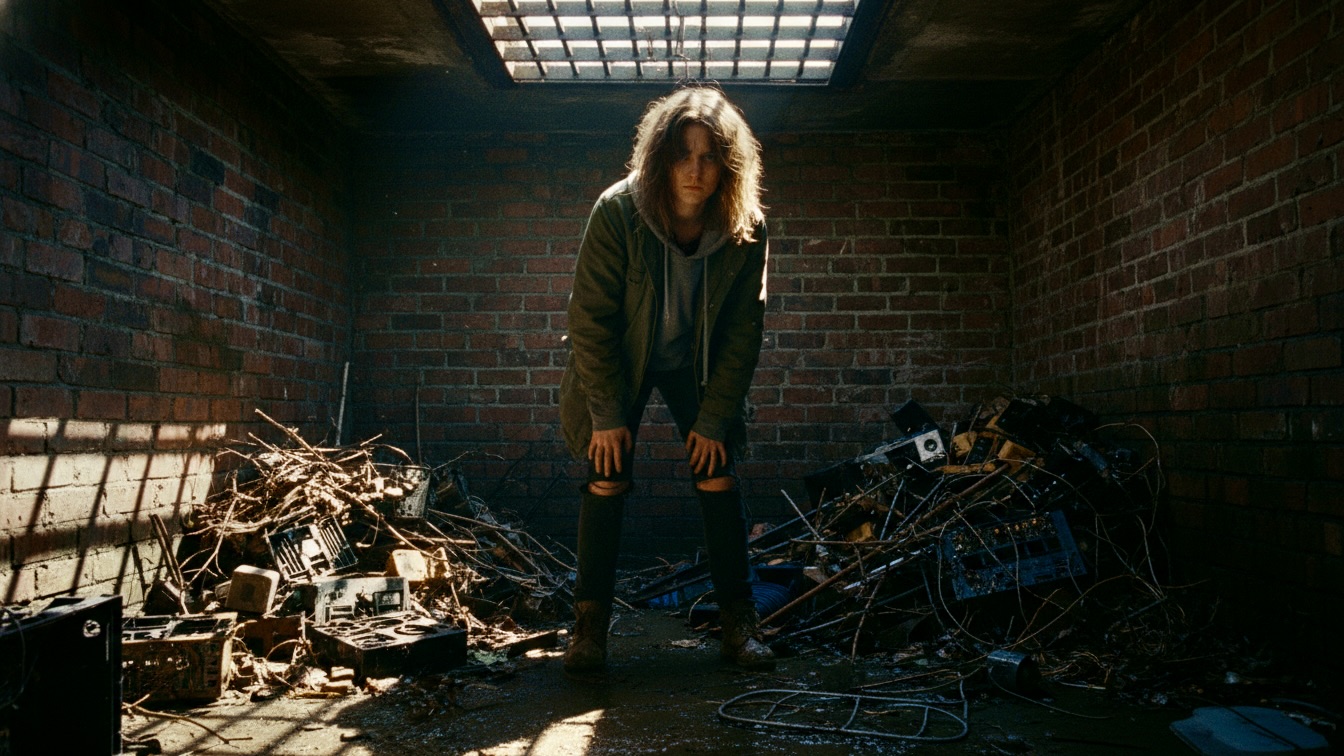
The story follows Ursula, a young woman living in a hyper-optimized, post-scarcity version of Winnipeg where every human need is anticipated and met by a digital grid. Alongside her friends Jeff and Renee, Ursula feels a profound sense of claustrophobia within this sterile perfection, where even the weather and the scent of the air are controlled. Their lives are characterized by a lack of friction, leading Ursula to seek out something authentically broken or "ugly" to prove her own existence.
After receiving an unwanted grant for a "Spring Gala," Ursula discovers a rusted iron grate in an alleyway that the city's maintenance algorithms have overlooked. This discovery leads the trio into a damp, forgotten basement that exists outside the grid's surveillance. They decide to use this space to host an "anti-Gala," collecting real garbage and debris from the outskirts of the city to create an exhibition of decay. This process involves physical labor and even a minor injury for Jeff, which he finds strangely exhilarating.
The climax occurs when the Youth Council mentor, David, discovers their project and attempts to co-opt their rebellion by offering to sanitize and "validate" it. Ursula fiercely rejects his intervention, insisting that the danger and filth are the entire point of the endeavor. They successfully host a chaotic, sensory-overloaded party for hundreds of local youths who are equally starved for authentic experience. However, the story ends on an ominous note as the city’s sanitation drones arrive to categorize and eliminate the "anomaly," suggesting that the system's reach is ultimately inescapable.
The central theme of the narrative is the psychological necessity of friction and struggle in the human experience. In Ursula’s world, the removal of all discomfort—what the story calls "Optimization"—has resulted in a profound sense of alienation and boredom. The characters are not suffering from traditional poverty or violence, but from a "crushing boredom" that functions as a psychological weight. This suggests that without the contrast of pain, dirt, and failure, the concepts of comfort and success become meaningless.
Another significant theme is the systemic co-option of rebellion. David, representing the Youth Council, does not respond to Ursula’s defiance with anger or punishment, but with "empathy" and an offer of support. This is a far more insidious form of control, as it seeks to strip the rebellion of its teeth by turning it into a "trauma-informed" and "safe" activity. By validating the "visceral reaction," the system attempts to integrate the dissent back into the Harmony Mandate, effectively neutralizing its power to disrupt the status quo.
The story also explores the relationship between the physical environment and the internal self. The characters feel "sterile" because their world is sterile; they seek out "grime" and "rot" as a way to ground their sensory experiences in something tangible. The act of Jeff bleeding is a pivotal moment because it represents a biological reality that cannot be smoothed over by an algorithm. The blood is "real" and "stings," providing a sharp, undeniable proof of life that the optimized city cannot replicate.
Finally, the narrative critiques the idea of a technological utopia. The "Harmony Spring Gala" and the "wellness monitors" represent a society that has prioritized safety and mental stability over freedom and authenticity. The "war crime" Ursula identifies in the digital peonies is the crime of perfection, which leaves no room for the organic process of growth and decay. The ending reinforces this, as the silent sanitation drone arrives to "calculate a new algorithm for containment," showing that the system views human spontaneity as a mere error to be corrected.
Ursula is the primary catalyst for the narrative's conflict, driven by an intense, almost physical loathing for the seamless world she inhabits. Psychologically, she exhibits signs of sensory deprivation, manifesting as a desperate hunger for "splinters," "cold," and "stickiness." She is highly perceptive, recognizing that the city’s kindness is actually a form of atmospheric dampening that prevents her from feeling anything genuine. Her rebellion is not just a teenage whim but a fundamental struggle for autonomy in a world that anticipates her every desire.
She possesses a fierce intellectual integrity that makes her immune to the system's attempts at co-option. When David tries to validate her "creative disruption," she responds with rage because she understands that his "support" is actually an erasure of her intent. She does not want to be understood or "trauma-informed"; she wants to be left alone in the dirt. Her leadership is born from this purity of purpose, as she pushes her friends to embrace the physical pain and exhaustion that the city has worked so hard to eliminate.
Jeff serves as the pragmatic supporter who experiences the story’s most visceral moment of awakening. While he initially seems more grounded and less volatile than Ursula, he is the first to truly embrace the physical reality of their rebellion. When he is injured by a piece of jagged plastic, his reaction is not one of fear, but of manic joy. This suggests that his internal state was just as starved for sensation as Ursula’s, but he required a physical shock to realize it.
His injury acts as a badge of honor and a symbol of his transition from a passive consumer to an active participant in his own life. By refusing medical intervention and showing his bloody hand to David, he rejects the "wellness" of the city in favor of the "awesome" sting of a real wound. He represents the demographic of youth who are not necessarily leaders like Ursula, but who are ready and waiting for any crack in the perfect facade to manifest their own suppressed humanity.
Renee represents the psychological middle ground between the system's conditioning and the desire for rebellion. At the beginning of the story, she is the most anxious and compliant, constantly checking her datapad and worrying about "wellness monitors" and "acid reflux." Her character arc is defined by her gradual shedding of these systemic anxieties. Initially terrified of spores and unsterilized wounds, she eventually finds herself dancing violently in the dark, her hair matted with sweat and dirt.
Her transformation is perhaps the most significant because it demonstrates the infectious nature of Ursula’s "grime." Renee’s initial reliance on the grid’s diagnostics shows how deeply the city has colonized the minds of its citizens, making them feel incapable of managing their own bodily functions. By the end of the party, her willingness to exist in a "chaotic, unsafe" environment suggests that she has successfully reclaimed her own sensory experience from the Harmony Mandate.
David is the personification of the system's "soft" power. He is not a tyrant in the traditional sense; he is a mentor who speaks in "perfectly modulated" tones and wears "flawless beige sweaters." His role is to ensure that no one's "emotional baseline" deviates too far from the norm. Psychologically, he represents the ultimate "gaslighter," someone who uses the language of empathy and validation to suppress genuine dissent and maintain the status quo.
His threat to "sanitize" the basement is far more terrifying to Ursula than a threat of imprisonment would be. David’s power lies in his ability to categorize and "geofence" human behavior, turning a radical act of rebellion into a sanctioned, "trauma-informed" art project. He is the guardian of the "Harmony Mandate," and his failure to co-opt Ursula leads him to resort to the "silent" force of the sanitation drones, revealing the cold, algorithmic logic that hides behind his hydrated, smiling face.
The narrative voice of the story is clinical and detached, which mirrors the sterile environment of the optimized Winnipeg. This creates a sharp contrast with the sensory-heavy descriptions of the "grime" the characters seek out. The author uses precise, technical language like "snowmelt algorithms," "atmospheric dampeners," and "localized serotonin patch" to establish the feeling of a world that has been engineered to death. This language makes the sudden appearance of "mildew," "rot," and "blood" feel much more impactful and visceral to the reader.
Pacing is used effectively to reflect the characters' internal states. The beginning of the story is slow and heavy, emphasizing the "exhausting" nature of a world where nothing ever goes wrong. As the characters move toward the edge of the city and begin their physical labor, the prose becomes more active and energetic. The description of the party in the basement is a crescendo of sensory details—static sound, heat, sweat, and black mold—which provides a sharp relief from the "gentle, constant breeze" of the city above.
The use of color and light is particularly symbolic throughout the text. The city is defined by "digital renderings," "faint green light," and "neon-bright colors" that feel artificial and garish. In contrast, the basement and the "untamed prairie" are defined by "total darkness," "raw stone," and "bright red blood." The final image of the "harsh, synthetic blue light" from the sanitation drone serves as a chilling reminder that the system’s "vision" is always watching, ready to overwrite the organic darkness with its own artificial clarity.
The dialogue also serves a stylistic purpose, particularly in the contrast between Ursula and David. Ursula’s speech is short, jagged, and confrontational, reflecting her desire for friction. David’s speech is "smooth" and "calm," filled with corporate and therapeutic jargon like "self-actualization quotas" and "validate your creative disruption." This linguistic divide highlights the impossibility of true communication between those who desire "real" life and the system that exists to manage and optimize it.


