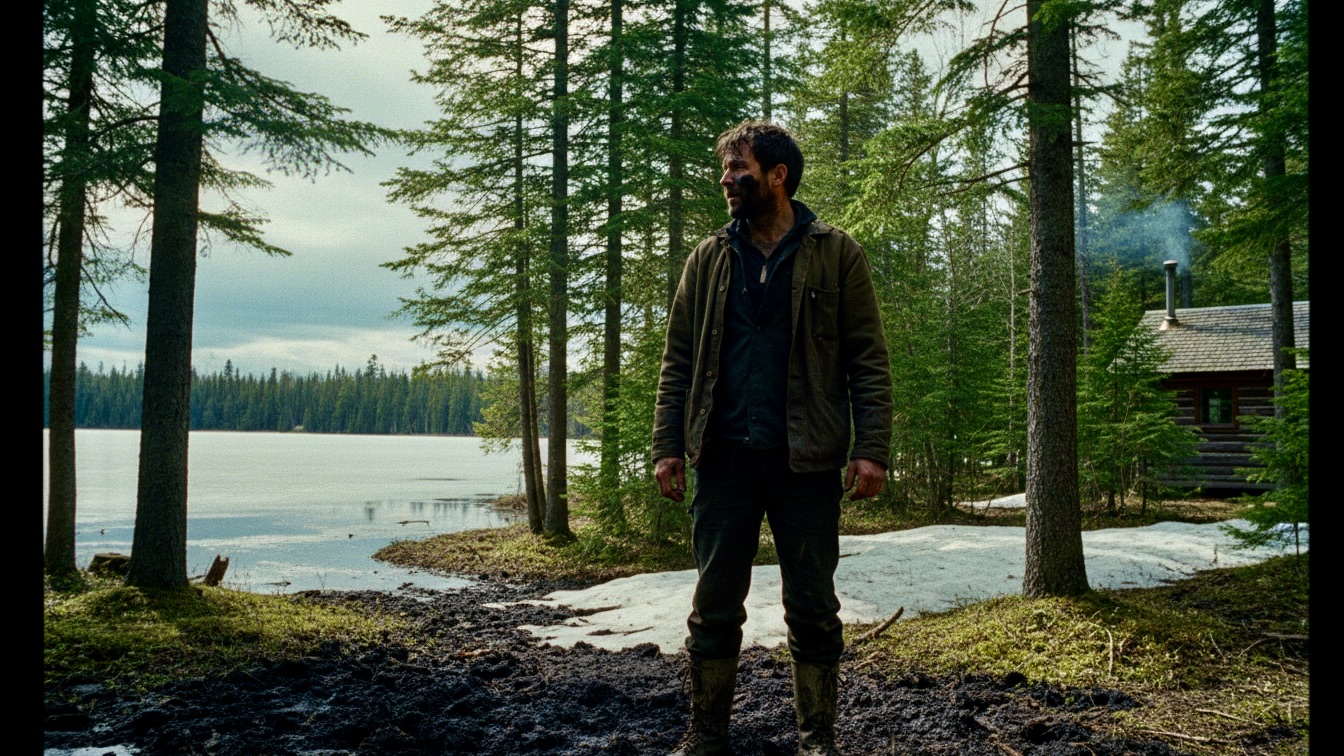
Format: Short Film / Anthology Episode | Est. Length: 10-12 minutes
This story functions as a cornerstone episode in an anthology series titled The Thaw, which explores the intersection of human fragility and the unforgiving, seasonal cycles of the Canadian wilderness. Each episode focuses on a different individual retreating from modern burnout to a remote cabin, where the land acts as both a mirror for their internal decay and a catalyst for their eventual reconstruction.
Andy, a city-softened professional in a pristine white SUV, finds his vehicle hopelessly mired in the black, frozen mud of a remote driveway. As he struggles with a winch, the sound of the forest silence mocks his frantic, futile attempts to maintain control.
A burnt-out corporate professional retreats to his family’s remote cabin to escape a mental collapse. He must trade his digital life for physical labor to earn his place in a landscape that refuses to accommodate his former identity.
The episode explores the theme of "re-wilding" the self, contrasting the frictionless, automated nature of modern urban existence with the brutal, tactile reality of manual labor. It examines the psychological transition from a life defined by abstract metrics to one defined by tangible, physical results, emphasizing the necessity of struggle in the healing process.
The narrative also touches upon the theme of ancestral inheritance, where Andy must reconcile the ghost of his father’s practical life with his own failed corporate trajectory. It suggests that true peace is not found in the absence of conflict, but in the acceptance of the world's inherent, chaotic rhythms.
Andy’s primary stake is his own psychological survival; if he cannot adapt to the physical demands of the cabin, he faces a total loss of self-worth and a return to the cycle of panic attacks that drove him from the city. For the cabin itself, the stakes are structural; without Andy’s commitment to maintenance, the property will succumb to rot and decay, effectively erasing the final physical connection to his family history.
The central conflict is man versus environment, manifested in the stubborn, frozen mud and the decaying infrastructure of the cabin. Internally, Andy battles his own ingrained corporate conditioning, which demands immediate, automated solutions to problems that require patience, physical endurance, and a fundamental shift in perspective.
Andy arrives at his family’s isolated cabin in a state of nervous exhaustion, only to immediately get his vehicle stuck in the spring thaw. His neighbor, Cathy, intervenes, exposing his lack of practical skills and forcing him to confront the reality that his city-honed instincts are useless in this environment.
Through the grueling process of freeing the truck and beginning repairs on the cabin, Andy begins to shed his corporate persona. By the episode's end, he has traded his digital life for the physical labor of roof repair, finding a sense of purpose and grounding that he never achieved in his professional career.
Andy is a man defined by his career, suffering from a profound disconnection between his internal state and his external reality. He begins the episode as a fragile, anxious figure, but ends it as a man beginning to find equilibrium through physical work and the acceptance of his own limitations.
Cathy serves as the grounded, cynical mentor who represents the reality of the landscape. She is skeptical of Andy’s "sabbatical" and acts as a necessary mirror, stripping away his delusions and forcing him to engage with the actual work required to sustain his life in the woods.
Ben is the local mechanic and laborer who represents the traditional, stoic values of the region. He is a man of few words who judges Andy not by his background, but by his willingness to sweat, providing the final validation Andy needs to feel he belongs.
The opening beat establishes Andy’s isolation and his failure to navigate the mud, highlighting the absurdity of his presence in his shiny SUV. The midpoint arrives when Cathy forces him to stop fighting the winch and start building a ramp, marking the transition from frustration to collaboration. The climax occurs as Andy successfully clears the creek with Ben, realizing that his new life is not a retreat, but a fundamental reconstruction of his identity.
The episode begins with a claustrophobic, anxious mood, characterized by the sharp, cold air and the feeling of being trapped by the environment. As the narrative progresses, the mood shifts toward a rhythmic, grueling sense of accomplishment, ultimately landing on a tone of quiet, resolute clarity.
If expanded, the season would follow Andy through the changing seasons, showing his development from a novice to a capable steward of the land. Each episode would introduce a new challenge—a storm, a mechanical failure, or a social encounter—that tests his resolve and forces him to shed another layer of his former, city-bound identity.
The thematic escalation would move from individual survival to community integration, as Andy learns that he cannot simply isolate himself from the world. His character evolution would culminate in him choosing to stay permanently, having successfully integrated his past skills with his new, grounded reality.
The visual style is stark and naturalistic, favoring wide, cold shots of the Canadian bush contrasted with tight, claustrophobic close-ups of Andy’s struggle. The color palette begins with the harsh, sterile whites and blacks of the thaw, transitioning into warmer, earthier tones as Andy begins to settle into the cabin.
The tone is grounded and contemplative, drawing inspiration from the slow-burn realism of films like Leave No Trace or the atmospheric tension of The Revenant. It avoids melodrama, relying on the physical texture of the woods and the sound of the environment to convey the emotional weight of the story.
The target audience is adults aged 25-50 who are interested in character-driven dramas and stories of personal transformation. It is particularly suited for viewers who feel the weight of modern digital burnout and are drawn to narratives about returning to nature and simplifying one's life.
The pacing is deliberate and slow, mirroring the slow transition of the seasons and the physical effort required to move through the mud. The act structure is fluid, focusing on the sensory details of the labor rather than traditional plot points, ensuring the 10-12 minute runtime feels immersive and earned.
The production requires a location that can authentically capture the "mud season" of the Canadian Shield, emphasizing the tactile, messy nature of the thaw. The sound design is critical; the contrast between the silence of the woods and the harsh, mechanical sounds of the winch and chainsaw must be visceral to ground the viewer in Andy’s experience.
Practical effects should be prioritized over digital ones, particularly regarding the mud and the physical labor of the characters. The cabin should be treated as a character itself, with its decaying wood and creaky floorboards reflecting the state of Andy’s own psyche throughout the episode.


