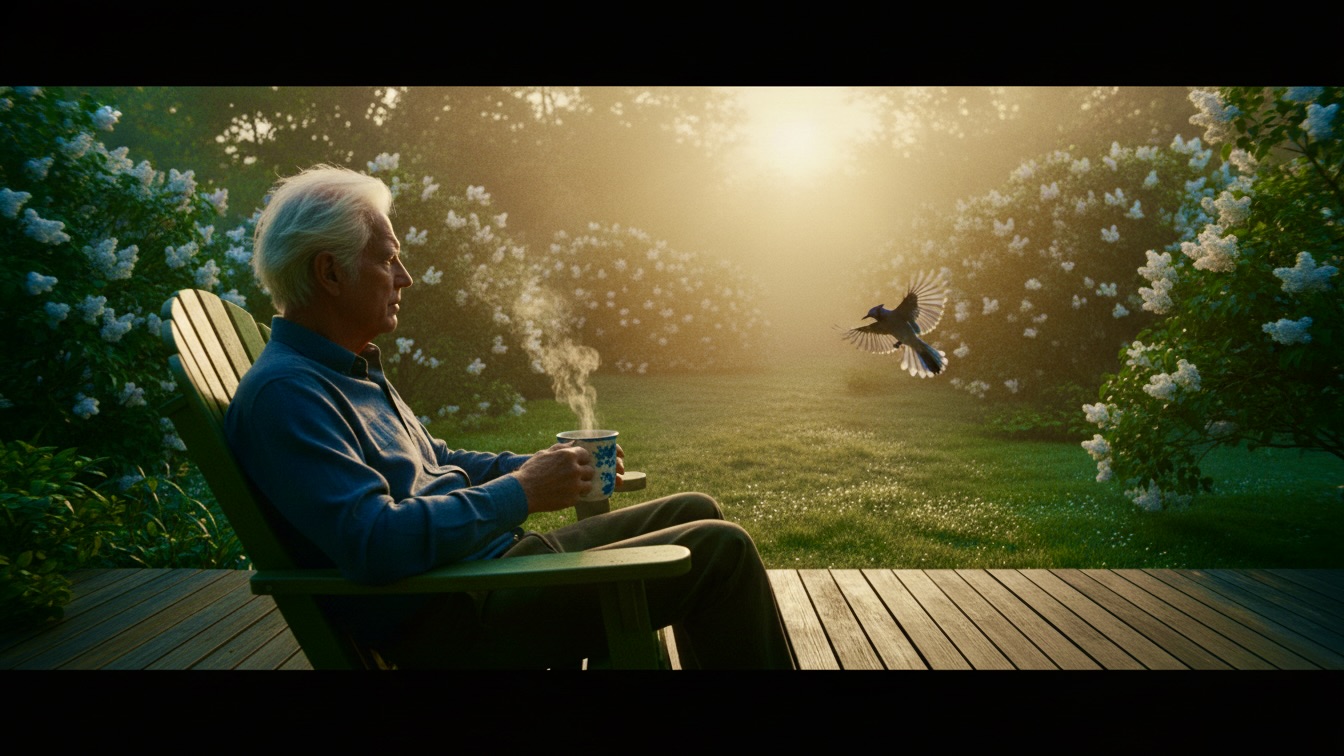
Arthur sits on his porch as the morning mist dissolves, finally finding the strength to face his past.
The air was a thick, wet wool. It clung to the screens of the wrap-around porch, turning the world beyond the floorboards into a smear of gray and charcoal. Arthur sat in the green Adirondack chair, the one with the peeling paint that bit into his thighs if he shifted too quickly. He didn't shift. He remained as still as the cedar posts holding up the roof. In his hands, a heavy ceramic mug hummed with the heat of black coffee. The rim was chipped—a small, sharp crescent where the glaze had popped off three years ago when he’d knocked it against the sink. He liked the chip. It gave his thumb a place to rest, a specific tactile landmark in the early morning gloom.
He breathed in. The air didn't just go into his lungs; it felt like it was cleaning the pipes. It was cold enough to make his nose sting but soft enough to carry the scent of damp mulch and the neighbor’s early blooming lilacs. This was the sudden oxygen he had been waiting for. For months, the house had felt like a box with the lid taped shut. Ever since Martha died, the hallways had shrunk, the ceilings had lowered, and the air had grown stale, recycled by a furnace that groaned like an old dog. But here, on the porch, with the spring mist pressing against him, the lid was off. He could breathe.
To his left, the sun was a faint, bruised orange smudge behind the treeline. It wasn't winning yet. The fog was a stubborn wall, refusing to break. Arthur watched a single bead of moisture roll down the screen. It moved in staccato jerks, gathering other droplets until it grew heavy and plummeted into the darkness of the hydrangea bushes below. He felt a strange kinship with that drop. He’d spent a long time gathering things—grudges, overtime hours, excuses—until the weight of it all simply became too much to hold.
In the absolute silence of the pre-dawn, he heard it. Thump-shh. Thump-shh. It was his heart. Usually, the sound terrified him. At eighty, a heartbeat is a ticking clock you can’t wind back up. It reminded him of doctor visits, the cold touch of a stethoscope, and the way the specialists looked at his charts with their mouths pressed into thin, grim lines. But today, the rhythm didn't sound like a countdown. It sounded like a footstep. A steady, grounded march. He was still here. The blood was still moving through the narrow, silted rivers of his veins, and for the first time in a decade, he didn't mind the sound. He leaned back, letting the wood of the chair support his spine, and closed his eyes.
Behind his eyelids, the fog didn't go away. It just changed color. It became the fluorescent haze of the office in 2004. He remembered the smell of that place—burned coffee, toner, and the static electricity of a dozen monitors. He remembered the way he had lived back then, moving through a different kind of mist. It was a fog of ambition that had tasted like copper. He had been so busy building a legacy of spreadsheets and quarterly reports that he had become a ghost in his own hallway. He saw himself standing in the kitchen of their old house, his tie loosened, his eyes fixed on a Blackberry screen while Sarah talked to him. She had been fifteen, maybe sixteen. She was telling him something about a play, or a boy, or a grade. He hadn't looked up. He had given her a one-word answer. A 'fine' or a 'later.'
That 'later' had stretched into twenty years. The anger had set in shortly after. Not the screaming kind. The quiet, cold kind that grows like mold in the dark. Sarah had stopped asking, and he had stopped offering. When she moved out, the distance wasn't measured in miles but in the things they didn't say. Even at Martha’s funeral, they had stood three feet apart, two strangers sharing a grief they couldn't coordinate. She had looked at him with eyes that were exactly like his—pale blue and guarded—and he had turned away because he couldn't bear the reflection of his own failure. He had blamed her. He had told himself she was difficult, that she was ungrateful, that she didn't understand the pressure he was under. He had wrapped himself in that lie like a shroud.
The coffee in the mug was cooling. A thin skin had formed on the surface. Arthur opened his eyes. The fog was beginning to fray at the edges. The sun had climbed a few inches higher, and the gray was turning into a brilliant, blinding white. The trees were starting to emerge—first the dark skeletons of the oaks, then the pale, ghostly green of the new leaves. It was happening. The world was coming back into focus.
Suddenly, the silence didn't just break; it shattered. A blue jay, a streak of neon against the white mist, dived from the roof of the porch. It moved like a bullet, a sharp, jagged line of blue that cut through the air. It landed on the birdbath with a wet thud and began to scream. It was a harsh, ugly sound, but it was honest. It was a demand for attention. Arthur watched the bird, its crest raised, its black eyes fixed on nothing in particular. It didn't care about the fog. It didn't care about the past. It was just there, vibrating with life in the cold spring morning.
Arthur looked down at his hand. It was shaking, just a little. The skin was thin, like parchment, and the veins were a map of a country he no longer recognized. He set the coffee mug down on the small table next to him. The sound of the ceramic hitting the wood was loud, final. He reached into the pocket of his cardigan and pulled out his phone. The screen was cracked in the lower right corner, a spiderweb of glass that caught the growing light.
He didn't check the time. He didn't check the weather. He scrolled through his contacts until he reached the 'S' section. There was only one name there that mattered. He stared at it for a long time. The fog in his mind, that heavy, suffocating layer of pride and resentment, was lifting. He realized that for years he had been waiting for her to apologize for drifting away, never acknowledging that he was the one who had cut the rope. The oxygen felt good now. It felt like a permission slip.
He thought about what he would say. He wouldn't say 'I'm sorry' right away. That was too big, too heavy to drop on her at six in the morning. He would tell her about the garden. He would tell her that the lilacs were early this year and that a blue jay had just woken up the entire neighborhood. He would tell her that the air was clear. He tapped the name. The screen shifted to the calling interface. He held the phone to his ear. The plastic was cold against his skin, a sharp contrast to the warmth of the coffee he’d just finished. He heard the first long, low hum of the connection.
Outside, the fog vanished. The sun hit the grass, turning the dew into a million tiny diamonds. The garden was green, vibrant, and painfully real. He could see the fence clearly now. He could see the path. He could see the way out.
“The line clicked open, and for a second, there was only the sound of her breathing.”


