Format: Short Film / Anthology Episode | Est. Length: 10-12 minutes
Imagine a world where the scars of the Industrial Revolution are healed not by demolition, but by biological intervention, turning the skeletal remains of the 20th century into the lungs of the 21st. This story serves as a cornerstone for a series exploring the intersection of high-tech environmentalism and blue-collar survival, where the battle for the future is fought in the ruins of the past.
Set in a near-future "Rust Belt" resurgence, the series follows disparate individuals using "guerrilla rewilding" to combat corporate land-grabbing and ecological collapse. Each episode focuses on a different industrial site being reclaimed by bio-engineered flora, building toward a larger narrative of a grassroots movement challenging the hegemony of data conglomerates. The overarching arc explores the tension between the "Old World" of heavy industry and a "New World" of synthetic biology, questioning who truly owns the air and the soil.
Mike, a wealthy former executive, steps into a decaying steel mill to meet a teenage squatter, trading his corporate fortune for a handful of synthetic seeds that shouldn't exist.
A disillusioned executive and a teenage visionary use illegal bio-engineered plants to transform a toxic steel mill into a sanctuary. They must defend their burgeoning ecosystem against a local government determined to pave it over for a data center.
The primary theme is "Regeneration," exploring how both environments and individuals can find new purpose after being discarded by the capitalist machine. It also delves into "Technological Symbiosis," contrasting the cold, sterile technology of data centers with the vibrant, living technology of the poly-synthetic hybrid plants.
The story also examines "Legacy and Guilt," as Mike attempts to atone for his corporate past by saving the town that his father’s industry destroyed. This emotional undercurrent grounds the science-fiction elements in a deeply personal struggle for redemption.
For Mike, the stakes are his last shred of humanity and his entire life savings; failure means becoming as obsolete as the mill itself. For Sam and the town, the stakes are the literal air they breathe and the survival of a community that is being suffocated by industrial rot and corporate greed. If the project fails, the mill becomes a sterile server farm, and the town loses its last chance at a breathable future.
The external conflict is a "Man vs. Society" struggle against Councilman Miller and the corporate interests he represents, who view the land only as a commodity to be exploited. Internally, Mike battles "Imposter Syndrome" and the guilt of his corporate past, while Sam struggles with the urgency of his mission against the slow-moving reality of legal and physical barriers. The environment itself acts as a secondary antagonist, with its toxic soil and structural decay threatening to kill the very life they are trying to plant.
Mike, an executive carrying the weight of a dying era, meets Sam at the rusted Bethlehem Steel mill to fund a radical ecological experiment. Sam has developed a poly-synthetic hybrid plant that thrives on heavy metals and rust, offering a chance to detoxify the valley that killed Mike’s father. Using high-end drones and bio-gel, they accelerate the growth, turning the grey graveyard into a lush, emerald sanctuary in a matter of hours.
The transformation draws the attention of Councilman Miller, who arrives with authorities to shut down the "illegal" operation in favor of a lucrative data center contract. However, the local community gathers at the gates, captivated by the first sign of life they’ve seen in decades. As the episode ends, Mike and Sam stand their ground against the looming legal threat, realizing that while the plants have taken root, the real war for the town’s future has only just begun.
Mike: A cynical, wealthy former executive who begins the story feeling like a "fraud" and a "piece of scrap metal." By the end, he finds "frantic clarity" and purpose, transitioning from a passive observer of decay to an active defender of growth. His psychological arc is one of shedding corporate skin to find a raw, authentic connection to the world.
Sam: A seventeen-year-old "stray cat" with the mind of a genius, Sam is the catalyst for change who views biology as a machine. He starts as a desperate underground innovator and ends as a symbol of hope, his youthful idealism validated by Mike’s resources and the community’s support. His arc moves from isolation and secrecy to becoming the face of a public movement.
Councilman Miller: The personification of stagnant bureaucracy and corporate subservience, Miller serves as the antagonist who sees the mill only as a site for demolition and profit. He remains static in his worldview, representing the rigid systems that the "Iron and Ivy" movement seeks to dismantle.
Mike arrives at the Bethlehem Steel mill, his expensive watch and clicking knees highlighting the friction between his corporate past and the industrial decay. He meets Sam, a tech-savvy teen living in the shadows, who challenges Mike’s perception of the mill as a "tomb" by revealing a hidden, vibrant life. They negotiate the terms of their partnership, establishing the high financial and personal stakes involved in the investment.
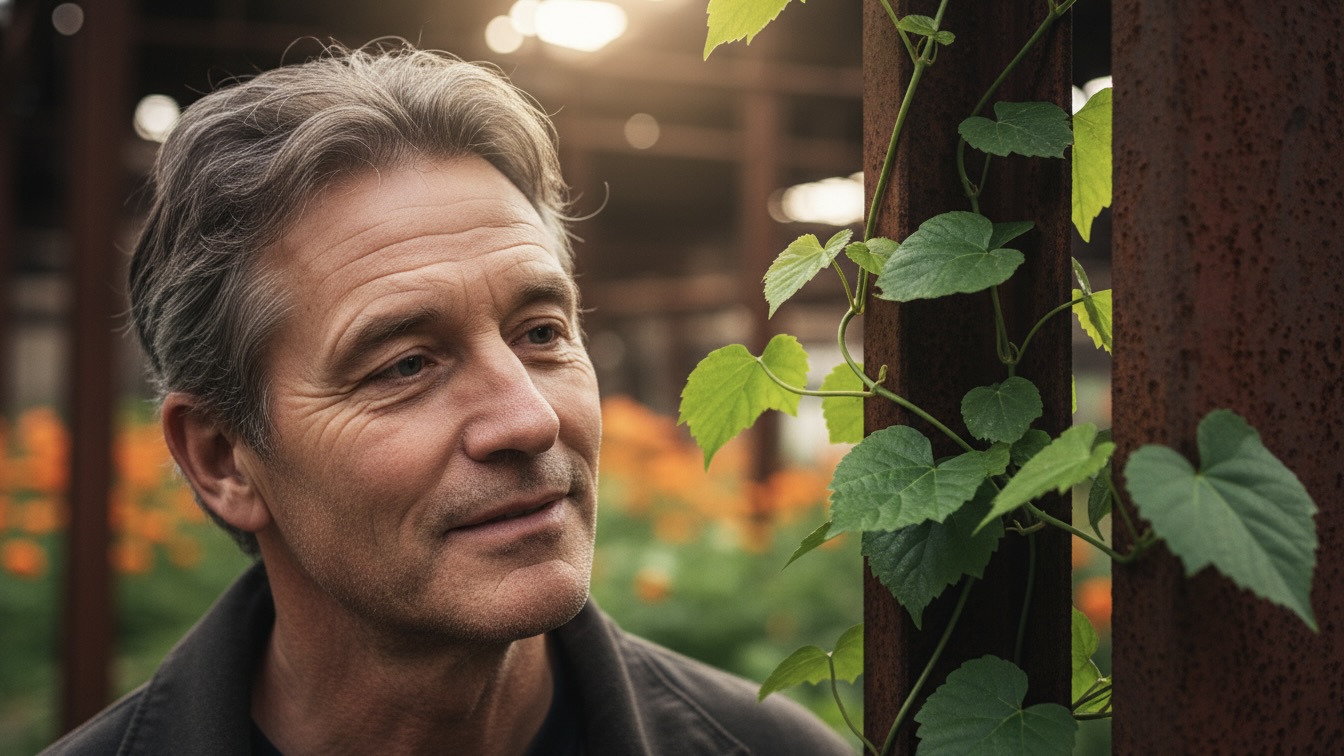
Sam reveals the poly-synthetic hybrid plant growing through an I-beam, explaining its ability to process heavy metals and clean the air. Mike touches the cold, vibrating leaf and experiences a moment of physical relief, finally deciding to commit his capital to the project. They begin the arduous task of hauling bio-gel to the roof, a physical trial that forces Mike to confront his own aging and obsolescence.
The duo launches a fleet of advanced drones to mist the mill with nutrients, creating a high-tech ballet over the rusted iron structures. As the drones hum overhead, the grey iron is rapidly overtaken by a wave of vibrant, saturated green, softening the jagged lines of the factory. This visual midpoint serves as the climax of the transformation, proving that Sam’s radical science actually works on a massive scale.
Councilman Miller arrives with SUVs and a megaphone, ordering them to cease operations and threatening demolition for a new data center. Mike refuses to back down, noticing that a crowd of local residents has gathered at the fence, mesmerized by the sudden bloom. The tension peaks as the authorities prepare to breach the gate, but the presence of the townspeople creates a political stalemate.
The drones create a prism of light in the mist as the crowd cheers, shifting the power dynamic from the councilman to the people. Mike and Sam watch the sun set over their new emerald kingdom, acknowledging that while they have won the first battle, a long-term war against the city is inevitable. The episode closes on Mike’s defiant resolve to "make it rain," signaling the start of a broader revolution.
The episode begins with a heavy, claustrophobic atmosphere of "Decay and Regret," mirrored by Mike’s tight chest and the smell of soot. As the green begins to spread, the mood shifts to "Awe and Vitality," providing the audience with a sensory release of clean air and vibrant color. It concludes on a note of "Defiant Hope," replacing the initial stagnation with the tension of an impending but righteous struggle.
A full season would track the "Green Contagion" as Sam’s seeds spread beyond the mill, sparking similar uprisings in other forgotten industrial towns. Mike would use his corporate knowledge to fight legal battles in the courtroom, while Sam leads a "Bio-Hacker" underground to stay one step ahead of corporate saboteurs. The narrative would expand to show how the "Ivy" begins to disrupt the digital infrastructure of the data centers, creating a literal conflict between nature and the grid.
The season climax would involve the data center conglomerate attempting to deploy a chemical defoliant to kill the growth, forcing the community to form a human shield around their new ecosystem. This escalation would transform the story from a local dispute into a national movement regarding the "Right to Nature" in a post-industrial world. The finale would see the mill fully integrated into the town's economy, proving that ecological restoration can coexist with human survival.
The visual style is "Industrial Neo-Noir" meets "Solarpunk," contrasting the monochromatic, gritty textures of rusted steel with the hyper-saturated, almost glowing greens of the bio-engineered plants. Cinematography should use tight, handheld shots in the beginning to emphasize Mike’s claustrophobia, opening up into wide, sweeping drone shots as the mill is reclaimed by nature. The lighting should transition from the grey, filtered light of a smog-filled valley to the sharp, prismatic brilliance of the nutrient mist.
The tone is reminiscent of Children of Men’s grounded grit mixed with the ecological wonder of Annihilation, but with a more optimistic, proactive core. The sound design should emphasize the transition from the "guillotine" sound of swinging metal to the organic, rhythmic pulse of the growing vines. Tonal comparables include the environmental urgency of Erin Brockovich and the high-tech rebellion of Mr. Robot.
The target audience includes adults and older teens (16-45) interested in "Cli-Fi" (Climate Fiction), social justice, and tech-thrillers. It appeals to viewers who enjoy stories about the "underdog" taking on corporate entities, as well as those who find aesthetic beauty in urban exploration and nature’s resilience. The series is designed for streaming platforms that favor high-concept, visually-driven anthology or serialized content.
The 10-12 minute runtime requires a "Fast-Burn" structure, moving quickly from the introduction to the technological intervention. The first four minutes establish the setting and the "Old World" stakes, the middle four minutes focus on the "Transformation" sequence (the drones), and the final four minutes handle the "Confrontation" and the shift in community sentiment. The tempo should feel breathless during the drone launch, slowing down only for the final, quiet moment of reflection between Mike and Sam.
The production relies heavily on "Augmented Reality" or high-end CGI to depict the rapid growth of the vines over the industrial structures. Practical effects should be used for the close-up "hero" plants to ensure the texture feels "cold and plastic" as described in the text, grounding the sci-fi elements in reality. The contrast between the rusted iron and the saturated green must be meticulously color-graded to avoid looking artificial.
The location requires a genuine industrial ruin to provide the necessary scale and "metallic sweat" atmosphere. Drone choreography is a key production element, requiring a mix of real drones for wide shots and digital doubles for close-proximity maneuvers around the actors and the mill’s architecture. Safety protocols for filming in a derelict structure must be factored into the shooting schedule.


