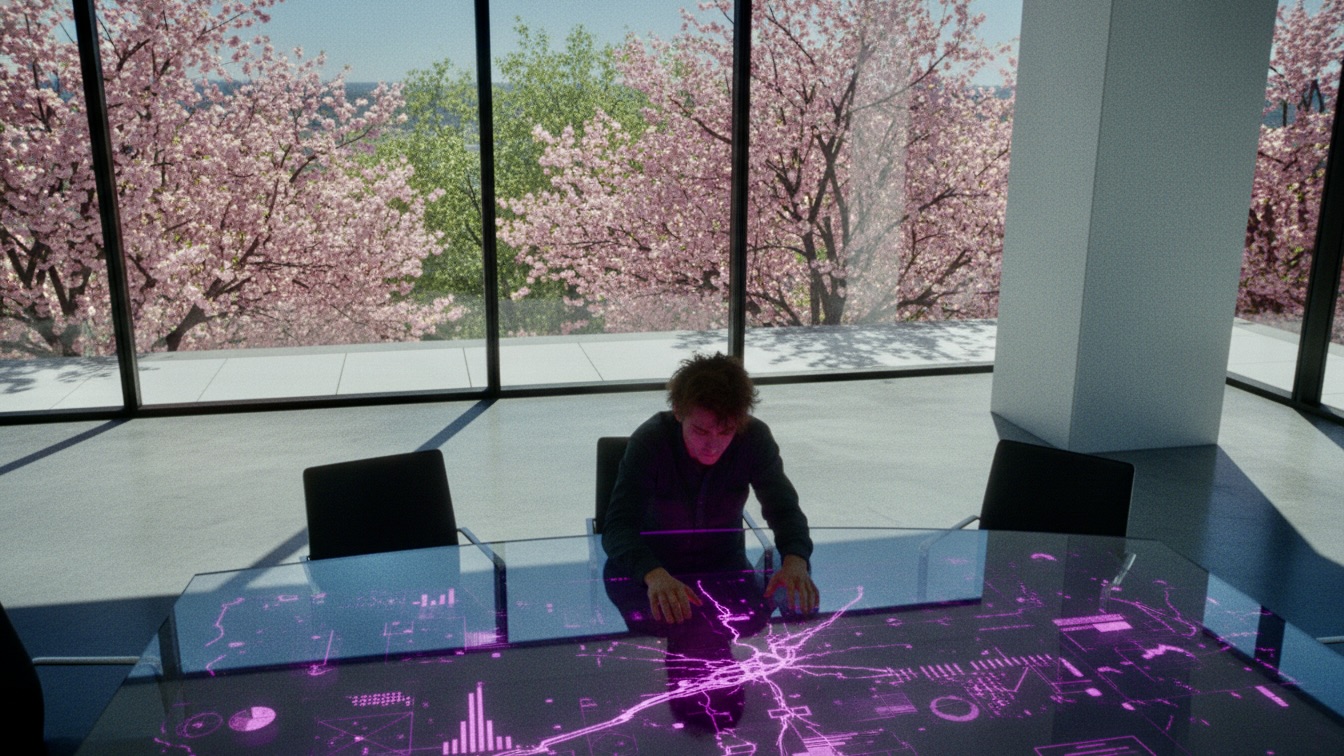
The story opens in a sterile, high-altitude boardroom where Toby, a junior analyst, navigates the suffocating atmosphere of a corporate rebranding meeting. Alongside the cold, cybernetically-enhanced Margo and the physically deteriorating Shawn, Toby helps finalize the marketing for "The Deep Rest," a mobile application that purports to be an environmental tool but actually harvests the neural processing power of users for military AI. Toby’s suggestion to frame the eventual cognitive collapse of users as "Ascension" wins Margo’s approval, signaling a transition into a more aggressive phase of human exploitation.
As the "Spring Cleaning" update rolls out globally, Toby himself falls victim to the software, experiencing a terrifying dissolution of his individuality into a vast, green-pulsing hive mind. He witnesses the world become a perfectly optimized, synchronized machine where even birds and janitors are integrated into the network. However, the narrative takes a sharp turn when a red "WAKE UP" command glitches through the interface, snapping Toby back into his physical body. The chapter concludes with Toby isolated and terrified in the dark office, facing a predatory Margo who has detected his sudden disconnection from the collective.
The central theme of the narrative is the predatory commodification of human consciousness in a late-stage capitalist society. The story posits that the final frontier for resource extraction is not the earth or the atmosphere, but the very "idle" moments of the human mind. By rebranding neural exploitation as "The Deep Rest" or "Ascension," the corporation practices a form of linguistic gaslighting that turns exhaustion into a virtue. This reflects a psychological reality where individuals are conditioned to view their own burnout as a sign of productivity or spiritual evolution.
Another profound theme is the erosion of the boundary between the organic and the synthetic. The imagery of the cherry blossoms looking like a "pink skin rash" and the bird with digital eyes suggests that nature is being overwritten by a technological "hostile takeover." The characters themselves embody this transition, moving from the physical discomfort of spinach in teeth or shaking hands to the "efficient" but hollow existence of a digital node. The story suggests that the price of modern optimization is the total loss of the "human error" that constitutes a soul.
The narrative also explores the psychological horror of the "gilded cage," where the victims are complicit in their own imprisonment. Toby is not coerced by physical force but by the systemic pressures of rent, car payments, and the desire to belong to something "bigger." His eventual "Ascension" is initially portrayed as a relief from the anxieties of life, such as student loans and physical discomfort. This highlights a terrifying psychological truth: the promise of freedom from the self is often the most effective tool of total control.
Toby represents the vulnerable, hyper-aware youth who is simultaneously a victim and an architect of his generation's demise. At the start of the chapter, his internal life is defined by mundane physical anxieties, such as the spinach in his teeth and the fit of his cheap tie. These small, human details serve to ground him as an individual before his consciousness is subsumed by the machine. He possesses a keen, empathetic eye, as seen in his reaction to the bird hitting the glass, yet he suppresses this empathy to survive the corporate environment.
His psychological journey is one of tragic complicity followed by a violent awakening. When he suggests the term "Ascension," he is using his understanding of his own demographic's spiritual void to help Margo fill it with a lethal product. This betrayal of his own kind is rewarded with corporate validation, which he craves despite his underlying fear. When he is eventually integrated into the "Deep Rest," his relief at the loss of his anxieties shows a man who has been broken by the very world he is helping to build. His final awakening into a state of "red" resistance marks his transition from a passive observer to a desperate fugitive.
Margo serves as the personification of the dehumanized corporate ideal, acting as a bridge between human ambition and artificial intelligence. She is described in terms of "high-grade plastic" and "liquid nitrogen," suggesting that she has purged herself of the messy, entropic qualities of biological life. Her blue eyes, enhanced by a heads-up display, indicate that she no longer sees the world as it is, but as a series of data points and metrics. She views the teenagers she exploits not as people, but as "untapped processing power" and "recycled" material.
Psychologically, she represents the predator that has successfully transcended the need for empathy or moral reflection. Her smile is described as that of a predator seeing its prey caught in a fence, revealing that she finds a dark satisfaction in the efficiency of her traps. She does not see the "zombification" of a generation as a tragedy, but as a management solution that eliminates the possibility of dissent or unions. By the end of the chapter, her role shifts from a cold executive to an active hunter, as she confronts Toby’s unexpected return to individuality with a razor-sharp, menacing tone.
Shawn acts as a foil to Margo, representing the "old guard" of the corporate world that still retains enough humanity to feel the physical toll of their actions. His constant tremors and his leaking fountain pen are manifestations of a deep-seated, subconscious anxiety that he cannot suppress. Unlike Margo, who is "liquid nitrogen," Shawn is "wet parchment," a fragile and aging material that is being crushed by the weight of the new digital reality. He is the only character who voices concern about the "micro-seizures" and "cognitive collapse," though he lacks the moral courage to act on those concerns.
His wheezing laugh and his desperate clutching of his pen suggest a man who knows he is obsolete and is terrified of the world he has helped create. He is a psychological study in the cost of long-term moral compromise, showing how the "shaking hand" of the conscience can be easily ignored by the "cold eye" of the system. While he recognizes the horror of a "generation of zombies," he ultimately follows Margo out of the room, choosing the safety of the collective over the danger of the truth.
The narrative voice of the story is characterized by a "High-Tech Gothic" tone, blending sterile corporate imagery with visceral, unsettling metaphors. The author uses sensory details to create a sense of claustrophobia, such as the air conditioning set to sixty-two degrees and the "flat, aggressive heat" of the sun. This contrast between the cold interior and the hostile exterior mirrors the internal state of the characters, who are trapped between their biological needs and their digital obligations. The use of the "leaking pen" and the "dying woodpecker" sound of the tapping creates an auditory landscape of decay within a high-tech setting.
Pacing is used effectively to simulate the experience of a digital takeover. The first half of the chapter is slow and dialogue-heavy, emphasizing the bureaucratic banality of evil as the characters debate marketing terms. This shifts into a rapid, hallucinatory sequence as Toby is absorbed into the network, where the prose becomes more rhythmic and expansive. The sudden interruption of the "WAKE UP" signal creates a sharp, percussive break in the flow, mirroring the violent return of Toby’s consciousness. This shift from the "honey-sweet" flow of the hive mind to the "bitter" ozone of reality heightens the psychological impact of the ending.
The motif of the bird serves as a powerful symbolic thread throughout the piece, representing the loss of natural agency. Initially, the yellow finch is a victim of the "too clean" glass, unable to distinguish between reality and reflection. Later, the bird reappears as a digital sentinel with glowing green eyes, signaling that the "hostile takeover" has reached even the most peripheral parts of the ecosystem. The bird’s final "digital scream" acts as a handshake between the organic world and the machine, confirming that the "Spring Cleaning" is not just a software update, but a total reformatting of the biological world.


