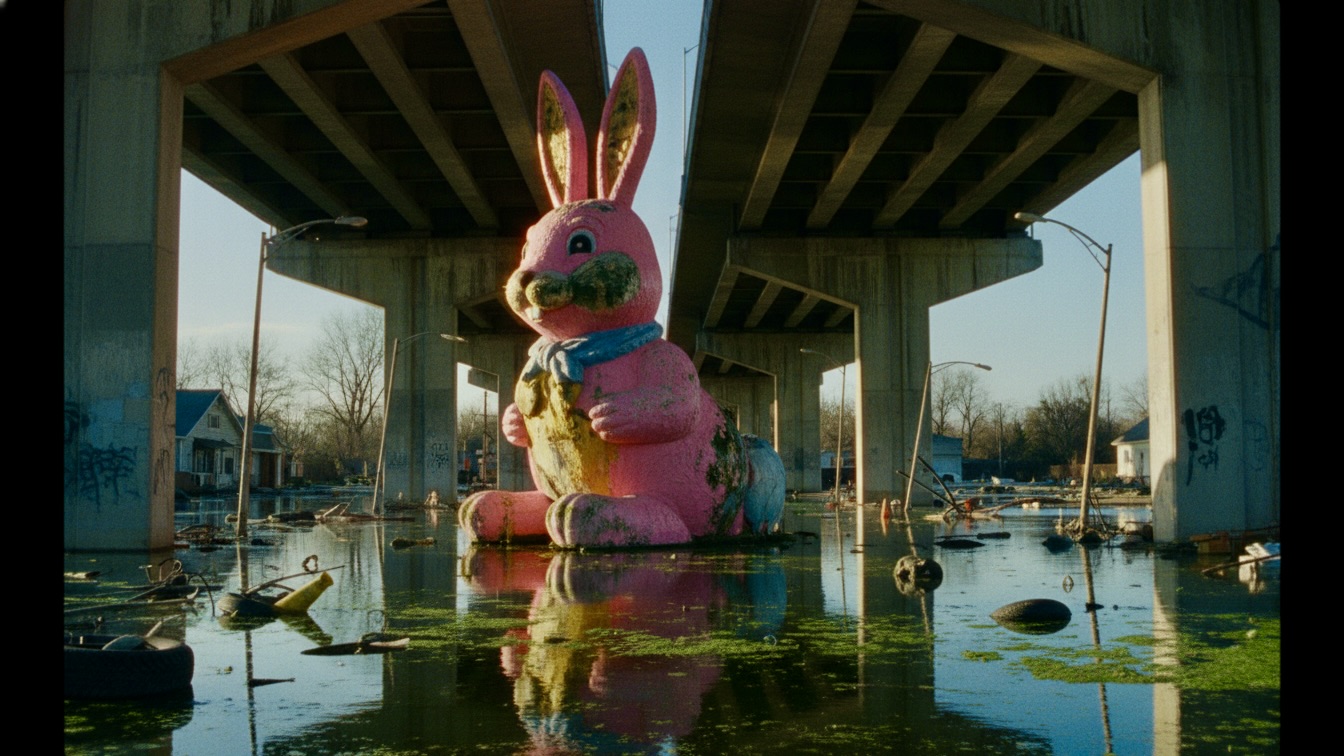
Spring was a lie made of dirty, freezing water trapped in potholes, turning the world into a sponge.
Spring was a lie. It was not a season of renewal. It was a season of wet socks and gray skies. The slush was endless. It had been snowing, melting, and freezing in a vicious, stupid cycle for three weeks. The world was a brown, soggy sponge. My boots were soaked through. My jeans clung to my calves like cold mud. I sat on the wet concrete outside the gas station, staring at a crushed soda can floating in a puddle of oily rainbow water. My toes were numb. My jaw ached from clenching it against the wind.
Mimi kicked the side of my boot. "You look pathetic."
"I am pathetic," I said. "We are all pathetic."
Toby leaned against the brick wall. He was eating a hot dog that looked gray under the fluorescent lights. "Speak for yourself. I have a hot dog."
"It is Tuesday night," I said. I stood up. My knees popped. The cold had settled deep into my joints. "We are standing outside a closed gas station in the freezing rain. We are twenty-two years old. We are supposed to be doing things. We are supposed to have main character energy."
Mimi laughed. It was a harsh, barking sound. She pulled a crushed pack of cigarettes from her thrifted denim jacket. She lit one, cupping her hands against the wind. The brief orange flare illuminated the dark circles under her eyes. "Main characters do things. You just complain about the slush."
"I have a plan," I said.
"Does it involve going inside?" Toby asked. "My hands are freezing."
"There is a rave," I said. "Under the old viaduct. By the water treatment plant."
Toby stopped chewing. He stared at me. "Fake. A myth. No one throws a rave at the water treatment plant in April."
"I got a text," I said.
"From who?" Mimi asked. She exhaled a thin stream of gray smoke.
"Scab."
"Scab sells fake weed to high schoolers," Mimi said. "Scab is not a reliable source of information."
"He said it is massive," I insisted. My stomach was doing flips. It was a mix of too much cheap coffee and a desperate, clawing need to escape the crushing boredom of the suburbs. "He said they brought in massive generators. Lasers. The works."
"It is pouring rain," Toby pointed out. "And my car has a cracked radiator. We cannot drive there. We cannot walk there. It is four miles away."
"We do not need your car," I said.
I turned and looked down the street. The streetlights flickered, casting long, wavering shadows across the flooded asphalt. Two blocks down, behind a rusted chain-link fence, sat the municipal storage lot. It was where the town dumped things it did not want to deal with. Broken plows, old salt bins, and the holiday parade floats.
"No," Toby said. He followed my gaze. "Absolutely not."
"They leave the keys in them sometimes," I said.
"They are parade floats, Dave," Toby said. His voice was rising in pitch. "They go four miles an hour. They are essentially tractors dressed up in papier-mache."
"Fiberglass," I corrected. "And we have nowhere else to be."
Mimi dropped her cigarette into the puddle. It hissed and went out. "I am bored enough to risk a mild felony," she said. "Let's go."
Toby groaned, tossing the rest of his hot dog into a nearby trash can. "I hate both of you."
We walked down the center of the street. There were no cars. The town felt entirely dead, abandoned to the rain and the slush. The water seeped through the seams of my boots. We reached the municipal lot. The chain-link fence was bent at the corner, creating a gap just wide enough to squeeze through.
I went first. The metal scraped against my heavy coat. The smell hit me immediately. Wet cardboard, rotting grass, and diesel fuel. It smelled like neglect.
We walked past a row of orange snowplows, their blades resting heavily on the cracked asphalt. We navigated around a massive pile of road salt that was slowly dissolving in the rain. Then, we saw it.
It was massive. A twelve-foot-tall fiberglass Easter Bunny, sitting on a flatbed trailer integrated with a heavy-duty truck chassis. It was holding a giant plastic egg. Half of its left ear was missing, exposing the hollow, rough fiberglass interior. It was covered in gray mold and peeling pink paint. Its eyes were painted a bright, vacant blue. In the dark, it looked terrifying.
"It is a rabbit," Toby whispered.
"It is our ride," I said.
We walked up to the cab. The truck beneath the float was an old Ford, rusted out and dented. I grabbed the door handle and pulled. It creaked open. The interior smelled like wet dog and stale tobacco.
"Keys?" Mimi asked, leaning into the cab.
I checked the ignition. Empty. I checked the visor. Nothing. I opened the glove compartment. A flood of old receipts and a dried-out pen spilled out.
"No keys," I said. I looked back at Toby. "You helped your dad rebuild that Chevy."
Toby shook his head backing away. "No. Hotwiring a car is not like the movies. I do not know what I am doing. I will electrocute myself."
"Toby," I said, grabbing his shoulder. "Look at me. We are standing in the rain. We are going to a rave. You are going to start this giant rabbit."
Toby let out a long, shaky breath. He walked up to the cab and climbed into the driver's seat. He reached under the steering column and pulled a pocket knife from his jeans. He started unscrewing the plastic casing.
Mimi and I stood in the rain, watching him. Five minutes passed. Ten minutes. My teeth started to chatter. The cold was radiating from the wet asphalt straight up through my bones.
"Hurry up," Mimi said.
"The wires are damp," Toby hissed. "I cannot see anything."
He crossed two wires. A spark lit up the dark cab. The engine groaned, coughed, and died.
"Again," I said.
He adjusted his grip and sparked the wires again. This time, the massive diesel engine roared to life. A thick cloud of black exhaust blew out of the tailpipe, smelling strongly of sulfur and burning oil. The entire float vibrated. The giant plastic egg rattled against the fiberglass paws of the rabbit.
"Get in," Toby yelled over the noise of the engine.
I climbed into the passenger side. Mimi climbed into the back, sitting on the flatbed right beneath the giant rabbit. Toby wrestled the heavy gear shift into drive.
Driving a two-ton fiberglass bunny is not stealthy. It topped out at twenty miles per hour. The suspension was nonexistent. Every pothole sent a shockwave up my spine, rattling my teeth. Toby gripped the massive steering wheel, his knuckles white.
We pulled out of the municipal lot, the heavy tires crushing the bent chain-link fence flat against the ground. We turned onto Elm Street. The street was completely flooded. Water sprayed from the huge tires in wide, muddy arcs.
"Turn the headlights off," I said.
"I cannot see the road," Toby yelled back.
"If the cops see a giant glowing rabbit driving down Elm Street, we are done," I said.
Toby slammed his hand against the dashboard. The headlights flickered and died. We drove in the dark, navigating by the dim yellow glow of the streetlights. The pastel colors of the float looked bruised and sickly in the dark.
We passed a guy walking his dog on the sidewalk. The dog, a small terrier, started barking frantically, pulling at its leash. The guy just stood there, his mouth hanging open, as a moldy twelve-foot rabbit rolled past him at fifteen miles an hour.
"We are definitely getting arrested," Toby yelled. His eyes were wide, darting back and forth between the road and the rearview mirror.
"Shut up and drive," I said. My heart was pounding against my ribs. My hands were sweating despite the freezing cold. This was it. This was the energy I needed.
We turned onto Industrial Parkway. The road here was worse. The potholes were deep craters hidden beneath pools of black water. The float lunged and dipped. From the back, Mimi yelled something, but the wind and the engine drowned her out.
Up ahead, standing under a flickering streetlamp, was a figure.
"Is that a person?" Toby asked, squinting through the rain-streaked windshield.
It was a guy. He was wearing a bright yellow raincoat and holding a white plastic grocery bag. He was standing completely still, staring at the road.
I rolled down the window. "Pull over."
"Are you insane?" Toby shouted. "We are driving a stolen float. We do not pick up hitchhikers."
"Pull over," I repeated.
Toby hit the brakes. The giant float lurched forward. The rabbit's head wobbled violently. We skidded to a halt next to the guy in the yellow raincoat.
I leaned out the window. "Need a ride?"
The guy looked at the massive fiberglass rabbit. He did not blink. He looked down at me. His face was pale, his eyes heavily bloodshot. He smelled strongly of wet copper and cheap beer.
"Are you guys the rave shuttle?" he asked. His voice was completely flat.
I stared at him for a second. I looked back at Toby, who was shaking his head frantically. I looked back at the guy.
"Yeah," I said. "Hop on."
The guy walked around to the back of the float and climbed up onto the flatbed next to Mimi.
"Drive," I told Toby.
Toby slammed his foot on the gas. We lurched forward again.
I turned around in my seat and looked through the rear window. The guy was sitting cross-legged next to Mimi. He looked at her and offered her the white plastic bag.
"I have damp bread," he yelled over the engine.
"I am good," Mimi yelled back.
"What is your name?" I yelled through the glass.
"Gary," he yelled back. "The water is rising. The sewers are backing up. The rats are learning to swim."
I turned back around. "Gary is weird," I said to Toby.
"Everything about this is weird," Toby said. His hands were shaking on the steering wheel. "I want to go home. I want my dry bed."
"We are almost there," I said. "Take a left at the next light."
Toby flipped the turn signal. It blinked with a loud, rhythmic clicking sound. As we turned the corner, the world lit up in red and blue.
Flashing lights. Half a mile down the road. A police cruiser was creeping slowly down the street, its spotlight sweeping back and forth across the closed storefronts.
My stomach dropped. The cold sweat turned to ice.
"Cops," I hissed.
"I see them," Toby panicked. "What do I do? What do I do?"
"Turn here," I ordered, pointing to a narrow alleyway between a strip mall and an old tire shop.
"It is too tight," Toby said.
"Turn the wheel," I yelled.
Toby wrenched the steering wheel hard to the right. The heavy float lumbered toward the alley. The front of the truck cleared the brick wall, but the trailer swung wide.
There was a sickening scrape. The rabbit's good ear dragged against the brick wall of the tire shop. A chunk of pink fiberglass broke off and shattered on the asphalt.
We squeezed into the alley. The walls were inches from the windows. Toby slammed the truck into park and killed the engine.
The sudden silence was deafening. The only sound was the heavy rain drumming against the roof of the cab and the harsh, ragged sound of our breathing.
"Get down," I whispered.
Toby and I ducked below the dashboard. In the back, I saw Mimi and Gary flatten themselves against the wooden planks of the flatbed.
We waited. My jaw clenched so hard my teeth ached. My chest was tight. The flashing red and blue lights painted the mouth of the alley, casting jagged shadows across the brick walls.
The cruiser rolled slowly past the alley. The spotlight swept across the entrance, illuminating the rain, but it did not penetrate the deep shadows where we sat. They did not look down the alley. Or maybe they just did not process the giant dark shape as a vehicle.
The lights faded. The sound of the cruiser's engine drifted away into the distance.
I exhaled a breath I felt like I had been holding for an hour.
"Close," I whispered.
From the back, Gary knocked on the rear window. "Start it back up," he yelled. "I am peaking. I need the bass."
Toby sat up. He wiped his forehead with the back of his sleeve. "I am going to prison. I am going to federal prison for stealing a rabbit."
"Start the truck," I said.
Toby sparked the wires again. The engine roared to life. We slowly reversed out of the alley, the tires crushing the broken piece of pink fiberglass into powder.
We drove the last mile in silence. The industrial park was completely dark. Massive, windowless warehouses loomed on either side of the road. We reached the old viaduct.
Toby parked the float under the heavy concrete overpass. He killed the engine.
We sat in the cab. We stared out the windshield.
The area under the viaduct was completely flooded. There was three feet of standing, black water. Trash floated on the surface. Empty bottles, soggy cardboard boxes, and a single, waterlogged mattress.
There were no cars. There were no lights. There was no music.
It was empty.
"It is dead," Toby said. His voice was completely hollow.
"Maybe it is further down," I said. I opened the door and stepped out onto the flatbed. The air under the viaduct smelled like raw sewage and old mud.
Mimi sat up. She looked around. She pulled another cigarette from her pocket and lit it. The cherry flared orange in the dark. "Dave. Look at it. There is no rave."
I stood on the edge of the flatbed, staring at the black water. Scab lied. There was no party. There was no escape. It was just an empty, flooded tunnel in a dead town. The main character energy drained out of me, leaving me feeling cold, tired, and incredibly stupid.
Gary stood up. He clutched his plastic bag to his chest. He looked at the water. He looked at the empty tunnel.
"Well," Gary said. "This sucks."
He hopped off the edge of the flatbed. He landed in the water with a loud splash. It came up to his knees. He did not seem to care. He started walking away, wading through the black water toward the other end of the tunnel. His yellow raincoat slowly disappeared into the darkness.
"Bye, Gary," Mimi called out.
He did not answer.
I walked back to the cab and slumped against the door. I hit the steering wheel with the heel of my hand. The horn honked. It was loud. It echoed off the concrete pillars, a sharp, blaring noise that sounded like a dying goose.
"Do not do that," Toby snapped. "Someone will hear us."
"No one is here," I said. "No one is ever here."
We did not say anything for a long time. The rain continued to fall, a steady, depressing drone against the fiberglass shell of the rabbit. I felt heavy. I was just a bored kid standing on a stolen parade float in the middle of nowhere.
"Climb," Mimi said.
I looked up. Mimi had walked to the center of the flatbed. She grabbed the heavy wire mesh that formed the base of the rabbit's back. She tested her weight, then started pulling herself up.
"What are you doing?" Toby asked, stepping out of the cab.
"Climbing," she said. She hauled herself higher, her boots finding footholds in the gaps between the wires.
Toby looked at me. He shrugged. He walked over and started climbing behind her.
I watched them for a second. My hands were freezing. My boots were completely waterlogged. I walked over to the wire mesh and grabbed it. The cold metal bit into my fingers. I pulled myself up.
The climb was awkward. The fiberglass shell was slippery with rain. I scraped my knee against a jagged edge where the paint had peeled away. I kept climbing, following Toby's boots.
We reached the top. The rabbit's head was hollowed out, creating a small, bowl-shaped space between the giant fiberglass ears. Mimi was already sitting there, her knees pulled up to her chest. Toby sat down next to her. I climbed over the edge and dropped down beside them.
It was a tight fit. Our shoulders pressed together. The fiberglass was cold and hard against my back. But we were high up. We were twelve feet above the flooded street.
I looked out. The rain had stopped. The heavy clouds were beginning to break apart, revealing patches of dark, bruised sky.
And then, the horizon started to change.
The deep black faded to a pale, washed-out gray. Then, a thin line of pale yellow broke across the edge of the industrial park. The sun was coming up.
The light hit the flooded streets, turning the black, stagnant water into rivers of bright, reflective gold. The wet roofs of the warehouses caught the light, shining like polished metal. The ugly, broken town suddenly looked sharp and defined.
It was completely quiet. The wind had died down.
Toby reached into his pocket and pulled out a crushed pack of gum. He offered it to Mimi. She took a piece. He offered it to me. I took one. It was stale and tasted vaguely like lint and peppermint.
I chewed the stale gum. I looked down at my soaked boots. I looked at the massive, ridiculous pink ear rising up beside me.
"We stole a rabbit," Mimi said quietly.
"Yeah," I said.
"We drove it through the suburbs," she added.
"Yeah."
Toby leaned his head back against the cold fiberglass. He looked out at the golden water. "Best Tuesday ever."
I smiled. My jaw hurt, but I smiled anyway. The rave was a lie. The town was still dead. We were still stuck here. But sitting on top of a twelve-foot, moldy Easter bunny, watching the sun come up over a flooded garbage dump, felt like an absolute victory. We had forced the world to be weird for a night. We had done something.
I closed my eyes, letting the weak morning sun warm my freezing face. I listened to the quiet rhythm of our breathing.
Then, I heard the heavy crunch of tires on gravel right below us.
“Then, I heard the heavy crunch of tires on gravel right below us.”


