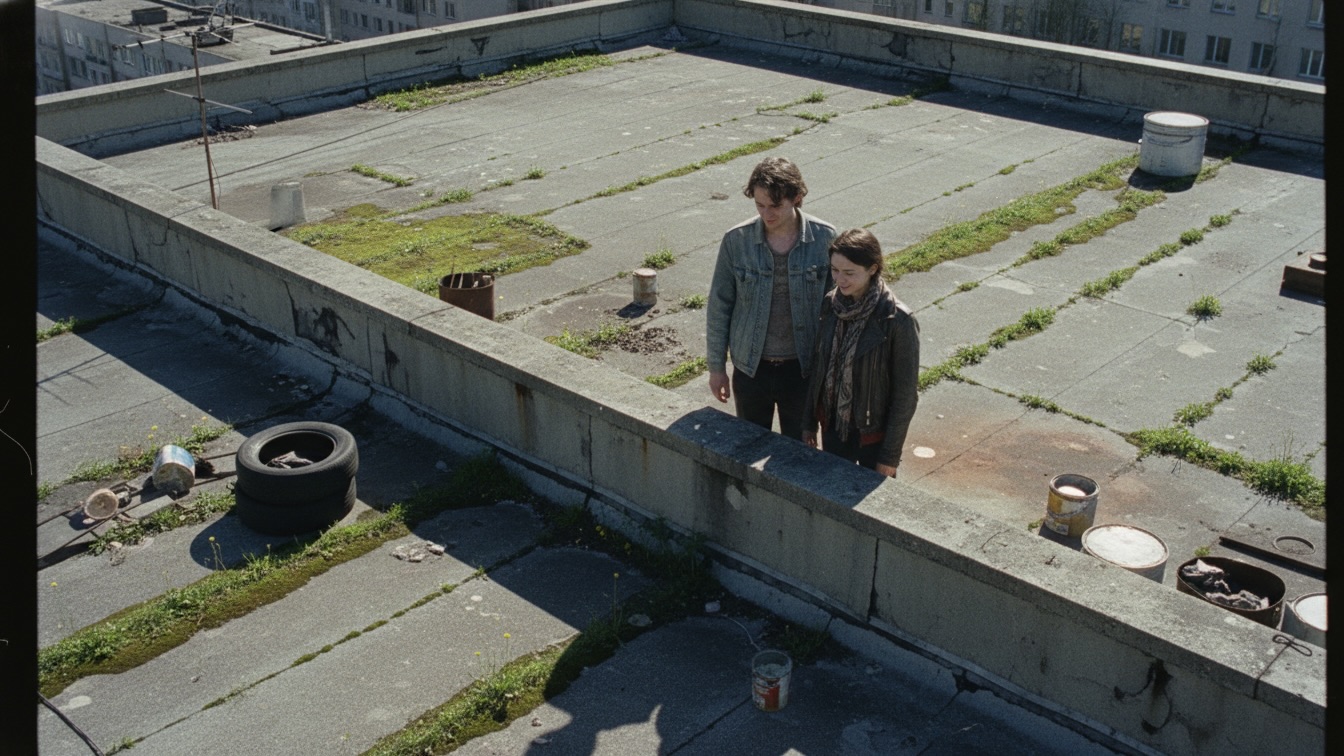
Jeffrey and Annie return from a manual labor stint at a creek, their bodies battered by physical work but their minds still tethered to a demanding digital world. The mag-lev train’s sudden stall and the subsequent re-entry into the neon-soaked city highlight the jarring transition from the honest cold of the water to the cognitive static of urban life. They seek refuge in a minimalist cafe, where they witness an old man known as the Ranger clearing a clogged drain with a simple metal hook. This silent, physical act of maintenance prompts them to flee the street level and seek the silence of a rooftop. Just as they achieve a moment of radical disconnection by powering down their devices, the technology overrides their control, signaling a totalizing and inescapable digital reclamation.
One of the central themes is the tension between physical reality and digital abstraction. The story contrasts the grey sludge and sore muscles of the creek with the white social feed and engagement metrics that dominate the characters' lives. The physical world is described as honest and grounding, while the digital world is a source of cognitive static and friction without heat. The characters find that while they can move physical mass, they are nearly powerless against the weight of digital obligations.
The narrative also explores the theme of performative existence and the loss of the private self. Annie lives in a constant broadcast mode, viewing her every silence as a digital deficit that must be managed to appease her followers. Jeffrey, too, is burdened by the cynical detachment his audience expects from him. Their identities are no longer internal but are instead dictated by the algorithms they serve. This creates a psychological landscape where sincerity is viewed as a liability and vulnerability is a danger to one's social standing.
Finally, the story critiques the illusion of autonomy in a hyper-connected society. The characters believe they can choose to disconnect, yet the non-negotiable override of their phones proves that their devices are no longer tools, but tethers of civic control. The detox was merely a scheduled pause, a recalibration allowed by the system rather than a true escape. The final red glow of the screens suggests that the infrastructure of the city is not just glass and steel, but a pervasive digital net that cannot be escaped by simply pressing a button.
Jeffrey serves as the cynical observer who is painfully aware of the echo chamber he has helped construct. He feels the notifications on his phone as a physical weight, a solid red circle that demands a performance of detachment he no longer wishes to provide. His desire to return to the freezing water of the creek reveals a deep psychological fatigue and a longing for a reality that does not require an opinion or a post. He is a man caught between the intellectual recognition of his entrapment and the visceral need for genuine human experience.
His interaction with the Ranger shows his respect for the real infrastructure, suggesting that Jeffrey craves a life of tangible impact rather than digital influence. When he powers down his phone on the rooftop, he is attempting a radical act of self-reclamation. However, the failure of this act suggests a tragic realization: he is so integrated into the system that his very presence is monitored and mandated. His journey is one of brief, failed liberation, ending in a return to the claustrophobia he sought to escape.
Annie is a character defined by the theatrical mask she wears for her millions of followers. She views her physical injuries, like the laceration on her thumb, as secondary to the digital deficit caused by her absence. Her language is saturated with the jargon of the market, speaking of engagement metrics and speculative narratives. This suggests a personality that has been almost entirely subsumed by her digital avatar, leaving her exhausted and fragile when the broadcast mode is interrupted.
Despite her outward obsession with the algorithm, Annie shows flashes of profound human exhaustion. Her willingness to follow Jeffrey to the roof and her eventual decision to power down her phone indicate a hidden desire for the shared quiet they found at the creek. She is not merely a drone of the system but a victim of it, someone who recognizes the theatricality of her life but feels compelled to maintain it for survival. Her silence on the roof is her most honest moment, representing a brief window where she is a person rather than a product.
The pacing of the chapter mirrors the psychological state of the characters, shifting from the brutal second of the train's stall to the rapid scrolling of the digital world. The author uses short, punchy sentences to emphasize the clinical and often hostile nature of the environment. This creates a sense of urgency and high tension that only subsides during the brief interlude on the rooftop. The transition from the dark, claustrophobic tunnel to the violent, bright light of the city serves as a sensory assault that reflects the characters' internal overstimulation.
Sensory details are used effectively to contrast the organic and the synthetic. The sulfur and wet dirt of the creek and the grey sludge on the jackets ground the story in a messy, tactile reality. In contrast, the city is defined by pale blue glows, mechanical mosquitoes, and hyper-saturated colors. These details highlight the unnaturalness of the urban landscape. The zinc table in the cafe is a particularly potent symbol, representing a cold, hostile design intended to discourage lingering or genuine human connection.
The narrative voice is flat and observational, which heightens the impact of the emotional shifts. By maintaining a certain clinical distance, the prose reflects Jeffrey’s own cynical detachment. However, this tone makes the moments of sudden oxygen and radical disconnection on the roof feel more earned and poignant. The final shift back into biological panic is underscored by the auditory assault of the siren, bringing the stylistic journey full circle from silence to an inescapable, mandated noise.


