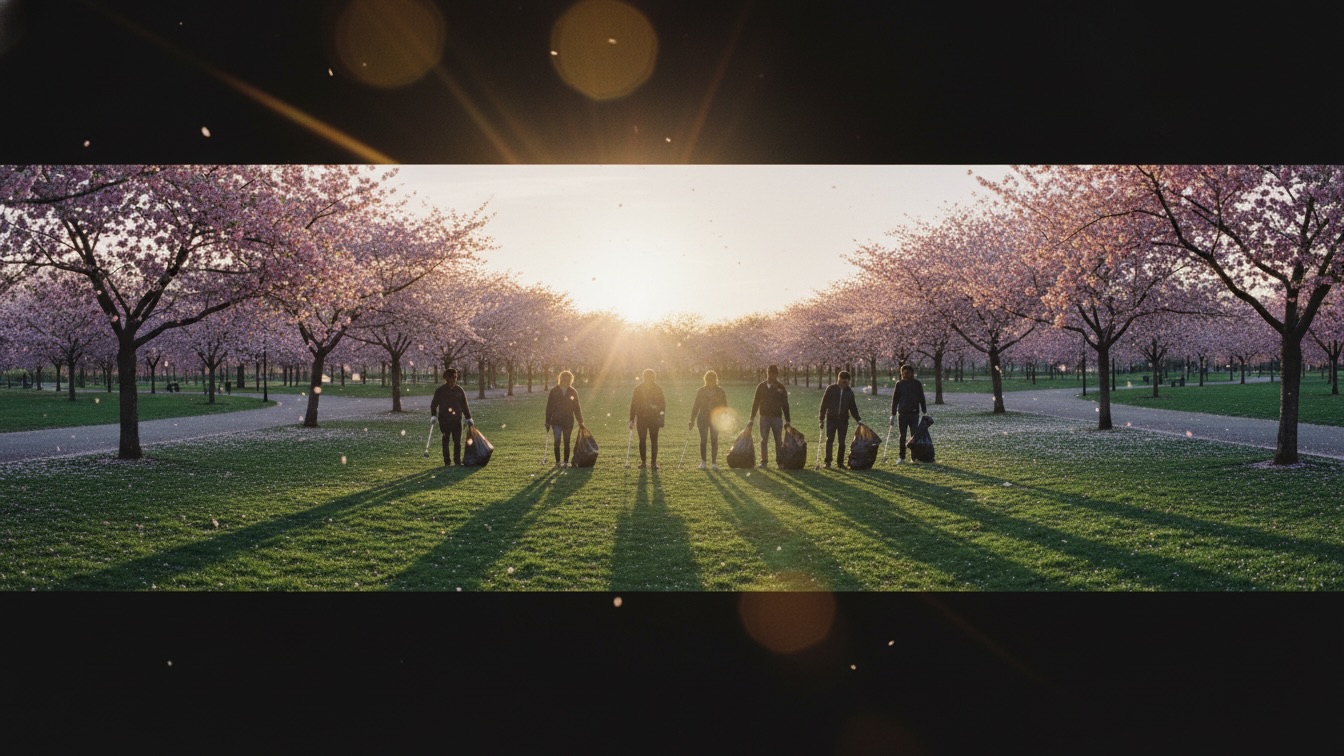
Mina watches the pink petals drift over a sea of discarded signs and broken glass in the city park.
The park did not smell like spring. It smelled like old beer and the metallic tang of dried blood. It smelled like the exhaust from the city buses that idled on 4th Street, waiting for the crowds to disperse. Mina sat on a bench that had a jagged piece of wood missing from its slats. She watched a single cherry blossom petal—pale, almost white—flutter down and land perfectly in the center of a muddy puddle. The puddle was ringed with cigarette butts and a crumpled flyer for a protest she had not attended. She felt the weight of the city in her lower back, a dull ache that seemed to radiate from the concrete itself.
She pulled her phone out. The screen had a hairline fracture across the top left corner, making the battery icon look like it was split in half. She tapped the camera app. Her face on the screen looked older than twenty-one. There were dark circles under her eyes that no amount of sleep seemed to fix. She was not an influencer. She was not a politician. She was just a person who lived three blocks away and was tired of the crunch of glass under her boots every morning.
"Vibe check," she whispered to the lens. Her voice was scratchy, caught in the back of her throat. "Look at the trees. Look at them. They’re blooming right now. Now look at the grass. We’re screaming at each other while the world is literally rotting under our feet. Saturday. Two o’clock. Don’t bring a megaphone. Don’t bring a sign. Bring a box of heavy-duty trash bags. Let’s just fix it. Please."
She hit post before she could change her mind. She did not check the notifications. She did not want to see the fire emojis or the insults. She just wanted to sit in the silence of the dying afternoon. The sun was a pale orange orb hanging low over the skyline, filtered through a haze of smog and dust. It was beautiful in a way that felt like an apology.
Stan arrived thirty minutes later. He did not knock. He never did. He smelled like cheap coffee and the damp wool of his oversized jacket. He stood in the doorway of her small apartment, his boots caked in the gray mud of the construction site where he worked. He looked at her with a mixture of pity and frustration.
"You’re getting dragged in the comments," he said, skipping the greeting. He sat on the edge of her kitchen table, swinging a leg. "People are saying you’re trying to sanitize the struggle. They’re saying you care more about grass than justice. It’s bad, Mina. Really bad."
Mina did not look up from her tea. The steam hit her face, damp and warm. "I care about the grass because the grass is real. The shouting isn’t doing anything anymore, Stan. It’s just noise. People go home and the park is still dead. The birds don't even land there anymore."
"It’s supposed to be messy!" Stan’s voice rose, cracking slightly. "Conflict is messy. You’re trying to turn a revolution into a gardening club. You're basically saying that if we just pick up some litter, the world will be fine. It’s respectability politics, and it sucks."
"No," Mina said, finally looking at him. Her eyes were hard. "I’m saying the dirt matters. The roots matter. If we burn everything down, what are we going to stand on when we’re finished? I’m tired of the burnt rubber smell, Stan. I just want to smell the flowers."
"You're being naive," he muttered, though he didn't leave. He stayed and watched her drink her tea, the silence between them thick and uncomfortable. It was the kind of silence that happens when two people realize they are standing on opposite sides of a canyon they used to be able to jump across.
Saturday arrived with a cruel, bright clarity. The sky was a hard blue, the kind of color that makes you squint. The cherry blossoms were at their peak, heavy and swollen with life, but the ground beneath them was a disaster. There were two groups gathered at the edges of the park. They weren't looking at the trees. They were looking at each other. They had megaphones. They had flags. They had the kind of anger that feels like a physical heat.
Mina stood in the middle of the central lawn, a vast no-man’s-land of flattened grass and debris. She felt small. She felt like a target. She had a roll of black trash bags in her hand, the plastic cold and slick. She didn't say anything. She didn't look at the groups. She just knelt.
The ground was damp. She felt the moisture seep through the knees of her jeans. She reached out and picked up a flattened plastic bottle. It was crusted with dirt. She unscrewed the cap—a tiny, sharp sound in the quiet—and dropped it into the bag. Then she picked up the bottle. Then a piece of a shredded cardboard sign that said something about 'freedom' or 'justice,' she couldn't tell which because the rain had blurred the ink.
"What are you doing?" a voice yelled from the left. It was a man in a tactical vest, his face flushed red. "We're trying to have a moment here!"
"Pick it up," someone from the right side shouted back. "She's just a shill! She's trying to distract us!"
Mina didn't look up. She found a discarded sneaker, its sole flapping like a dead fish. She found a handful of zip ties. She found a broken pair of sunglasses. Her movements were slow and deliberate. She wasn't performing. She was working. Her fingernails were already stained with the black loam of the park.
Stan was standing near the edge of the fountain, his arms crossed. He looked at the crowd, then at Mina. He looked like he wanted to scream. He looked like he wanted to help. The tension in the air was like a bowed string, vibrating with the potential to snap. A few people started to move toward the center, not to help, but to confront her. They were close now. She could smell their sweat and their fury.
"Hey," one of them said, a young woman with a piercing in her eyebrow and a look of pure exhaustion. "You think this helps? You think this fixes the system?"
Mina looked up then. She didn't smile. "No. I think it fixes the park. My lungs hurt, Chloe. Don't yours?"
Chloe blinked. She looked down at the ground. She looked at a crushed soda can near her boot. She didn't say anything for a long time. The megaphones were still going, but the people holding them were losing their audience. One by one, the protesters were looking down. They were seeing the mess. They were seeing the literal filth they were standing in.
Then, the sound started. It wasn't shouting. It was the sound of plastic bags being snapped open. Snap. Snap-snap.
Stan moved first. He didn't say a word to Mina. He just walked over, grabbed a bag from her roll, and started picking up the pieces of a shattered protest sign near the base of a cherry tree. He handled the wood and paper with a strange kind of reverence, as if he were burying a pet.
Chloe followed. Then a man from the other side of the line—the man in the tactical vest. He didn't look happy about it, but he started gathering the discarded water bottles his own group had left behind.
"I'm not doing this for you," he grunted toward Mina as he passed.
"I know," she said. "Do it for the worms."
The afternoon slowed down. The shouting died out, replaced by the rhythmic sound of labor. People who had been screaming at each other five minutes ago were now wordlessly passing trash bags back and forth. They weren't friends. They weren't on the same side. But they were on the same earth.
The sun began to dip, casting long, dramatic shadows across the clearing. The park was changing. The gray, matted look of the grass was giving way to a raw, bruised green. The cherry blossoms, no longer competing with the neon glare of discarded packaging, seemed to glow in the twilight. The scent of the earth—damp, rich, and full of the promise of spring—began to rise. It was a heavy smell, the smell of things starting over.
Mina stood up, her back popping. Her hands were filthy. She looked around. The park was pristine. There were fifty full trash bags lined up neatly by the curb, a silent monument to a different kind of protest. The two groups were still there, but they weren't shouting. They were just sitting on the grass, or on the benches, looking at what they had done. They looked like people who had just woken up from a long, feverish dream.
Stan walked over to her. He looked tired, but the sharpness in his eyes had softened. He held out a hand, showing her a small, pale object. It was a ceramic bead, probably from a necklace. It was perfectly clean.
"Found this under the fountain," he said. "Thought you might want it."
"Thanks," she said, taking it. It was cold and smooth.
"We're still going to be angry tomorrow, you know," he said, looking out at the city. "This didn't fix the world."
"I know," Mina said. "But we can walk through the park tomorrow without tripping. That’s a start."
As the last of the light faded, the park grew quiet. The city hummed in the distance, a constant, low-frequency vibration. Mina looked toward the oldest cherry tree at the far end of the meadow, its branches heavy with blossoms. She saw something moving in the shadows near the trunk.
“She saw the shape of a heavy boot pressing into the soft, wet mud near the oldest tree, where no one should have been standing.”


