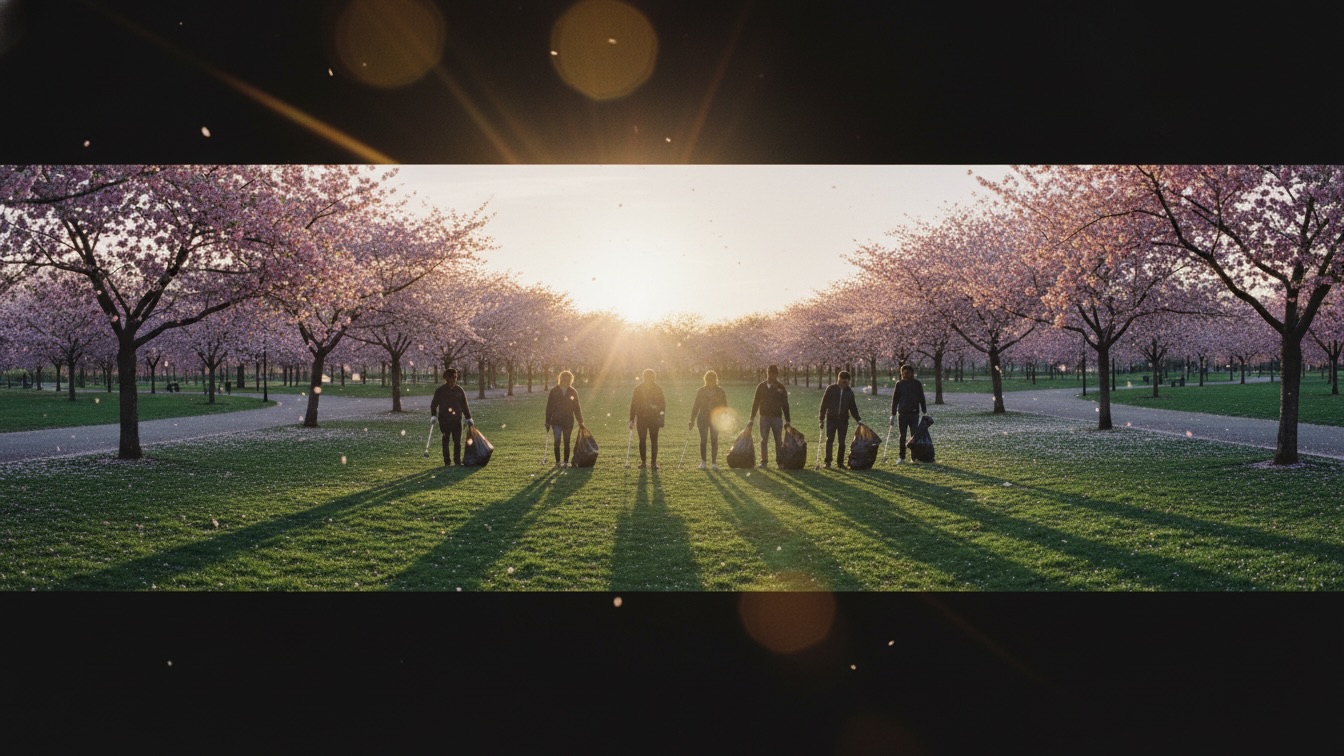
The story follows Mina, a young woman living in a city plagued by social unrest and physical decay. Distressed by the filth and hostility permeating her local park, she uses social media to organize a "clean up" event, asking participants to bring trash bags instead of protest signs. Her friend Stan warns her that her actions are being viewed as a betrayal of the political struggle, labeling her attempt at restoration as mere "respectability politics." Despite the criticism and the presence of two angry, opposing protest groups, Mina arrives at the park on Saturday and begins cleaning the debris alone.
As Mina works silently amidst the shouting and tension, her quiet dedication begins to influence those around her. One by one, the protesters, including Stan and a woman named Chloe, abandon their megaphones and flags to join her in the manual labor of cleaning the grounds. The act of collective physical work replaces the verbal conflict, leading to a temporary truce and the physical restoration of the park. By the end of the day, the park is transformed from a site of matted gray waste to a space of "bruised green" and blooming cherry blossoms. Mina finds a small, clean ceramic bead, symbolizing a modest but tangible victory in a world that remains fundamentally broken.
The central theme of the narrative explores the tension between abstract ideological conflict and the tangible reality of the physical environment. The story suggests that while political discourse is necessary, it can become a form of "noise" that ignores the literal ground upon which people stand. Mina’s insistence that "the dirt matters" highlights a psychological need for a foundation that is not mediated by rhetoric or digital screens. By focusing on the park’s decay, the author argues that a society cannot sustain a revolution if it allows its immediate surroundings to rot.
Another significant theme is the transformative power of collective, apolitical labor. The act of cleaning serves as a bridge between opposing factions who have lost the ability to communicate through words. When the "snap" of trash bags replaces the blare of megaphones, the characters move from a state of performative anger to a state of shared stewardship. This shift suggests that physical work can provide a common language and a sense of shared humanity that remains elusive in purely ideological spaces.
Finally, the story examines the concept of "micro-restoration" as a response to systemic collapse. Mina acknowledges that cleaning the park does not "fix the world" or resolve the deep-seated anger of the protesters. However, the narrative posits that the ability to "walk through the park without tripping" is a valid and necessary starting point. This theme emphasizes that small, manageable acts of care are essential for psychological endurance in an era of overwhelming global and social crises.
Mina is a twenty-one-year-old woman who serves as the emotional and moral anchor of the narrative. Psychologically, she appears to be suffering from a profound sense of sensory burnout and environmental grief. She is not driven by a lack of political conviction, but rather by a desperate need for order and beauty in a world that feels increasingly chaotic and abstract. Her decision to clean the park is an act of radical self-preservation, allowing her to reclaim a sense of agency that the digital and political spheres have stripped away.
She possesses a quiet resilience, choosing to lead through silent, repetitive action rather than the performative rhetoric that characterizes her peers. This demonstrates her transition from a passive observer of decay to an active steward of her environment. Her refusal to engage with the "fire emojis" or the insults on her phone shows a psychological maturity and a rejection of the dopamine-driven conflict of social media. For her, the "tang of dried blood" and the "crunch of glass" are more than metaphors; they are physical burdens she can no longer ignore.
Stan serves as the narrative’s ideological foil to Mina. As a construction worker, he is intimately familiar with the physical world, yet he remains deeply embedded in the dialectics of social struggle. His initial cynicism reflects a fear that focusing on "small" things like litter will distract from the systemic issues that cause the mess in the first place. He represents the voice of the collective, worried about how actions are perceived by the "movement" rather than their immediate physical impact.
His psychological journey is marked by a shift from defensive posturing to empathetic participation. While he begins the story by warning Mina about her public image, he is ultimately the first to cross the ideological line to help her. His act of picking up the trash with "reverence" suggests that he finds a different kind of meaning in the physical restoration of the park. By the end of the story, his "sharpness" has softened, indicating that the act of labor has provided him with a reprieve from his own anger.
Chloe is a secondary character who represents the bridge between the two extremes of the protest. When she first approaches Mina, she is characterized by "pure exhaustion," a psychological state that makes her vulnerable to Mina’s pragmatic message. Her question about whether cleaning "fixes the system" is a final attempt to hold onto her ideological framework. However, her decision to join the cleanup signifies a surrender to the immediate needs of her own body and environment.
The narrative style is marked by a heavy reliance on sensory details that contrast the artificial with the natural. The author uses harsh, industrial smells like "old beer," "metallic blood," and "burnt rubber" to establish a tone of urban decay. These are contrasted with the "pale orange" of the sun and the "damp, rich" scent of the earth. This sensory duality reinforces the theme of a world caught between its own destructive tendencies and its inherent beauty. The "hairline fracture" on Mina's phone serves as a subtle metaphor for the broken way she perceives her own life and the world around her.
The pacing of the story is deliberate, mirroring the slow, rhythmic nature of the cleanup itself. The initial scenes are filled with the tension of "shouting" and "megaphones," creating a sense of frantic energy. However, as the characters begin to work, the prose slows down, focusing on small, specific movements like unscrewing a bottle cap or snapping a plastic bag. This shift in pacing effectively moves the reader from a state of high-conflict anxiety to a state of meditative labor, echoing the internal shifts of the characters.
The narrative voice is a close third-person perspective that stays grounded in Mina’s internal experience. This allows the reader to feel the "weight of the city" in her lower back and the "hard blue" of the sky. The tone is somber and realistic, avoiding easy sentimentality. By ending the story with a "small, pale" ceramic bead and the sight of something moving in the shadows, the author maintains a sense of mystery and unresolved tension. It suggests that while the park is clean, the underlying complexities of the city remain just out of sight.


