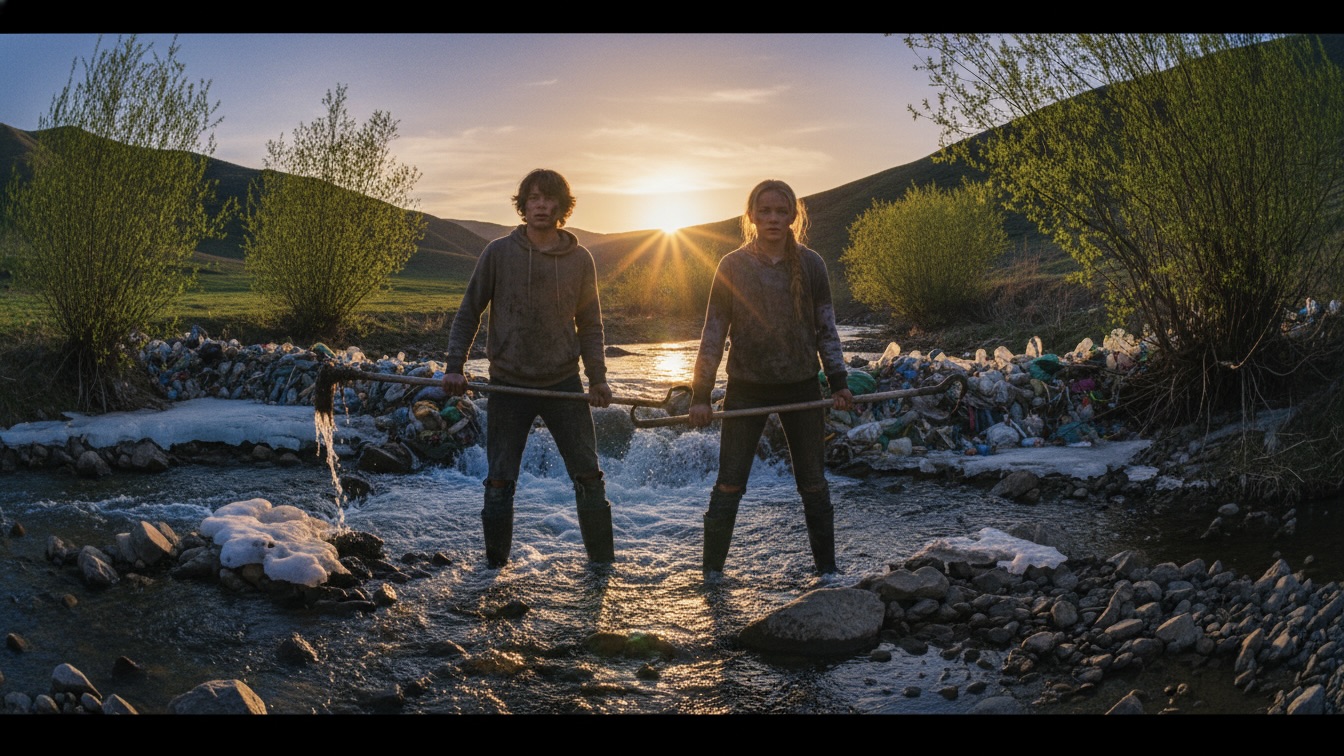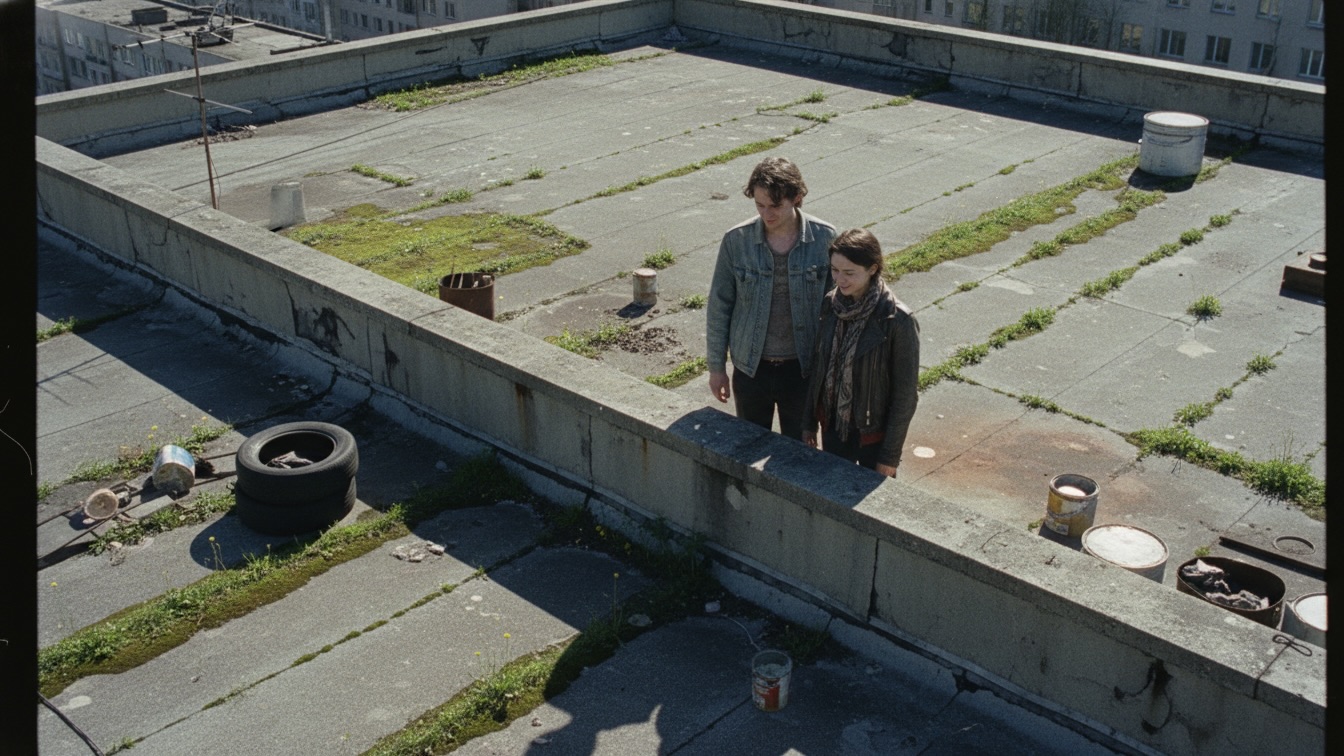
The transit train stopped dead in the tunnel, trapping them between the mud and the loud concrete city.
The mag-lev train stalled in the tunnel. It did not decelerate. It simply lost all kinetic momentum in a single, brutal second. Jeffrey hit the rigid plastic of the seat in front of him. His left shoulder took the impact. He heard a dull pop. He rubbed the joint. It felt hot under his jacket. The jacket still smelled like sulfur and wet dirt from the creek. The train car was silent. The electric hum of the propulsion system was gone. The overhead lights flickered, died, and were replaced by the flat, yellow glow of the emergency backup strips.
Jeffrey looked across the aisle. Annie sat in her seat. She did not brace for the impact. She had been leaning back. Now, she was hunched forward. Her thumbs moved over her glass screen. The screen was cracked in the top left corner. A spiderweb of shattered glass lay over a bright white social feed. Her yellow gloves were gone. Her hands were bare, red, and covered in micro-abrasions from the nylon netting they had pulled from the water. She did not look like the pristine digital avatar she projected to her millions of followers. She looked like a tired human sitting in a broken train.
"Did you feel the structural shift," Jeffrey asked. He did not ask it as a question. His voice was flat.
"The inertia dampeners failed," Annie replied. She did not look up from the screen. Her eyes tracked the rapid scrolling of text. "It is a temporary recalibration of the grid. This is to be expected during the reboot phase of the regional infrastructure."
Her voice was sharp. The theatricality of the creek was gone. She was back in broadcast mode. She spoke to him, but she was performing for an invisible audience. It was a defense mechanism. The silence of the tunnel was too heavy. The yellow light was too revealing.
"You are bleeding," Jeffrey pointed out.
Annie stopped scrolling. She looked down at her left thumb. A thin red line crossed her knuckle. A drop of blood smeared across the glass screen of her phone, right over a targeted advertisement for synthetic hydration supplements. She wiped the blood away with the cuff of her expensive outdoor jacket. The jacket was ruined. It was stained with grey sludge.
"It is a minor laceration," Annie said. "The physical damage is negligible compared to the digital deficit. My engagement metrics have plummeted. The algorithm punishes silence. Silence is interpreted as death."
"We were silent for six hours by the water," Jeffrey said. He leaned his head against the cold window. Outside, there was only the concrete wall of the tunnel. It was streaked with black grime and the rust of old pipes.
"That was an enforced vacuum," Annie said. She resumed scrolling. Her thumb moved faster now. "This is a deliberate choice. The market does not tolerate deliberate choices. My followers are demanding a statement on my absence. They are forming speculative narratives. I must assert control over the timeline."
Jeffrey reached into his own pocket. His fingers found the cold, hard rectangle of his phone. He pulled it out. The screen flared to life. The brightness hit his retinas like a physical blow. He squinted. The notification counter in the top right corner was a solid red circle. It read nine hundred and forty-two. He felt his stomach drop. The number was not just a metric. It was a physical weight. It was nine hundred and forty-two demands for his attention. It was an obligation to perform his specific brand of cynical detachment.
He opened his main forum. The text scrolled past in a blur of aggressive black font on a white background. His peers were mocking the local government’s manual labor initiative. They were posting heavily edited videos of the blackout, layering ironic audio tracks over footage of dark streets. They wanted him to participate. They wanted him to validate their boredom.
"They think it is a joke," Jeffrey said. His throat felt dry.
"Of course they do," Annie said. "Sincerity is a liability. If you care about the mud, you are vulnerable. If you joke about the mud, you are safe. You taught them that, Jeffrey. You are the architect of your own echo chamber."
Jeffrey locked his screen. The black glass reflected his face. There were dark bags under his eyes. His jaw was tight. He felt a sudden, violent urge to throw the device at the concrete wall outside the window. He wanted to shatter it. He wanted to go back to the freezing water. The cold had been brutal, but it had been honest. The cold did not ask him for an opinion.
"I do not want to go back to the apartment," Jeffrey said.
Annie finally looked up. Her eyes met his. For a fraction of a second, the theatrical mask slipped. He saw the same exhaustion in her face that he felt in his bones. The shared quiet of the morning had not entirely vanished. It was just buried under the sudden influx of data.
"The apartment is a designated isolation zone," Annie said softly. "It is a box where we consume. We cannot go back yet. We require a transitional space."
The train lurched. The yellow emergency lights snapped off. The bright, clinical white LED panels overhead engaged with a loud electronic hum. The propulsion system whined. The train began to move forward, accelerating rapidly out of the tunnel.
They burst into the city. The spring sun hit the windows. It was a violent, bright light. The skyline rose around them, a dense cluster of glass and steel. Every surface that could hold a screen was broadcasting. Digital billboards the size of city blocks flashed with vibrant, hyper-saturated colors. The detox ordinance was officially over. The city was overcompensating.
Jeffrey squeezed his eyes shut. The noise was not just auditory. It was visual. It was a cognitive static that filled the air. He felt a pressure building behind his forehead. It felt like a physical band tightening around his skull.
The train pulled into the central station. The doors slid open with a hiss. The air that rushed into the car was warm. It smelled of ozone, roasted coffee, and the faint, sweet decay of street garbage baking in the spring heat. The platform was a sea of people. Everyone was looking down. Everyone was illuminated by the pale blue glow of their screens.
Jeffrey and Annie stepped off the train. They moved together. They did not discuss it. They simply stayed within two feet of each other. Separating meant admitting that the creek had meant nothing. It meant surrendering to the crowd.
They walked through the station. The architectural design was meant to be expansive, with high vaulted ceilings and massive skylights, but the space felt entirely claustrophobic. The air was thick with the overlapping frequencies of thousands of devices searching for a signal.
"We must acquire caffeine," Annie stated. She was navigating the crowd without looking at them. She used the cracked screen of her phone like a radar. "The biological imperative for stimulants is paramount. There is a verified dispensary two blocks east. The aesthetic is minimal. The noise pollution should be manageable."
"Lead the way," Jeffrey said. He kept his hands in his pockets. He did not look at his phone. He looked at the back of Annie’s jacket. The grey sludge was drying into a pale dust. It was the only real thing in the station.
They exited the station and walked onto the street. The spring heat was trapped between the tall buildings. The wind was dead. The sidewalks were crowded. Drones buzzed overhead, delivering small cardboard packages to high-rise balconies. The sound of the drones was a constant, irritating whine, like a swarm of mechanical mosquitoes.
They reached the cafe. It was a narrow space wedged between a synthetic clothing retailer and a automated pharmacy. The front was entirely glass. Inside, the design was hostile. The walls were bare concrete. The tables were raw zinc. The chairs were hard plastic. The intention was clear: consume and leave.
They walked to the counter. An automated kiosk took their order. Two black coffees. No modifiers. They found a zinc table near the front window. They sat down. The metal was cold against Jeffrey’s forearms.
Annie placed her phone flat on the table. The screen was still on. The notifications were rolling in at a frantic pace. A continuous stream of banners.
"The syndicate is fragmenting," Annie said. She stared at the screen, but she did not touch it. "Three sub-factions have declared the blackout a deliberate psychological operation by the opposition. They are demanding I endorse this theory. If I do not, I am complicit."
"And if you do, you validate a delusion," Jeffrey said.
"The truth is a secondary concern to group cohesion," Annie replied. She rested her elbows on the zinc table and rubbed her temples. The red, raw skin of her hands stood out against the grey metal. "I am finding it difficult to care. The stakes feel incredibly low."
"Because they are low," Jeffrey said. He pulled his own phone out and placed it next to hers. He did not unlock it. He just let it sit there. The screen lit up every three seconds with a new alert. "We spent the morning moving physical mass. We altered the flow of a watershed. We touched the dirt. This..." He gestured to the two phones. "This is just moving air. It is friction without heat."
Annie looked at his phone. "Your followers are equally demanding. They are calling you a class traitor for participating in the manual labor protocol. They have unearthed a photograph of you holding the metal hook. They are mocking your posture."
Jeffrey let out a short, harsh laugh. "My posture was dictated by the weight of a waterlogged tire. Let them mock it. I would like to see them pull fifty pounds of dead weight out of freezing water."
"They cannot," Annie said. "Their muscle mass has atrophied. They exist entirely as text."
A mechanical arm behind the counter dispensed two paper cups. A voice over the speaker called their order number. Jeffrey stood up, retrieved the cups, and set them on the table. He took a sip. The coffee was scalding. It burned his tongue. The pain was sharp and immediate. He welcomed it. It grounded him in his body.
He looked out the glass window. The street was a blur of motion. Cars, bikes, pedestrians. A constant, flowing river of data and flesh. Then, the flow broke.
Standing on the opposite corner, completely still, was the Ranger.
Jeffrey blinked. He leaned forward. His chest hit the edge of the zinc table.
"Look," Jeffrey said.
Annie followed his gaze. She saw him.
The Ranger looked entirely out of place. He was still wearing his heavy canvas coat and his muddy boots. The dirt from the creek was caked onto his pants. He stood among the clean, fast-moving city dwellers like a stone in a stream. The people walking past him did not seem to notice him. They simply adjusted their paths to avoid him, their eyes locked on their screens.
The Ranger was not looking at the screens. He was looking at the ground. He held one of the long metal hooks in his right hand. The same hook they had used to break the dam.
He walked slowly to the edge of the sidewalk. He stopped at a metal storm drain grating. The grate was completely clogged. It was choked with wet paper cups, plastic wrappers, and the colorful, synthetic detritus of the city. A small puddle of stagnant water had formed around it.
The Ranger looked up. He looked directly through the glass of the cafe. He looked straight at Jeffrey and Annie.
His face was unreadable. It was the same topographical map of wrinkles and weathered skin. He did not wave. He did not smile. He simply raised the metal hook and pointed it at the clogged storm drain.
The message was physical. It bypassed the digital noise entirely. The trash is everywhere. The flow is blocked. The work is not done.
"He followed us," Annie whispered. Her voice lacked its usual theatrical projection. It was small.
"He didn't follow us," Jeffrey said. He watched the old man. "He's just here. He is part of the infrastructure. The real infrastructure."
The Ranger jammed the metal hook into the grate. He twisted it, caught a massive tangle of plastic, and heaved. The trash came loose with a wet, sucking sound. The stagnant water rushed down into the dark hole of the sewer. The puddle vanished. The flow was restored.
The Ranger pulled the hook free, turned, and walked into the crowd. Within three seconds, the mass of pedestrians swallowed him. He was gone.
Jeffrey sat back in his chair. His heart was beating fast. The tight band around his chest was squeezing harder. The cafe suddenly felt unbearably hot. The constant pinging of the two phones on the zinc table sounded like a fire alarm. The digital noise was crashing over him, drowning out the brief moment of clarity the Ranger had brought.
"We need altitude," Jeffrey said. He stood up. He left the scalding coffee on the table.
Annie looked at him. She did not argue. She grabbed her phone, shoved it into her pocket, and stood up. "There is a fire escape in the alley behind this structure. It leads to the roof of the adjacent pre-war building. Access is technically restricted."
"I do not care about the restrictions," Jeffrey said. He grabbed his own phone.
They pushed through the glass door of the cafe and walked fast. They turned the corner into a narrow alleyway. The alley smelled like old grease and wet brick. It was dark. The sun could not reach down here. The noise of the main street was muffled.
Annie found the iron ladder. It was rusted and pulled down to chest height. She grabbed the cold iron and pulled herself up. Jeffrey followed. They climbed.
The physical exertion felt good. The muscles in Jeffrey's back, still sore from the morning, stretched and complained. The rust flaked off onto his hands. It was a tangible reality. They climbed past three floors of blank brick wall. The air grew slightly cooler as they moved away from the street level.
Annie reached the top. She swung her leg over the concrete parapet and dropped onto the roof. Jeffrey pulled himself over a second later.
They stood up.
The roof was a flat expanse of weathered concrete, cracked and uneven. In the corners, where water pooled during the rain, bright green moss and early spring weeds were pushing violently through the grey stone.
Above them, there was nothing but the sky.
It was a vast, clear blue. The spring sun beat down on them without the interference of glass or steel. The wind hit them. It was a strong, steady wind coming off the river. It smelled like moving water and fresh air.
Jeffrey closed his eyes. The wind rushed past his ears, drowning out the whine of the drones and the low hum of the city grid. He took a deep breath. The air filled his lungs.
The tight band around his chest snapped.
It was sudden oxygen. A massive, physical sense of a burden being lifted. The claustrophobia of the train, the station, and the cafe evaporated into the open sky. The cognitive static that had been buzzing in his brain went silent. He could feel his own feet on the concrete. He could feel the cold wind on his face. He felt entirely present.
He opened his eyes. Annie was standing a few feet away. She was looking at the sky. Her posture had changed. The rigid, defensive stance was gone. Her shoulders were dropped. Her breathing was slow and deep. The wind caught her hair, whipping it around her face. She did not try to fix it.
Jeffrey reached into his pocket. He pulled out the phone. The screen was still bombarding him with notifications. The red circle now read one thousand and twelve.
He looked at the device. It looked absurd. It looked like a tiny, glowing piece of plastic trying to compete with the sun. It was meaningless.
He pressed his thumb against the physical power button on the side of the casing. He held it down.
A prompt appeared on the screen. Slide to power off.
He slid his thumb across the glass.
The screen went black. The vibration stopped. The device became nothing more than a dead weight in his hand.
Annie turned her head. She saw what he had done. She reached into her own pocket. She pulled out her cracked screen. She did not hesitate. She held the button, swiped the glass, and watched the light die.
She looked at Jeffrey. The theatrical mask was completely gone. Her face was open, exhausted, and remarkably human.
"The silence is better," Annie said. Her voice was normal. It was not projected. It was just for him.
"Yes," Jeffrey said.
They walked to the edge of the roof. They looked out over the city. From up here, the chaos of the streets looked distant. It looked like a machine that they had stepped out of. They were no longer gears turning in the engine. They were observers. They stood in the shared quiet, breathing the sharp spring air, letting the sun warm the dried mud on their clothes.
For ten minutes, the world was perfectly still. The sudden oxygen filled them. It was a radical act of disconnection. It was a victory.
Then, Jeffrey felt a vibration against his thigh.
He frowned. He reached into his pocket. His hand brushed against the cold glass. The phone was dead. He had powered it down. It was impossible.
The vibration happened again. It was not the short, frantic buzz of a social notification. It was a long, deep, sustained pulse. It felt like a heartbeat.
He pulled the phone out.
The screen was black, but the device was humming. It was a physical vibration that made his fingers tingle.
He looked at Annie. She was holding her phone. Her eyes were wide. Her device was doing the same thing.
"I severed the power connection," Annie said. Her voice was trembling slightly. "The battery is physically disconnected from the logic board via software command. This should not be happening."
"The hardware reached its expiration date," Jeffrey muttered, repeating his own words from the creek. But this was not hardware rot. This was something else.
The long, deep pulse stopped.
For a second, there was nothing.
Then, both screens ignited simultaneously.
They did not show the lock screen. They did not show the social feeds. The screens bypassed the manual power cycle entirely. They glowed with a solid, blinding red light. The brightness was turned up to maximum, fighting the sun.
A loud, piercing tone erupted from the small speakers. It was a dual-frequency siren that cut through the wind and drilled directly into their eardrums. It was a sound designed to induce immediate biological panic.
Jeffrey dropped the phone onto the concrete. It did not shatter. It just lay there, glowing red, screaming at the sky. Annie dropped hers next to it.
They took a step back.
The sudden oxygen was gone. The claustrophobia slammed back down, heavier than before. The city around them seemed to shift. Below them, on the streets, the massive digital billboards stopped flashing their advertisements. They all turned the same solid, violent red. The whine of the delivery drones changed pitch, dropping into a synchronized, menacing hum.
The detox was over. The recalibration was complete.
Jeffrey stared down at the two screaming devices on the concrete. The screens bypassed the manual power cycle, glowing red with a mandatory civic broadcast that could not be muted.
“The screens bypassed the manual power cycle, glowing red with a mandatory civic broadcast that could not be muted.”