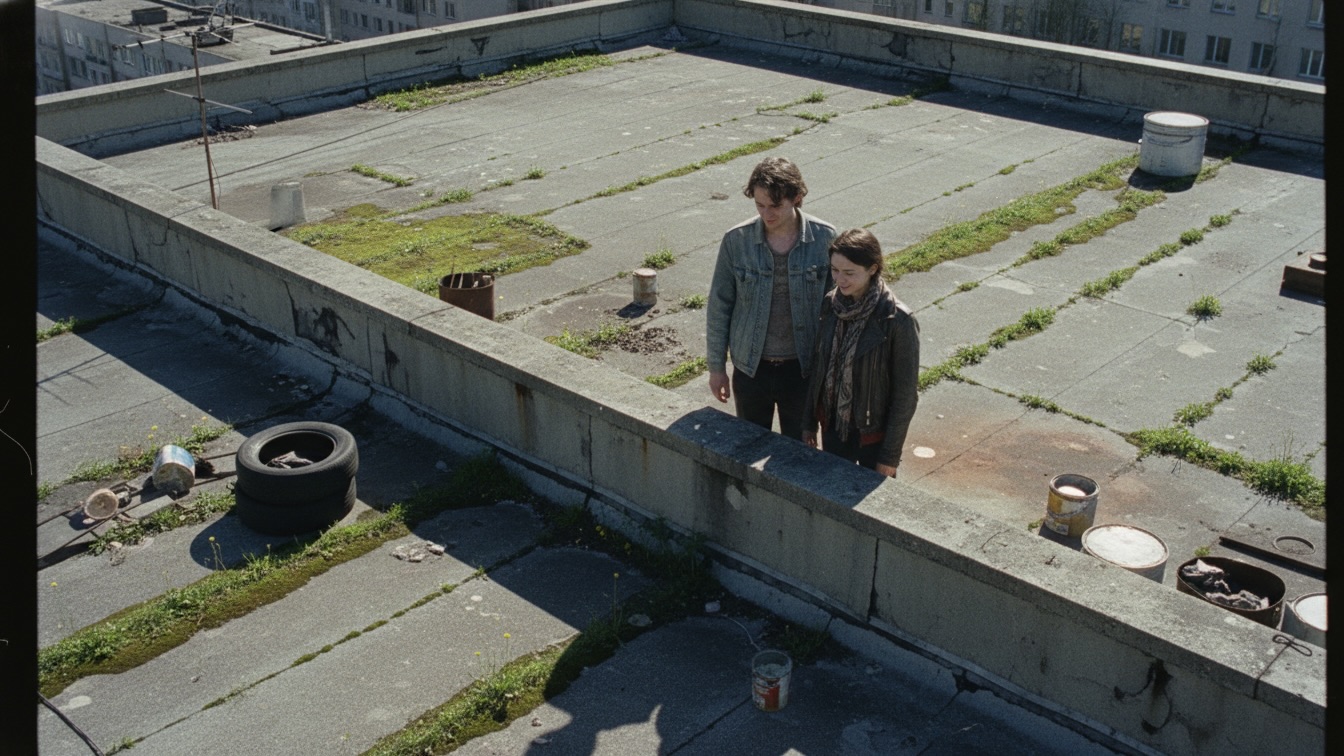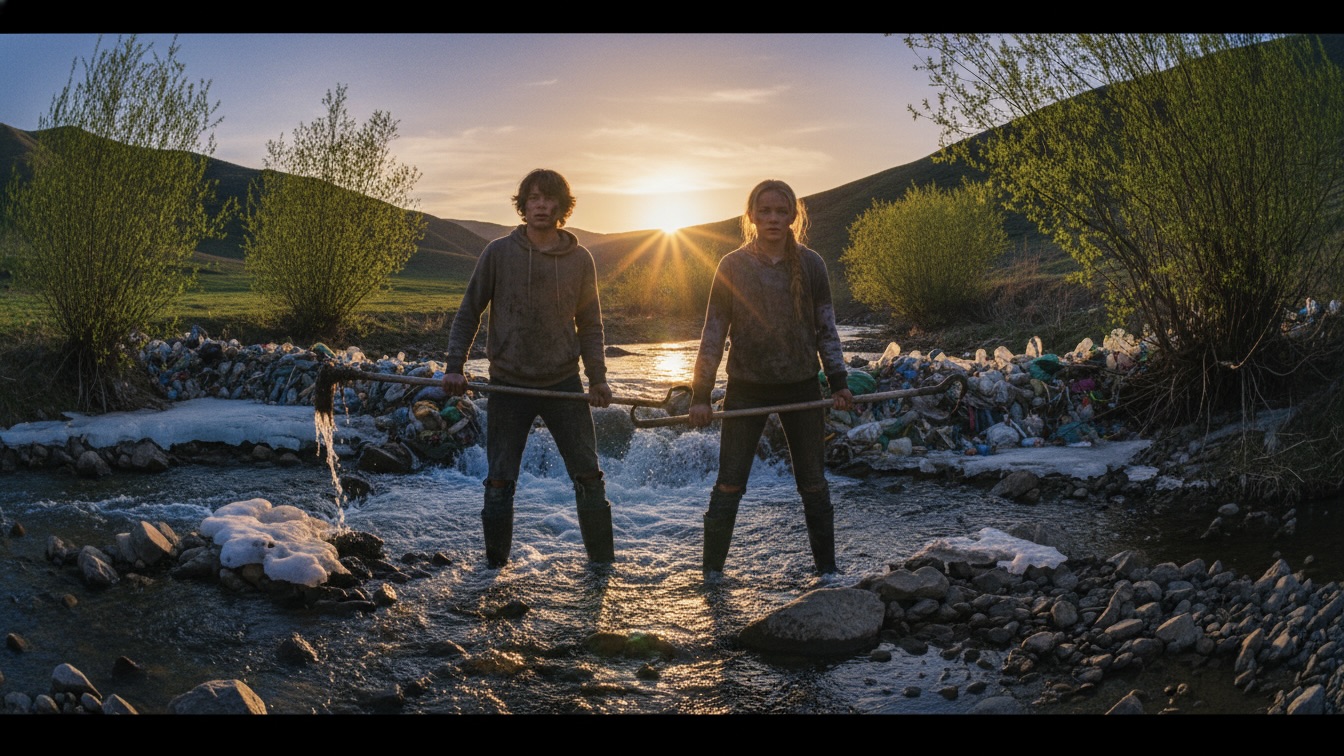
Two rivals face the silence of a tech outage while clearing a creekbed as the spring thaw begins.
The birds did not know the satellites were dark. They sang because the sun hit the valley. It was a cold, hard light. The kind that shows the cracks in everything. Jeffrey stood at the edge of the mud. His hand went to his pocket. It was empty. The phantom vibration of a ghost notification twitched against his thigh. It had been forty-eight hours since the regional grid went black. No feed. No filters. No curated reality. Just the smell of wet dirt and the sound of the water. It was too loud. The world was too big without a screen to frame it. He felt small. Exposed. Like a bug under a glass that had suddenly shattered.
Annie arrived three minutes later. She wore high-end outdoor gear that looked like it had never seen a speck of dust. Her face was set in a mask of controlled annoyance. She didn't look at him. She looked at the creek. The water was high. It was a muddy brown, churning with the runoff of the mountain snow. The ice was mostly gone. Only white jagged teeth remained along the banks. It looked like the land was trying to bite the sky. The silence between them was heavy. It was the silence of two people who had spent three years shouting at each other in comment sections without ever breathing the same air. Now, the air was all they had.
"The Ranger is late," Annie said. Her voice was sharp. It had a stage-like quality. She spoke as if she were addressing a crowd of thousands, even though there was only Jeffrey and the trees. "I find this lack of punctuality typical of the current administrative collapse. It is a failure of the system at the most granular level."
Jeffrey didn't look up from his boots. "The system didn't fail, Annie. The hardware reached its expiration date. You can’t patch a physical rot with a software update. Your belief in the infinite scalability of the grid was always a fantasy. This outage is just reality asserting its dominance."
"Your nihilism is a tired aesthetic, Jeffrey," Annie replied. She adjusted her gloves. They were bright yellow. They looked like caution tape. "It is a defense mechanism for those who lack the imagination to build. You find comfort in the wreckage because you are afraid of the labor of maintenance."
Jeffrey finally looked at her. His eyes were tired. There were dark circles under them from two nights of actual sleep without the blue light of the glow-box. "I’m not afraid of labor. I’m just bored of the theater. We’re here because the local government thinks manual labor will 'reconnect' us. It’s a cheap psychological trick. A digital detox ordinance. It’s performative."
"Performance is how we define value in a vacuum," Annie said. She stepped into the mud. It sucked at her boots. She didn't flinch. "If we do not act as if things matter, they cease to matter. The creek is full of trash. That is a fact. My ideological disagreement with you does not change the chemical composition of the water."
Before Jeffrey could respond, the Ranger appeared. He didn't come from a car. He seemed to just step out of the trees. He was an old man with skin like a topographical map. He carried two long metal hooks and a pile of mesh bags. He didn't say hello. He didn't ask how they were coping with the outage. He just dropped the gear in the mud between them.
"The watershed is blocked," the Ranger said. His voice was like stones rubbing together. "The plastic is backing up the flow. If the water doesn't move, the nesting grounds downstream will flood. The birds are coming back. They don't care about your grid. They care about the mud. Get to work."
He pointed toward a bend in the creek where the water had turned into a stagnant pool. A wall of trash rose out of the water like a monument to a dead civilization. It was a tangle of plastic bottles, Styrofoam blocks, and the occasional skeletal remain of a discarded drone. It looked like a scab on the earth. The Ranger turned and walked back into the brush without another word. He didn't provide a manual. He didn't offer a tutorial. He just left them with the mess.
Jeffrey picked up a hook. It was heavy. It felt real in a way that nothing had felt in years. The cold metal bit into his palm. "I suppose we should begin the extraction process," he said. He tried to sound ironic. It didn't work. He just sounded cold.
"We must coordinate," Annie said. She took the other hook. "If we pull from the sides, the center will collapse. We need to create a structural weakness in the dam. I will take the left bank. You take the right. Do not drop your end."
"I know how gravity works, Annie," Jeffrey snapped. "I don't need a briefing."
They waded in. The water was ice. It hit Jeffrey’s shins and sent a shock up his spine that made his teeth ache. He gasped. It wasn't a poetic gasp. It was a sharp, ugly sound. The cold was a physical weight. It felt like his legs were being crushed by invisible hands. He looked at Annie. Her face was pale. She was shivering, but she held the hook tight. She looked like she was trying to manifest a heater with the sheer force of her will.
For the first hour, they didn't talk. They worked. The work was slow. It was deliberate. Every piece of trash was a battle. A plastic crate was wedged deep into the mud. Jeffrey had to lean his entire weight onto the hook to budge it. The mud fought back. It was a thick, grey sludge that smelled of sulfur and decay. When the crate finally broke free, it sent a spray of foul water into Jeffrey’s face. He didn't wipe it away. He didn't have the energy. He just threw the crate onto the bank and reached for the next thing.
Across the stream, Annie was wrestling with a tangled mass of nylon netting. It was caught on a submerged branch. She was tugging at it, her face red with effort. "The tension is too high," she muttered. "I cannot gain sufficient leverage."
Jeffrey watched her for a moment. He saw her slip. Her boot lost its grip on a slick stone, and she went down on one knee. The water rushed over her thigh. She didn't scream. She just closed her eyes and gripped the netting tighter. The theatrical mask was gone. She just looked like a person who was very cold and very tired.
"Wait," Jeffrey said. He waded toward her. The water pushed against him. It was a struggle to move ten feet. He reached out his hand. He didn't think about her politics. He didn't think about her social media presence. He just saw a person falling in the water. "Hold the hook. I'll lift the branch."
Annie looked at his hand. She hesitated for a second. Then she took it. Her glove was wet and slimy. His hand was covered in grit. It was the first time they had ever touched. It wasn't a moment of cinematic magic. It was just two people trying not to drown in a foot of freezing water. Jeffrey felt the strength in her grip. She wasn't delicate. She was holding on like her life depended on it.
He jammed his hook under the branch and heaved. The wood groaned. The netting slid free. Annie pulled it back toward the shore. They stood there in the middle of the creek, breathing hard. The air was cold in their lungs. It felt like drinking liquid light. The claustrophobia of the last few days—the feeling of being trapped in a world that had lost its meaning—began to lift. There was no static here. There was just the weight of the hook and the flow of the water.
"Thank you," Annie said. Her voice was lower now. The theatricality had been washed away by the creek. "That was... efficient."
"It was necessary," Jeffrey replied. He looked at the dam. They had cleared a small gap. A thin stream of clear water was beginning to push through the trash. It was a small victory, but it was visible. It was real. "We're halfway there."
They went back to work. The rhythm changed. They stopped arguing about the future and started talking about the trash. They found things that told stories. A broken child’s shoe. A motherboard from a 2022 laptop. A plastic rose. They worked in a strange kind of sync. Jeffrey would loosen a section, and Annie would haul it out. The physical struggle replaced the mental friction. The anger he had felt for her—the burning, ideological hatred fueled by years of digital conflict—seemed to be draining out of him into the mud. It was hard to hate someone when you were both covered in the same filth.
By noon, the dam was gone. The creek was a wide, brown road of moving water. The stagnant smell was being replaced by the scent of wet stone and pine. The birds were back. They were small, grey things, darting over the surface of the water, hunting for the insects that were waking up in the spring heat. Jeffrey climbed onto the bank and collapsed onto a flat rock. His muscles felt like they were made of lead. His fingers were numb. But his head was clear. The constant hum of anxiety that usually lived in the back of his skull was gone. It had been replaced by a profound, heavy silence.
Annie sat down a few feet away. She took off her yellow gloves and looked at her hands. They were red and raw. She looked at the creek. "The flow is restored," she said. She didn't sound like she was giving a speech. She sounded like she was stating a fact to herself. "The data suggested this would be a difficult task. The data was correct."
"The data didn't mention how much it would hurt," Jeffrey said. He pulled a crushed protein bar from his pocket. He broke it in half and held out a piece. "It's probably mostly sugar and cardboard. But it's food."
Annie took it. "At this point, I would eat the cardboard if it had enough calories." She took a bite. They sat in silence, eating the dry bars and watching the water. The sun was higher now. The valley was bright. The green of the new buds on the willow trees was so sharp it almost hurt to look at. It was a violent, beautiful spring.
"Do you think the grid will come back today?" Annie asked. She wasn't looking at him. She was watching a bird land on a branch.
"Maybe," Jeffrey said. "The Ranger said the engineers were working on the main hub. But I don't know if I want it to."
Annie turned to look at him. "You don't? You spent the first hour complaining about how bored you were."
"I was," Jeffrey said. He looked at his hands. They were covered in the creek. "But I haven't felt this... awake in years. Everything is so quiet, Annie. I can hear my own thoughts. I don't like all of them. But at least they’re mine. They aren't just echoes of something I read five minutes ago."
Annie nodded slowly. "I understand. The noise is constant. Even when it’s quiet, the noise is there. But here..." she gestured to the clear water. "The water doesn't have an opinion on me. It doesn't care if I’m right. It just moves."
"It's the first time I've seen you without a filter," Jeffrey said. It was a bold thing to say. He expected her to snap back, to return to the theatrical defense. But she didn't.
She looked at her reflection in a small pool of water between the rocks. She looked tired. Her hair was a mess. There was a streak of mud across her forehead. "I look like a disaster," she said. A small smile touched her lips. It was a real smile. It didn't reach for a camera. It was just for the two of them. "It’s refreshing."
"Yeah," Jeffrey said. "It is."
They sat there for a long time. The Ranger didn't come back to check on them. They didn't need him to. They had done the work. The creek was running clear. The burden of the digital world—the weight of the expectations, the anger, and the constant need to be seen—had been washed away. For a few hours, they weren't ideological rivals. They weren't Gen Z statistics. They were just two humans in the mud, breathing the sudden oxygen of a world that had slowed down enough for them to catch up to it.
Jeffrey reached for his pocket again. This time, it was a conscious choice. He felt the empty space. He felt the lack of the device. It didn't feel like a void anymore. It felt like room to breathe. He looked at Annie. She was leaning back against a tree, her eyes closed, letting the spring sun hit her face. She looked peaceful. It was a look he hadn't seen on anyone’s face in 2026.
"We should probably head back," Jeffrey said softly.
"In a minute," Annie replied. "Let’s just stay here until the shadows reach the water. I want to remember what the silence feels like."
Jeffrey nodded. He watched the creek. The water was clear now. You could see the stones at the bottom. They were all different colors. Red, blue, grey, white. They had been there the whole time, hidden under the trash. They just needed the weight to be lifted so they could be seen. He felt a strange sense of hope. It was a fragile thing. It felt like the new buds on the trees—thin and green and easily broken. But it was there.
As the sun began to dip behind the ridge, the light turned a deep, burning gold. The valley was filled with a warm, heavy glow. The air began to cool. Jeffrey stood up and brushed the dried mud from his pants. He felt different. His body was sore, but his mind was still. He felt like he had been underwater for years and had finally breached the surface. The oxygen was sharp. It was cold. But it was real.
They walked back toward the trailhead in silence. It wasn't the heavy silence of the morning. it was a shared quiet. A recognition of what they had done. They passed the Ranger’s hut. The lights were off. Everything was still. But as they reached the edge of the parking lot, a sound broke the peace. It was a low, electronic hum. It was coming from the transformer box near the road. A small green light on the side of the box began to flicker. Then it turned solid.
Jeffrey felt a cold chill that had nothing to do with the creek water. He looked at Annie. She had seen it too. Her face tightened. The peaceful expression vanished, replaced by a flicker of the old anxiety. The grid was coming back. The noise was returning. The filters were being recalibrated. The world was about to get very loud again.
He reached into his pocket. He knew what he would find. He felt the smooth, cold glass of the phone he had forgotten was there. It was vibrating. A relentless, rhythmic pulse against his palm. One notification. Ten. Fifty. The world was screaming for his attention. It wanted to know where he had been. It wanted to tell him who to hate. It wanted to fill the silence he had worked so hard to find.
Jeffrey looked at the screen. The brightness was blinding in the twilight. He saw Annie doing the same. Her face was illuminated by the pale blue light of her own device. She looked different now. The mud was still there, but the clarity in her eyes was fading. She was already scrolling. She was already gone.
He looked back at the creek. It was dark now. The water was a black ribbon cutting through the grey trees. It was still moving. It was still clear. But the sound of it was being drowned out by the hum of the transformer and the pings of the phones. The thaw was over. The freeze was coming back in a different form. Jeffrey felt the weight return to his chest. It was heavier than the trash. It was heavier than the mud.
He looked at his screen one last time before sliding it back into his pocket. A news alert flashed across the top of the display. Something about a new ordinance. Something about the next phase of the recovery. He didn't read it. He didn't want to know. He looked at the horizon, where the last of the light was disappearing. The spring was beautiful, but it was short. And the shadows were growing longer than they had ever been before.
“As the green light on the transformer stabilized, Jeffrey’s phone screamed with the collective weight of a thousand missed notifications.”