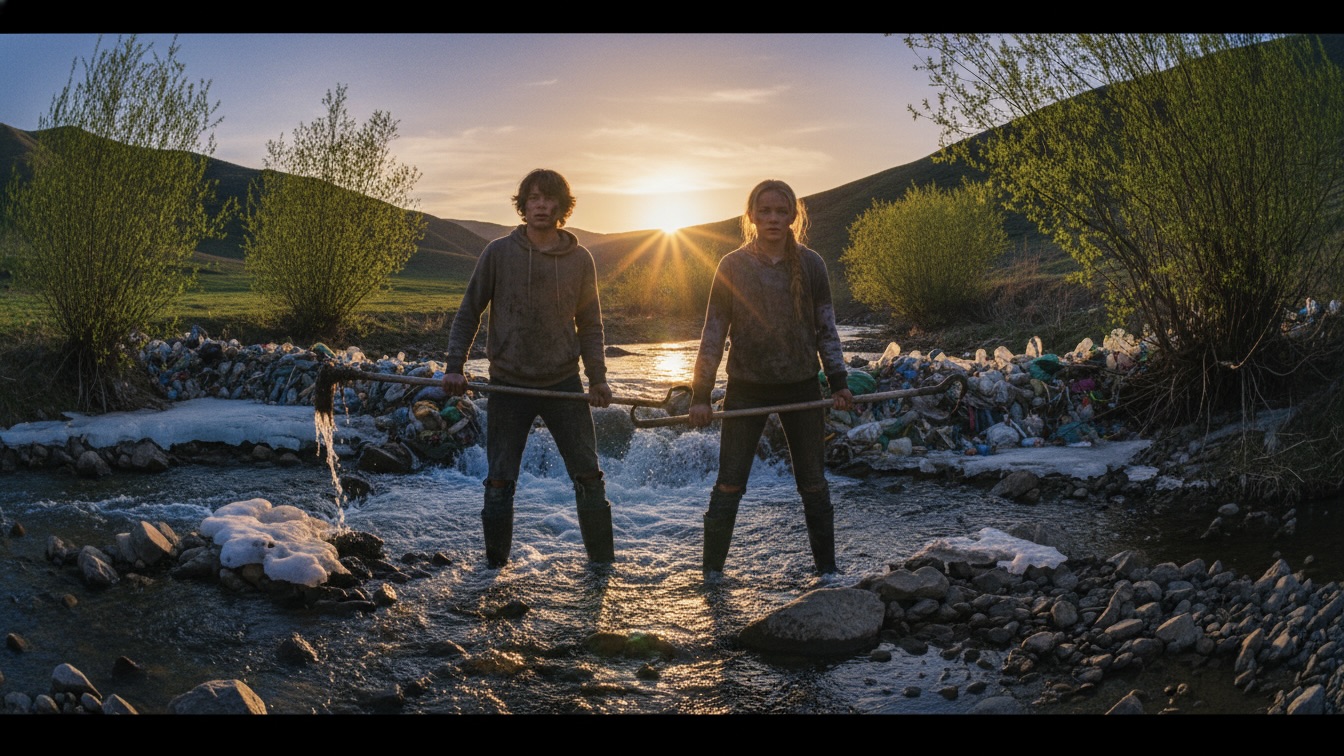
Format: Short Film / Anthology Episode | Est. Length: 10-12 minutes
Imagine a world where the digital sky has fallen, leaving humanity to rediscover the weight of their own hands and the cold reality of the earth beneath them. This story serves as a visceral entry point into a series that explores the friction between our curated digital identities and the unyielding, physical demands of a planet that no longer recognizes our filters.
"A Watershed Protocol" is a standalone episode within the anthology series The Analog Recalibration, which chronicles the implementation of "Digital Detox Ordinances" in a near-future society reeling from chronic grid failures. The series explores a world where the government mandates manual labor as a psychological corrective for a population suffering from "digital rot"—a state of profound alienation caused by life behind screens. Each episode follows different citizens forced into "Protocols" that require them to solve physical ecological crises, tracking the slow, painful restoration of human empathy through shared labor in a world that has gone quiet.
Jeffrey stands at the edge of a muddy creek, his thigh twitching with the phantom vibration of a phone that has been dead for forty-eight hours. As he stares into the "cold, hard light" of a world without a screen to frame it, he realizes the silence of the valley is louder than any notification he has ever received.
In a world paralyzed by a massive digital grid failure, two bitter ideological rivals are forced by government ordinance to clear a trash-choked watershed. As they struggle against the freezing current and the physical debris of their civilization, they find a rare, unfiltered connection that is threatened by the sudden return of the technology that divided them.
The primary theme is the conflict between "Curated Reality" and "Physical Truth," exploring how digital personas act as masks that prevent genuine human interaction. The story posits that manual labor is a grounding force, stripping away performative ideologies and forcing individuals to acknowledge the shared biological reality of cold, exhaustion, and the need for cooperation. The trash dam serves as a physical manifestation of "digital rot"—the accumulated waste of a society that prioritizes virtual scalability over physical maintenance.
The secondary theme focuses on the "Sanctity of Silence" and the loss of internal thought in the age of connectivity. By removing the "glow-box," the characters are forced to hear their own voices and perceive the world without the constant static of external opinions. The episode suggests that while the digital world offers convenience and "value," the physical world offers "wakefulness" and a sense of presence that is fragile and easily drowned out by the return of the hum.
The immediate ecological stakes involve the survival of downstream nesting grounds, which will flood if the watershed remains blocked by the mounting pile of plastic and debris. However, the deeper psychological stakes involve the characters' sanity and identity; without the task, they remain trapped in a state of anxious withdrawal and mutual hostility. For Jeffrey and Annie, the successful clearing of the dam represents their only chance to reclaim a sense of agency and "wakefulness" in a world that has become a "vacuum" of meaning.
The primary external conflict is the "physical rot" of the trash dam and the brutal, freezing mountain runoff, which acts as a relentless physical barrier to their progress. The Ranger serves as a secondary, grounded antagonist—an unyielding representative of nature who demands labor without providing the digital "tutorials" the characters rely on. Internally, both characters struggle against the "phantom vibrations" of their missing devices and the deep-seated ideological hatred they have cultivated through years of digital conflict, making cooperation feel like a form of surrender.
Following a regional grid collapse, Jeffrey and Annie—two strangers who have spent years attacking each other in online comment sections—are forced together by a "Digital Detox Ordinance." They meet at a muddy, stagnant creek where an old Ranger tasks them with clearing a massive dam of plastic waste that threatens the local ecosystem. Initially, they retreat into their established personas: Jeffrey into nihilistic cynicism and Annie into performative, high-strung idealism. They snipe at each other while struggling with the heavy metal hooks, their bodies recoiling from the shock of the freezing water and the foul smell of the "scab on the earth" they are tasked to remove.
The turning point occurs when Annie slips in the current, her theatrical mask shattering as she faces the very real danger of the freezing water. Jeffrey chooses to help her, and their first physical contact breaks the ideological spell, leading to a period of synchronized, rhythmic labor. As they clear the dam, they find a profound silence and a sense of "wakefulness" that they haven't felt in years, sharing a moment of genuine human connection over a crushed protein bar. However, as the sun sets, the grid suddenly flickers back to life; the immediate flood of notifications on their phones reclaims their attention, instantly dissolving their bond and returning them to their isolated, digital selves as the "noise" of the world begins again.
Jeffrey: A Gen Z cynic suffering from severe digital withdrawal, Jeffrey begins the episode as a nihilist who finds "comfort in the wreckage" to avoid the labor of maintenance. His psychological arc moves from a state of anxious, screen-addicted paralysis to a moment of profound "wakefulness" and clarity during the physical labor. By the end, he is the only one who mourns the return of the grid, recognizing that his "own thoughts" are being drowned out once again by the digital hum.
Annie: A high-strung ideologue who uses "performance" to define her value, Annie starts the episode wearing pristine gear and speaking as if to a crowd of thousands. Her arc is one of "de-masking," as the freezing water and physical struggle wash away her theatricality, revealing a raw, vulnerable, and "efficient" human underneath. However, she is the first to succumb to the return of the grid, her face instantly losing its newfound clarity as she disappears back into the scroll of her device.
The Ranger: A supporting character with "skin like a topographical map," he represents the uncaring but necessary reality of the natural world. He acts as the catalyst for the characters' transformation, providing the tools for their "extraction" from the digital void but offering no emotional support. He is the silent observer of the "watershed protocol," existing entirely outside the influence of the grid.
Jeffrey stands in the mud of a silent valley, twitching from phantom vibrations and feeling "exposed" without a screen to frame the world. Annie arrives in high-end gear, and the two immediately fall into their roles as ideological rivals, their dialogue echoing years of digital conflict while they wait for instructions. The silence between them is heavy, representing the "vacuum" of a world where they can no longer shout at each other from behind a filter.
The Ranger emerges from the trees like a ghost of the old world, dropping heavy metal hooks and mesh bags into the mud without a word of greeting. He explains that the "watershed is blocked" by human trash and that the birds’ survival depends on their manual labor, not their opinions. He leaves them without a manual or a tutorial, forcing them to confront the "physical rot" of the dam using only their own strength.
Jeffrey and Annie wade into the ice-cold creek, the physical shock of the water forcing a "sharp, ugly sound" from Jeffrey as they begin the grueling work. They struggle individually, their movements clumsy and their ideological sniping continuing as they wrestle with plastic crates and nylon netting. The labor is slow and deliberate, making every piece of trash a "battle" against a "grey sludge" that smells of decay.
Annie loses her footing on a slick stone and nearly goes under, her theatrical composure vanishing as she grips the netting in a desperate attempt to stay upright. Jeffrey wades toward her and offers his hand, marking their first genuine human contact and a shift from ideological rivalry to physical cooperation. He heaves a submerged branch free while she pulls the netting, their combined effort finally creating a "structural weakness" in the dam.
As the dam begins to break, the rhythm of their work changes, and they find a "strange kind of sync" that replaces their mental friction. They stop arguing about politics and start talking about the stories behind the trash they find—a child’s shoe, a motherboard, a plastic rose. The "burning, ideological hatred" Jeffrey felt for Annie drains into the mud, replaced by the simple, heavy weight of the hook and the flow of the water.
They sit on the bank in the "profound, heavy silence" of the cleared creek, sharing a protein bar and watching the water run clear over multi-colored stones. Jeffrey admits he feels "awake" for the first time in years, and Annie acknowledges that the "water doesn't have an opinion" on her. They share a real, un-calibrated smile, enjoying a moment of "refreshing" disaster where they are just two humans in the mud.
The peace is shattered by a "low, electronic hum" from a nearby transformer as the grid flickers back to life and the green lights turn solid. Their phones begin to vibrate with a "relentless, rhythmic pulse," and both characters are instantly drawn back into the blinding brightness of their screens. The clarity in Annie’s eyes fades as she begins to scroll, and Jeffrey feels the "weight return to his chest," realizing the "thaw" is over and the digital freeze has returned.
The episode begins with a mood of Anxious Isolation, characterized by the jittery, uncomfortable silence of digital withdrawal. As the characters enter the water, the mood shifts to Visceral Struggle, where the physical pain of the cold and the weight of the trash dominate the sensory experience. This transitions into a brief, fragile Grounded Connection during the climax, providing the audience with a sense of relief and "wakefulness." The episode ends on a note of Tragic Alienation, as the return of the grid feels like a loss of the characters' newly discovered humanity, leaving the viewer with a sense of profound claustrophobia.
In a full season, "A Watershed Protocol" would be the midpoint of an arc exploring the "Great Recalibration," where the government's "Digital Detox" programs become increasingly mandatory and invasive. The season would track the growing resistance to the grid's restoration, with some citizens choosing to live in "Dark Zones" to preserve the "silence" they discovered during the outages.
Thematic escalation would involve the realization that the "grid" is not just a utility, but a psychological architecture that the characters can no longer survive without, even as it destroys their empathy. The season would conclude with a choice: to accept a "software update" for the human soul that eliminates the need for physical connection, or to remain in the "mud" of reality, where things are "cold and hard" but real.
The visual style is defined by "Cold, Hard Light" and high-contrast cinematography that emphasizes the "cracks in everything." The camera work should be tactile and intimate, focusing on the textures of wet dirt, rusted metal, and the "jagged teeth" of ice along the banks. The color palette transitions from the desaturated, icy greys of the morning to a "deep, burning gold" during the afternoon connection, before returning to the "pale blue light" of the screens in the finale.
The tone is a blend of Speculative Realism and Atmospheric Melancholy, comparable to the grounded sci-fi of Children of Men or the quiet, character-driven tension of The Leftovers. It avoids the slickness of traditional science fiction, opting instead for a "violent, beautiful" aesthetic that makes the natural world feel both dangerous and sanctuary-like.
The target audience is Adults 25-45, specifically those experiencing "tech-fatigue" or "doom-scrolling" anxiety in the modern era. It appeals to viewers who enjoy high-concept anthology series like Black Mirror but prefer a more grounded, character-centric approach to speculative fiction. The episode resonates with an audience that feels the "constant hum" of connectivity and craves a narrative that validates the desire for "silence" and physical reality.
The pacing is Deliberate and Rhythmic, designed to make the 10-12 minute runtime feel substantial. The first act (The Withdrawal) is jittery and fast-cut to mirror the characters' internal anxiety. The second act (The Labor) slows down significantly, using long takes to emphasize the physical effort and the weight of the trash. The final act (The Reconnection) accelerates into a jarring, sensory-overload conclusion as the phones return to life, creating a sharp contrast with the "profound silence" of the preceding scenes.
The "Trash Dam" is a critical practical set piece that must be constructed to look like a "monument to a dead civilization," featuring recognizable but decayed 2020s technology mixed with organic debris. The production requires a location with a shallow, moving creek and the ability to safely submerge actors in cold water, as the "visceral" nature of the cold is essential to the performances.
Sound design is the most vital post-production element; the "silence" of the valley must be layered with rich, natural sounds (water, birds, wind) that are suddenly and violently replaced by the "electronic hum" and "pings" of the digital world. The contrast between the "liquid light" of the natural atmosphere and the "blinding brightness" of the phone screens should be emphasized through color grading to make the return of the grid feel like an intrusion.


