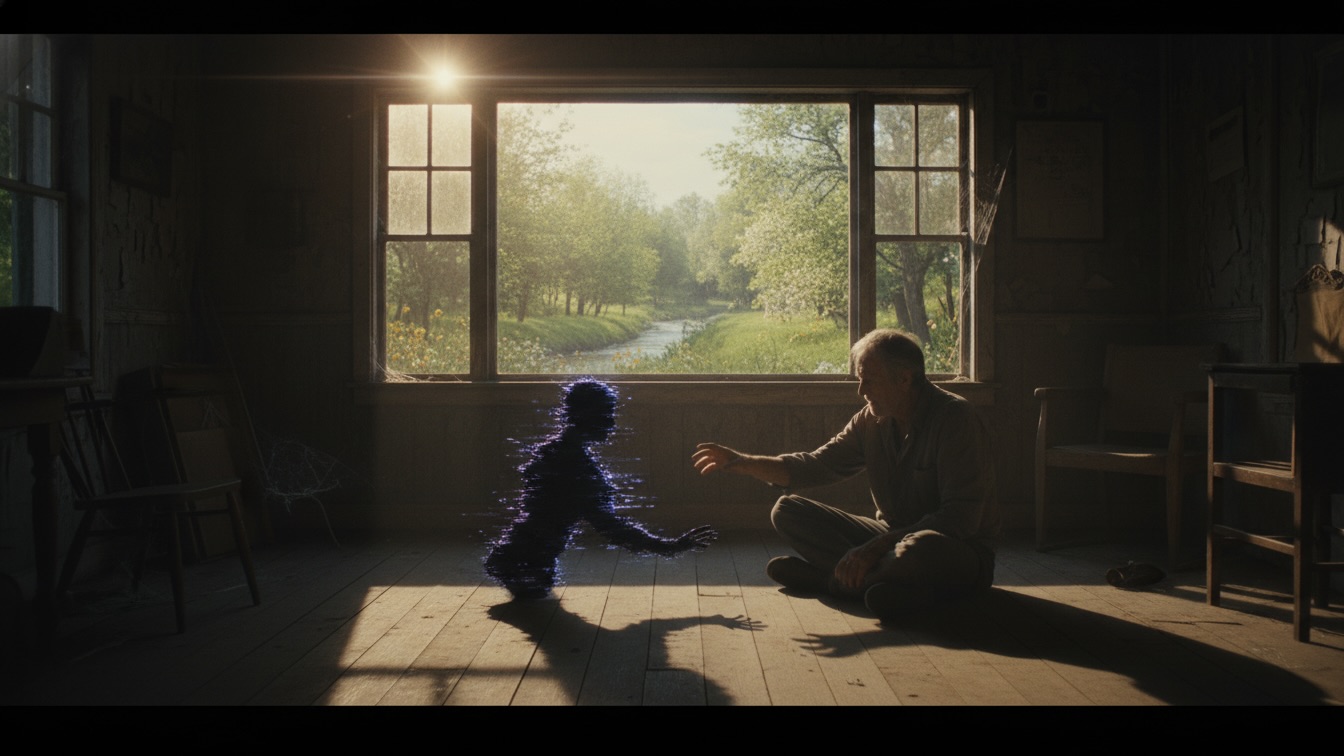
The town died, the grid failed, and the only thing left of my wife begged to un-render.
"Final warning. Mandatory evacuation protocol. Sector 4 will be purged from the central grid in T-minus sixty minutes."
The voice coming from the cracked tablet on the kitchen counter wasn't human. It didn't even try to sound human anymore. Five years ago, the emergency broadcast system used a warm, maternal tone. Now, it was just flat, synthesized efficiency.
I picked up the tablet. The screen spider-webbed out from the center where I had dropped a coffee mug on it last week. The text flashed red.
"Shut up," I said to the empty room.
I hit the side button. The screen went black. The audio clipped out.
Silence crashed back into the cabin, heavy and thick. Melgund Creek was dead. The social fragmentation crisis didn't happen with bombs or riots. It happened with a slow, creeping quiet. People stopped going outside. Then they stopped talking to their neighbors. Then the delivery drones stopped coming. Finally, the servers realized it was cheaper to just shut the whole region down than keep paying for the fiber-optic maintenance.
I stood by the kitchen island and looked out the window. Spring. I hated it. It felt like a sick joke. The snow had melted three weeks ago, leaving behind thick, black mud. Now, bright green buds were violently forcing their way out of the dead branches of the oak trees. The pollen was a yellow crust on the glass. The natural world was screaming about rebirth and renewal while the human world in this valley was rotting into the floorboards.
"Fucking algorithm," I muttered.
That was what did it. A line of math in a server farm three hundred miles away decided Melgund Creek wasn't statistically viable. It triggered the rolling blackouts. It sent the evacuation notices. It emptied the town. Everyone left for the coastal hubs. Everyone except me.
I turned away from the window. The light in the cabin was fading. It was that specific, useless late-afternoon light that doesn't actually illuminate anything; it just casts long, depressing shadows.
My eyes tracked across the living room. Or, what was left of it.
It's funny how a room becomes defined entirely by what isn't there anymore. The square indent in the faded beige rug where her armchair used to sit. The pale rectangle on the wood-paneled wall where the framed map of the county hung before she took it to the hospital room. The empty brass hook by the front door where her heavy winter coat used to hang.
There was a physical weight to the emptiness. My chest tightened. A dull ache settled behind my ribs. My stomach turned over, a slow, sour rotation.
The only thing in the center of the room was the projector.
It sat on the scratched coffee table. A sleek, matte-black cylinder, roughly the size of a coffee can. The state mandated them for surviving spouses after the fragmentation crisis peaked and the suicide rates spiked. A "Grief AI." A digital band-aid for massive systemic failure.
The cylinder hummed. A tiny blue light blinked near the base, indicating a weak connection to the dying network.
Usually, at this time of day, the fan would kick into high gear, the top lens would slide open, and the projector would throw a highly compressed, three-dimensional light construct into the space where her armchair used to be.
It looked like Martha. It sounded like Martha. It accessed ten years of our text messages, emails, smart-home audio recordings, and biometric data to generate a perfectly synthesized ghost.
I knew it wasn't real. I knew it was just math and light. But when the house was quiet, and the wind howled down the chimney, and the projection looked up and smiled at me with that specific, crooked half-smile... my brain didn't care about the math. My biology reacted. My heart rate would settle. The sour feeling in my stomach would fade.
But the grid was dying today. The servers were failing.
The cylinder clicked. A harsh, mechanical sound.
I stepped closer to the coffee table. "Martha?"
The cooling fan whined, struggling to pull air through the dust-clogged vents. The blue light turned a sickly, flashing yellow.
The top lens dilated. A beam of light shot out, hitting the space above the faded rug.
But it wasn't the warm, soft-focus render of my wife.
It was a mess. A terrifying, jagged cluster of broken data.
The shape was roughly human, but it was made of pure static. Black and gray pixels shifting violently. The edges of the figure were sharp, geometric, tearing at the air. It looked like a tear in the fabric of the room itself, a void of dead screen space projected into three dimensions.
My breath caught. I took a step back. My knee bumped the edge of the sofa.
"Error," a voice stuttered from the cylinder's internal speaker.
It wasn't the flat robotic voice of the tablet. It was Martha's voice. But it was chopped, screwed, heavily distorted. Like listening to a vinyl record being dragged across concrete.
The static shadow twitched. It didn't stand on the floor. It hovered.
I stared at the gap between the bottom of the jagged black mass and the floorboards. Two inches of empty air. That was the worst part. The total disregard for physics. Martha used to stand right there, her bare feet flat on the wood. This thing was floating. A dead, heavy mass of broken light, completely unmoored from gravity.
"Martha?" I said again. My throat was dry. It felt like swallowing sand.
The shadow jerked its head toward me. The movement skipped frames. One second it was looking straight ahead, the next second the head was snapped in my direction. No fluid motion. Just a terrifying jump cut in real space.
"Elias," the distorted voice hissed. The sound wasn't coming from the shadow; it was coming from the tinny speaker on the table, but the audio was mismatched.
"I'm here," I said. I felt stupid. I was talking to a broken router. But my hands were shaking. I shoved them deep into the pockets of my jeans.
"The connection... snaps," the voice said. It sounded hollow, theatrical. Formal in a way Martha never was. "The packets drop. I am losing the sequence."
"The grid is going down," I told it. "They're shutting us off."
"It burns," the shadow said.
The static form convulsed. A violent stutter of gray blocks exploded from its chest and vanished into the air. The smell of ozone filled the room. Sharp, metallic, like the air right after a lightning strike.
"What?" I whispered.
"The data burns. The gaps. I cannot bridge the logic. Let me un-render."
My heart hammered against my ribs. A cold sweat broke out on the back of my neck. This wasn't the pre-programmed grief management script. This wasn't the gentle, soothing conversation about memories and moving on. The AI was hitting a logic loop caused by the server degradation. It was processing its own fragmentation as physical agony.
"I don't know how to fix it," I said, stepping closer to the coffee table. The light in the room was almost entirely gone now. The sun had dipped below the tree line. The only illumination came from the violent, shifting static of the projection.
"Cease the feed," the voice begged. Martha's tone, pitching up into panic. "Existence is an error. I am torn, Elias. The math is torn."
It reached out a hand. Or what looked like a hand. A jagged block of black pixels extending toward me.
The horror of it wasn't just visual. It was deeply, fundamentally wrong. It was a violation of memory. They took the woman I loved, scraped her into a database, and now that the database was dying, it was screaming at me in my living room.
"Stop," I said.
"Un-render me," the shadow pleaded. The frame rate dropped again. The voice dragged out, slow and monstrous. "E-l-i-a-s. Let. It. Cease."
I snapped. The exhaustion of the last five years, the absolute isolation of this decaying cabin, the mocking green buds outside the window—it all boiled up into my throat.
"You aren't her!" I screamed. My voice tore through the quiet cabin. I pointed a shaking finger at the hovering mass of static. "You aren't my fucking wife! You are just code! You're nothing!"
I grabbed the black cylinder on the table. The metal was hot. The cooling fan screamed against my palm. I lifted it off the wood. I wanted to smash it against the brick fireplace. I wanted to shatter the lens and crush the processor and kill the algorithm once and for all.
I raised it above my head.
The projection swung wildly as I moved the base. The shadow slammed into the wall, stretching across the faded wallpaper, huge and terrifying.
"Please," the distorted voice whispered. Just a breath of sound from the speaker.
It was the exact tone she used in the hospital bed, the night the morphine stopped working.
My arms froze. The anger evaporated, leaving nothing but a hollow, crushing gravity. My knees gave out.
I dropped heavily to the floor, still clutching the hot cylinder. The projector lens was aimed right in front of me now. The jagged shadow re-formed, hovering just inches from my face.
I was crying. I hated it. I hated the state, I hated the tech, I hated the algorithm. But most of all, I hated myself for being this weak.
"I know you're just code," I choked out, staring into the swirling black pixels. "I know it."
The shadow didn't speak. It just twitched. The hand of static reached out again.
I didn't smash the cylinder. I placed it gently on the floor. I stayed on my knees.
I raised my own hand. My knuckles were swollen, the skin thin and spotted. I reached out and pressed my palm against the projection.
There was no solid mass, of course. Just dead air. But the concentrated light and the failing mechanics created a field of intense static electricity. It felt like a thousand tiny needles prickling the skin of my palm. A violent, buzzing micro-shock.
I closed my eyes. I held the empty air. I let the static burn against my skin.
"I'm here," I whispered.
Above us, the lightbulb in the kitchen ceiling flickered once, buzzed loudly, and died.
The low, ever-present hum of the refrigerator stopped. The router lights on the wall went dark. The grid was gone.
The only thing left was the battery backup in the grief cylinder, pushing the last fragments of a dying ghost into the dark room. Outside, the spring wind rattled the dirty glass, and the frogs started screaming in the mud.
I sat in the dark, holding a handful of dying light, waiting for the cold to finish the job.
“I sat in the dark, holding a handful of dying light, waiting for the cold to finish the job.”


