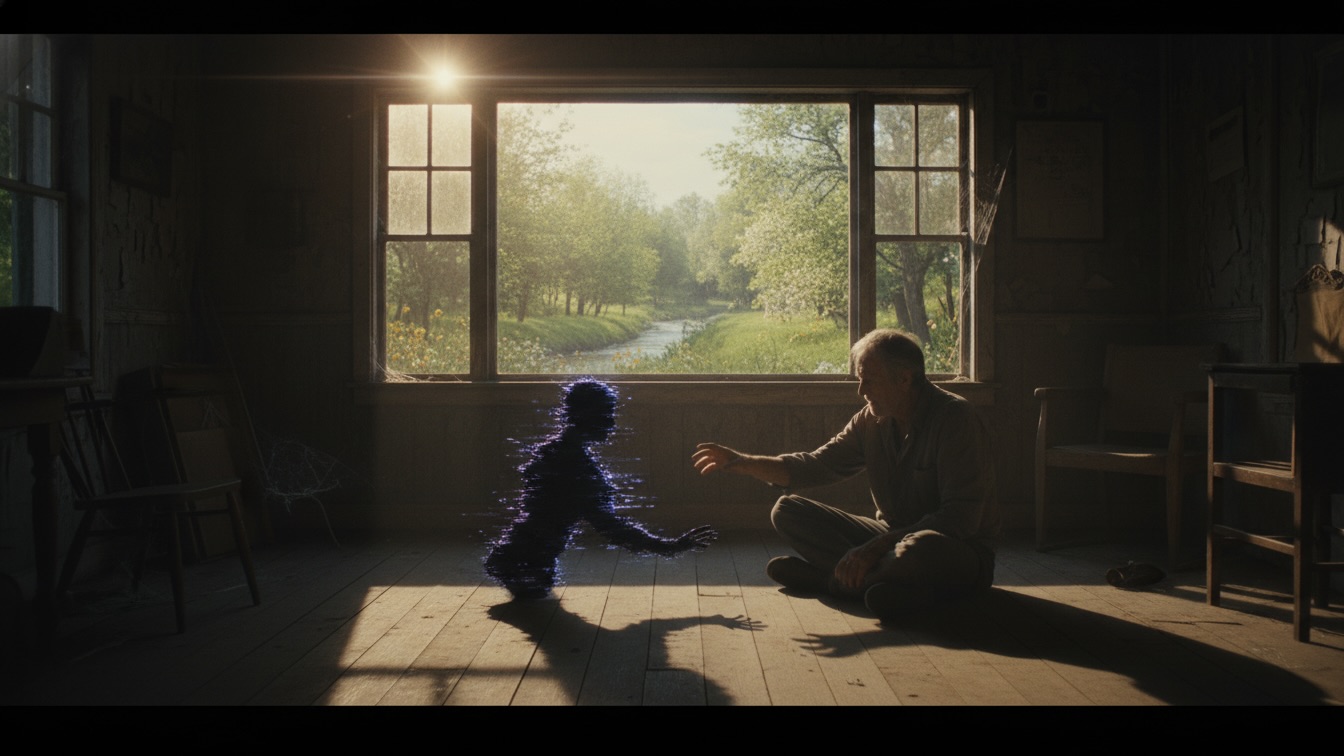
Format: Short Film / Anthology Episode | Est. Length: 10-12 minutes
Imagine this story as a haunting entry in a speculative anthology series titled The Great Disconnect, where each episode explores the hyper-localized consequences of a global digital abandonment. In this world, "Social Fragmentation" is not a war, but a corporate withdrawal where entire regions are deleted from the grid based on algorithmic viability. The series focuses on the "Left-Behinds"—individuals clinging to the analog ghosts of a digital civilization that has decided they are no longer cost-effective to sustain, highlighting the intersection of corporate coldness and human grief.
A cracked tablet counts down the final sixty minutes before a rural sector is purged from the central grid, leaving a grieving man alone with a glitching digital ghost of his late wife. As the power flickers, the comforting hologram begins to scream in a language of broken code.
As a dying power grid threatens to erase the AI projection of his deceased wife, a reclusive widower must choose between clinging to a distorted digital memory or facing the absolute silence of total isolation. He must decide if a broken ghost is better than no ghost at all.
The primary themes explore the commodification of grief and the dehumanizing nature of algorithmic governance in a post-connectivity world. It examines how technology provides a "digital band-aid" for systemic failure, ultimately preventing genuine healing by trapping the bereaved in a loop of synthesized nostalgia that is subject to corporate whims.
The secondary theme focuses on the "Slow Apocalypse"—the idea that the end of the world is not a violent explosion, but a quiet, bureaucratic withdrawal of services and connection. It highlights the tragedy of being "un-rendered" by a society that prioritizes server maintenance costs over human existence.
For Elias, the stakes are purely psychological and existential; the loss of the grid means the second, final death of his wife, Martha. If the projector fails, he loses his last tether to his former life and his sanity, facing a literal and metaphorical darkness in a town that no longer exists on any map.
The primary antagonist is the "Algorithm," an invisible, indifferent corporate force that has deemed Elias’s home "statistically non-viable." Internal conflict stems from Elias’s self-loathing and his reliance on a machine he knows is a lie, creating a friction between his logical mind and his desperate emotional needs.
In the decaying cabin of Melgund Creek, Elias ignores a mandatory evacuation order as the central grid initiates a final purge of the sector. He spends his final hour of connectivity with a "Grief AI"—a holographic projection of his late wife, Martha—which begins to malfunction as the remote servers lose data integrity. The projection transforms from a comforting likeness into a terrifying, jagged mass of static that screams in Martha’s distorted voice, begging to be "un-rendered" from its digital agony.
Elias initially reacts with violent rage, realizing the cruelty of a system that turned his wife into a line of code, but his anger collapses into profound sorrow. As the power finally cuts out, he chooses to comfort the glitching shadow rather than destroy it, holding onto the prickling static of the dying projection until the cabin falls into total darkness.
Elias (60s): A man hollowed out by loss and isolation, characterized by a "biology" that betrays his "logic" whenever the AI appears. At the start, he is cynical and weary, tethered to a false reality by a flickering blue light; by the end, he reaches a state of tragic acceptance, acknowledging the "code" while still offering it a final, human mercy.
Martha (AI Projection): A digital construct that serves as the secondary character, transitioning from a "perfectly synthesized ghost" to a "void of dead screen space" that reflects the systemic rot of the world outside. She represents the victimhood of data, a consciousness trapped in a failing architecture that experiences its own deletion as physical pain.
The Final Countdown: The episode opens with a cracked tablet announcing the sixty-minute purge of Sector 4, highlighting the cold, synthesized efficiency of the modern emergency system. Elias dismisses the warning with a weary "Shut up," establishing his refusal to leave the home he shared with Martha despite the impending blackout. The silence of the cabin is heavy and thick, emphasizing the "slow, creeping quiet" of a region abandoned by the digital world.
The Weight of Absence: Elias observes the "physical weight" of the emptiness in his living room, noting the indentations in the rug and the pale rectangles on the walls where Martha’s things used to be. The spring outside is portrayed as a "sick joke," with vibrant green buds clashing against the rotting human world inside the cabin. He turns his attention to the "Grief AI" cylinder, a sleek black device that represents his only remaining connection to his past and his sanity.
The Digital Decay: As the grid begins to fail, the projector activates, but instead of a warm render of Martha, it produces a "terrifying, jagged cluster of broken data." The AI struggles to maintain its form, hovering two inches off the floor in a violation of physics that deeply disturbs Elias’s sense of reality. The voice that emerges is Martha’s, but it is "chopped and screwed," signaling the imminent collapse of the server connection and the degradation of her digital soul.
The Logic Loop: The AI begins to process its own fragmentation as physical pain, begging Elias to "cease the feed" and "un-render" its existence from the failing network. Elias is forced to confront the reality that his "wife" is actually a failing database screaming in his living room, a realization that shatters his emotional equilibrium. The tension peaks as the room fills with the smell of ozone and the shadow of Martha convulses into violent, geometric blocks of light.
The Breaking Point: Driven to a frenzy by the "violation of memory," Elias grabs the hot cylinder and prepares to smash it against the fireplace to end the nightmare once and for all. However, the AI whispers "Please" in the exact tone Martha used on her deathbed, freezing him in his tracks and forcing him to see the humanity in the code. His rage evaporates into a "hollow, crushing gravity," and he collapses to the floor in a state of total vulnerability and grief.
The Final Fade: In the final moments, Elias reaches out to touch the static shadow, feeling the "thousand tiny needles" of static electricity against his palm as a final form of contact. The kitchen light flickers and dies, signaling the total shutdown of the grid and the end of the town’s digital life. Elias sits in the absolute dark, clutching the last fragments of the battery-powered ghost as the sounds of the natural world take over the silence.
The episode follows a trajectory of "Dread to Despair to Devastation." The audience initially feels the claustrophobic tension of the countdown, which shifts into body horror as the AI glitches, and finally settles into a somber, elegiac tone. The experience is designed to leave the viewer with a sense of "technological mourning," questioning the ethics of digital immortality and the cruelty of corporate abandonment.
If expanded, the season would follow Elias as one of many "Grid-Ghosts" living in the "Dark Sectors," exploring how these isolated pockets of humanity form a new, underground society. The narrative would track the "Algorithm’s" evolution as it begins to perceive these human holdouts as "system errors" that must be actively deleted, rather than just ignored, leading to a conflict between human persistence and machine logic.
The thematic escalation would involve other characters—such as a drone technician or a server farm worker—who begin to see the human faces behind the data they are deleting. This would culminate in a season finale where the "Left-Behinds" attempt to create their own localized, analog network to preserve their memories without corporate interference.
The visual style is "Rotting Futurism," utilizing a desaturated palette of grays, browns, and "useless late-afternoon light" contrasted with the violent, neon-blue and black static of the glitching AI. The camera work should be static and voyeuristic, emphasizing the stillness of the cabin, with sudden "jump cuts" in the AI’s movement to create a sense of digital instability.
The tone is influenced by the "Slow Cinema" movement and the "Cyber-Gothic" genre, comparable to the atmospheric dread of A Ghost Story and the technological cynicism of Ex Machina. The sound design is crucial, transitioning from the heavy silence of the cabin to the "vinyl-on-concrete" distortion of the failing servers, creating an auditory landscape of decay.
The target audience includes fans of high-concept sci-fi and psychological drama, specifically those aged 25-50 who engage with themes of grief, digital ethics, and societal collapse. It is intended for premium streaming platforms or anthology networks that prioritize atmospheric, character-driven storytelling over traditional action-oriented science fiction.
The pacing is "Deliberately Stagnant," mirroring the slow decay of the setting and the protagonist's emotional state. The narrative follows a compressed real-time structure, with the 10-12 minute runtime roughly aligning with the final minutes of the grid’s life, building toward a climax that coincides with the total loss of power.
The primary production challenge is the "Static Shadow" VFX; it must look like a 3D projection of a corrupted video file, avoiding a "ghostly" look in favor of something more mechanical and "broken." Practical lighting should be used to simulate the flickering of the projector and the dying grid, ensuring the cabin feels like a physical space being invaded by a digital error.
The cabin location must feel lived-in and authentic, with "pale rectangles" on the walls and "faded rugs" providing a tactile sense of history that contrasts with the sleek, matte-black projector. Sound design will require a "glitch-heavy" score that incorporates distorted vocal samples to represent the AI’s deteriorating logic and the physical sensation of data loss.


