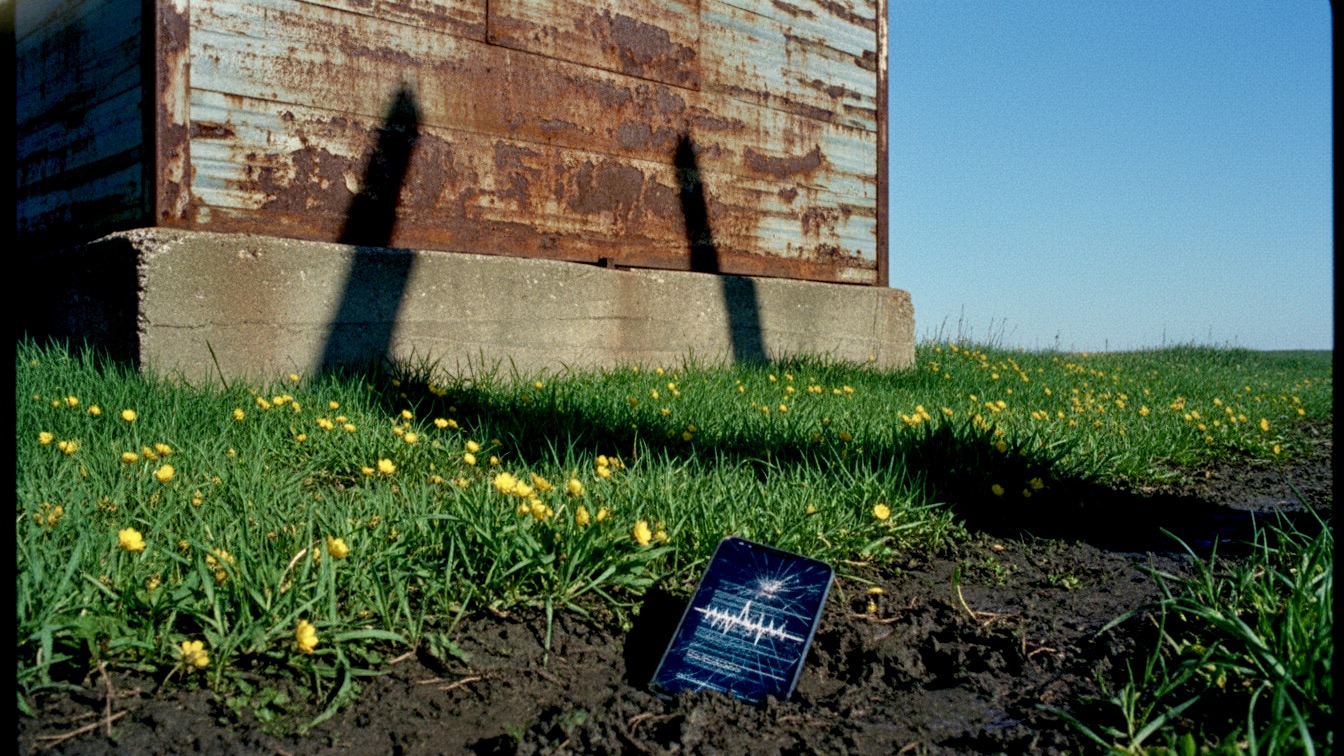
Ella, a woman grappling with the decay of her small prairie community, discovers that a vintage radio in her basement is broadcasting impossible messages from deceased loved ones. She is joined by Brad, a tech-obsessed neighbor, and Devon, a skeptical friend who dismisses the phenomenon as a political psy-op. As the signals grow more invasive and localized, the trio tracks the source of the transmissions to a sealed bunker beneath an abandoned grain elevator. Inside, they find a grotesque fusion of modern server technology and organic, root-like structures that feed on the town’s secrets and insecurities. The bunker’s influence manifests as a psychic contagion, causing the group to turn on one another before they barely escape the subterranean chamber.
The core theme of this chapter is the erosion of truth in an era of hyper-mediated reality. The story explores how the boundary between technology and nature can become blurred, suggesting a world where the infrastructure of communication has been compromised by something ancient and predatory. By linking the radio signals to the soil and the roots of the prairie, the narrative suggests that the rot is not merely external or political, but foundational to the land itself.
The story also delves into the psychology of paranoia and social disintegration. The characters are unable to distinguish between genuine technological threats and the manifestations of their own internal guilt and trauma. The bunker acts as a physical metaphor for the subconscious, a dark place where repressed memories and secrets are harvested to fuel conflict. As the characters descend into the earth, they lose their ability to maintain social cohesion, proving that fear is a more effective weapon than any government intervention.
Ella serves as the anchor of the narrative, representing a stoic resilience that is slowly being worn down by her environment. She carries the weight of past trauma, specifically the tractor accident that haunts her memory, which makes her particularly vulnerable to the radio’s psychological manipulation. Her skepticism is a defensive mechanism, yet she possesses a pragmatic drive that forces her to investigate the source of the disturbance despite her better judgment. By the end of the chapter, her isolation is total, as the trust she held for her companions has been permanently severed by the bunker's influence.
Brad functions as the embodiment of intellectual obsession and the fragility of modern belief systems. He is desperate to rationalize the irrational, using his tablet and signal tracking as a buffer against the terrifying reality of the supernatural. His vulnerability lies in his grief for his grandfather, which provides a direct conduit for the signal to exploit his emotions. His quick shift toward suspicion at the end of the chapter highlights how easily his analytical mind can be redirected into destructive, paranoid patterns.
Devon represents the cynical detachment that often accompanies societal collapse. He attempts to impose a logical, political framework on the situation, blaming foreign actors and disinformation campaigns to avoid facing the visceral horror of the bunker. His secret plan to leave the town reveals a deep-seated cowardice that the signal successfully weaponizes against him. His flight from the bunker is the ultimate act of self-preservation, confirming the very suspicions that his companions were beginning to harbor.
The narrative voice is claustrophobic and sensory-driven, effectively mirroring the protagonist's internal state. The author employs sharp, evocative imagery, such as the smell of wet asphalt and rotting snow, to ground the supernatural elements in a gritty, tangible reality. The pacing is deliberate, starting with the mundane frustration of a leaking pipe and accelerating into a frantic, high-stakes escape.
The tone is consistently unsettling, characterized by a persistent sense of wrongness that permeates the descriptions of the environment. The author uses the shift from the gray, damp basement to the blinding, violent blue of the prairie sky to heighten the tension, suggesting that the horror is not just contained within the dark, but is present even in the light. By focusing on the sensory details of the rot and the rhythmic, buzzing electronic interference, the prose creates an atmosphere of encroaching dread that feels both inevitable and inescapable.


