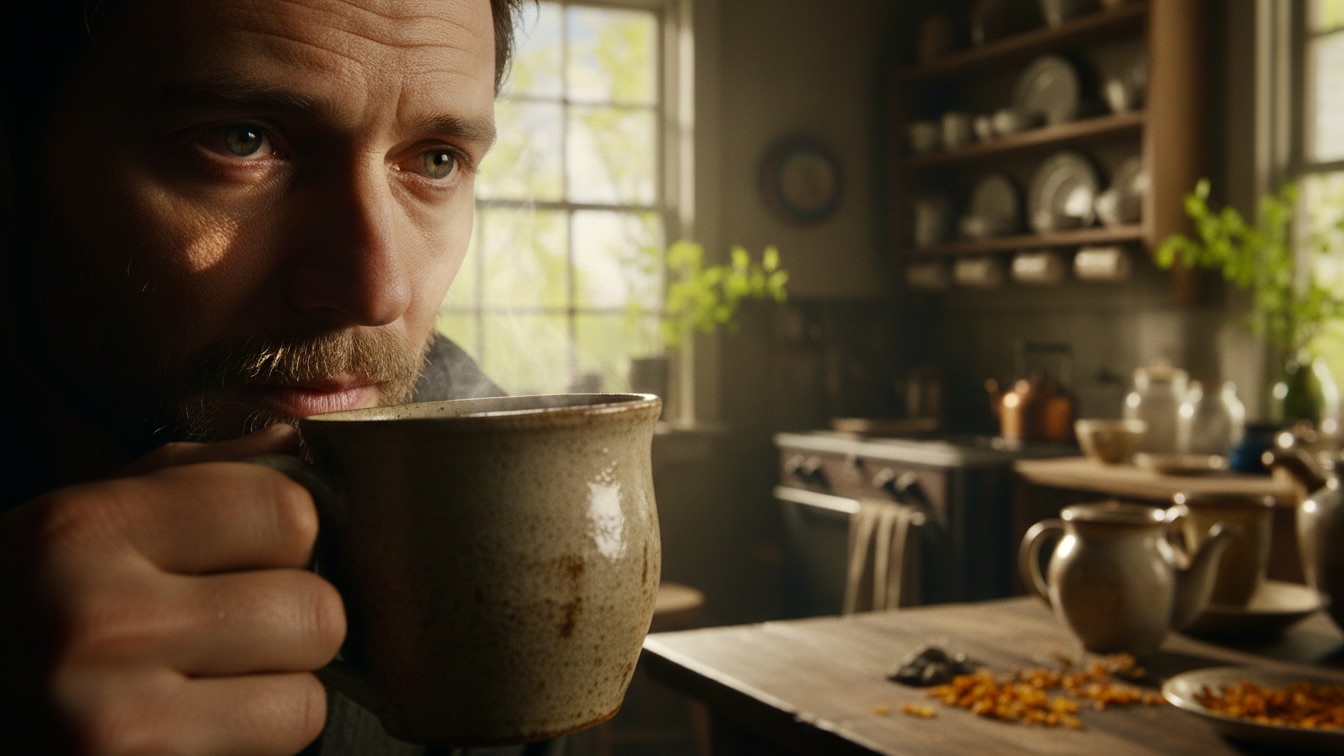
Randy hears the house eating his memories until Ida forces him to confront the muskeg and the tea.
The scratching started at 4:14 AM. It was a dry, frantic sound, like a finger-nail dragging across a chalkboard, but rhythmic. Randy sat up in the bed that smelled of damp wool and old feathers. The Victorian estate didn't just stand; it leaned. It leaned toward Lake Superior as if it wanted to drown. He watched the wallpaper. It was a pale, sickly yellow, peeling away in long, vertical strips that looked like dead skin. Behind the paper, the lath and plaster groaned. He was convinced the house was hungry. It had already taken his phone charger, his car keys, and the clear memory of his wife’s laugh. Now it wanted the rest.
He climbed out of bed. The floorboards were cold enough to ache. He walked to the wall and pressed his ear against a patch of dampness. The scratching stopped. It was a calculated silence. He could feel the house holding its breath. The wood was porous, soaked with decades of lake mist and woodsmoke. He felt like he was standing inside a ribcage. He walked to the window. Outside, the spring was a lie. The trees were still black skeletons, and the lake was a sheet of grey slate. There were no buds, only the hard, frozen earth waiting for a reason to soften. Randy felt like that earth. Hard. Cold. Locked in a season that refused to turn.
"Randy!"
Ida’s voice cut through the floorboards like a saw. It was loud, abrasive, and entirely too alive for this hour. He didn't answer. He just watched the grey water. The lake didn't have waves this morning; it had a pulse. It pushed against the rocky shore with a heavy, wet thud. He wondered if the house would eventually just slide down the bank and disappear. It would be a quiet end. No more scratching. No more remembering.
"Get down here!" she yelled again. "The water’s boiling!"
He moved because he didn't have the energy to resist. His joints felt like they were full of sand. He walked down the grand staircase, his hand trailing on the mahogany banister. The wood felt oily. Everything in this house felt like it was coated in a thin layer of something organic. He reached the kitchen. The air here was different. It smelled of woodsmoke and something sharp, like crushed pine needles and old leather. Ida was standing at the heavy oak table. She wore a thick wool sweater that had seen better decades and a pair of reading glasses perched on the tip of her nose.
She didn't look at him. She reached into a large brown paper bag and pulled out a handful of dried leaves. She slammed them onto the table. The sound was like a gunshot in the quiet room. Dust and small, brown fragments puffed into the air.
"Sit," she said.
Randy pulled out a chair. It screeched against the linoleum. "What is this?"
"Labrador tea," Ida said. "We’re cleaning it. Pick out the stems. Keep the leaves with the rusty bottoms."
Randy looked at the pile. The leaves were small, leathery, and curled at the edges. When he flipped one over, the underside was covered in a thick, orange-brown fuzz. It looked like rust. It looked like the house.
"I heard it again," Randy said. His voice was thin. It didn't sound like his own.
"Heard what?" Ida asked. She was snapping stems with a brutal efficiency.
"The scratching. In the walls. It’s getting louder. It took the photo of us on the mantel. It's gone, Ida. The house took it."
Ida stopped. She looked at him over her glasses. Her eyes were hard, like marbles. "The house didn't take your photo, Randy. You probably moved it and forgot. You’re glitching."
"I didn't move it."
"Whatever. Focus on the tea. This stuff is magic. It grows in the muskeg. You know what that is?"
"A bog," Randy muttered. He picked up a leaf. It felt like a small, dead tongue.
"Not just a bog," Ida said. "It’s a place where things don't rot properly. It’s too acidic. Too harsh. Nothing should grow there, but this does. It thrives on the struggle. It likes the acid. It’s the only thing that stays green when everything else is turning to mush."
Randy stared at the rusty underside of the leaf. "It looks diseased."
"It’s protection," Ida snapped. "The fuzz keeps the moisture in. It keeps the cold out. It’s a suit of armor. You could learn a thing or two from a shrub."
They worked in silence for a long time. The only sound was the snapping of stems and the hiss of the kettle on the stove. Randy’s fingers began to smell. It wasn't a bad smell, but it was intense. It was deep, earthy, and medicinal. It reminded him of the woods behind his childhood home, but concentrated. It was the smell of the earth’s blood. He felt his head clear slightly. The fog of the morning started to lift, replaced by the sharp, stinging reality of the muskeg.
"You’re too isolated," Ida said suddenly. She didn't look up. "It’s low-key toxic."
Randy blinked. "What?"
"This. This whole 'grieving widower in a haunted house' vibe. It’s played out. It’s a trap. You’re sitting here waiting for the walls to talk because you don't want to talk to anyone real."
"I'm not waiting for anything."
"Liar. You’re feeding your own ghosts. You think the house is eating your memories? No. You’re just letting them starve. You’re starving yourself of anything new, so the old stuff is starting to look like monsters."
"You don't know what it’s like," Randy said. His chest felt tight. "The silence is heavy. It has a weight. I can feel it pressing on my skin."
"It’s just air, Randy. Air and bad insulation."
She grabbed a handful of the cleaned leaves and dropped them into a ceramic teapot. She poured the boiling water over them. A cloud of steam rose, carrying that heavy, leathery scent. It filled the room, pushing back the smell of damp and decay. It was a stubborn smell. It didn't ask for permission.
"Drink," she said, pushing a mug toward him.
Randy took the mug. It was warm. He held it between his palms, letting the heat seep into his bones. He took a sip. The taste was bitter, then floral, then something like turpentine. It was harsh. It bit at the back of his throat.
"It’s strong," he said.
"It has to be," Ida replied. "To match the world."
As he drank, the scratching started again. It was right there, in the kitchen wall, just behind the stove. Randy froze. The mug shook in his hand. "There. Do you hear it?"
Ida tilted her head. She listened. "Yeah. I hear it."
"It’s the house," Randy whispered. "It’s coming for the kitchen now."
Ida rolled her eyes. She stood up and walked over to the pantry. She grabbed a heavy iron skillet from a hook. She walked to the wall and banged the skillet against the plaster three times. Clang. Clang. Clang.
A frantic scuttling sound followed. It moved up the wall, across the ceiling, and toward the back door. There was a small, high-pitched squeak, and then silence.
"It’s a squirrel, Randy," Ida said, hanging the skillet back up. "A grey squirrel. It’s been nesting in the eaves since March. It’s not a ghost. It’s just a rodent looking for a dry place to sleep."
Randy stared at the wall. The silence was different now. It wasn't predatory. It was just... empty. He looked down at his tea. The steam was still rising. He felt a strange sensation in his stomach. It wasn't the grief. It was something smaller. A spark. A tiny, stubborn realization that the world was still just the world. There were no monsters here, only rot and rodents and a very bitter cup of tea.
"A squirrel?" he asked.
"A fat one," Ida said. "I saw it on the bird feeder yesterday. It’s got a bit of a limp. Probably why it’s so loud. It’s struggling."
Randy took another sip. The bitterness didn't seem so bad now. It was grounding. He looked at the window. The grey light was shifting. A sliver of pale yellow was breaking through the clouds over the lake. It wasn't a sunrise yet, but it was a promise.
"I should fix the hole," Randy said.
Ida nodded. "You should. And you should finish your tea."
Randy looked at the orange fuzz on the remaining leaves. It wasn't rust. It was wool. It was a coat. He felt the warmth of the mug spreading through his chest. For the first time in months, he didn't feel like he was disappearing. He felt heavy. He felt present. He felt like a man sitting in a kitchen, drinking tea with his aunt.
"Ida?" he said.
"Yeah?"
"Thanks."
"Don't get soft on me," she said, but her voice was quieter. "Just clean the rest of the bag."
He reached for the leaves. He felt the texture. He heard the wind outside, but it didn't sound like a scream anymore. It just sounded like wind. He felt a genuine spark of hope. It was a small thing, fragile as a leaf in a bog, but it was there. He swallowed the last of the tea, the heat stinging his throat in a way that made him feel undeniably alive.
Then, the front door heavy oak door, which had been locked since last night, creaked open on its own.
“Then, the front door heavy oak door, which had been locked since last night, creaked open on its own.”


