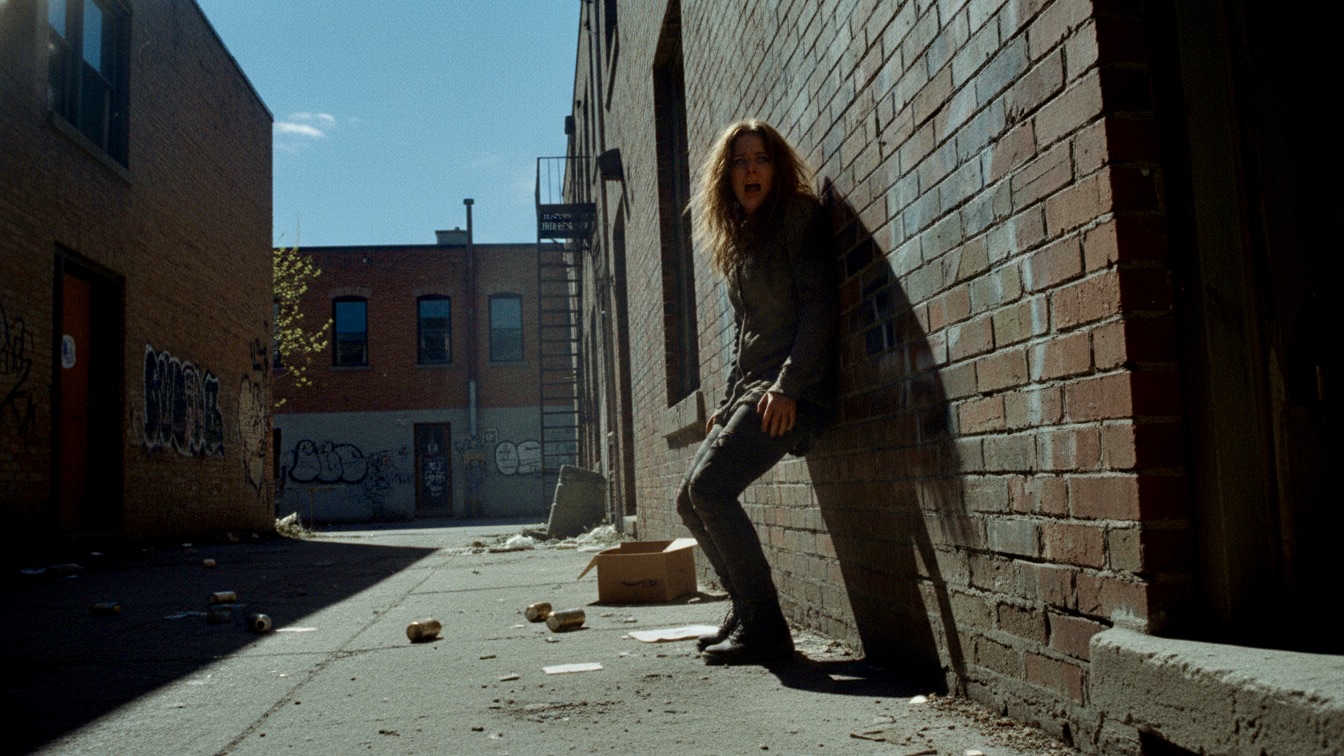
The flight was canceled, the battery was dead, and the hallway was five feet longer than before.
The spring sun was a violent thing. It punched through the high, arched windows of the compound’s lobby, projecting harsh yellow squares onto the cracked marble floor. Outside, the city was in the middle of a beautiful, catastrophic April. Almond trees were blooming somewhere in the distance, but the air blowing through the bullet holes in the glass smelled like cordite, pulverized concrete, and hot dust.
Inside, there was only the wait.
Mae sat on a deflated leather sofa, staring at a phone that had been dead for six hours. The screen was a black mirror coated in fingerprints and a fine layer of grit. She wiped it on her jeans, a nervous habit that accomplished nothing. Her stomach felt hollow, scraped out. She hadn't eaten since yesterday morning, but hunger had been replaced by a low, buzzing nausea.
"What time is it?" Will asked.
He was sitting on the floor, his back pressed against a structural pillar. He was picking at a hangnail on his thumb. He had been picking at it for twenty minutes. It was bleeding, but he didn't stop.
"Does it matter?" Dylan said from across the room. Dylan was pacing. He had been pacing since the power went out. His boots made a dry, scuffing sound against the marble. Scuff, step, turn. Scuff, step, turn. "It's afternoon. That's all we need to know. The convoy was supposed to be here at noon. It's past noon."
"Maybe they got delayed," Will said, his voice flat. He didn't believe it. None of them did.
"Delayed by what, Will?" Dylan snapped. "Traffic? It's a warzone. There is no traffic. There are only craters."
"Shut up," Mae said. She didn't yell. She didn't have the energy. Her throat felt tight, like she had swallowed a golf ball. "Just shut up, Dylan. Pacing isn't going to make a truck appear."
Dylan stopped. He ran a hand through his hair, leaving a streak of gray dust across his forehead. He looked at the heavy oak doors at the front of the lobby. They were barred from the inside with a thick steel pipe. The Canadian embassy staff had abandoned this secondary compound three days ago, leaving only Marvin, a low-level liaison who currently looked like he wanted to die.
Marvin was in the corner, holding a battery-powered radio to his ear. The radio was producing a steady stream of static, punctuated by sharp, aggressive pops.
Nadia was the only one not looking at the doors. She was staring at the ceiling. The compound was an old building, a leftover from the British Mandate era, repurposed fifty times over the last century. The ceiling was high, decorated with faded plaster molding that looked like rotting leaves.
"The chandelier is off center," Nadia said.
Her voice was quiet, almost a whisper, but in the heavy silence of the lobby, it cut through the air.
"What?" Will asked, looking up.
"The chandelier," Nadia repeated. She pointed a shaking finger upward. "It used to be in the middle of the ceiling medallion. Now it's not."
Mae frowned, squinting through the dust motes dancing in the sunbeams. A massive, tarnished brass chandelier hung from the plaster ceiling. Nadia was right. The heavy brass chain didn't drop from the center of the decorative plaster circle. It was off by about three feet, hanging awkwardly near the edge of the molding.
"It was probably always like that," Dylan said dismissively. "Shoddy construction."
"No," Nadia said, her voice tightening. She pulled her knees to her chest. "I looked at it yesterday. It was in the middle. I swear to God it was in the middle."
"Buildings settle," Will offered, though he sounded unsure. He looked back down at his bleeding thumb.
"Buildings don't move a light fixture three feet to the left, Will," Nadia said. Her breathing was getting shallow. Mae could see the pulse jumping in Nadia's neck.
A low, deep thud echoed from the outside. The floor vibrated. Dust rained down from the plaster ceiling, coating their shoulders. Another shell hitting the eastern suburbs. The war was getting closer. But strangely, as the echo of the explosion died away, the silence inside the lobby felt heavier. It was an unnatural silence. A dead zone. It felt like the air pressure had suddenly dropped, popping their ears.
Marvin lowered the radio. He looked at the four of them. His eyes were red-rimmed and completely devoid of hope.
"Flights are canceled," Marvin said. His voice cracked.
Nobody moved. The words hung in the dusty air.
"What do you mean, canceled?" Dylan stepped forward, his fists clenched. "We're on a diplomatic manifest. They have to get us out."
"Airspace is closed," Marvin said, staring blankly at the radio. "Command says there are too many hot pieces of flying metal up there. An evacuation plane wouldn't make it to cruising altitude. They've grounded everything."
"So what's the plan?" Mae asked. Her voice shook. Her stomach cramped violently. "We just stay here? Until the front line rolls over the building?"
"They said to hold our position," Marvin replied softly. "They said to wait for a ground extraction. Could be tomorrow. Could be next week."
"We don't have food for next week," Will said. He laughed, a short, ugly sound. "We don't have water for tomorrow."
"There's water in the basement," Marvin said, pointing toward a dark archway at the back of the lobby. "Old storage tanks. And some emergency rations. You'll have to go down and get them. I... I need to keep trying the radio. See if I can catch a military frequency."
Dylan stared at Marvin for a long second, his jaw muscles flexing. Then he turned to Will and Mae. "Fine. We go to the basement. We get the stuff. We wait."
He grabbed a heavy flashlight from a pile of discarded gear on a table. He clicked it on. The beam was strong, cutting a harsh white cone through the shadows of the archway.
"I'm not going down there," Nadia said. She was still staring at the ceiling.
"Don't be stupid, Nadia," Dylan snapped. "We need everyone to carry water. I'm not doing all the heavy lifting."
"The building is wrong," she whispered.
Mae walked over to Nadia and put a hand on her shoulder. Nadia was shivering, despite the stifling heat in the room. Her skin felt clammy.
"Hey," Mae said softly. "It's just stress. The bombing is messing with our heads. Let's just go get the water. Keep our minds busy."
Nadia slowly lowered her head and looked at Mae. Her eyes were wide, the pupils blown out. "Do you hear it?"
"Hear what?"
"The static."
Mae listened. She heard the distant rattle of gunfire. She heard Will's rough breathing. She heard Marvin twisting the dial on the radio. But beneath all that, there was a sound. It wasn't quite a sound, actually. It was a sensation. A vibration in the jawbone. A low, rhythmic hum that felt like standing too close to a massive electrical transformer. It made her teeth ache.
"It's just the pipes," Mae lied. She pulled Nadia to her feet. "Come on."
The four of them walked toward the archway. The transition from the sunlit lobby to the dark corridor was jarring. The air here was instantly ten degrees cooler.
The flashlight beam hit the stairs. They were steep, made of rough-hewn stone, spiraling downward into pitch black.
Dylan went first, his boots thudding heavily. Mae followed, holding Nadia's hand. Will brought up the rear.
As they descended, the light from the lobby vanished completely. The darkness was absolute, thick enough to choke on. The only light was Dylan's flashlight, bouncing erratically off the stone walls.
"Watch your step," Dylan muttered.
They reached the bottom. The basement was massive. It didn't look like a diplomatic storage room. It looked like a tomb. Thick brick pillars held up a vaulted ceiling. The floor was dirt.
Dylan swept the light across the room. There were no water tanks.
Instead, the room was filled with wooden crates. Dozens of them. They were stacked haphazardly, covered in a thick layer of pale dust.
"Where's the water?" Will asked, his voice echoing off the brick walls.
Dylan walked over to the nearest crate. He wiped the dust off the side with his sleeve. Faded black letters were stamped into the wood.
PROPERTY OF THE CROWN. 1924. MINISTRY OF ANTIQUITIES.
"What is this?" Dylan muttered. He ran his hand over the lid. It was nailed shut, but the wood was rotting.
"This is a diplomatic compound," Mae said, stepping closer. "They must have used it to store things. Old things. Things they were supposed to ship back to London or Ottawa decades ago."
"Smuggled artifacts," Will said. He sounded disgusted. "Great. We're trapped in a warzone with a bunch of stolen pots."
Dylan wedged his fingers under the rotting lid of the crate and pulled. The wood splintered with a loud crack. He shined the flashlight inside.
The crate was filled with dry, brittle straw. Nestled in the center was a stone statue. It was about two feet tall, carved from dark, porous rock. It didn't look human. The proportions were wrong. The arms were too long, wrapping around a swollen belly. The face was just a smooth, featureless dome, except for a wide, open mouth filled with jagged teeth.
Mae felt her stomach drop. A cold sweat broke out on the back of her neck. Looking at the statue physically hurt her eyes, like trying to focus on an optical illusion.
"Put the lid back," Nadia said. She was standing ten feet away, refusing to look at the box.
"It's just a rock," Dylan said, but his voice lacked its usual arrogance. He stepped back from the crate.
That was when the light shifted.
Dylan hadn't moved the flashlight, but the shadows in the room suddenly stretched. They elongated, pulling across the dirt floor like spilled ink. The shadow of the statue crept up the brick wall, growing massive, towering over them.
"Dylan, move the light," Will said, his voice high and tight.
"I'm not moving it," Dylan whispered. His hand was perfectly still.
The shadow on the wall shifted. It didn't match the statue. The statue was stationary, but the shadow raised an arm.
Mae couldn't breathe. Her lungs felt paralyzed. This wasn't happening. Her brain scrambled to rationalize it. A trick of the eye. A draft moving the dust. The flashlight battery dying.
But the shadow turned its head.
"We need to leave," Mae said. She grabbed Will's jacket. "Now."
They turned back toward the stairs.
There were no stairs.
Where the stone staircase had been, there was only a solid wall of old brick.
Panic, raw and electric, spiked through Mae's chest. She dropped Nadia's hand and ran to the wall, slamming her palms against the brick. It was cold and solid. It had been there for a hundred years.
"Where are the stairs?" Will shouted. He spun around, shining his phone light blindly. It barely cut through the gloom. "Dylan, where are the stairs!"
"They were right here," Dylan said. He was panting. He swung the flashlight around in frantic arcs. "We just came down. They were right here."
"The architecture," Nadia whispered. She was standing in the center of the room, looking at the crates. "It's broken."
"Shut up!" Dylan yelled. He pointed the flashlight down a long, narrow corridor between two stacks of crates. "There has to be another exit. A service door. Come on."
He didn't wait for them. He walked quickly down the corridor, the light bouncing off the rotting wood.
"Dylan, wait!" Mae called out, but she followed him. Will and Nadia stayed close behind her.
The corridor of crates seemed to go on forever. It shouldn't have been possible. The compound was large, but it wasn't a warehouse. They had been walking for three minutes. The geometry was entirely wrong.
Then, the whispering started.
It wasn't a sound you could hear with your ears. It felt like pressure inside the skull. Like hundreds of dry voices speaking at once, right behind the eyes. It was a language of clicks, hisses, and scraping stone.
Mae pressed her hands over her ears, but it didn't help. The sound was inside her head. Will was doing the same, his face twisted in pain.
"Do you hear that?" Will gasped.
Dylan stopped at the end of the corridor. The crates ended, opening up into a small, circular room made of smooth, gray concrete. There was a metal door on the far side.
"A door," Dylan said, ignoring Will. He walked toward it.
"Dylan, don't," Mae said. Her instincts were screaming. Every nerve ending in her body was firing, telling her to run the other way. The metal door looked wrong. It was too pristine. No rust. No dust. Just a flat, featureless slab of steel with a heavy handle.
"It's an exit," Dylan said, grabbing the handle.
"Don't open it!" Nadia screamed.
Dylan pulled the handle down. The door swung open effortlessly.
Dylan stepped through.
The flashlight beam vanished.
"Dylan?" Mae called out.
Silence.
She walked to the doorway and looked through.
There was no room on the other side. There was no hallway. There was just a solid wall of gray concrete, exactly one inch behind the door frame.
Dylan was gone.
Mae stared at the blank concrete wall. Her brain completely flatlined. She couldn't process the visual information. A man stepped through a door, but there was no space for him to step into. He didn't fall. He didn't vanish into thin air. He was just... consumed by the architecture.
"Where did he go?" Will asked, his voice breaking into a sob. He pushed past Mae, staring at the concrete. He slammed his fists against it. "Dylan! Dylan!"
The concrete didn't make a sound. It didn't echo. It absorbed the impact of Will's fists entirely.
The flashlight lay on the ground near the door frame, its beam shining uselessly against the wall. Mae picked it up. Her hands were shaking so badly she almost dropped it.
"He's gone," Nadia said. She was standing ten feet back, her arms wrapped around herself. "The building ate him."
"Shut up, Nadia!" Will screamed, turning on her. Tears were cutting tracks through the dust on his face. "Just shut up with that weird crap! He has to be here. There's a trapdoor. A hidden panel."
"Will, stop," Mae said. She grabbed his arm and pulled him away from the door. "Look at the wall. Look at it."
Will looked. The concrete wasn't smooth anymore. It was shifting. Tiny ripples were moving across the surface, like water freezing and unfreezing in rapid succession.
The whispering in their heads grew louder. The clicks and hisses turned into a low, rumbling drone.
"We have to hide," Mae said. The rational part of her brain, the part that worried about batteries and flights and the war outside, was completely gone. She was operating on pure, animal terror.
She pointed the flashlight back the way they came. The long corridor of crates had changed. The stacks had shifted, moving closer together. The path was narrower now.
"Run," Mae said.
They ran. They sprinted back through the narrow gap between the wooden boxes. The air was thick with dust, choking them. Mae’s lungs burned. Behind them, she could hear the sound of heavy wood dragging across dirt. The crates were moving, closing the path.
They burst out of the corridor into the main basement area. The stone stairs were still gone.
"Where do we go?" Will choked out, coughing up dust.
Mae swept the light around. In the far corner, tucked behind a massive brick pillar, was a small alcove. An old coal chute.
"There," she pointed.
They scrambled across the dirt floor, diving behind the pillar and pressing themselves into the tight space of the alcove. Mae clicked the flashlight off.
Absolute darkness fell over them again.
Mae sat on the cold dirt, pulling her knees to her chest. Will was next to her, breathing in ragged, wet gasps. Nadia sat silently on her other side, completely still.
Outside, far above them, another bomb hit the city. The vibration traveled down through the foundations, rattling the brickwork behind their heads. But the sound was muffled, distant.
Inside the basement, there was only the sound of the crates slowly dragging across the dirt. Moving. Searching.
Mae closed her eyes. She thought of her apartment in Toronto. She thought of the cracked mug she drank coffee out of every morning. She thought of the annoying way her fridge hummed. She tried to hold onto those mundane, normal things, but the memories felt thin, like paper dissolving in water.
The reality of the dark was absolute. The war outside was human. It was loud and violent, but it made sense. Missiles. Metal. Politics.
This didn't make sense. They were trapped inside a machine made of brick and stolen history, and it was turning itself on.
In the absolute blackness of the alcove, Mae felt something cold brush against her ankle. It wasn't a rat. It felt like a long, smooth finger made of dry clay.
She didn't scream. She just squeezed her eyes shut tighter.
Above them, somewhere in the twisting, impossible geometry of the compound, a door slammed shut.
“Above them, somewhere in the twisting, impossible geometry of the compound, a door slammed shut.”


