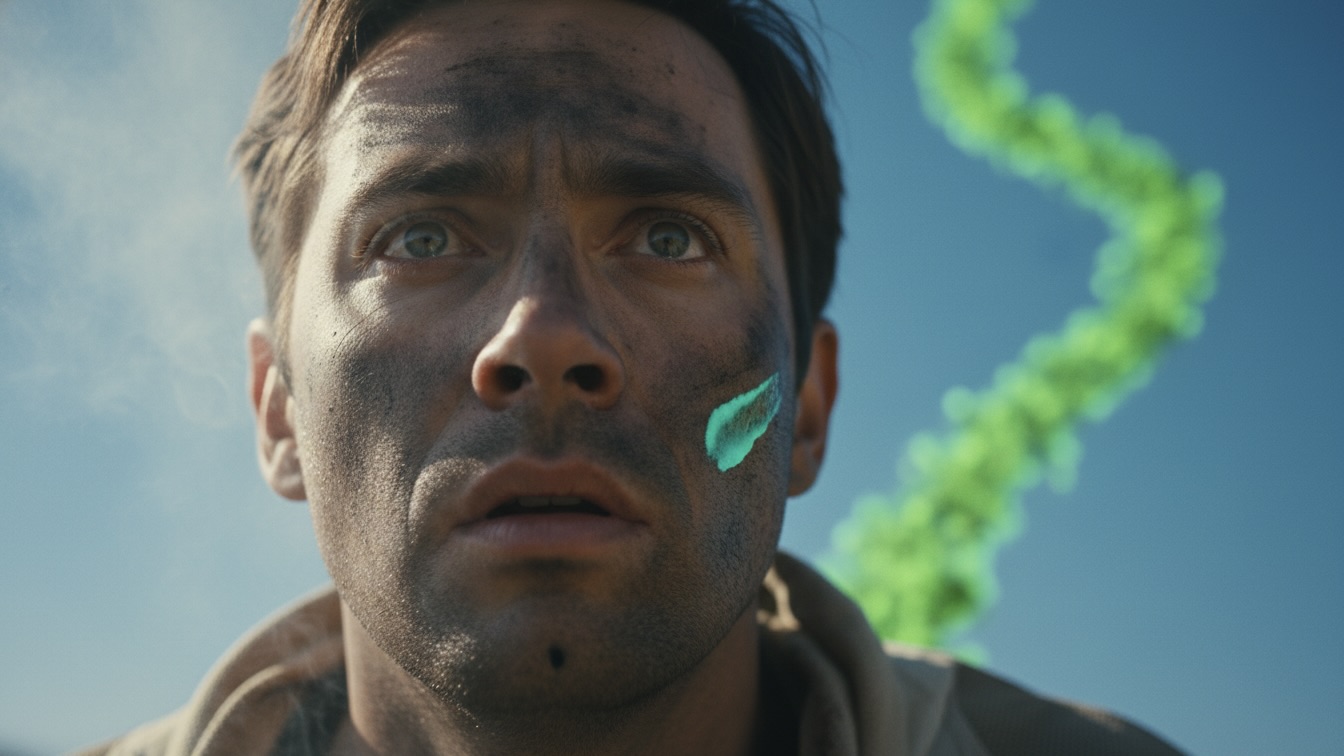
Tomas watches his bees bring back glowing chemicals before a black-clad team arrives to steal his lethal hive data.
"You’re doing that thing where you stare at the sky like it’s going to personally apologize to you," Janet said. She didn't look up from her tablet. She was leaning against the edge of the rooftop garden, her boots scuffing the white gravel. The sun was a bright, aggressive coin over the city, and the spring air smelled like a mix of cherry blossoms and industrial bleach.
Tomas didn't move. He kept his eyes on the silver glints cutting through the upper atmosphere. They weren't planes. They were too fast, too quiet. They looked like needles stitching a wound in the blue. "They’re scouting, Janet. Look at the flight paths. They’re mapping the grid."
"Everyone is mapping the grid. That’s just life in 2026. Data is the only thing we actually produce anymore," she replied, her voice dry. She finally looked up, squinting. "Is that a new filter on your glasses or is the sky actually that color?"
"It’s the bees," Tomas said, his voice dropping. He pointed toward Hive Three. The landing board was crowded. Usually, the workers came back dusty with yellow or pale orange dust. Today, they were landing with legs coated in a vibrant, glowing neon green. It looked like radioactive lint. "They’ve been hitting the chemical plant on the East Side. The one that’s supposed to be decommissioned."
Janet walked over, her curiosity finally overriding her irony. She leaned down, her shadow falling over the hive. "That’s not pollen. That looks like... highlighter fluid."
"It’s synthetic enzyme residue," Tomas said. He opened the top of Hive Three. He didn't use smoke. He didn't need to. The bees were sluggish, moving in strange, geometric circles rather than their usual chaotic dance. "They’re bringing it back and mixing it with the royal jelly. Look at the cells."
Deep inside the frame, the honey wasn't golden. It was a thick, translucent teal. It pulsed. Tomas felt a cold knot tighten in his stomach. He’d seen the simulations. This wasn't food. It was a catalyst. The bees weren't just making honey; they were refining a biological compound that shouldn't exist in nature.
"It’s pretty," Janet whispered. "In a 'we're definitely going to die' kind of way."
"It’s a weapon," Tomas said. "The hive isn't just a hive anymore. It’s a printer. They’re using the bees to manufacture something stable enough to transport but volatile enough to..."
He stopped. A low, thrumming sound began to vibrate through the soles of his shoes. It wasn't the city’s usual white noise. It was a deep, sub-bass growl that made his teeth ache. In the sky, the silver glints dropped altitude. The jet engines didn't roar; they whined at a frequency that felt like a drill entering his skull.
The bees reacted instantly. The hive didn't just buzz. It screamed. Thousands of tiny wings vibrated in unison, syncing with the engine noise. Tomas felt the world tilt. The white gravel of the rooftop began to look like pixels. He saw Janet, but her face was trailing a half-second behind her movements, a ghosting effect like a bad monitor.
"Tomas?" Janet’s voice sounded like it was underwater. "I feel... weird. The air tastes like copper."
"Get back," Tomas groaned, clutching his head. The vibration was a physical weight. He saw images flashing in the air between him and the hives—maps of the city, thermal heat signatures, red circles blooming over the downtown sector. The bees were projecting the data. Their collective neural network was being hijacked by the frequency of the jets. They weren't just bees anymore; they were a living hard drive being accessed by a remote server.
"They’re here," a voice cracked through the static of the hum.
Tomas spun around. Three figures in matte black tactical gear were already over the ledge. No ropes. No sound. They had scaled the forty stories with suction-grip gloves. They looked like insects themselves, their helmets smooth and faceless.
"Step away from the units," the lead figure said. His voice was modulated, a flat electronic bark. This was The Handler. He didn't have a name, just a function.
"These aren't your units," Tomas said, his heart hammering against his ribs. He reached for the heavy metal hive tool in his belt. It was a pathetic weapon against carbon-fiber armor, but his hand moved on instinct.
"The biological data in Hive Three is property of the state," The Handler said. He stepped forward, the gravel crunching under his heavy boots. "You’ve done a great job, Tomas. The mutation exceeded our projections. Now, move."
"You're killing them," Janet yelled, her voice shaking. "The bees are dying in the streets. I saw them this morning. They’re falling out of the sky in the same patterns your drones are flying!"
"Collateral," The Handler said. He raised a stun-baton. The tip crackled with blue light. "Last warning. We take the jelly, or we take you too."
Tomas looked at the hives. He looked at the neon-stained workers struggling to stay airborne. They were his. He’d spent three years on this roof, breathing their scent, learning their moods. He knew what they were capable of when they were threatened.
"Janet, get behind the water tank," Tomas said quietly.
"What? Tomas, they have guns!"
"Do it now!"
Tomas didn't wait. He didn't think. He slammed his hive tool into the side of Hive Three, not prying it open, but shattering the side panel. Then he did the same to Hive Four and Five.
"What are you doing?" The Handler lunged forward.
"Giving them a target!" Tomas screamed. He grabbed a handful of the teal royal jelly—it felt like cold, electrified slime—and flung it at The Handler’s chest. The substance clung to the black armor, glowing with a fierce, unnatural light.
The hum from the sky reached a breaking point. The bees didn't fly; they exploded out of the shattered hives like a storm of sparks. They didn't go for the flowers. They didn't go for the water. They went for the teal glow.
It was a physical collision. A wall of vibrating, stinging bodies slammed into the retrieval team. The sound was a roar. The Handler disappeared under a cloud of black and neon green. He screamed, a human sound that cut through the electronic modulation of his helmet. He stumbled back, his hands clawing at the air, but the bees were inside the seams of his suit, under the collar, behind the visor.
Tomas dove for the gravel as the other two team members opened fire. Not with bullets, but with high-frequency sonic bursts. The air rippled. Tomas felt the breath knocked out of him. He crawled toward the edge of the roof, his fingers digging into the dirt of the planter boxes.
"Tomas!" Janet was huddled behind the steel tank, her eyes wide.
The rooftop was a chaos of sound and motion. The sun felt too bright, the shadows too sharp. The bees were a living cloud, a defensive screen that moved with a terrifying, singular intelligence. They weren't just stinging; they were clogging the air intakes of the soldiers' helmets, gumming up their sensors with the thick, neon wax.
The Handler was on his knees now, a buzzing statue. The teal jelly on his chest was a beacon.
Suddenly, the ground shook.
It wasn't the jets. It was a deep, tectonic shudder that came from the center of the city. Tomas looked over the ledge. A mile away, a pillar of white light erupted from the city center. There was no fire at first, just a silent, expanding sphere of distorted air.
"The strike," Tomas whispered. The air hit him a second later—a hot, dry blast that smelled like scorched metal. It knocked him flat on his back.
He looked up. The bees were no longer attacking. They were rising. Thousands of them, a shimmering neon pillar against the blue spring sky. They weren't flying toward the flowers. They were flying away from the blast, their tiny bodies forming a perfect, geometric arc that pointed directly toward the safest exit from the city.
They had been trying to show him the whole time. The deaths, the patterns, the neon pollen—it wasn't a mutation. It was a map.
"Janet, we have to go," Tomas said, pushing himself up. His knees felt like water. The retrieval team was gone, vanished into the smoke or fled back over the ledge. The Handler lay motionless, covered in a shroud of dead bees.
"Where?" Janet asked, her face pale and streaked with soot. "The whole center is gone."
Tomas pointed to the sky, to the neon trail the swarm was leaving in the air. "We follow them. They’ve already figured out where the next one is going to hit."
He looked back at the shattered hives. The spring blossoms were being scorched black by the heat of the distant fire, but the bees were already miles away, a glowing green thread in the gathering dark.
He realized then that the utopian city wasn't built for people. It was built for the data. And the data had just decided to leave.
“He realized then that the utopian city wasn't built for people; it was built for the data, and the data had just decided to leave.”


