The narrative opens in the oppressive, early morning hours within a decaying Victorian estate overlooking Lake Superior. Randy, a grieving widower, finds himself paralyzed by the sensory details of his environment, convinced that the house is a predatory entity consuming his possessions and memories. His internal monologue reveals a deep-seated despair, as he interprets the scratching in the walls and the peeling wallpaper as signs of a sentient, hungry architecture. He feels trapped in a frozen psychological state, mirrored by the bleak, unyielding spring landscape outside his window.
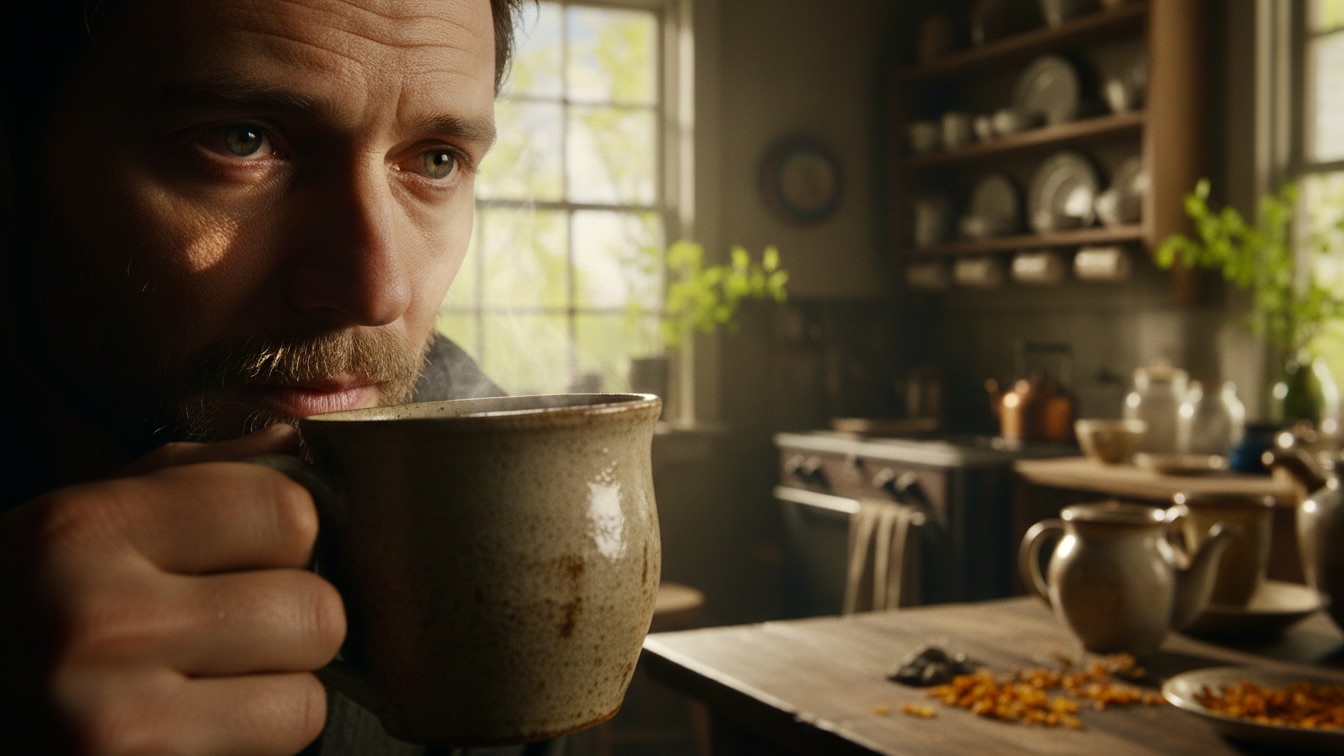
The tension shifts when Randy is summoned to the kitchen by Ida, a pragmatic and sharp-tongued woman who disrupts his melancholic isolation. She forces him to engage in the tactile, grounding task of cleaning Labrador tea leaves, a plant known for its resilience in harsh, acidic environments. During this interaction, Ida confronts Randy about his self-imposed isolation, dismissing his supernatural fears as "low-key toxic" manifestations of his grief. She challenges his perception of the house as a monster, suggesting instead that he is starving his own mind of new experiences.
The climax of the domestic scene occurs when Ida proves that the terrifying scratching Randy heard was merely a squirrel nesting in the eaves. This revelation provides Randy with a moment of profound psychological clarity and a rare spark of hope, as he begins to see the world as a place of physical reality rather than metaphysical dread. He feels a sense of presence and warmth for the first time in months, signaled by the bitter, medicinal tea. However, the chapter concludes with a chilling subversion of this newfound peace as the locked front door swings open on its own, reintroducing the element of the uncanny.
The central theme of the story is the struggle for resilience amidst environmental and emotional decay. This is most poignantly illustrated through the metaphor of the Labrador tea, a plant that thrives in the acidic, unforgiving muskeg. Ida uses the plant to teach Randy that survival often requires a "suit of armor," represented by the rusty, wooly underside of the leaves. The narrative suggests that life can persist even in the most inhospitable conditions, provided one is willing to embrace the bitterness of reality rather than retreating into the fog of memory.
Another significant theme is the distortion of reality through the lens of grief. Randy’s psychological state has transformed his home into a "ribcage," a living organism that eats his history. This externalization of internal pain is a classic Gothic trope, where the setting reflects the protagonist's fractured psyche. By interpreting a common rodent as a malevolent haunting, Randy illustrates how trauma can lead to a loss of agency, making the sufferer feel like a victim of their surroundings rather than an inhabitant of them.
Finally, the story explores the tension between the mundane and the supernatural. For most of the chapter, the narrative leans toward a psychological explanation for Randy’s distress, with Ida serving as the voice of reason and grounding. She demystifies the "ghosts," replacing them with the tangible struggles of a limping squirrel and the need for home repairs. Yet, the final sentence abruptly reinstates the possibility of the paranormal, suggesting that while some fears are imagined, the world remains fundamentally unpredictable and occasionally inexplicable.
Randy is a man consumed by the inertia of profound loss. His psychological state is characterized by a high degree of sensory sensitivity and a tendency toward catastrophic thinking. He perceives his environment as hostile and predatory, which serves as a defense mechanism to avoid the more painful, internal reality of his wife's absence. By blaming the house for "taking" his memories, he avoids the terrifying realization that his own mind is failing to hold onto them.
His journey in this chapter is one of temporary grounding. The act of cleaning the tea leaves forces him out of his head and back into his body, allowing him to experience the "stinging reality" of the present. When he realizes the scratching was just a squirrel, he experiences a moment of genuine psychological integration. He moves from a state of "disappearing" to feeling "heavy" and "present," indicating a fragile but significant shift toward recovery and a desire to engage with the physical world again.
Ida serves as the narrative’s foil to Randy’s passive despair. She is characterized by her "brutal efficiency" and her refusal to indulge in Randy’s gothic fantasies. Her language is modern and blunt, using terms like "glitching" and "toxic" to strip the romanticism away from Randy’s mourning process. She represents the harsh, medicinal necessity of the Labrador tea itself—bitter and abrasive, but ultimately life-sustaining.
She functions as a lay-psychologist for Randy, diagnosing his isolation as a "trap" and forcing him to confront the "rodents" in his life. Her use of the iron skillet to scare away the squirrel is a symbolic act of reclaiming the domestic space from the imaginary monsters of grief. While she appears cold, her actions are motivated by a deep, unspoken care for Randy’s well-being. She understands that he does not need comfort; he needs to be shocked back into the reality of his own existence.
The author employs a heavy use of Gothic atmosphere and sensory imagery to establish a mood of oppressive decay. The description of the house "leaning" toward the lake and the wallpaper looking like "dead skin" creates an immediate sense of unease. These metaphors blur the line between the organic and the inorganic, making the setting feel uncomfortably alive. The juxtaposition of the "black skeletons" of trees against the "grey slate" of the lake reinforces the theme of a world frozen in a state of emotional winter.
Pacing in the narrative is deliberate, moving from the slow, internal dread of the bedroom to the sharp, rhythmic activity of the kitchen. The sounds of the house—the "frantic" scratching and the "screech" of the chair—are contrasted with the "gunshot" sound of Ida slamming the tea leaves onto the table. This shift in auditory texture mirrors Randy’s movement from a dreamlike state of dissociation into the jarring clarity of the present moment. The sensory details of the tea, including its smell of "earth's blood" and its "turpentine" taste, provide a grounding anchor for both the character and the reader.
The narrative voice is closely aligned with Randy’s perspective, allowing the reader to experience his paranoia firsthand. However, the introduction of Ida’s dialogue provides a necessary counter-narrative that challenges the protagonist’s reliability. The final sentence is a masterstroke of pacing and tone, as it suddenly upends the established psychological resolution. By ending on the image of the heavy oak door creaking open, the author leaves the reader in a state of cognitive dissonance, effectively mirroring Randy’s own precarious grip on reality.


