The ink bled down the velvet walls, smelling of cheap musk and the heavy rot of thirty years.
The floorboards were cold. Not just a drafty cold, but a deep, structural ice that sank directly into the bursitis in Lee-Anne’s left hip. She opened her eyes. The ceiling above her was high, crusted with plaster rosettes that looked less like flowers and more like fungal growths. She lay there for a long time, listening to her own breathing. It was ragged. Her chest felt tight, the way it did when she drank too much coffee on an empty stomach. She pressed her palms flat against the wood. It felt gritty. Dust and time.
She sat up, her joints popping in the quiet. She was sixty-two years old, wearing the faded gray sweatpants she usually slept in, but she wasn't in her apartment. She was sitting in the grand foyer of a Victorian mansion.
The house was dying. She knew this immediately, the same way a person knows a piece of fruit has turned just by the weight of it in their hand. The walls were lined in a heavy, crushed maroon velvet. It was a suffocating fabric, the kind of material that swallowed light and held onto odors for decades. Right now, it was holding onto a very specific smell.
Lee-Anne’s stomach turned over. A hard, sour clench right beneath her ribs.
It was his cologne. Not a subtle scent. It was the sharp, synthetic blast of cheap musk, rubbing alcohol, and fake pine. The stuff that cost twelve dollars at the pharmacy. Arthur had bought it by the gallon, splashing it on his neck every morning for thirty-four years to cover the smell of stale cigarettes. Here, in this rotting hallway, the scent was so thick she could practically taste it on the back of her tongue. It tasted like ash and disappointment.
She pushed herself up from the floor. Her knees ached. She grabbed the edge of a heavy oak console table to steady herself. Her fingers brushed against a sticky residue. She looked down.
The walls were bleeding.
From the seams where the velvet met the heavy crown molding, thick black ink was seeping out. It didn't gush. It crawled. It formed slow, heavy teardrops that slid down the fabric, leaving permanent, greasy stains. The ink smelled like iron and old, wet paper. It smelled like unpaid bills, angry letters never sent, and silence.
An omniscient observer, floating above the dust motes in the stagnant air, would recognize the architecture of this place. It wasn't built with bricks and mortar. It was built with thirty-four years of compromised boundaries. The foundation was settling into the mud of passive aggression. The heavy oak beams were carved from the long, silent dinners where the only sound was the scraping of forks. The velvet was the suffocating weight of keeping up appearances.
Lee-Anne wiped her sticky fingers on her sweatpants. She looked down the long, dim corridor. The light in the house was bad. It wasn't just dark; it was yellowed, like an old photograph left in the sun. The air was thick. Every breath felt like drawing water into her lungs.
"Okay," she said aloud. Her voice sounded flat in the massive space. It didn't echo. The velvet ate the sound.
She started walking.
Her cheap foam slippers slapped lightly against the warped floorboards. She passed a doorway on her left. The kitchen. She didn't look inside, but she felt the draft coming from it. She remembered the Tuesday, maybe fifteen years ago, when he had thrown the coffee mug. It hadn't hit her. It had shattered against the drywall two feet to her left. 'I wasn't aiming at you,' he had said, his voice flat, completely devoid of apology. He had left the room. She had cleaned up the shards. The dent in the drywall had stayed there until the day she moved out, a small, permanent monument to his temper.
The ink was flowing faster now. It pooled at the baseboards, a sticky black river.
She walked past another room. The living room. The heavy drapes were pulled shut, but she could see the silhouette of his armchair. The chair where he had sat every evening, staring at the television, unreachable. The chair that had become an island. She rubbed her chest. The tightness was spreading to her throat. Her mouth was dry.
She reached into the pocket of her oversized cardigan, looking for a tissue or a mint. Her fingers brushed against something hard and plastic.
She pulled it out. A yellow Bic lighter.
Lee-Anne stared at it. The plastic was scuffed, the metal guard around the flame slightly bent. She hadn't smoked in twelve years. She had quit the year she turned fifty, a small, desperate attempt to reclaim ownership of her own body. But she had always kept a lighter in her purse. A habit. A comfort. A tiny piece of potential energy.
She gripped it in her hand. The edges dug into her palm. It felt real. Grounded. The only real thing in this hallucination of a house.
Then, the temperature dropped.
It was sudden. The yellow light flickered and dimmed. The air turned brittle. Lee-Anne stopped walking. The hairs on her arms stood up. Her breath plumed white in front of her face.
A sound came from the far end of the hallway.
It sounded like wet leather dragging across rough wood. A slow, heavy slithering.
Lee-Anne didn't run. She stood still, her thumb resting on the cold metal wheel of the lighter. She watched the shadows at the end of the corridor. They were stretching, pooling together, rising from the floorboards like a stain moving in reverse.
The shadow beast was not a monster with scales and teeth. It was worse. It was a dense, shifting mass of absolute lack. It was made of the dark corners of their old bedroom. It was formed from the heavy, suffocating silence of a Sunday afternoon when neither of them had anything left to say. It was tall, stooped, and it moved with a weary, dragging entitlement.
It was stalking her. Not with the frantic energy of a predator, but with the slow, inevitable pace of a bill collector.
Lee-Anne’s heart hammered against her ribs. Her hands started to shake. She squeezed the lighter tighter. The physical reaction was undeniable—her body wanted to flee. Her calves tightened, her jaw clenched so hard her teeth ached.
But she didn't move. She was so tired of running. She was so tired of navigating the labyrinth of his moods.
The beast pulled itself forward. As it moved, the walls bled faster. The black ink poured over the velvet, ruining it completely. The smell of the cheap cologne grew overpowering, making her eyes water and sting.
The thing stopped ten feet away from her.
It didn't have a face, but she could feel it looking at her. It raised one heavy, shifting limb. In its grasp was a bouquet of roses.
They were completely dead.
The stems were brown and brittle, the thorns dull and snapping off. The petals were black, shriveled like old scabs. As the beast held them out, a few petals detached and hit the floor with a dry, clicking sound.
Lee-Anne stared at the flowers. Apology roses. He only ever bought them when he had crossed a line he knew he couldn't talk his way out of. Always grocery store roses. Always wrapped in cheap plastic. They were never a gift; they were a transaction. A down payment on her forgiveness.
The beast shifted. The silence in the hallway stretched, pulled tight like a wire about to snap.
Then, it spoke.
It didn't have a mouth. The voice seemed to vibrate out of the rotting wood and the bleeding walls. It was low, wet, and perfectly familiar. It sounded like him, but hollowed out, stripped of any humanity, leaving only the manipulative core.
"Forever is a trapdoor, babe," the beast croaked.
The word hit her like a physical blow. Babe. The casual, dismissive nickname. It wasn't a term of endearment. It was a leash.
Lee-Anne’s stomach stopped churning. The fear, the somatic panic that had been rattling her bones, suddenly solidified. It crystallized into something cold, hard, and incredibly sharp. Anger.
She looked at the beast. She looked at the dead roses.
Somewhere outside this terrible house, spring was happening. She knew it. She could feel it pressing against the boarded-up windows. The world outside was green and wet and pushing upward through the dirt. But in here, it was nothing but rot and repetition.
"Stop calling me that," Lee-Anne said. Her voice didn't shake this time. It cracked like a whip in the heavy air.
The beast lowered its head, a gesture of mock submission that she recognized all too well. "You promised. Better or worse. You built this with me."
"I survived it," she said. "I didn't build it."
"Forever, babe." The beast pushed the bouquet forward. The brittle stems scraped together. "Take them. You always take them."
She looked at the dead, black petals. She thought about the thirty-four years of taking them. Putting them in a vase. Watching them die on the kitchen counter while he drank beer in the living room. The profound, crushing waste of time. The years she would never get back, spent managing a man who refused to manage himself.
She looked down at her hand. The yellow plastic lighter.
She raised her thumb, resting it on the spark wheel.
"Fuck your forever," Lee-Anne said.
She struck the wheel.
The flint sparked. A tiny, perfect flame sprang to life. It was a small, stubborn spark. Bright orange and blue, burning clean in the heavy, polluted air of the hallway.
The beast recoiled slightly, the shadows rippling away from the light.
Lee-Anne stepped forward. Her knees didn't ache anymore. She didn't feel old. She felt inevitable.
She reached out and thrust the lighter directly into the center of the dead bouquet.
For a second, nothing happened. The dry petals just smoked. And then, they caught.
The fire didn't act like normal fire. It didn't just burn the organic matter. It caught hold of the resentment. It ignited the cheap cologne in the air. The dead roses erupted into a blinding white flare.
The beast dropped the burning bouquet, letting out a sound that wasn't a scream, but a loud, rushing hiss, like a vacuum seal breaking.
The burning roses hit the floorboards. The fire spread outward in a perfect circle, running along the cracks in the wood, finding the black ink that had pooled at the baseboards.
The ink was highly flammable.
The baseboards caught. The flames raced up the walls, consuming the maroon velvet. The heavy, suffocating fabric blistered and blackened, peeling away from the plaster in great, burning sheets. The smell of the cologne was instantly incinerated, replaced by the sharp, clean smell of woodsmoke and ash.
Lee-Anne stood in the center of the hallway. She didn't move.
The fire roared around her. It climbed the walls, licking at the fungal plaster rosettes on the ceiling. The heat was intense, but it didn't burn her. It felt incredible. It felt like standing under a hot shower after walking through a freezing rain. The tightness in her chest dissolved. Her lungs expanded. She took a deep breath of the smoke, and it tasted like freedom.
The shadow beast was thrashing in the flames. But it wasn't burning; it was melting. The structural integrity of the shadows was breaking down. Without the house to contain it, without the velvet and the ink and the smell of the cologne to anchor it, the beast simply lost its shape. It collapsed inward, turning from black to gray, falling to the floor in a pile of fine, tasteless ash.
The house began to fall apart. The massive oak beams, hollowed out by years of silence, cracked and splintered. The roof gave way.
Lee-Anne looked up as the ceiling collapsed.
Instead of falling debris, the roof simply vanished, revealing the sky.
It was dawn.
The fire burned the rest of the walls away, eating the last of the Victorian mansion, leaving nothing but a massive ring of white-hot embers.
Lee-Anne stood in the center, perfectly untouched. The heat faded. The light changed. The yellow, sick cast of the house was gone, replaced by the cool, pale blue of early morning.
The smell of smoke drifted away on a sudden, sharp breeze.
She closed her eyes.
When she opened them again, she was lying in bed.
Her bed. Her mattress, firm the way she liked it. Her lightweight cotton blanket. The room was quiet, save for the hum of the small refrigerator in the kitchenette of her one-bedroom apartment.
She sat up. Her back twinged slightly, a normal, sixty-two-year-old ache, completely disconnected from the freezing dread of the mansion. She swung her legs over the side of the bed. Her feet found the soft, woven rug she had bought for herself last month.
She looked toward the window.
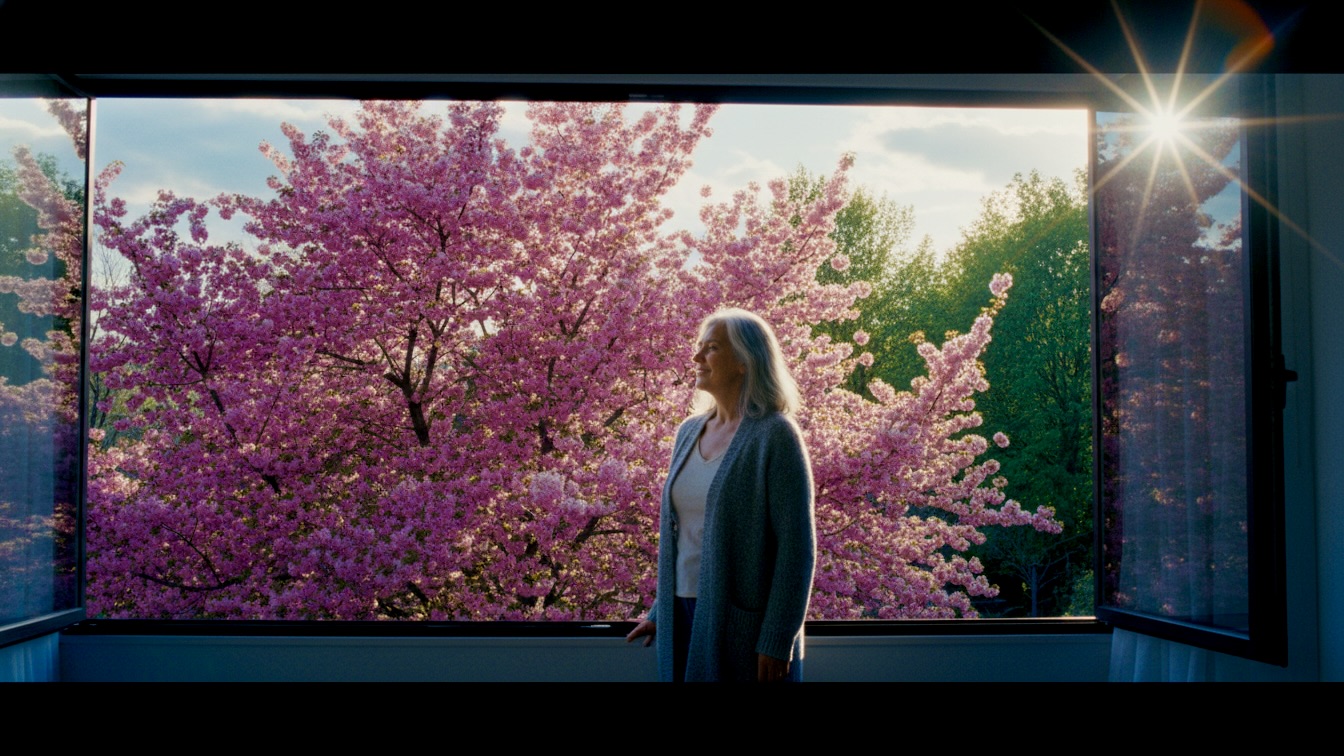
The blinds were open. It was morning. The sun was just coming up over the apartment complex across the street. The light was golden and clear. Outside her window, the large cherry blossom tree was in full, ridiculous bloom. The branches were heavy with bright pink flowers, shaking slightly in the spring wind.
Lee-Anne took a breath. The air in her apartment smelled like fresh coffee grounds and the faint, clean scent of her own lavender soap. There was no cologne. There was no ink.
She looked down at her hands resting in her lap. They were empty. The lighter was gone.
She sat there for a long moment, watching the wind move the pink branches against the bright sky. The heavy, invisible backpack she had been carrying for over three decades—the baggage, the managing, the constant, exhausting translation of another person's moods—was simply gone. It had burned to ash.
A slow, quiet smile spread across her face. She stood up, walked to the kitchen, and started the coffee.
“She sat there for a long moment, watching the wind move the pink branches against the bright sky, finally ready to live.”


