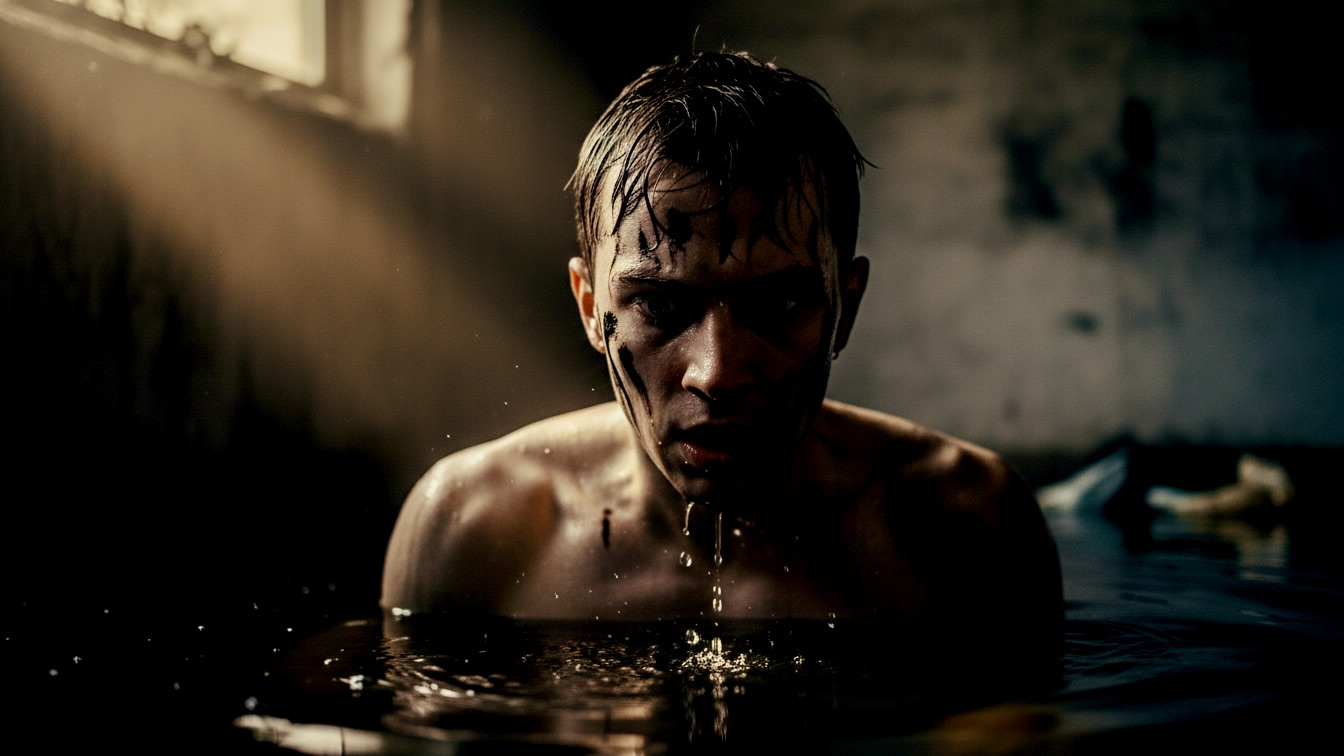
The spring thaw did not bring life to the valley. It only uncovered what the snow had killed.
The mud sucked at Edmund’s boots with the sound of tearing meat. Spring had arrived in the valley not with a gentle thaw, but with a violent, rotting heat. The snowpack on the northern ridge had collapsed over the weekend, sending thousands of gallons of meltwater rushing down the incline. It was supposed to be a relief. After seven months of ice, isolation, and rationing canned goods, the town had prayed for the spring. They had prayed for running water. They got it.
But the snow had been hiding the truth. The old battery manufacturing plant at the top of the ridge, abandoned for two decades, had not survived the winter storms intact. Its containment ponds had frozen, cracked, and finally shattered. Now, the heavy metals, the battery acid, the industrial runoff—it was all mixing with the pristine snowmelt. The water rushing into the valley basin was toxic. It was a slick, oily black. It smelled like sulfur and old copper pennies. And it was draining directly into the town’s primary aquifer.
Edmund stopped at the edge of the churchyard. His lungs burned. He breathed in. Once. Twice. The air tasted metallic. His jaw was locked so tight his molars ached. He forced his mouth open, rubbing the hinge of his jaw with a dirt-stained thumb. His right foot tapped a frantic, irregular rhythm against a submerged gravestone. He looked up at St. Jude’s.
The pioneer church was a rotting wooden carcass. Built in the late nineteenth century, it had been sinking into the soft valley earth for decades. The white paint had flaked away, leaving gray, splintered siding. The steeple had collapsed three years ago during a windstorm, leaving a jagged hole in the roof that made the building look like it had been decapitated. Now, surrounded by a moat of black meltwater, it looked less like a sanctuary and more like a tomb.
Inside the town limits, half a mile behind him, people were dying. It started three days ago. The water from the taps had turned a cloudy gray. Then came the stomach cramps. Then the black vomit. The violent tremors. The rapid organ failure. Seven people were already dead, laid out in the high school gymnasium because the ground was still too frozen to dig graves. Thirty more were sick. Edmund’s younger brother was one of them.
Edmund wiped his nose on the sleeve of his jacket. The fabric was stiff with dried mud and sweat. He did not have time to stand here. He needed the keys.
He stepped off the gravestone and waded into the yard. The water immediately crested his boots. The cold was a physical shock. It punched through his thick socks, biting into the skin of his ankles. He gasped, his breath hitching in his throat. The temperature of the runoff was barely above freezing. He forced his legs to move, pushing through the resistance of the black water. Every step stirred up clouds of decayed leaves and foul-smelling silt.
The heavy oak doors of the church were warped. Edmund grabbed the rusted iron handle and pulled. The wood groaned, scraping loudly against the swollen frame. He threw his shoulder into it. The door gave way with a crack, and he stumbled into the narthex.
It was dark inside. The air was thick, suffocatingly humid, and smelled of wet rot and mildew. The floorboards squished under his weight. He bypassed the main sanctuary, ignoring the rows of empty, water-damaged pews. He headed straight for the narrow doorway at the back. The stairs to the basement.
The basement was where the town kept the emergency radio. It was a military-surplus ham setup, powered by a heavy-duty solar bank on the roof. It was their only link to the outside world. The only way to call for medical evacuation. The only way to get the state government to send helicopters, clean water, or doctors.
Stefan had the keys.
Stefan was the town elder. He was the one who had organized the rationing. He was the one who had secured the perimeter when the roads washed out. And he was the one who had locked the comms room, claiming they needed to assess the situation before causing a panic.
Edmund stood at the top of the basement stairs. The water had completely flooded the lower level. It was pooling on the fourth step from the top. He could hear the soft, rhythmic sloshing of water against concrete down below. He could also see a faint, flickering light. A battery-powered lantern.
Edmund started down the stairs.
The water hit his shins. Then his knees. The cold was absolute. It felt like his legs were being crushed in a vise. His muscles seized up, vibrating violently as his body tried to generate heat. He gritted his teeth, tasting blood where he had accidentally bitten his cheek. He kept moving.
He reached the bottom of the stairs and waded out into the flooded basement. The ceiling was low, lined with exposed pipes and cobwebs. The water was knee-deep everywhere. Across the room, illuminated by the harsh white glare of an LED work lantern, was Stefan.
Stefan was standing on a makeshift island of stacked wooden pallets, keeping his boots dry. He was wearing a heavy canvas coat over a faded gray sweater. He had a wrench in his hand. He was staring at the wall where the town’s central water filtration manifold was mounted.
Stefan turned his head slowly as Edmund splashed toward him. The older man’s face was deeply lined, his eyes hidden in the shadows of his brow. He did not look surprised.
"You shouldn't be down here, Ed," Stefan said. His voice was calm. Too calm. It scraped against the damp acoustics of the basement.
"Give me the keys," Edmund said. His voice shook. He hated that it shook. The cold was getting to his chest, making his breaths short and jagged.
Stefan set the wrench down on a dry crate. He wiped his hands on a greasy rag. "The water is freezing. You're going to get hypothermia. Go home."
"My brother is throwing up blood," Edmund said, stepping closer. The water rippled violently around his legs. "Half the town is throwing up blood. The wells are poisoned, Stefan. The runoff from the battery plant got into the aquifer."
"I am aware of the contamination," Stefan said. He tossed the rag onto the crate. He looked down at Edmund, standing in the black water. There was no pity in his eyes. Just a cold, calculating distance.
"Then give me the keys to the radio room," Edmund said. He held out a trembling, numb hand. "We have to call it in. We need medevac. We need clean water trucked in. We have to call the state."
"No."
Edmund froze. His hand stayed suspended in the air. The silence in the basement stretched out, broken only by the dripping of condensation from the ceiling.
"What did you say?" Edmund asked. His stomach turned over. A sick, hot feeling flooded his chest, fighting the cold of the water.
"I said no," Stefan repeated. He picked up the lantern, shifting the harsh light so it hit Edmund directly in the eyes. Edmund squinted, turning his head slightly. "We aren't calling anyone. We aren't bringing the outside world into this valley."
"People are dying!" Edmund yelled. The sound bounced off the concrete walls.
"People die, Ed. That is the nature of a closed system," Stefan said. His voice took on a pedantic, lecturing tone. It was the same tone he used in town meetings. It made Edmund want to hit him. "This town has been soft for too long. We rely on the grid. We rely on supply chains. We rely on the state to save us when the weather turns. That is weakness."
Edmund stared at him. The words sounded like static. It was cognitive dissonance. He could not process what he was hearing. "You're talking about a purge. You're letting them die."
"I am letting nature run its course," Stefan corrected. He stepped to the edge of the pallet, looking down at the black water swirling around Edmund’s knees. "The sickness will take the weak. The old, the frail, the ones who cannot adapt. The ones who survive will be immune. They will be strong. If we call the state, they will come in with their helicopters and their regulations. They will put us in camps. They will take our autonomy. I won't let that happen."
"You're insane," Edmund breathed. The tapping of his foot had stopped. His entire body was rigid. "You are literally out of your mind."
"I am the only one thinking clearly," Stefan shot back. The calm facade cracked, revealing a harsh, paranoid edge. "You are a weak-minded sheep, Edmund. You just want someone to come and fix it for you. You want a savior in a helicopter. There are no saviors. There is only the valley. And the valley requires a toll."
Edmund’s eyes darted away from Stefan’s face. He looked past the older man, toward the wall. Toward the water filtration manifold.
The town had pooled its money five years ago to install a heavy-duty reverse osmosis system in the church basement, tapping directly into the main aquifer line before it branched out to the houses. It was supposed to filter out heavy metals. It was supposed to handle exactly this kind of emergency.
Edmund squinted past the glare of the lantern. The thick PVC pipes were intact. But the heavy, industrial carbon blocks—the massive cylindrical filters that did the actual cleaning—were scattered on the concrete ledge behind the manifold.
They weren't just removed. They were destroyed.
Edmund waded a step closer, ignoring Stefan. He stared at the filters. The plastic casings were shattered. The densely packed carbon inside was exposed, cracked into useless chunks. Next to the debris lay a heavy steel sledgehammer.
Edmund felt the blood rush to his ears. The sound was like a rushing river, drowning out the dripping water.
He looked at the manifold again. A thick, flexible bypass hose had been clamped into place, connecting the intake valve directly to the outflow pipe. The toxic water was bypassing the system entirely.
Stefan hadn't just refused to call for help.
Stefan had poisoned them.
"You bypassed the filter," Edmund said. His voice was a hollow whisper.
Stefan did not answer immediately. He looked back at the wall, then back to Edmund. "The system was failing anyway. It was delaying the inevitable."
"You smashed the carbon blocks," Edmund said, his voice rising, scraping against his throat. He pointed a numb, shaking finger at the debris. "You deliberately let the runoff into the drinking supply. You did this. You killed them."
"I accelerated the process!" Stefan barked, stepping forward on the pallet. "I ripped the band-aid off! We were dying a slow death of dependence. Now, we will be forced to adapt. To find new springs. To become resilient."
Edmund looked at Stefan’s chest. The heavy canvas coat. Hanging from a metal zipper pull on the coat was a braided paracord lanyard. At the end of the lanyard, resting against Stefan’s stomach, were two heavy brass keys. The keys to the comms room.
The cold in Edmund’s legs vanished. It was replaced by a sudden, terrifying heat. It started in his gut and flashed upward, locking his jaw, tightening the muscles in his neck. He felt a profound, chemical shift in his brain. The panic, the desperation, the fear for his brother—it all evaporated, leaving behind a sharp, singular focus.
He needed the keys.
"Give me the keys," Edmund said. It wasn't a request anymore. It was a flat, dead statement.
Stefan sneered. He reached up and tucked the keys inside his coat, zipping it up to his chin. "Go home, Ed. Be with your brother. Pray for him. But you are not touching that radio."
Edmund moved.
He didn't think about it. The cognitive static cleared out completely. He lunged forward, throwing his entire body weight against the resistance of the knee-deep water.
Stefan’s eyes widened. He tried to step back, but the wooden pallets were slick with moisture. Edmund crashed into him, grabbing the heavy canvas coat. The momentum carried them both backward off the island of pallets.
They hit the black water with a massive, echoing splash.
The shock of total immersion knocked the breath out of Edmund. The water was like liquid ice. It filled his ears, his nose, his eyes. It tasted like blood and poison. He thrashed, his heavy boots finding the concrete floor. He pushed himself up, dragging Stefan with him.
Stefan fought back violently. The older man was wiry and fueled by paranoid adrenaline. He slammed a fist into the side of Edmund’s head. White light flashed in Edmund’s vision. His ear rang loudly. He stumbled back, losing his grip on the coat.
"You stupid kid!" Stefan screamed, spitting black water. He scrambled backward, trying to get back to the pallets.
Edmund didn't stop. He dove forward again, tackling Stefan around the waist. They went down a second time.
This time, Edmund ended up on top.
The water was churning, thick with mud and debris. Edmund pinned Stefan’s shoulders to the concrete floor. The water was deep enough here that Stefan’s face was fully submerged.
Stefan bucked wildly. His hands came up, clawing at Edmund’s face, tearing at his cheeks. Edmund squeezed his eyes shut against the pain. He locked his elbows, pressing his entire weight down onto Stefan’s chest.
Beneath him, Stefan was screaming under the water. The sound was muffled, a series of panicked, gargling bubbles breaking the surface.
Edmund felt a surge of pure, violent adrenaline. He opened his eyes. The work lantern on the crate cast long, harsh shadows across the churning water. He watched Stefan’s face through the distorted, oily surface. The older man’s eyes were wide, bulging with terror. His mouth was open, taking in the toxic water he had forced upon the town.
He killed them, Edmund thought. The thought was crystal clear. He killed my brother. He deserves this.
Stefan’s thrashing became more frantic. He was suffocating. The cold was shutting his body down. His hands scrabbled uselessly against Edmund’s forearms, the grip getting weaker.
Edmund watched the bubbles. He felt the darkness inside him, the brutal, pragmatic calculus of survival. Stefan was right about one thing: the valley required a toll.
Just a few more seconds, Edmund thought. Just hold him down.
But then the image of his brother, coughing up black bile on a cot in the gymnasium, flashed into his mind. If he killed Stefan here, if he drowned him in this basement, he was no better. He was just another monster in the dark.
Edmund gasped for air, his own lungs burning. He shifted his weight, pulling Stefan up by the collar of his coat.
Stefan broke the surface, hacking violently. He choked on the water, his body convulsing as he vomited black fluid onto Edmund’s chest. He went limp, his head lolling back against the water. He was conscious, but completely spent. The fight was gone.
Edmund straddled him, breathing in ragged, loud bursts. His hands were shaking so hard he could barely control them. He reached down to the collar of Stefan’s coat. He found the zipper. He yanked it down.
He dug his numb fingers inside the wet canvas. He found the braided paracord lanyard. He pulled hard. The cord snapped against the back of Stefan’s neck, breaking free.
Edmund held the heavy brass keys in his fist. The metal dug into his palm. It grounded him.
Stefan lay in the freezing water, coughing weakly. He looked up at Edmund, his eyes glassy and defeated. "You're making a mistake," he wheezed. "They'll take everything."
"Shut up," Edmund said. His voice was raw.
Edmund stood up. His legs felt like lead. The cold had permeated his bones. Every movement was a massive effort. He turned his back on Stefan and began to wade toward the stairs.
The water was thick. It pulled at him, trying to drag him back down. He kept his eyes on the doorway at the top of the stairs. The keys clinked against each other in his clenched fist. A harsh, metallic sound in the damp darkness.
He reached the bottom of the stairs and began to climb. He didn't look back at the older man shivering in the black water. The radio was waiting.
“He turned the heavy brass key in the lock, but the comms room door was already swinging open.”


