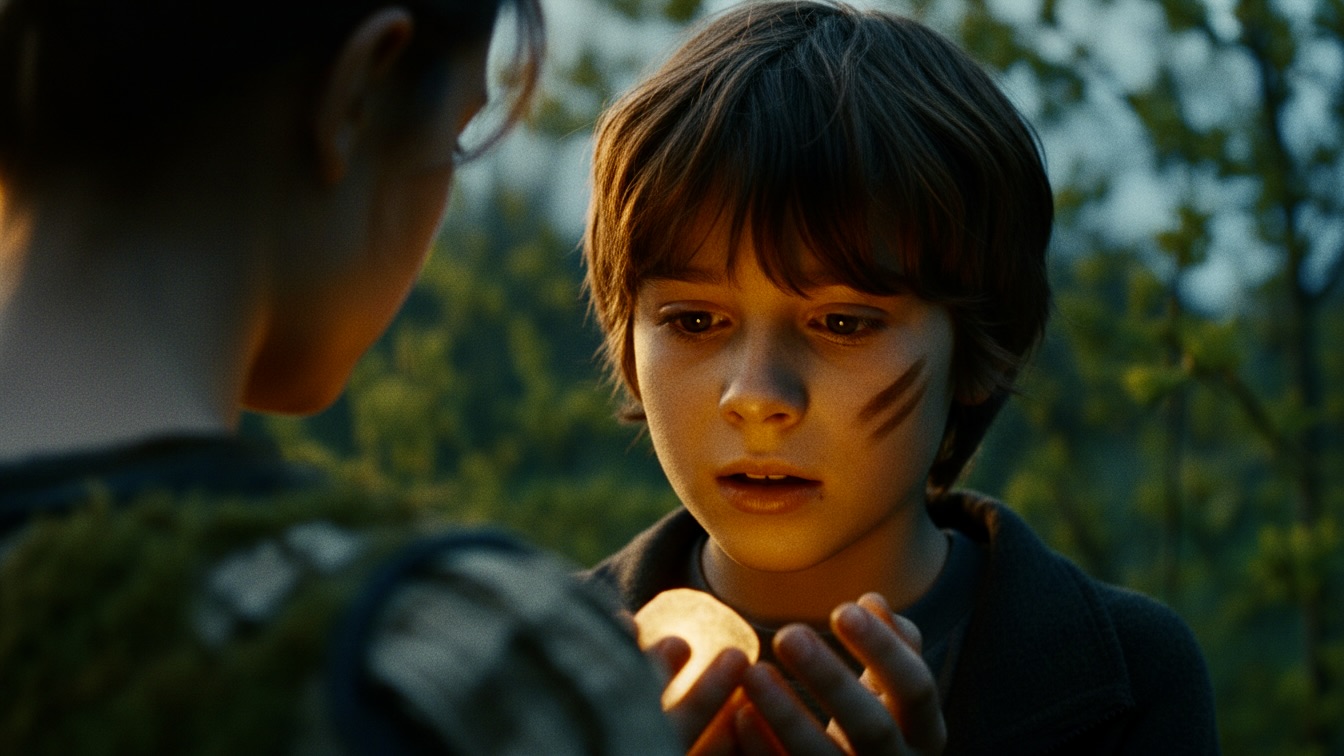
A Saturday morning at the flea market turns into a survival sprint when the crowd begins tearing itself apart.
The air inside the Mill Creek Fairgrounds felt damp. It was only 9:15 AM on a Saturday in April, but the humidity was already crawling up the back of Leo's neck. He adjusted the strap of his messenger bag, feeling the weight of his camera against his ribs. Beside him, Mia was scrolling through her phone, her thumb moving in a rhythmic, bored blur. She was wearing a vintage oversized denim jacket that made her look smaller than she was. Around them, the flea market was a crush of bodies. People were elbowing past each other to get to tables piled with rusted tools, overpriced vinyl, and plastic bins of Lego bricks. It was the first big outdoor swap of the spring, and the suburban desperation for a bargain was a physical force.
"Do we actually need to be here?" Mia asked. She didn't look up from her screen. "I feel like I'm breathing in someone's attic dust."
"I need that 50mm lens," Leo said. He scanned the rows of blue and silver tarps spread across the grass. "Old Pete said he'd have it. If I get it now, I can shoot the blossoms at the park before they fall."
"The blossoms are just going to look like every other year, Leo. Pink and dead in a week."
Leo didn't answer. He liked the pink. He liked the way the spring light hit the concrete, making everything look less like a dump for ten minutes a day. He pushed past a man in a camouflage hat who was arguing over the price of a weed whacker. The crowd felt tighter than usual. It wasn't just the number of people; it was the way they were moving. There was a jittery energy to the foot traffic. People weren't just browsing; they were vibrating.
At a table near the center of the row, a woman in a bright yellow cardigan was staring at a pile of costume jewelry. She wasn't picking anything up. She was just leaning over the table, her face inches from a tangled nest of fake pearls. Her shoulders were twitching. It looked like she was sobbing, but there was no sound. Leo slowed down as they passed her. He caught a glimpse of her profile. Her eyes weren't crying. They were wide, the pupils blown out until there was almost no iris left. Her jaw was working, grinding side to side with a wet, clicking noise.
"Leo," Mia said. Her voice had changed. The boredom was gone. She had stopped looking at her phone. "Look at that guy."
She pointed toward the snack bar, a small cinderblock hut selling hot dogs and lukewarm coffee. A teenager in a red vest—one of the market staff—was standing by a trash can. He wasn't working. He was staring at his own hands. He began to scratch at his left forearm. He wasn't just itching; he was digging. His fingernails were dragging long, red lines through the skin. He didn't flinch. He just kept digging, his expression totally blank, as if he were peeling a potato.
"What is that?" Leo whispered. The sound of the market seemed to shift. The low hum of chatter was being replaced by something sharper. A woman's voice rose in a high, jagged peak of a scream over by the glassware stall. It wasn't a 'help me' scream. It was a sound of pure, unadulterated rage.
Then the first table went over. A heavy oak dresser, being sold by a couple in their fifties, crashed onto its side. The man who had pushed it didn't stop to look. He threw himself onto the woman who had been browsing the drawers. He didn't punch her. He reached for her face with both hands, his fingers hooking into the corners of her mouth.
"Go," Leo said, grabbing Mia’s arm. "We need to go now."
"The exit is that way," Mia pointed toward the main gate, but it was already a choke point. A mass of people was surging toward it, but not everyone was trying to get out. Some were trying to get in. Others were just colliding in the middle, a chaotic knot of tearing fabric and hitting flesh. The air was suddenly filled with the sound of breaking glass. Someone had smashed a case of vintage watches, and the sound seemed to act as a starter pistol. The woman in the yellow cardigan finally stopped twitching. She lunged across the jewelry table, her body crashing through the plastic display cases. She grabbed the vendor by the hair and slammed his head down onto the edge of the table. The sound was like a dry branch snapping.
"Not that way," Leo shouted over the rising din. "The fence. The back fence near the woods."
They turned, but the aisle was a gauntlet. A man in a stained tracksuit was sprinting toward them, his mouth open, trailing a string of greyish saliva. He wasn't looking at them; he was looking through them. Leo swung his messenger bag, the heavy camera body inside connecting with the man's chest. The man didn't even grunt. He stumbled, regained his balance, and immediately tackled a girl who was trying to crawl under a table.
"Don't look, Mia! Just run!" Leo yelled.
They scrambled over a pile of discarded clothes. The smell of the market had changed. The damp cardboard was gone, replaced by the hot, metallic scent of blood and something sharp, like ozone. It felt like the air was thinning. Every breath Leo took felt like he was inhaling needles. The claustrophobia was a physical weight, a ceiling dropping down on them. The stalls felt like a maze designed to keep them trapped. Every turn led to another scene of senseless brutality. A grandmotherly woman was methodically beating a dog with a heavy brass lamp. A group of men were tearing the doors off a van, their hands bleeding from the jagged metal.
"There!" Mia pointed. The chain-link fence was visible behind a row of portable toilets. Between them and the fence was a wide patch of grass where the furniture vendors set up. It was a field of sharp edges—wrought iron bed frames, glass-topped coffee tables, and heavy wardrobes.
They ran. Leo's boots skidded on something wet—spilled soda or something worse. He didn't check. He kept his eyes on the fence. Behind them, the noise was a wall of sound—screaming, the rhythmic thud of feet, the crashing of wood. It sounded like the world was being put through a woodchipper.
Suddenly, someone grabbed Leo's jacket from behind. He was jerked backward, his heels digging into the turf. He spun around to see a middle-aged man with a 'World's Best Dad' mug still clutched in one hand. The man’s face was a mask of strained muscles, his teeth bared. He didn't say a word. He just swung the heavy ceramic mug at Leo's head. Leo ducked, the mug whistling past his ear and shattering against a nearby dresser.
"Get off him!" Mia screamed. She didn't hesitate. She picked up a heavy iron skillet from a nearby display and swung it with both hands. It hit the man in the side of the knee with a sickening crunch. The man collapsed, but he didn't scream. He immediately started trying to crawl toward them using only his fingernails to drag himself across the grass.
"Mia, come on!" Leo hauled her toward the fence.
They reached the chain-link. It was eight feet high, topped with a decorative but sharp fleur-de-lis pattern. Leo dropped his bag and cupped his hands. "Up. Now!"
Mia stepped into his hands and scrambled up the wire. She was fast, her sneakers finding purchase in the diamond gaps. She reached the top, swung her leg over, and dropped to the other side. Leo didn't wait. He jumped, grabbing the cold metal. His fingers burned as he pulled himself up. Below him, three people were closing in. They weren't running; they were loping, a strange, disjointed gait that looked like their bones didn't fit in their sockets. One of them reached for his boot. Leo kicked out, feeling his heel connect with a nose. He didn't feel the impact. He just felt the desperate need for space.
He threw himself over the top. The metal snagged his jeans, tearing a long strip from his thigh, but he didn't care. He hit the ground on the other side hard.
And then, silence.
It was as if a vacuum had been turned on. The sound of the massacre behind the fence was muffled, a dull roar that seemed a thousand miles away. Leo stayed on his knees for a second, gasping. The air was different here. It was the sudden oxygen. It was cool, crisp, and tasted of the pine trees in the woods ahead. The crushing weight that had been sitting on his chest for the last twenty minutes simply evaporated.
He looked up. Mia was standing a few feet away, her hands on her knees, shaking. She looked at him, her face pale, a smear of dirt across her forehead. "Leo?"
"I'm okay," he panted. He stood up, his legs feeling like jelly. He looked through the fence.
On the other side, the madness continued in a silent movie. He saw the woman in the yellow cardigan standing on top of a car, her arms raised to the sky, her mouth open in a silent howl. People were moving in patterns that made no sense, a frantic, swirling tide of violence. But they didn't seem to see the fence. They didn't see Leo or Mia. It was as if the perimeter of the market was a physical barrier for their minds.
Leo turned away from the fence. The park was beautiful. The sun was hitting the new leaves of the oaks, turning them a vibrant, translucent green. A few hundred yards away, a family was setting up a picnic. A toddler was chasing a ball. A golden retriever was barking at a squirrel. It was a perfect Saturday morning in April.
"They don't know," Mia whispered. She was looking at the family. "How do they not know?"
Leo looked back at the fence, then at the peaceful park. The contrast was a physical blow. The violence behind them was so loud, so total, and yet twenty feet away, the world was just... continuing. The spring breeze carried the scent of lilacs from a nearby garden. It felt like a lie.
"We have to tell someone," Leo said, but his voice lacked conviction. He reached into his pocket for his phone. The screen was cracked. He tried to swipe, but the touch sensor was dead.
"My phone is gone," Mia said. "I must have dropped it when I hit the skillet guy."
They stood on the edge of the woods, two dirty, bleeding ghosts in the middle of a postcard. The clarity of the morning was terrifying. Every detail was too sharp—the way the light caught the dew on the clover, the distant sound of a lawnmower, the blue of the sky. It was too bright. It was too quiet.
"Let's get to the car," Leo said. "We'll drive to the police station. Maybe it's just here. Maybe it's just the market."
They started walking along the tree line, keeping the fence to their left. The car was parked in the overflow lot, a dirt patch half a mile up the road. As they walked, Leo couldn't stop looking back. The fence line was a border between two different realities. On one side, the end of the world. On the other, a spring morning.
They reached the edge of the overflow lot. Most of the cars were empty, their owners still inside the chaos. But as they approached Leo’s beat-up silver sedan, he saw a woman sitting on the hood of a nearby SUV. She was wearing a jogging outfit, her AirPods still in her ears. She was looking at her fitness watch, tapping the screen with a frustrated expression.
She looked up as they approached. "Hey," she called out. "Do you guys have a signal? My GPS is acting crazy. It says I’m in the middle of a lake."
Mia stopped. She looked at the woman, then back at the fence, which was now hidden by a line of trees. "You didn't hear anything?"
"Hear what?" the woman asked. She hopped off the SUV. "Is there an event or something? The parking lot is packed."
Leo felt a cold shiver that had nothing to do with the breeze. "You should leave," he said. "Get in your car and drive away from the fairgrounds."
"Why? Is there a leak or something? I smelled something weird a minute ago, like burnt hair."
Leo didn't answer. He unlocked his car and pushed Mia toward the passenger door. He got behind the wheel, his hands shaking so hard he could barely fit the key into the ignition. He cranked the engine. It sputtered, then caught. He didn't look at the jogger as he backed out. He didn't look at the blooming cherry trees lining the exit road.
He turned onto the main highway. For a few miles, everything looked normal. They passed a Starbucks with a line at the drive-thru. They passed a car wash. They passed a church with a sign that said 'Spring Bake Sale Tomorrow'.
"Maybe it's over," Mia said. She was hugging herself, staring out the window. "Maybe it was like a gas leak or something. Something localized."
Leo didn't say anything. He kept his eyes on the road. He was looking for the first sign of a yellow cardigan, or a man digging into his own arm.
They came to a red light at a major intersection. A black sedan was idling in front of them. The driver was a young woman, maybe their age. She was singing along to something, her head bobbing to a beat only she could hear.
Leo watched her in the rearview mirror. Then, he saw it.
She stopped singing. Her head tilted to the side at an impossible angle. Her hands, which had been tapping the steering wheel, began to claw at the leather. She didn't look angry. She looked surprised. Then she turned around and looked directly at Leo through her back window.
Her pupils were gone. Just two black holes in a sea of white.
She didn't scream. She didn't move. She just leaned forward and slammed her forehead into the glass of her own rear window. The glass didn't break. She did it again. And again. The rhythmic thud was the only sound in the quiet car.
Behind them, another car honked. Then another. The sound was a chorus, rising up from the line of traffic. It wasn't an impatient honk. It was a steady, held note of a dozen sirens.
Leo looked at the sidewalk. A man walking a golden retriever had stopped. He wasn't looking at the dog. He was looking at his own hand, which was wrapped tightly around the dog's leash. He began to twist the leather, tighter and tighter, until the dog started to whimper. The man’s face didn't change. He just kept twisting.
"Leo," Mia whispered. "The radio."
Leo reached out and turned the knob. It was already on. A pop song was playing—something bubbly and over-produced. But under the music, there was a sound. A high-frequency hum, like a mosquito trapped in the dashboard. It was getting louder.
"Turn it off," Mia said. "Turn it off!"
Leo hit the power button, but the hum didn't stop. It wasn't coming from the speakers. It was coming from the air. It was coming from the beautiful, clear spring sky.
He looked up through the windshield. The sun was a bright, perfect circle. And then, for a split second, it flickered. Not like a cloud passing over it. Like a lightbulb about to burn out.
In that moment of darkness, Leo didn't see the road or the cars or the screaming people. He saw the truth of the weight he had felt at the market. It wasn't a gas leak. It wasn't a virus.
It was a harvest.
He looked at Mia. She was staring at him, her eyes wide. She wasn't scratching herself. She wasn't screaming. But she was starting to hum. A low, vibrating sound that matched the frequency in the air.
"Mia?" Leo reached for her hand.
She didn't pull away. But she didn't grab back, either. Her fingers were cold. She turned her head toward him, her jaw working side to side, the wet clicking noise starting deep in her throat.
"It's such a nice day," she whispered. Her voice was flat, the words empty of any human inflection. "Don't you think it's a nice day, Leo?"
Leo slammed the car into gear and swerved around the black sedan, his tires screeching against the asphalt. He didn't know where he was going. He just knew he had to keep moving. He looked in the side mirror and saw the jogger from the parking lot. She had followed them. She was running down the middle of the highway, her pace inhumanly fast, her eyes fixed on the back of his car.
He pushed the accelerator to the floor. The car roared, but the hum in the air was louder now, a physical vibration that made his teeth ache. He passed a playground where the children had stopped playing. They were all standing in a circle, holding hands, looking up at the sun.
He didn't look at them. He couldn't. He kept his eyes on the horizon, praying for a cloud, praying for a storm, praying for anything that would break the perfect, terrifying clarity of the spring morning.
But the sky remained blue. The flowers remained in bloom. And the world continued to tear itself apart under the warmth of the April sun.
He reached the bridge that led out of the valley. Usually, you could see the whole city from the top—the glass towers, the river, the parks. He topped the rise and slammed on the brakes.
The city was there. But it wasn't the city he knew.
Smoke was rising in thin, straight columns from a dozen different points. The traffic on the bridge was a tangled mass of metal and fire. And standing on the suspension cables, hundreds of feet above the water, were people. They weren't jumping. They were just standing there, their arms outstretched, like birds waiting for a wind that would never come.
Leo looked at the passenger seat. Mia was gone. Not physically—she was still sitting there. But the person he knew was gone. She was staring at her own reflection in the side window, her fingers tracing the line of her own throat.
"The lens," she said. Her voice was a rasp now. "Did you get the lens, Leo?"
"No," Leo said. He felt a tear track down his cheek, the salt stinging a scratch he didn't remember getting. "I didn't get it."
"That's okay," she said. She turned to him, and for a second, her pupils snapped back into focus. They were filled with a terror so deep it looked like death. "It wouldn't have mattered. There's nothing left to see."
Then the hum reached a crescendo, a sound so loud it felt like his skull was cracking open. The sun flickered one last time and stayed dark. But it wasn't night. It was something else. A heavy, suffocating weight that felt like the earth was closing its eyes.
Leo gripped the steering wheel until his knuckles turned white. He looked out at the darkened world, at the silent city, and at the girl who used to be his best friend.
He realized then that the escape from the market hadn't been a rescue. It had just been a change of scenery. The oxygen he had felt, that sense of clarity and relief, had been the atmosphere of a vacuum.
He closed his eyes and waited for the clicking sound to start in his own throat.
“He realized then that the escape from the market hadn't been a rescue; it had just been a change of scenery.”


