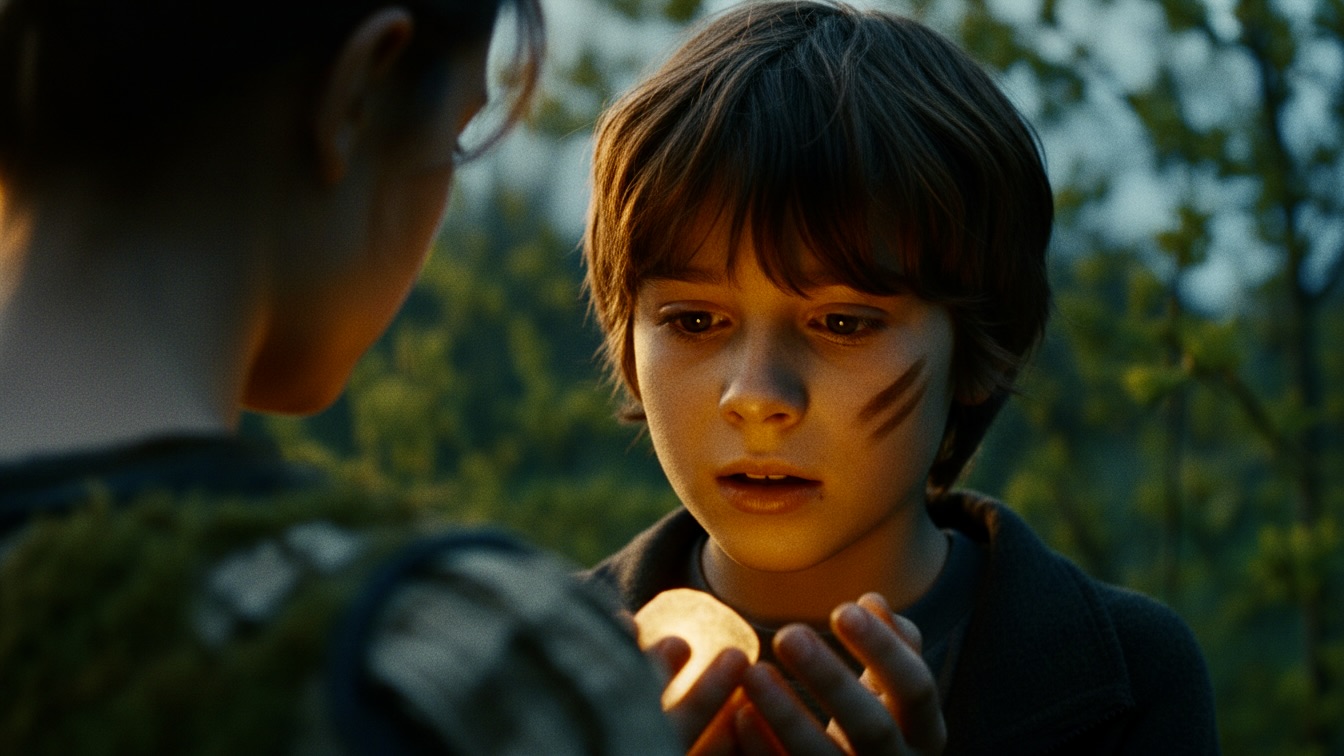
Leo and Mia visit the Mill Creek Fairgrounds on a humid April morning, intending to purchase a vintage camera lens. The mundane atmosphere of the flea market quickly sours as Leo notices the crowd exhibiting disturbing, repetitive behaviors and a strange, jittery energy. This tension erupts into a sudden wave of inexplicable and savage violence, with shoppers and vendors alike attacking one another without provocation or words. Leo and Mia narrowly escape the fairgrounds by scaling a chain-link fence, leaving behind a scene of absolute carnage.
Once outside the perimeter, they find a world that appears deceptively normal, filled with families enjoying the spring weather. However, as they attempt to drive to safety, they realize the phenomenon is not localized but is spreading like a psychic contagion. A high-frequency hum begins to vibrate through the air, and the sun flickers as if failing. By the time they reach a bridge overlooking the city, Leo realizes that society has collapsed entirely. Mia loses her sense of self to the "harvest," leaving Leo to face a darkened, silent world alone.
The primary theme of the story is the terrifying fragility of the social contract and the veneer of civilization. The author uses the setting of a flea market—a place defined by commerce and suburban routine—to show how quickly human connection can be replaced by predatory instinct. The transition from haggling over trinkets to physical mutilation occurs almost instantly, suggesting that the structures we rely on for safety are paper-thin. This theme is reinforced by the "harvest" concept, which implies that humanity is not the master of its own destiny but is subject to external, cosmic forces.
Another central theme is the irony of clarity and the deceptive nature of beauty. Leo spends the beginning of the story searching for a lens to capture the "pink" of the spring blossoms, seeking a way to frame the world as something beautiful. However, the clarity he eventually receives is a horrific one, revealing a world that is being systematically dismantled. The "perfect Saturday morning" becomes a mask for a vacuum, suggesting that the beauty of nature is indifferent to the suffering of humanity. The spring light does not offer hope; it merely provides a high-definition view of the end of the world.
The narrative also explores the psychological concept of the "other" and the loss of individual agency. As the "harvest" takes hold, characters lose the traits that make them human—speech, empathy, and unique movement—and become part of a collective, mechanical horror. This loss of identity is portrayed as a physical and mental invasion, represented by the clicking jaws and the blown-out pupils. The story posits that the most frightening thing is not death itself, but the erasure of the soul while the body continues to function as a vessel for something alien.
Leo is an observer by nature, a trait emphasized by his obsession with his camera and the pursuit of a specific 50mm lens. This desire for a new lens serves as a metaphor for his psychological need to find focus and meaning in a world he already perceives as a "dump." He is the more grounded of the two protagonists, acting as the primary protector when the violence begins. His internal conflict shifts from a mundane desire for artistic fulfillment to a desperate struggle to maintain his grip on reality.
As the story progresses, Leo’s role as an observer becomes a source of profound trauma. He is forced to witness the degradation of his surroundings with a clarity that he can no longer turn off or frame through a viewfinder. His decision to keep moving even when the situation is hopeless shows a stubborn attachment to human survival instincts. By the end, he is stripped of his purpose; when Mia asks about the lens, his admission that he didn't get it signifies his total loss of hope. He is left as a witness to a world where there is nothing left to see, representing the ultimate failure of the observer.
Mia initially serves as a foil to Leo’s earnestness, embodying a sense of modern apathy and boredom. Her oversized denim jacket and her constant scrolling through her phone suggest a young woman who is disconnected from her immediate environment. This detachment, however, is the first thing to shatter when the threat becomes real. She transitions from a bored bystander to a decisive actor, as seen when she uses the iron skillet to defend Leo. This shift reveals a hidden strength and a fierce loyalty to her companion that her initial demeanor hid.
Despite her brief display of agency, Mia’s trajectory is a tragic illustration of the story's central horror. She is the one who notices the subtle shifts in the environment first, her boredom turning into a heightened sensitivity to the "hum." Her eventual succumbence to the "harvest" is portrayed as a slow, agonizing erasure of her personality. When she begins to hum and speak in a flat, empty voice, it signifies the death of the person Leo knew. Her final moments of lucidity are filled with a terror so deep it transcends physical pain, making her a symbol of the vulnerability of the human mind.
The pacing of the narrative is expertly constructed to mirror the onset of a panic attack. It begins with a slow, stifling description of the humidity and the crowded market, creating a sense of physical discomfort before any violence occurs. Once the first table is overturned, the prose becomes more frantic, with shorter sentences and more aggressive verbs. This creates a "gauntlet" effect, where the reader feels as trapped as Leo and Mia. The transition from the chaotic market to the "silent movie" of the park provides a brief, chilling lull before the final escalation on the highway.
Sensory details are used to ground the supernatural elements in a visceral reality. The author focuses on "attic dust," "wet, clicking noises," and the "metallic scent of blood" to evoke a strong physical reaction. These details contrast sharply with the "cool, crisp" air of the park and the "vibrant, translucent green" of the trees. By using such vivid imagery, the author emphasizes the dissonance between the natural world and the human catastrophe. The "hum" and the flickering sun add a layer of cosmic horror that elevates the story from a simple riot to a global extinction event.
The narrative voice is detached yet intimate, providing a clear view of the horror while staying close to Leo’s internal state. This choice of perspective allows the reader to feel the weight of the "vacuum" that Leo experiences. The use of the term "harvest" is a crucial stylistic choice, as it reframes the violence from a senseless tragedy into a purposeful, albeit monstrous, process. This word choice lingers over the final scenes, providing a cold, logical explanation for the madness that is more terrifying than if it were left unnamed. The story ends on a note of absolute stillness, leaving the reader in the same suffocating silence as the protagonist.


