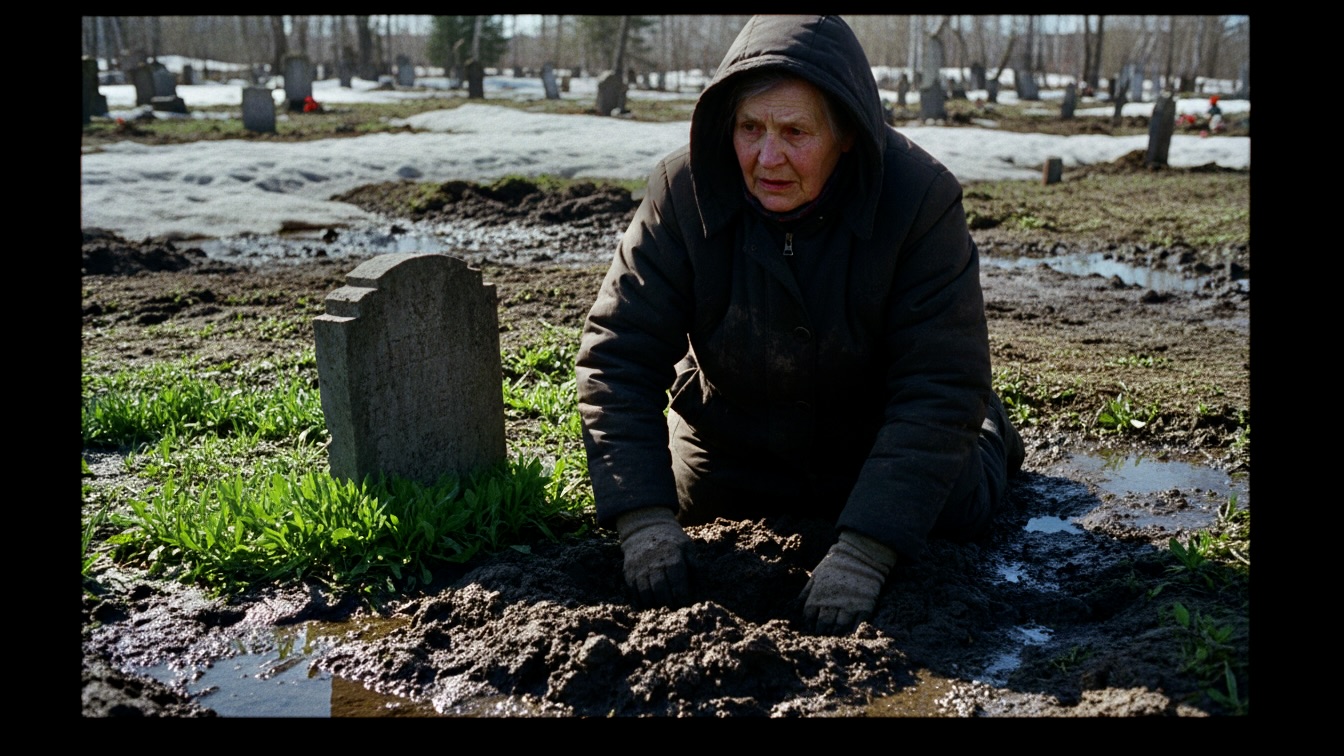
Elias finds an old woman chanting over a muddy grave as the winter snow finally begins to rot away.
The snow was dying. It didn't melt with grace. It turned into a gray, porous sludge that smelled of wet dogs and car exhaust. Elias felt the dampness creeping through the soles of his boots. He was sixty-four, and his left hip reminded him of it with every step into the soft mud of St. Jude’s. The cemetery was a graveyard of broken resolutions. People came here in the winter to cry, but in the spring, they just stayed away from the mess. The ground was a soup of dead grass and gravel.
He shouldn't have come today. The air was too thin, smelling of ozone and the sour breath of the earth opening up. But the paperwork was sitting on his kitchen table, a yellowed demand from the diocese about the upkeep of a plot he hadn't visited in a decade. Life was just a series of bills you paid until you became the reason someone else got a bill. He adjusted his scarf. The wool was scratchy against his neck. He felt old. He felt used up.
He heard the sound before he saw her. It wasn't a scream. It wasn't a song. It was a rhythmic, wet clicking, like someone trying to swallow a mouthful of marbles. He stopped by a leaning headstone—somebody named Miller who had died in 1944. The sound was coming from the older section, where the trees were still black and skeletal against the bright, mocking blue of the spring sky.
Elias rounded a thicket of dead rhododendrons. He saw her. She was kneeling in a patch of slush that was more brown than white. She wore a heavy, stained parka that had lost most of its puffiness. Her hair was a matted nest of silver, escaping from a plastic rain bonnet. She wasn't praying. Her hands were deep in the mud, digging at the base of a small, granite marker.
"Mrs. Gable?" Elias asked. His voice felt dry, like he’d been eating sand.
The woman didn't stop. Her mouth moved rapidly. The words were a thick slurry. It wasn't Latin. It wasn't anything Elias recognized. It sounded like the gurgle of a clogged drain. She was chanting, her body swaying back and forth. Each time she leaned forward, her face nearly touched the freezing mud.
"Mrs. Gable, it’s Elias. From the hardware store. Years ago."
She stopped. The silence that followed was heavy. A crow landed on a nearby iron fence, its claws scratching against the rust. The bird looked at them with a flat, black eye. Mrs. Gable turned her head slowly. Her face was a map of deep lines, caked with dirt. Her eyes were milky, the color of a cloudy marble.
"The frost is gone," she said. Her voice was surprisingly clear, though it had a jagged edge.
"It’s spring," Elias said. "Mostly. You shouldn't be out here. You’re soaked."
"It’s coming up," she whispered. She looked back at the hole she had started. "The water brings it up. It doesn't want to stay down when the ice breaks."
Elias took a step closer, his boots making a disgusting sucking sound in the muck. He looked at the grave. The name was gone, eroded by a century of acid rain and salt. "What are you doing?"
"Keeping the rhythm," she said. She began to chant again. This time, Elias caught a few sounds. They weren't words. They were vibrations. A low, humming drone that seemed to vibrate in his own teeth. It was a sound of deep, ancient weariness. It was the sound of a machine that had been running for a thousand years without oil.
"You need to go home," Elias said. He reached out a hand, but hesitated. He didn't want to touch the wet wool of her coat. He didn't want the cold to transfer to him. "I’ll call someone."
"Don't call," she snapped. She looked up at him, and for a second, the milkiness in her eyes cleared. There was a sharp, terrifying intelligence there. "You think this is about me? You think I like the taste of dirt?"
"Then stop."
"If I stop, the weight shifts," she said. She shoved her hands deeper into the mud. She seemed to be searching for something. Her fingers clawed at the earth with a frantic, animal energy. "The transactions have to be balanced, Elias. You know how it works. You spend your whole life selling nails and hammers. You know the cost of holding things together."
Elias felt a cold sweat break out on his lower back. "I don't know what you’re talking about."
"The earth is a stomach," she said. She pulled something from the mud. It was a long, thin bone, stained dark brown. It looked like a finger. She didn't look shocked. She tucked it into the pocket of her parka like a piece of loose change. "It’s full. And when the snow melts, it gets sick. It tries to throw things back."
Elias backed away. His hip twinged. He looked around the cemetery. It felt different now. The headstones didn't look like markers; they looked like teeth. The whole place was a mouth, slowly opening as the frost retreated. The bright spring sun felt like a spotlight on a crime scene.
"I’m leaving," Elias said. "I’m going to the gate house."
"The gate house is empty," she said, her voice dropping back into that rhythmic drone. "The boy who works there is sleeping. He doesn't hear the clicking. Nobody hears it but the old ones. We’re the ones who have to push it back."
She leaned over the hole and started chanting again. The sound was louder now. It seemed to be coming from the ground itself, a low-frequency thrum that made the puddles of meltwater ripple. Elias watched, frozen, as a small bubble of black gas escaped from the mud near her knees. It popped with a faint, putrid hiss.
He turned and walked away. He didn't run—his body wouldn't let him—but he moved with a stiff, panicked urgency. He passed the Miller grave. He passed the rhododendrons. The cemetery felt larger than it had ten minutes ago. The rows of graves seemed to stretch out, the paths twisting in ways that didn't make sense. The mud was getting deeper. It was up to his ankles now.
He reached the main gravel path. He looked back. Mrs. Gable was a small, dark shape against the gray slush. She looked like a piece of trash that someone had forgotten to pick up. She was still swaying. Still clicking. The crow was still watching her.
Elias reached his car, a silver sedan that was covered in a film of salt and road grime. He got inside and locked the doors. His breath was coming in short, ragged gasps. He looked at his hands. They were shaking. He gripped the steering wheel until his knuckles went white. The heater kicked on, blowing cold air at his face before it finally started to warm up.
He looked in the rearview mirror. The cemetery was quiet. The sun was still shining. It was a beautiful spring day. But he could still feel it. That vibration in his teeth. That sense that the world was just a thin crust over something very hungry and very full.
He put the car in gear and drove toward the exit. He passed the gate house. Mrs. Gable was right; the windows were dark. No one was there. The gate was standing open, its hinges orange with rust. He drove out onto the main road, his tires splashing through the meltwater.
He thought about his sister’s grave. He hadn't found it. He didn't want to find it. He didn't want to know if the earth was trying to give her back, too. He thought about the bone in Mrs. Gable’s pocket. It was just a transaction. A balance of weight. He pushed the accelerator down, feeling the engine groan as he sped away from the dying snow.
By the time he reached the edge of town, the clicking in his head had stopped. But the dampness in his boots remained. It was a cold that wouldn't go away, a reminder that the season of growth was also the season of rot. He pulled into a gas station. He needed coffee. He needed to talk to someone who didn't know about the weight of the earth.
He stood at the counter, waiting for the clerk to finish a phone call. The man was young, maybe twenty. He was laughing at something on his screen. He looked up at Elias with a blank, bored expression.
"That’ll be two-fifty," the clerk said.
Elias handed him the money. The coins felt heavy. He looked at the clerk’s hands. They were clean. No mud. No dirt. Just the smooth, unburdened skin of someone who hadn't started paying the real bills yet.
"Nice day out," the clerk said, tossing the change onto the counter.
"The snow is melting," Elias said.
"About time. Sick of the shoveling."
Elias took his coffee and walked back to his car. He sat there for a long time, watching the traffic. People were driving to work, to the grocery store, to the gym. They were all living on top of it. They were all part of the transaction, whether they knew it or not. He took a sip of the coffee. It was bitter and burnt. It tasted like reality.
He looked down at his boots. The mud was drying now, turning into a fine, gray crust. He reached down and scraped a bit of it off with his fingernail. Underneath the mud, the leather was cracked. Everything was breaking down. Everything was returning to the soup.
He thought of Mrs. Gable’s face. The way she had looked at him. She wasn't crazy. She was just tired. She was a woman who had been left to manage a ledger that no one else wanted to look at. And soon, Elias realized, there would be no one left to do the clicking. The old ones were fading. The gatekeepers were dying off.
He started the car again. He had to go home. He had to pay that diocese bill. He had to keep the paperwork in order. It was the only thing he could do. He drove through the bright spring light, but all he could see were the shadows of the trees, reaching out like skeletal fingers to catch the sun before it hit the ground.
When he got home, the house was silent. It smelled of lemon polish and stale air. He sat in his recliner and stared at the wall. The ticking of the grandfather clock in the hallway felt too loud. It matched the rhythm of Mrs. Gable’s clicking. Tick. Click. Tick. Click.
He closed his eyes, but he couldn't stop seeing the bone. It wasn't the death that scared him. It was the lack of finality. The idea that the ground wasn't a destination, but a waiting room. And that sometimes, the wait was over before we were ready for it to be.
He stayed there until the sun went down and the room turned gray. The spring air coming through the cracked window was cool, but it didn't feel fresh. It felt like the breath of something that had been holding its breath all winter. Elias reached over and turned on the lamp. The light was harsh and yellow. It didn't hide anything. He picked up the phone to call his daughter, but then he put it back down. What would he say? That the mud was hungry? That he’d seen a woman burying bones in her pockets?
No. He would just tell her he was fine. He would tell her the snow was finally gone. He would tell her that everything was exactly where it was supposed to be, even if he knew it was a lie. He leaned back and listened to the house settle. It was a series of small, sharp sounds. The wood expanding. The pipes groaning. The world adjusting its weight.
“As he drifted toward sleep, he realized the clicking wasn't coming from the clock, but from the other side of his bedroom wall.”


