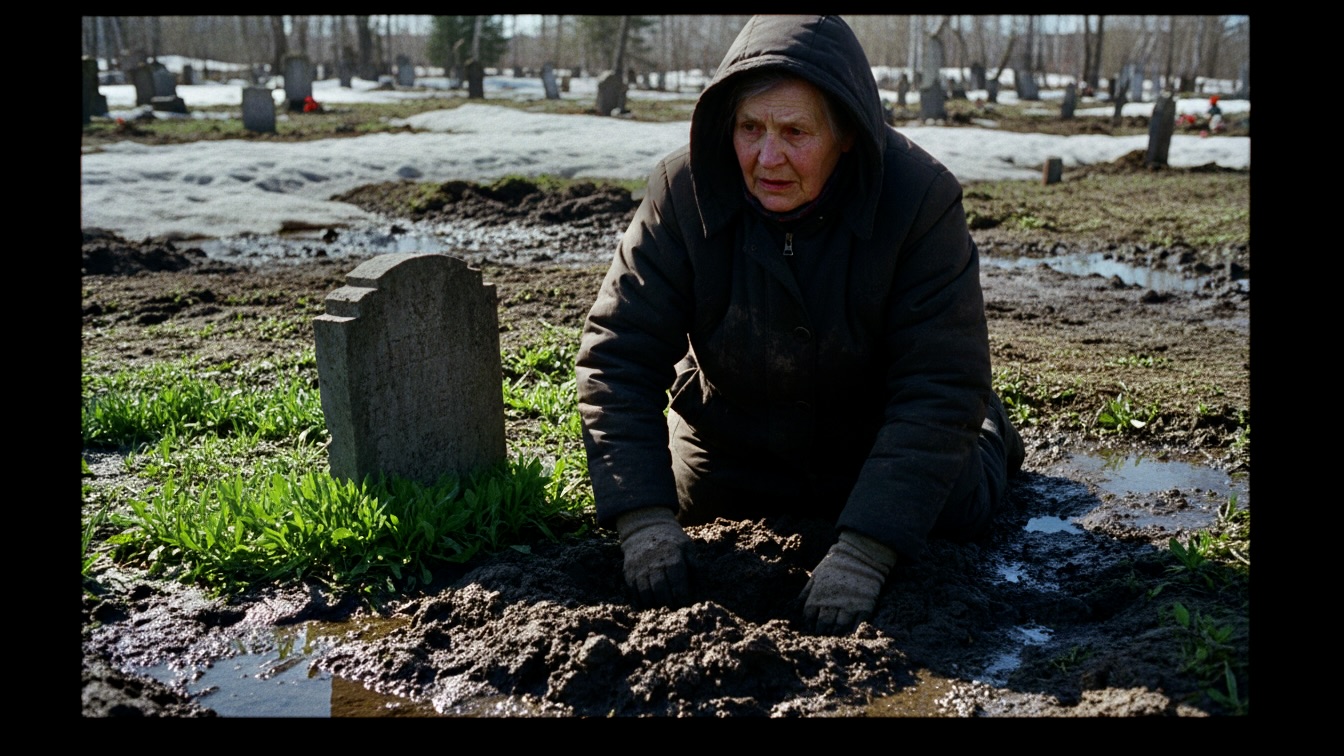
Elias, a sixty-four-year-old man burdened by the physical and emotional weight of aging, visits St. Jude’s Cemetery during a particularly grim spring thaw. He has come to address a bureaucratic demand from the diocese regarding a long-neglected family plot, but the atmosphere of the graveyard is one of decay rather than renewal. The melting snow has transformed the landscape into a repulsive sludge that smells of wet dogs and exhaust, mirroring Elias's own sense of being "used up." While navigating the muck, he encounters Mrs. Gable, an elderly woman he once knew from his hardware store, who is frantically digging in the mud and chanting in an unrecognizable, rhythmic drone.
Mrs. Gable reveals a terrifying perspective on the changing seasons, claiming that the earth is a "stomach" that attempts to regurgitate its contents when the ice breaks. She retrieves a human bone from the mud and pockets it, explaining that she is performing a necessary transaction to maintain the world's balance. Terrified by her intensity and the visceral sensation that the ground beneath him is a hungry mouth, Elias flees the cemetery. He attempts to find solace in the mundane world of a gas station and the sterile silence of his own home, but he is left with the haunting realization that the older generation is fading, leaving no one to manage the dark ledger of the earth.
The narrative presents a stark subversion of the traditional literary trope of spring as a time of rebirth and hope. In this story, spring is depicted as a "season of rot," where the melting snow reveals the filth and decay that the winter had conveniently hidden. The "dying snow" does not vanish with grace but leaves behind a "porous sludge," suggesting that the transition between life and death is messy, visceral, and inherently unpleasant. This theme suggests that renewal is not a clean slate but a regurgitation of the past, forcing the living to confront the physical reality of what they have buried.
Another central theme is the concept of life as a series of transactions and bureaucratic burdens. Elias views his existence through the lens of bills, paperwork, and the literal "cost of holding things together." Mrs. Gable expands this metaphor to a cosmic level, suggesting that the stability of the world requires a constant, rhythmic exchange of weight. This perspective strips away the sentimentality of grief and replaces it with a cold, mechanical necessity. It implies that human existence is merely a temporary stay against a hungry, entropic earth that demands payment in bone and dirt.
The story also explores the isolation of the "gatekeepers"—the older generation who bear the burden of knowledge that the young are too "unburdened" to notice. Elias and Mrs. Gable represent a vanishing cohort who understand the "clicking" of the world’s machinery. The younger clerk at the gas station serves as a foil, representing a blissful, ignorant detachment from the "real bills" of existence. This theme highlights a psychological dread regarding the future; as the "old ones" die off, the narrative suggests that the thin crust of reality may finally give way because no one is left to "push it back."
Elias is a man defined by his physical decline and his professional history as a provider of tools for maintenance. His hip pain serves as a constant, rhythmic reminder of his mortality, grounding his psychological state in a sense of inevitable breakdown. Having spent his life selling nails and hammers, he is conditioned to look for ways to hold things together, yet he finds himself in a situation where the structural integrity of his world is failing. He is a character caught between the desire for order, represented by his kitchen table paperwork, and the chaotic, "hungry" reality of the natural world.
Psychologically, Elias is experiencing a profound existential crisis triggered by the loss of his sister and his own advancing age. He avoids his sister’s grave not out of lack of love, but out of a fear of what the "hungry" earth might have done to her remains. His reaction to Mrs. Gable is one of "stiff, panicked urgency," indicating a man who is no longer capable of fighting the encroaching darkness. He prefers the "bitter and burnt" taste of reality in his coffee to the terrifying metaphysical truths offered by the cemetery, yet he cannot escape the vibration in his teeth.
Elias’s internal conflict culminates in a sense of weary resignation. By the end of the chapter, he recognizes himself in Mrs. Gable’s "tired" face, realizing that he is part of a failing defense against the void. His decision to lie to his daughter and tell her "everything was exactly where it was supposed to be" is a final, desperate act of maintenance. He assumes the role of a gatekeeper, choosing to bear the weight of the truth alone so that the next generation can remain "unburdened" for a little while longer.
The author employs a gritty, naturalistic style that utilizes heavy sensory details to create an atmosphere of pervasive unease. The descriptions are intentionally repulsive, focusing on "wet dogs," "sour breath," and "disgusting sucking sounds" to ensure the reader feels the dampness and decay. This sensory immersion serves to bridge the gap between the physical environment and Elias’s internal state of "used up" exhaustion. The personification of the earth as a "stomach" and the headstones as "teeth" transforms a familiar setting into a predatory entity, heightening the narrative's Gothic undertones.
Pacing in the chapter is masterfully handled, beginning with a slow, meditative trudge through the mud that gradually accelerates into a frantic, internal panic. The "rhythmic, wet clicking" sound acts as a metronome for this tension, building a sense of auditory dread that persists even after Elias leaves the cemetery. The shift from the expansive, frightening graveyard to the sterile, brightly lit gas station provides a sharp contrast that emphasizes Elias’s isolation. The final return to the silence of his home slows the pace back down, leaving the reader with a lingering, cold stillness.
The narrative voice is one of detached weariness, reflecting Elias’s own perspective on a world that has become a "series of bills." The use of short, punchy sentences during moments of stress mimics the "short, ragged gasps" of the protagonist. This stylistic choice creates a sense of claustrophobia, even in the open air of the cemetery. The ending, which parallels the ticking of a clock with the clicking of Mrs. Gable’s ritual, effectively ties the mundane passage of time to the terrifying "transactions" of the earth, leaving the thematic loop uncomfortably closed.


