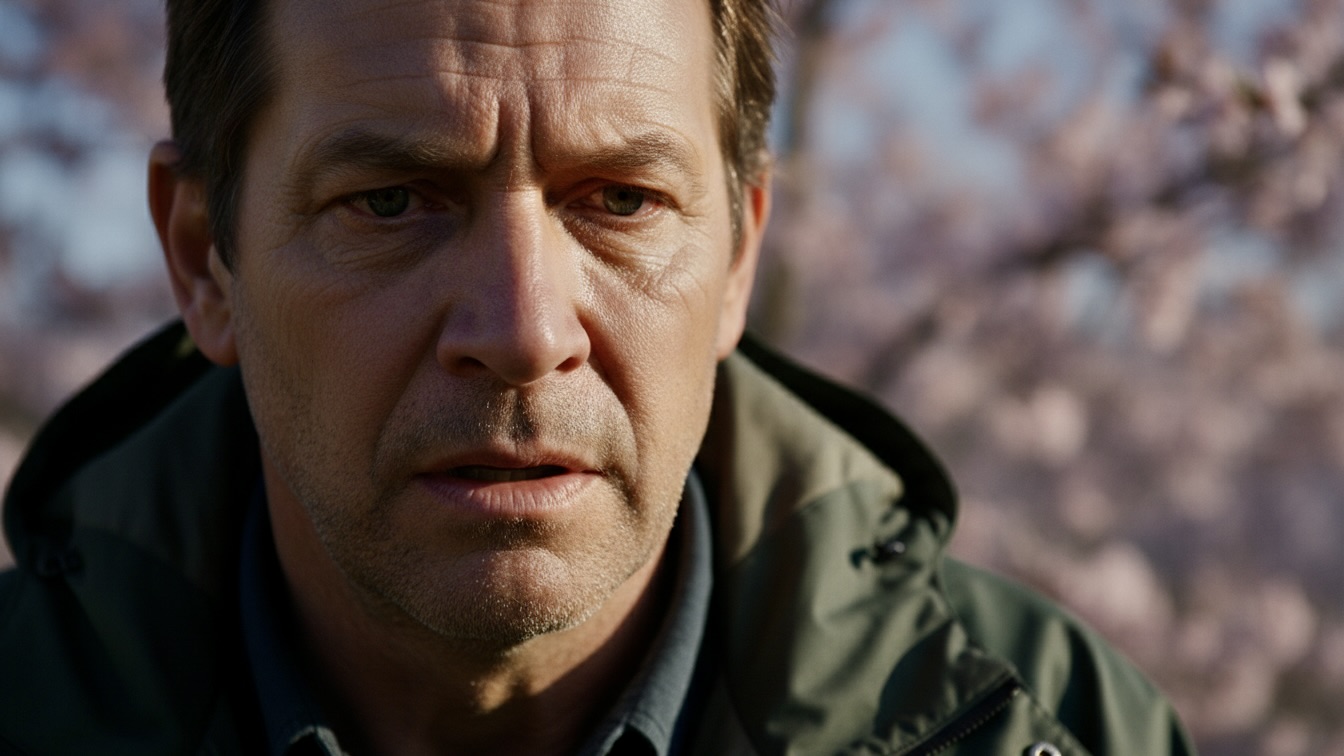
Wally discovers the spring runoff fish are arranged like ancient runes while the depot party turns into a nightmare.
The mud at the edge of the Depot was a grey, gelatinous slurry that clung to Wally’s boots like wet cement. It smelled of motor oil and old snow. Spring in this town didn’t bring life; it just uncovered the things the winter had failed to kill. Wally crouched by the drainage ditch, his joints popping. He wasn’t a young man, and the damp air made his hip ache. In the shallow, churning runoff, the fish were waiting. They were salmon, or they used to be. Now they were pale, bloated shapes floating in the silt. But they weren’t drifting aimlessly. They were wedged against the rocks in deliberate patterns. Straight lines. Intersecting diagonals. Circles within circles. They looked like runes carved into the mud by a hand that didn’t use fingers.
He pulled a small digital camera from his windbreaker. The shutter clicked. The fish didn’t move, even as the water rushed over their milky eyes. They looked calcified. Wally reached out with a stick, poking the side of a large buck. It didn’t squish. It clacked. The sound was hard, like plastic hitting stone. He felt a chill that had nothing to do with the April breeze. Up the hill, the Depot party was in full swing. Bass from a cheap speaker system thudded through the earth, a rhythmic vibration that Wally felt in his teeth. He stood up, wiping mud onto his jeans. He needed to get closer to the fence.
Brenda was the first one to spot him as he crested the ridge. she was wearing a bright yellow raincoat and holding a plastic cup of something that smelled like fermented punch. She was laughing, her face flushed from the booze and the sudden warmth of the afternoon sun. “You’re late!” she shouted over the music. She stumbled slightly on the uneven grass, spilling a dark red liquid onto the hem of her coat. “The Mayor already did the ribbon cutting. You missed the cake.”
“Not here for cake, Brenda,” Wally said. He kept his eyes on the perimeter fence. It was a dense wall of wildflowers, planted by the corporation last autumn as a “green initiative.” In the spring light, the flowers were a violent shade of violet, their stems thick and hairy. They didn’t look like any local species. They looked hungry.
“What’s with the face?” Brenda asked. She leaned in, her breath hot. “You look like you’re at a funeral. Lighten up. It’s the thaw.”
“The fish are wrong,” Wally said. He looked past her. The Mayor was standing near the scrap piles, surrounded by a group of local business owners. He was a broad man with a smile that felt like a threat. “The water is wrong.”
“The fish are fine,” a voice boomed. The Mayor stepped away from his circle, walking toward them with a calculated swagger. “It’s just the runoff, Wally. Happens every year. The silt gets stirred up, the oxygen levels drop. It’s science.”
“Is it science that makes them hard as PVC?” Wally asked.
The Mayor laughed, a dry, barking sound. “Look at you. Serious as a heart attack. Hey everyone!” he shouted to the crowd. “The clown finally showed up! Wally, where’s your red nose?”
A few people chuckled. Little Timmy, the baker’s son, ran by with a bunch of helium balloons tied to his wrist. The bright blue and red spheres bobbed in the air, tugging at the boy’s arm. “Do a trick!” Timmy yelled, pointing at Wally.
Wally didn’t smile. He reached into his deep pocket and pulled out a yellow handheld device. It was battered, the screen scratched and clouded. He flipped the switch. The device emitted a low, steady hum that quickly escalated into a frantic, staccato clicking. The sound cut through the music like a razor.
“That’s not a balloon animal,” Brenda said, her smile faltering. “What is that?”
“Geiger counter,” Wally said. He stepped toward the wildflower fence. The clicking became a solid wall of noise. “And it’s screaming.”
The Mayor’s face went pale, then a mottled purple. “Get that thing out of here. You’re scaring people. It’s probably just some old medical waste in the scrap. We’re cleaning it up.”
“It’s not the scrap,” Wally said. He pointed the sensor at the flowers. The device wailed. “It’s the fence.”
As if responding to his voice, the vines of the wildflower fence began to twitch. It was subtle at first, a shivering of the violet petals. Then, a thick, green tendril lashed out. It didn’t go for a person. It went for the balloons. With a wet, snapping sound, the vine wrapped around the string in Little Timmy’s hand. The boy shrieked as he was yanked toward the fence.
“Let go!” Wally yelled, lunging forward. He grabbed Timmy by the waist and pulled back. The string snapped, and the balloons were dragged into the dense foliage. The flowers didn’t just hold them; they folded over them. The plastic spheres were pulled deep into the scrap piles behind the vines, disappearing into the shadows. The fence settled back into place, looking perfectly still once more.
“What the hell was that?” Brenda whispered. She dropped her cup. The red punch soaked into the mud.
“It’s feeding,” Wally said. “The silt, the plastic, the party favors. It doesn’t matter. It’s a bio-filter. But it’s outgrown the cage.”
He walked back to the ditch, ignoring the Mayor’s protests. He needed proof. He reached into the freezing water, ignoring the bite of the cold, and grabbed the tail of the rune-forming salmon. It felt heavy. Unnatural. When he hauled it out, the crowd gasped. The fish wasn’t rotting. The skin of the salmon had been perfectly replaced by a clear, rigid polymer. You could see the internal organs through the translucent sides, but the organs weren’t flesh anymore. They were shaped like discarded bottles, wires, and microplastics. A brand name from a popular soda company was etched into the scales of its flank. The fish was a living piece of litter, its heart a crumpled bottle cap that still managed to pulse with a sickly, rhythmic beat.
“They aren’t dying,” Wally said, holding the monstrosity up for the Mayor to see. “They’re being recycled. The plant takes the runoff and turns the life into the waste it fed on. It’s a closed loop.”
Suddenly, a heavy, metallic thud echoed across the Depot. The massive iron gates at the entrance swung shut with a violent force, the deadbolts sliding into place with a series of heavy clicks. The crowd panicked, rushing toward the exit, but the gates didn’t budge. The automated security system had engaged.
Then, the sound started. It wasn’t the party music. That had died out when the power lines hummed and snapped. This was a low, vibrating drone coming from deep within the earth. It was a familiar melody, distorted and slowed down until it sounded like a funeral dirge. It was the midnight hockey anthem, the song they played at the local arena to signal the end of the game. But there was no arena here. There was only the mud and the fence.
The ground beneath their feet began to heave. The violet flowers grew visibly taller, their stalks thickening into ropes of muscle. The runes in the ditch began to glow with a faint, bioluminescent green.
“We need to get to the shed,” Wally said, grabbing Brenda’s arm. “Now.”
“Why the shed?” she stammered, her eyes wide with terror.
“Because that’s where the herbicide is,” Wally said. “And if I’m right, the anthem is just the dinner bell.”
The Mayor tried to speak, but the ground buckled beneath him, sending him sprawling into the mud. The wildflower vines were no longer swaying. They were reaching for the warmth of the humans, their petals peeling back to reveal rows of hard, plastic teeth. The spring thaw was over. The harvest had begun.
“The ground buckled, and the first of the violet vines wrapped around the Mayor’s screaming throat.”


