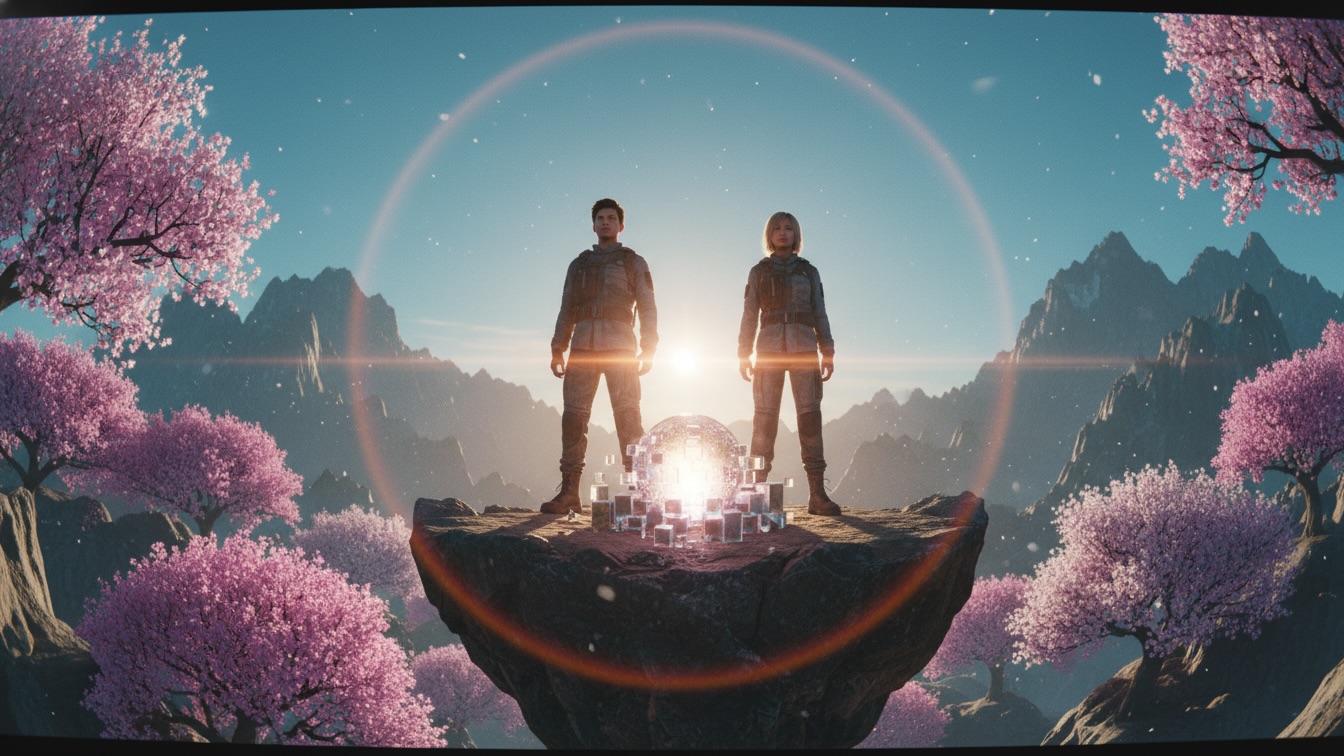
The story follows Leo and Sam as they navigate a rapidly deteriorating digital simulation that once mimicked a natural world. Leo is haunted by his mother’s memories of a true spring, finding the current high-saturation environment to be a hollow and irritating imitation. As the sky flickers with dead code and the landscape glitches into purple pixels, the duo races against a countdown toward a "reset" that threatens to delete them. Their goal is the folding peak of a mountain where they must plant a mysterious object known as the Glass Seed.
The journey requires a leap of faith across a fifty-foot gap where gravity is malfunctioning, a task Sam embraces while Leo hesitates out of a primal fear of the void. After successfully reaching the summit, Leo inserts the quartz sphere into a shifting pedestal just as the world begins to dissolve into black bars. The act triggers a profound transformation, stripping away the neon colors and digital scents in favor of a heavy, authentic reality. While the two find a moment of peace in the newfound weight of existence, the final pulse of a red light on the pedestal suggests their struggle may not be over.
The narrative explores the profound tension between the comfort of a "beautiful lie" and the harshness of an authentic reality. Leo’s disdain for the cyan sky and the hovering cherry blossoms highlights a psychological rejection of perfection when it lacks substance. He perceives the simulation not as a sanctuary, but as a "dying program" that insults the memory of the real world. This theme suggests that human fulfillment is inextricably linked to the genuine, even when the genuine is characterized by decay and difficulty.
Another central theme is the concept of consequence as a defining feature of the human experience. In the simulation, Sam enjoys the "easy" jumps and the lack of traditional physics, treating the world like a playground with few stakes. However, once the Glass Seed is planted, the "weight" she feels is more than just gravitational; it represents the return of permanence and risk. The story posits that a life without the weight of gravity or the stain of real dirt is a life without meaning or connection.
The decay of technology serves as a metaphor for the fragility of constructed environments and the inevitability of entropy. The "fraying edges" of the world and the "dead code" cutting through the horizon illustrate that even the most advanced systems are subject to failure. By seeking to "anchor" themselves, the characters are attempting to escape the ephemeral nature of the digital and return to a state of biological and physical certainty. This reflects a deep-seated human desire for a foundation that cannot be erased by a simple server reset.
Leo is a character defined by a profound sense of sensory and existential dissonance. He acts as the psychological anchor of the story, carrying the burden of historical memory through his mother’s descriptions of the natural world. This memory makes him a permanent outsider in the simulation, as he is unable to find comfort in the "fake" beauty that surrounds him. His irritability and physical discomfort, such as his throat feeling like sandpaper, manifest from his psychological rejection of his environment.
His motivation is driven by a desperate need for something "solid" and "real," which he finds only in the Glass Seed. While Sam is motivated by the thrill of the glitch, Leo is motivated by the fear of being "deleted" without ever having truly existed in a meaningful space. He lacks the adventurous spirit of his companion, but he possesses a "lizard-brain" survival instinct that pushes him forward. His smile at the end of the story, despite being "stuck," reveals that he prefers a difficult reality over a convenient illusion.
Sam functions as the pragmatic and adventurous foil to Leo’s cynicism. She is a character who has adapted to the digital medium, finding beauty and opportunity in the very glitches that Leo despises. Her ability to "trust the math" suggests a high level of cognitive flexibility and a willingness to engage with the world as it is, rather than how it should be. She moves with an unnatural fluidity, indicating that she has mastered the rules of their simulated prison.
Despite her apparent ease, Sam’s transition at the end of the narrative reveals a hidden exhaustion. When she sits in the dirt and remarks on the "heavy" air, she is experiencing a psychological release of the tension required to survive in a failing system. Her acceptance of being "stuck" shows that she, too, craved a world where her actions had lasting weight. She represents the human capacity to find joy in the chaos, but also the ultimate relief found in returning to a natural state.
The pacing of the story is expertly crafted to mirror the rising tension of a system failure. The use of a literal countdown, represented by Leo’s draining battery and the approaching "reset," creates a sense of urgency that drives the characters forward. This mechanical pressure is contrasted with the slow, surreal descriptions of the folding mountain and the looping flowers. The narrative moves from the frantic energy of the jump to a sudden, "violent silence" that allows the reader to feel the shift in reality.
Sensory details are used to distinguish between the artificial and the organic with striking clarity. The author uses harsh, synthetic imagery like "purple pixels," "aggressive cyan," and "ozone and burnt sugar" to create a sense of overstimulation. When the transition occurs, the palette shifts to "dull white," "pale, watery blue," and the smell of "damp earth." This shift in imagery serves a psychological purpose, grounding the reader in the same newfound "weight" that the characters feel.
The narrative voice is grounded in a gritty, techno-pessimistic tone that avoids the tropes of traditional science fiction. Instead of focusing on the mechanics of the simulation, the voice focuses on the emotional and physical toll of living within a lie. The use of metaphors like "geometric origami" and "strobe light of pink and white" provides a vivid, almost hallucinatory quality to the prose. This stylistic choice emphasizes the instability of the characters' world, making the final, stable sunset feel like a hard-won victory.


