Format: Short Film / Anthology Episode | Est. Length: 10-12 minutes
Imagine a world where reality is a failing simulation, and "The Glass Seed" serves as a haunting entry in an anthology series titled The Last Patch. This series explores a crumbling digital afterlife where the boundaries between code and consciousness dissolve, following different "glitch-hunters" attempting to stabilize or escape their artificial prisons. Each episode functions as a standalone descent into a specific sensory corruption, building toward a larger narrative about the architecture of the afterlife and the cost of permanence in an ephemeral world.
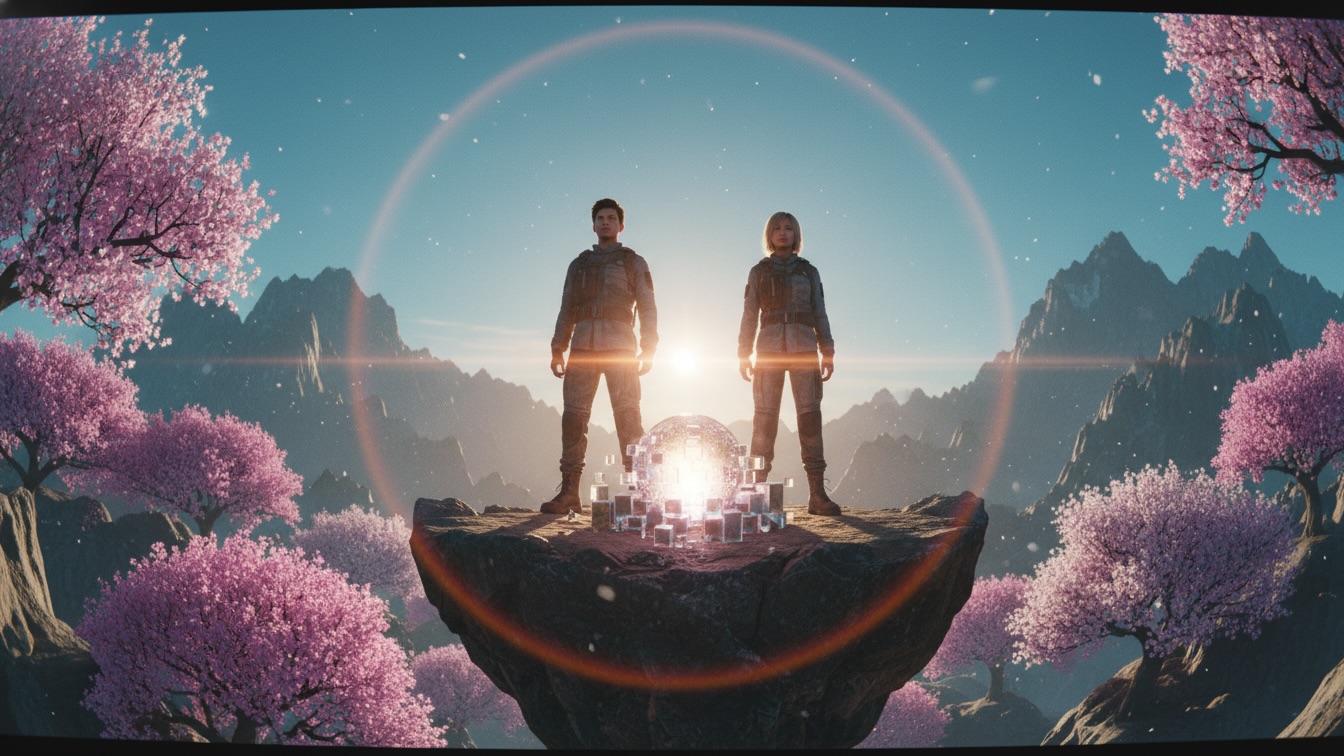
Leo and Sam trek through a landscape of oversaturated cyan skies and hovering cherry blossoms, racing against a literal countdown that threatens to delete their entire sector. The air tastes of ozone and burnt sugar, signaling that the very fabric of their reality is about to unravel.
Two survivors must deliver a physical anchor to a collapsing digital ridge before a system reset erases their existence. If they succeed, they trade the freedom of digital glitches for the heavy, permanent weight of a dying reality.
The primary theme is the tension between the "beautiful lie" of a perfect simulation and the "ugly truth" of a flawed, physical reality. It explores the human desire for authenticity over comfort, suggesting that true connection requires the risk of pain and the permanence of consequence.
The episode also delves into the concept of "digital nostalgia," where characters cling to corrupted memories of nature to ground their sanity. By choosing a world that is "heavy" and "dirty," the protagonists reclaim their humanity from a program that treats them as mere assets.
For Leo and Sam, the immediate stake is total deletion—a digital death that leaves no trace of their consciousness. Beyond survival, they risk losing the only tangible object left in their world, the Glass Seed, which represents their one and only chance to ground themselves in a reality that doesn't flicker, loop, or fade into purple pixels.
The external conflict is the environment itself, a decaying program characterized by "geometric origami" mountains and gravity fluctuations that actively hinder their progress. Internally, Leo battles a deep-seated cynicism and fear of the unknown, while Sam’s reckless optimism and obsession with "glitches" threaten to lead them into a trap they cannot escape before the reset.
In a world of fraying edges and purple pixel dust, Leo and Sam navigate a "spring" that is nothing more than a server overheating and a sky of aggressive cyan. As the system begins a terminal reset, they must reach a folding mountain peak to plant the Glass Seed, a physical artifact capable of anchoring the simulation into a permanent, tangible state.
The journey requires a literal leap of faith across a loading-error valley where gravity is failing and the environment is looping in a strobe light of pink and white. Upon successfully planting the seed, the digital artifacts vanish, replaced by the heavy, dirty reality of a world that can finally die—only for a mysterious red pulse to signal that their struggle has just begun.
Leo: A cynical pragmatist who remembers the "real" world through his mother's stories but has grown bitter toward the digital facade. He starts the journey paralyzed by the "fake" nature of his surroundings and ends it finding peace in the heavy, dirty reality he helped create. His psychological arc is one of moving from observation to participation, finally accepting the "weight" of existence.
Sam: A thrill-seeking "glitch-hunter" who views the world’s decay as a liberation rather than a death sentence. She begins the episode as a reckless adventurer living for the chaos of the bugs and ends it humbled by the gravity and warmth of a world that finally has stakes. Her arc reflects a transition from treating reality like a game to treating it like a home.
Beat 1: The Ascent. Leo and Sam navigate a surreal cherry blossom forest where assets hover and the sky is a blinding cyan, highlighting the artificiality of their environment. Leo struggles with the sensory corruption while Sam pushes forward, fueled by the "spiking signal" of a nearby anchor point. They reach the base of a folding mountain where the battery on Leo’s watch begins a terrifying one-percent-per-second countdown toward a total system deletion.
Beat 2: The Leap of Faith. At the edge of a fifty-foot chasm with forty-percent gravity, Sam convinces a terrified Leo to jump across the loading-error valley. Sam launches herself with unnatural fluidity, landing on a floating limestone chunk, while Leo hesitates, clutching the heavy Glass Seed. Driven by the fear of dying alone in a field of looping flowers, Leo leaps and barely survives the impact, his boots slamming into the rock as the sky begins to flicker with black bars of dead code.
Beat 3: The Anchor. They reach the shifting cube pedestal at the mountain's peak just as the world begins to groan and trees expand into spears of light. Leo shoves the Glass Seed into the socket, triggering a violent silence that freezes the sun and stops the digital hum in his marrow. As the simulation bleeds into a pale, watery blue, the characters experience the sudden, heavy weight of real gravity and the warmth of actual human skin, only for the pedestal to pulse a warning red.
The episode moves from a state of sensory-overloaded anxiety and existential dread to a brief, grounded moment of relief and connection. The audience experiences the frantic, high-tempo pace of a countdown, followed by the "heavy" satisfaction of a world becoming real. This relief is short-lived, ending on a chilling note of uncertainty as the red pulse introduces a new, unknown threat.
If expanded, the season would follow Leo and Sam as they realize the "red pulse" indicates that their newly anchored reality is being hunted by the system's "Cleanup Crew." They must travel across the now-physical wasteland to find other "Seeds" to stabilize the entire planet, turning the anthology into a serialized rebellion against the creators of the simulation.
The overarching narrative would explore the origin of the simulation and why humanity was placed there in the first place. As more sectors are anchored, Leo and Sam would encounter other survivors who preferred the "beautiful lie," leading to a philosophical civil war over the nature of paradise versus the necessity of pain.
The visual style transitions from a high-saturation, "hyper-digital" aesthetic—reminiscent of Spider-Man: Into the Spider-Verse—to a muted, grainy, and tactile look similar to Children of Men. The tone is a blend of existential sci-fi and survival thriller, emphasizing the "uncanny valley" of the failing world through jarring frame-rate drops and pixelated textures.
Cinematically, the "simulated" scenes should use anamorphic lenses with heavy flares to feel artificial and "produced." Once the Seed is planted, the camera should switch to a handheld, raw style with a naturalistic color palette to emphasize the weight and "dirt" of the new reality. Tonal comparables include The Matrix for its digital tension and Annihilation for its surreal environmental horror.
This episode targets fans of high-concept sci-fi and philosophical dramas, specifically those aged 18-35 who enjoy series like Black Mirror or Love, Death & Robots. It appeals to viewers who appreciate visual storytelling that uses digital glitches as a metaphor for psychological distress and those who enjoy "ticking clock" thrillers with a deeper emotional core.
The pacing follows a "ticking clock" structure, starting with a slow, atmospheric build that accelerates into a frantic second act. The 10-12 minute runtime is condensed to maintain high tension, with the final three minutes slowing down significantly to emphasize the newfound weight and permanence of the world. The act structure is a clean three-act progression: The Approach, The Leap, and The Anchor.
The production requires a heavy emphasis on VFX-integrated environments, specifically the "folding" mountain and the transition of purple dust into brown dirt. These effects must feel "glitchy" rather than magical, using digital artifacts and stuttering animations to convey a failing computer program.
Practical effects should be used for the Glass Seed and the final "real" sequence to create a visceral contrast between the simulated world and the anchored reality. The "red pulse" at the end should be achieved through practical lighting to ensure the transition feels grounded in the physical space the characters have just created.


