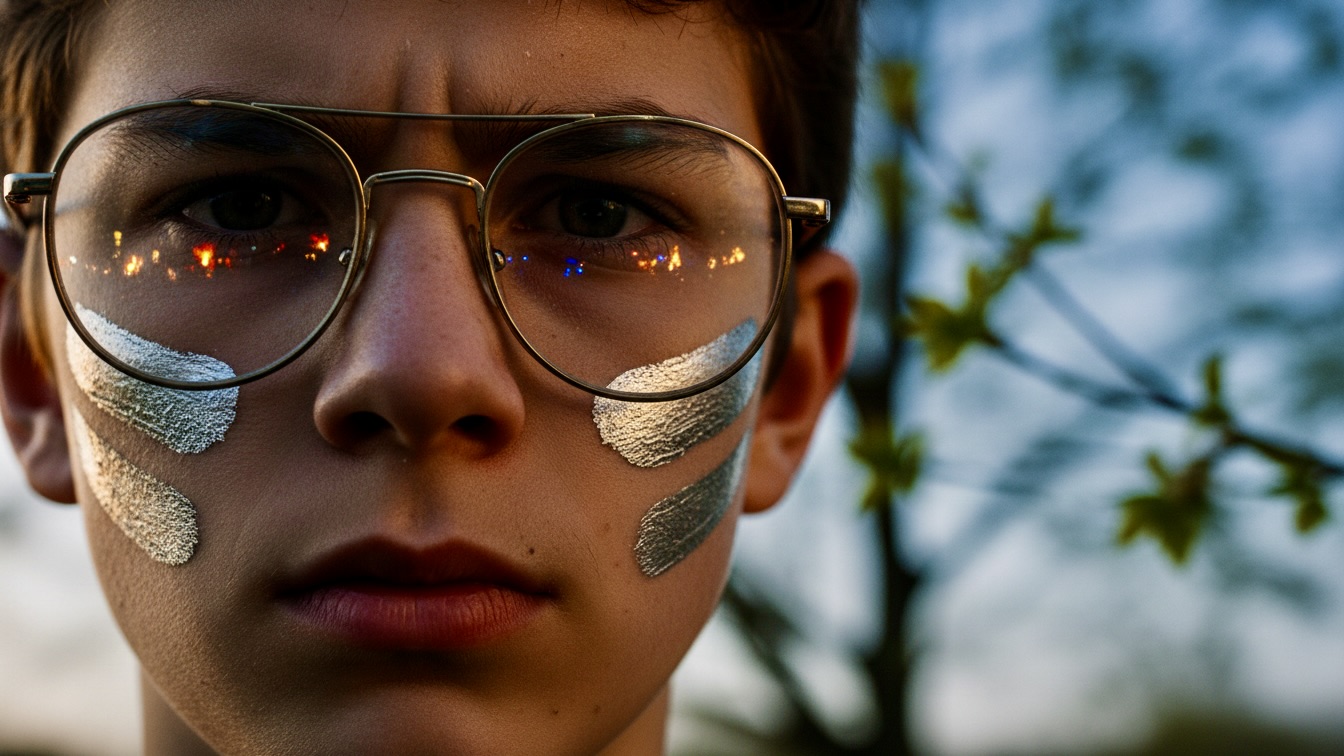
I found them in a bin of dead tech. Heavy glass lenses that didn't connect to anything at all.
The Link starts with a soft chime behind my left ear. It is a clean sound. Tonal. Pure. It marks the moment my world stops being gray and starts being perfect. The Civic Harmony app initializes, and suddenly, the cracked pavement of my bedroom floor is covered by a soft, virtual rug. The peeling wallpaper is hidden by a warm, digital oak paneling. I don't look at the real walls anymore. Nobody does. To look at the reality is to acknowledge the decay, and the app doesn't like negative reinforcement. It lowers your score. It makes you a problem.
I stepped out of the apartment into the spring morning. The Link told me the air quality was 'Optimal.' It showed me cherry blossoms drifting through the air, pink and delicate, though I knew the trees on our street had died five years ago during the drought. The sun was a bright, filtered yellow. It didn't burn. It just glowed. I walked toward the transit station, my boots thudding on what the Link told me was a polished marble sidewalk. I knew it was stained concrete. I could feel the grit through my soles, a vibration that didn't match the image in my eyes. That was the first sign of the glitch—the Shadow Mass.
Sometimes, the Link couldn't keep up. In the corners of my vision, I saw shapes. Dark, shifting masses that moved against the flow of the digital crowd. They looked like heat haze or ink spilled in water. When I turned my head to look directly at them, the Civic Harmony app would stutter, the 'Optimal' sun would flicker, and the mass would vanish, replaced by a bench or a flower pot. It was an unnatural silence. The mass didn't make noise, yet the app seemed to mute the surrounding area to compensate for the visual error. My stomach turned over every time it happened.
I ducked into 'Yesterday’s Tech,' a shop that smelled of ozone and damp cardboard. The owner, a man who kept his Link turned to the lowest setting, didn't look up. I moved to the back, to the bins of things the city had forgotten. I wasn't looking for parts. I was looking for an escape. My hand brushed against something cold and heavy. Not plastic. Metal. I pulled it out from under a pile of tangled charging cables. They were glasses. Real ones. Heavy brass frames with thick, scratched glass. No sensors. No battery. No Link.
I slid them on over my lenses. The world didn't change at first. The Link was still projecting its polished reality onto my retinas. But then, I tilted my head. The angle of the brass frames caught the light, and for a split second, the AR overlay broke. I saw the shop for what it was. A tomb. The walls were black with mold. The owner wasn't a middle-aged man in a clean apron; he was a gaunt, shivering ghost in a rag of a shirt. I ripped the glasses off. My heart hammered against my ribs. I looked again with just the Link. He was back to being a clean, digital construct. I bought the frames for three credits. The transaction was silent. The app didn't even register them as technology. They were just scrap.
I walked to the Central Plaza. The Link told me the Spring Festival was in full swing. I saw children playing with virtual ribbons and families sitting on the grass, eating digital picnics that looked like something out of a magazine. The air was filled with the smell of fake jasmine, piped in through the city’s misting vents. It was beautiful. It was a lie. I stopped in the middle of the square and pulled the brass frames from my pocket. I took a breath, closed my eyes, and slid them on. I kept them low on my nose, then pushed them up.
The world screamed. The silence was gone. The 'Spring Festival' was a riot. The children weren't playing; they were huddled behind concrete barriers. The 'grass' was a scorched patch of dirt littered with glass and spent canisters. And the Shadow Mass? They weren't glitches. They were people. Thousands of them. They were wearing rags, holding signs that had been digitally scrubbed from my vision. They were shouting, but the Link had been filtering the audio, turning their screams into the sound of wind in the trees. I saw a woman five feet away from me. In the Link, she was a topiary shaped like a swan. In reality, she was bleeding from a gash on her forehead, screaming at a line of police who looked like silver statues in the AR feed.
I felt a hand on my shoulder. I flinched, almost dropping the glasses. It was my father, Emile. In my Link, he looked rested, his suit sharp and pressed. He was the Lead Architect for the Civic Harmony app. He was the one who designed the 'Flower Festival' overlay. He looked at me, his eyes tracking the brass frames on my face. His expression didn't change, but his social credit indicator—a floating green dot only I could see—flickered to amber. He was disappointed.
"Take them off, Jay," he said. His voice was calm, the voice of a man who lived in a world where nothing ever went wrong.
"You see this?" I pointed at the bleeding woman. To him, I was pointing at a bush. "You see what's actually happening?"
"I see a boy who is risking his future," Emile said. "The raw reality is a fast track to being tanked. Your credit is at 840. Do you want to be a ghost? Do you want to live in the Shadow Mass?"
"They aren't shadows," I said. My voice shook. "They're people. You're erasing them."
"We are giving them peace," he replied. "The city cannot function on anger. We provide the harmony. The reality is just... data we haven't smoothed out yet. Put the Link back to full immersion. Now."
I looked at him. He wasn't even looking at the riot. He was looking at his own internal feed, probably checking my stress levels. I backed away. I didn't run. I just walked, keeping the brass frames pressed to my face. The contrast was nauseating. If I looked through the top of the glasses, I saw the war zone. If I looked through the bottom, I saw the paradise. My brain couldn't bridge the gap. I felt like I was being torn in half.
I found the alleyway Sandi had told me about. She was waiting there, her face smeared with something thick and reflective. It looked like liquid mercury. She held a brush in her hand. She didn't have a Link. Her ears were scarred where the implants had been ripped out. She looked at my brass frames and nodded once. A short, sharp movement.
"You saw it," she said.
"The plaza," I said. "It's... it's not a festival."
"It’s a massacre in slow motion," she said. She dipped the brush into the silver pot. "They use the facial recognition drones to track the protestors. If the Link can't see you, the system can't tank you. We use mirror-paint. It scatters the laser-mapping. Makes you a blind spot."
"My father designed the app," I said. I felt the weight of it. The history. The consequences. He wasn't a villain in his own mind. He was a gardener, pruning the ugly parts of the world so the rest could bloom.
"Then he’s the one who made us ghosts," Sandi said. "Hold still."
She painted the silver streaks across my cheekbones and forehead. It felt cold. It smelled of chemicals and old pennies. It was the first real thing I had felt all day that wasn't filtered through a 'Sensation Optimization' algorithm. As she worked, the drones buzzed overhead. In the Link, they looked like colorful dragonflies. Through the brass frames, they were black, multi-armed spiders with red lenses that never stopped blinking. They were searching for us. They were searching for the truth.
"Why do you do it?" I asked. "You could just... live in the festival."
Sandi stopped. She looked at me, her eyes hard. "Because the festival isn't real, Jay. And when the food runs out, or the water turns black, the Link will just show you a feast and a clear spring while you starve. I’d rather die seeing the dirt than live in a dream."
We moved back toward the plaza. The sun was setting, or at least the Link said it was. The sky was a vibrant, impossible purple. Through the glasses, it was a smoggy, bruised gray. The protestors were pushing against the police line now. The silver statues—the riot police—were swinging clubs. In the AR, it looked like they were waving batons of light, creating beautiful trails in the air. In reality, they were breaking bones. I saw a man go down. His social credit tag turned red, then vanished. He was being erased from the system in real-time. To everyone else in the square, he simply ceased to exist. They walked over him as if he were a glitch in the pavement.
I stood in the center of the chaos. The noise was a physical wall now. The screams, the rhythmic chanting, the thud of boots. My Link was frantic, trying to patch the holes. It kept overlaying images of flowers over the blood on the ground. It was a desperate, flickering mess. I saw Emile across the square. He was watching me. He looked terrified. Not of the riot—he couldn't see it—but of me. I was a smudge in his perfect world. I was the shadow mass.
I reached up to my temples. My fingers found the small, recessed buttons of the Link implants. My hands were shaking. If I did this, there was no going back. I would be a ghost. I would be a shadow. I would never see the polished marble or the cherry blossoms again. I would only see the mold, the grit, and the blood.
I looked at the woman who was still screaming. I looked at Sandi, who was holding a mirror-paint brush like a weapon. Then I looked at my father, who was living in a beautiful, silent lie.
I pressed the buttons. The chime didn't sound this time. There was only a sharp, electric pop, and then the world went dark for a heartbeat. When I opened my eyes, the brass frames were all I had. The purple sky was gone. The flowers were gone. The silence was dead.
I stood in the middle of the smoke and the fury. The air tasted like vinegar and burning rubber. It was the most honest thing I had ever tasted. A drone descended, its red eye locking onto the silver paint on my face. It hovered there, confused by the reflection, unable to find the boy it was supposed to protect.
I looked at the drone, then at the city, then at the server towers glowing in the distance. The spring air was cold, biting at my skin. I didn't feel safe. I felt awake.
"This isn't a glitch," I said, the words lost in the roar of the crowd. "It's the whole damn server."
“This isn't a glitch, it's the whole damn server.”


