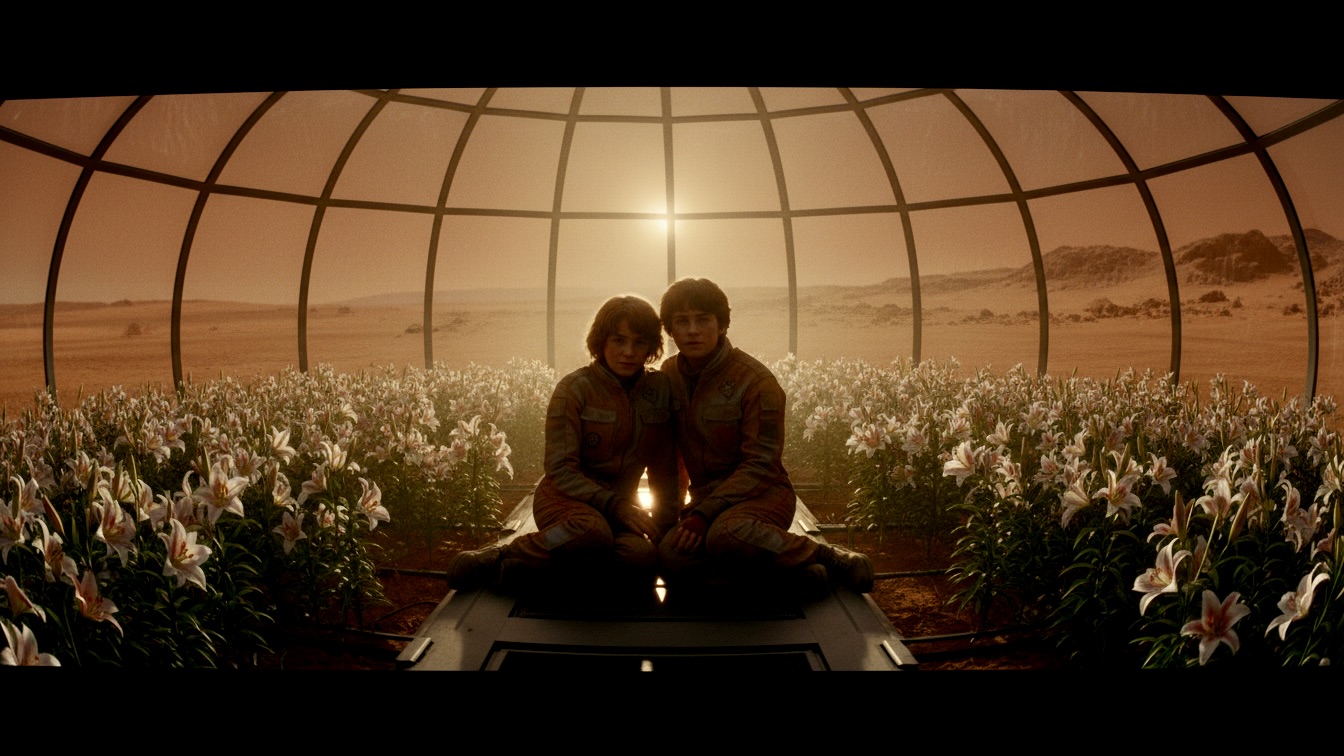
The solar flare killed the bots, leaving Lee and Shane to save the lilies by hand or lose everything.
The siren didn't scream. It groaned. It was a deep, chest-rattling vibration that meant the sun was currently throwing a tantrum. Lee felt it in her molars before she saw the red emergency lights flicker to life. The habitat's internal network hissed, a sound like steam escaping a pipe, and then the lights didn't just flicker—they died. For three seconds, the only thing Lee could see was the after-image of her computer screen burned into her retinas. Then, the backup power kicked in. It was a weak, sickly orange glow that barely reached the corners of the lab.
Everything was quiet. Too quiet. The hum of the oxygen scrubists had stopped. The whir of the nutrient pumps was gone. On Mars, silence was a death sentence. It meant the machines had quit. And if the machines quit, the humans were next. Lee didn't wait for an announcement over the comms. She knew where the most fragile life on the planet lived. She grabbed her tool kit—a beat-up plastic box held together by duct tape—and ran.
The hallway smelled like ozone and burnt hair. The solar flare had fried the external sensors and sent a surge through the grid that the surge protectors hadn't been ready for. Lee’s boots hit the metal floor with a rhythmic clang. Her breath was coming in short, sharp bursts. She wasn't just worried about the air. She was worried about the grant. The last research grant for the botany sector was due to be awarded in three days. If the lilies died, she had nothing. No career, no ticket to the upper-tier habitats, just a lifetime of scrubbing algae tanks.
She burst through the airlock of the Greenhouse Beta. The smell hit her immediately. It wasn't the flowers yet. It was the smell of a machine in distress. Water was spraying from a ruptured line in the ceiling, a fine mist that was turning the red dust on the floor into a sticky mud. In the center of the room, standing over the primary lily bed, was Shane.
Shane looked like he was trying to wrestle a snake. He had his hands clamped over a cracked pipe, water squirting out between his fingers, drenching his white lab coat until it was translucent. He looked frantic. His hair, usually styled in that perfect, annoying swoop, was plastered to his forehead.
"What are you doing?" Lee yelled over the sound of the spraying water.
"Fixing it!" Shane shouted back. He looked like he was about to cry. "The pressure valve blew. If the pressure stays low, the nutrient delivery fails, and they'll wilt in an hour."
Lee dropped her kit and waded through the mud. She watched him for five seconds—the way he was gripping the pipe, the way he was trying to use a piece of generic tape to seal a high-pressure leak. It was amateur hour. It was embarrassing.
"Your technique is straight trash," Lee said, her voice flat. "Move over before you drown the only thing making this rock smell less like recycled farts."
Shane hesitated, his face flushing a deeper red than the Martian landscape outside the reinforced glass. "I have it under control, Lee."
"No, you don't. You're creating a vacuum seal that’s going to pop the joint further down. Move."
She didn't wait for him to agree. She shouldered him aside. He stumbled back, his wet boots sliding on the slick floor. Lee ignored him. She reached into her kit, pulled out a specialized resin patch and a thermal clamp. Her hands were steady. They had to be. She'd spent three years in the lower-tier maintenance tunnels before getting into the botany program. She knew pipes better than she knew people.
She worked fast. The resin set in seconds under the heat of the clamp. The spray stopped. The silence returned, heavier this time. Lee wiped a bead of greasy water from her eyelid and looked at Shane. He was standing there, dripping, looking at the lilies. These weren't just any flowers. They were the only heirloom Stargazers on the planet. They were a genetic link to a world they had only seen in low-res VR simulations.
"The bots are dead, aren't they?" Shane asked. His voice was small.
Lee checked her tablet. It was dead. She tried the manual override on the nearest terminal. Nothing. "The flare fried the logic boards. Every automated system in the greenhouse is toasted. The pumps, the lights, the pollinators."
Shane’s eyes widened. "The pollinators? But... they bloom tonight."
Lee looked at the lilies. The buds were tight, swollen, almost ready to burst. Without the tiny drone-bees to move the pollen, the flowers wouldn't produce seeds. They wouldn't survive the season. The entire project would be a failure.
"We have to do it ourselves," Lee said.
Shane laughed, a dry, nervous sound. "Do what? Pollinate them? There are hundreds of them. We don't even have the equipment."
"We have brushes," Lee said. She walked over to the supply cabinet and kicked it open. She pulled out a tray of fine-tipped sable brushes meant for cleaning delicate lab equipment. "And we have forty-eight hours until the bloom cycle ends. You want that grant, Shane? You want to prove you're not just a legacy admission? Then pick up a brush."
For the first twelve hours, they didn't speak. It was just the sound of their breathing and the soft skritch-skritch of the brushes against the delicate stamens. It was painstaking work. You had to be gentle. If you pressed too hard, you bruised the petals. If you were too light, the pollen didn't stick.
Lee’s back was a scream of agony. Her neck felt like it was being held together by rusted wire. Every time she closed her eyes, she saw the yellow dust of the pollen. It was everywhere—on her skin, in her hair, coating her lungs.
Shane was across the bed from her. He was slow. He was meticulous to the point of annoyance. He checked every flower three times. But he wasn't quitting. Lee expected him to quit after hour six. She expected him to complain about his hands or the heat. The backup life support was keeping the greenhouse at a humid eighty degrees to save the plants, and they were both sweating through their jumpsuits.
Around hour twenty, the hallucinations started. Not big ones. Just the walls pulsing slightly. The red dust outside the window looking like it was flowing like water.
"Tell me something," Shane said. His voice was raspy, barely a whisper. He didn't look up from a particularly stubborn lily.
"What?" Lee asked. Her tongue felt like a piece of dry leather.
"Earth. What do you think the green actually looks like? Not the screen version. The real version."
Lee paused. She thought about the stories her grandmother told her. The ones about the smell of rain on hot asphalt and the way the grass felt between your toes. "I think it's messy," she said. "I think it's not as bright as the VR. I think it’s probably full of bugs and dirt and things that want to eat you. But I think it’s heavy. Like, the air has weight because it’s full of life. Not this thin, recycled stuff."
Shane nodded slowly. "My dad says there used to be forests so thick you couldn't see the sun. Even at noon. Just a roof of leaves."
"Must have been nice," Lee said. "Being able to get lost. You can't get lost on Mars. You just go from one box to another."
"That's why I'm here," Shane said. He finally looked at her. His eyes were bloodshot, surrounded by dark circles. "I took this job because my parents wanted me to be a 'pioneer.' They wanted the family name on a plaque in the first terraformed forest. I don't even like the cold. I hate the canned food. I just... I didn't want to be the one who failed the legacy."
Lee felt a sharp pang of something that wasn't annoyance. It was empathy. It was a gross, uncomfortable feeling. "You're doing okay, Shane. Your technique is still trash, but you're doing okay."
He managed a weak smile. "Thanks, Lee. That’s the nicest thing you’ve ever said to me."
By hour thirty, the fatigue was a physical weight. Lee was trying to check the soil dampness in the third bed, but her sensors were off. She kept thinking it was too wet, then too dry. She was frustrated, her movements becoming jerky and dangerous to the plants.
Shane watched her for a moment. He walked over, his movements slow and stiff. "Lee. Stop. You're going to snap the stem."
"I can't tell if it’s getting enough water," she snapped. "The automated sensors are down, and I can't... I can't feel it."
Shane knelt beside her. "Let me." He reached out and pressed his fingers into the dark, loamy soil. He closed his eyes. "It's too dry. About two inches down, it’s like powder."
"How can you tell?"
"My mom had a window box," he said softly. "Real soil. Not this synthetic mix. She made me tend it every day. She told me you can't just look at it. You have to feel the vibration of the moisture. Here."
He reached out and took Lee’s hand. His skin was hot, his palm rough from the work. He guided her fingers into the dirt. "Don't just poke it. Press. Feel the resistance. Water makes the soil heavy. If it feels light, it’s thirsty."
Lee let him guide her hand. For a second, the grant didn't matter. The flare didn't matter. There was just the cool dampness of the earth and the warmth of Shane’s hand over hers. It was the most human she’d felt in years. No screens, no data points. Just dirt and skin.
"I see it," she whispered. "I feel it."
He didn't pull his hand away immediately. They stayed like that, kneeling in the mud, a couple of tired kids in a plastic bubble on a dead planet. The subtext was thick enough to choke on. They weren't rivals anymore. They were the only two people who cared if these flowers lived.
As the second night fell—or at least, as the lights dimmed to simulate night—the temperature dropped. The greenhouse was designed to hold heat, but without the primary power, the Martian cold began to seep through the glass. The heaters were barely wheezing.
"We need to stay warm," Lee said. Her teeth were starting to chatter. "If our body temps drop, we'll get clumsy. We'll ruin the pollination."
They dragged several equipment mats together in the center of the lily beds. They huddled together, back to back at first, then side by side as the chill deepened. They used a heavy thermal tarp as a blanket.
"If the Director sees us like this, we're definitely losing that grant," Shane joked, though his voice was shivering.
"The Director can bite me," Lee muttered. She leaned her head against Shane’s shoulder. He was solid. He was a constant in a world that was currently falling apart.
Suddenly, the air changed.
It wasn't a sound or a light. It was a sensation. A thickness in the back of the throat. Lee opened her eyes. The lilies were opening. All at once, as if they’d reached a collective decision. The petals uncurled, revealing the deep, rich colors of a sunset they’d never see on Mars.
And the smell.
It was overwhelming. It wasn't the chemical scent of the air fresheners or the metallic tang of the scrubbers. It was sweet, heavy, and spicy. It was the smell of life. It was a sudden rush of oxygen that felt like it was cleaning out Lee’s entire soul.
"Oh," Shane breathed. "Wow."
They didn't move. They just sat there, surrounded by the bloom, breathing in the first real fragrance the planet had ever known. The claustrophobia of the tiny hab, the pressure of the competition, the fear of the void—it all just lifted. For a moment, they weren't on a dead rock. They were in a garden.
"We did it," Lee said. She felt a tear track through the dust on her cheek.
"We did," Shane agreed. He reached out and squeezed her hand. This time, it wasn't about the soil.
Twelve hours later, the airlock hissed open. Director Ryan walked in, followed by a team of technicians. He looked exhausted, his uniform wrinkled, but when he stepped into the greenhouse, he stopped dead. He took a long, deep breath.
He looked at Lee and Shane, who were standing by the primary bed, covered in mud, pollen, and sweat. They looked like hell, but they were standing tall.
"The automated systems..." Ryan started, looking at the dead consoles. "How are they still alive?"
"We did it by hand, sir," Lee said. Her voice was steady, even though she was vibrating with fatigue.
Ryan walked over to a lily, inspecting the pollen coverage. He looked at the patches on the pipes. He looked at the two of them. "The board was going to cancel the botany grant," he said quietly. "They thought the sector was too reliant on fragile tech. They thought it wasn't worth the risk if a flare could wipe it all out."
Shane stepped forward. "The tech is fragile, sir. We aren't. We saved them. And we can do it again."
Ryan nodded slowly. "I can see that. I’ll be recommending that the grant be split between the two of you. This isn't a one-person job. Not if we want to actually grow something here."
As Ryan and the techs began the process of restoring the power, Shane and Lee walked toward the airlock. They were done. They needed sixteen hours of sleep and a shower that lasted a week.
"So," Shane said, leaning against the frame of the airlock. "Co-grantees. Does this mean you’re going to stop calling my technique trash?"
Lee looked back at the lilies, then at him. She felt a strange, new energy bubbling up under her exhaustion. A quest that was bigger than a grant.
"Maybe," she said, a small smirk playing on her lips. "But only if you help me with the next part."
"The next part?"
"The lilies were just the start," Lee said, her eyes bright. "I saw the inventory list for the deep storage vault. They have oak seeds, Shane. Real, honest-to-god trees. If we could save these, we can grow a forest."
Shane looked at her, and for the first time, he didn't look like a scared kid. He looked like a partner. "A forest on Mars? That's impossible."
"Good," Lee said, stepping into the airlock. "I’m bored of doing the easy stuff."
She hit the cycle button, the sound of the airlock sealing them in as they prepared to step back into the sterile world, carrying the scent of the new world with them.
“She knew the seed vault was high-security, but as she looked at Shane, she realized she wasn't the only one ready to break the rules to turn the red planet green.”


