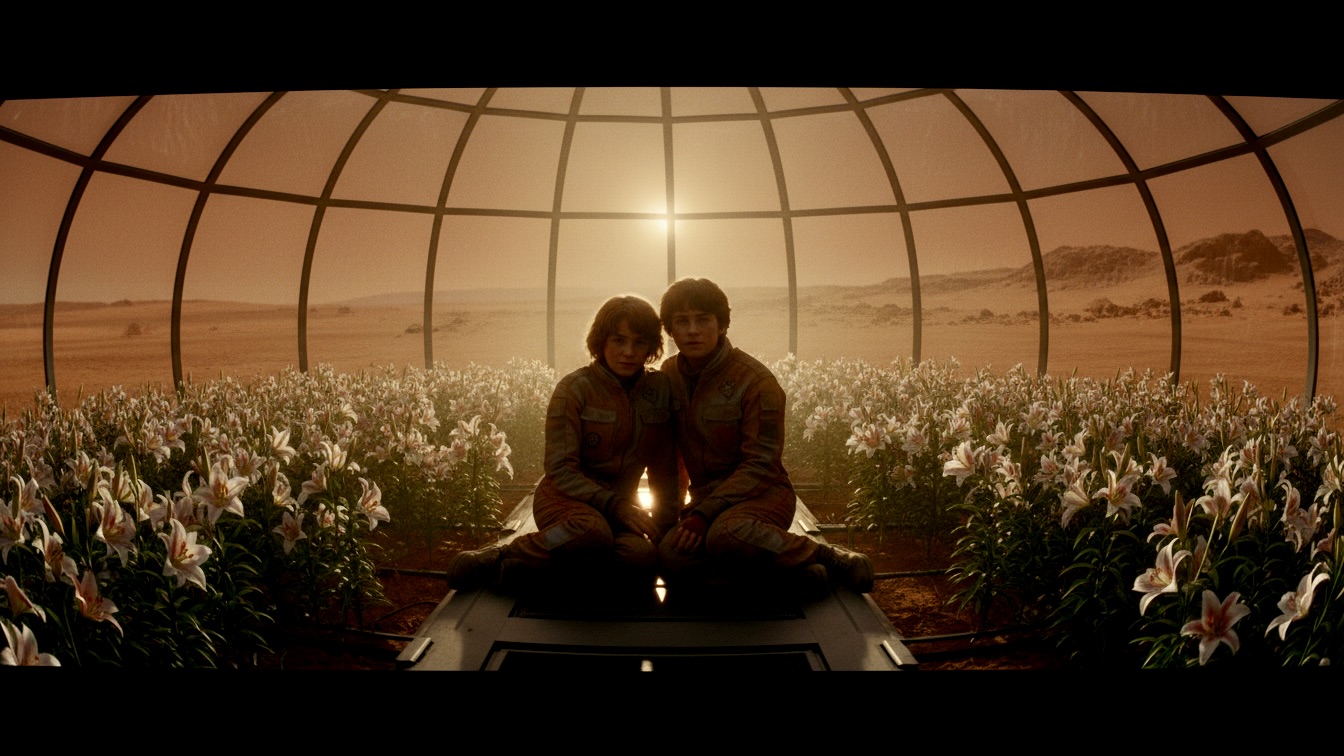
The narrative begins with a catastrophic solar flare striking a Martian colony, causing a total system failure within the habitat. Lee, a pragmatic botanist with a background in heavy maintenance, rushes to Greenhouse Beta to save the precious Stargazer lilies. She finds her colleague, Shane, struggling unsuccessfully to contain a high-pressure pipe leak that threatens the crop. After Lee expertly repairs the plumbing, they realize the automated pollinators have been destroyed by the electromagnetic surge.
Faced with the imminent loss of their research grant and the death of the heirloom plants, Lee and Shane commit to pollinating the hundreds of flowers by hand. Over the course of forty-eight grueling hours, they labor in sweltering heat and physical exhaustion. During this period, their professional rivalry softens into a mutual understanding as they share stories of Earth and their personal motivations. Shane reveals the burden of his family legacy, while Lee discovers that Shane possesses a unique, sensory connection to the soil that she lacks.
As the lilies finally bloom, the pair experiences a rare moment of sensory beauty on the otherwise sterile planet. The overwhelming fragrance and the successful pollination serve as a testament to their endurance. When the habitat director arrives to survey the damage, he is impressed by their manual intervention and decides to split the grant between them. The story concludes with Lee and Shane forming a new partnership, looking beyond the lilies toward the ambitious goal of planting a Martian forest.
A central theme of the story is the tension between technological fragility and human resilience. The narrative illustrates how quickly the sophisticated infrastructure of Mars can collapse, leaving the inhabitants vulnerable when their machines fail. While the "logic boards" and "automated systems" are rendered useless by the solar flare, the protagonists prove that human adaptability is the ultimate fail-safe. This theme suggests that true colonization requires more than just advanced hardware; it demands a visceral, manual commitment to the environment.
The narrative also explores the psychological weight of "The Lost Earth" and the yearning for organic connection. Both characters are driven by a desire to recreate a world they have never truly known, using the lilies as a biological bridge to their ancestral home. The descriptions of Earth as "messy" and "heavy with life" contrast sharply with the "recycled farts" and sterile boxes of Martian life. This longing transforms the act of pollination from a mere scientific task into a sacred ritual of preservation.
Class and legacy form another significant thematic layer within the text. Lee represents the "lower-tier" worker who has fought for every opportunity, viewing the botany grant as a literal ticket to a better life. In contrast, Shane carries the psychological burden of a "legacy admission," struggling to live up to his family's pioneering reputation. The resolution of the story suggests that neither raw ambition nor inherited status is sufficient on its own. Instead, it is the synthesis of Lee’s technical grit and Shane’s intuitive sensitivity that ensures their survival.
Lee is defined by a fierce, defensive pragmatism shaped by her history in the lower-tier maintenance tunnels. Her psychological landscape is one of scarcity and survival, where she views her environment through the lens of utility and mechanical integrity. She initially treats Shane with unconcealed contempt, projecting her insecurities about class and competence onto his "trash" technique. For Lee, the lilies are not just plants; they are a strategic asset that represents her only escape from a lifetime of manual labor.
As the crisis progresses, Lee’s rigid emotional exterior begins to crack, revealing a capacity for deep empathy. Her interaction with Shane during the pollination process forces her to move beyond her "pipes and resin" mindset to appreciate the nuance of living things. She experiences a significant internal shift when she allows Shane to guide her hand in the soil, transitioning from a person who controls her environment to one who feels it. By the end of the chapter, she has evolved from a solitary survivor into a visionary leader who sees the value in partnership.
Shane operates under the shadow of intense imposter syndrome, exacerbated by his "legacy" status and his apparent lack of technical skill. Psychologically, he is paralyzed by the fear of failing his family's name, which manifests as frantic, ineffective action during the initial pipe burst. He is acutely aware of Lee’s superior mechanical abilities, which initially makes him defensive and prone to "amateur" mistakes. However, his persistence through the forty-eight-hour ordeal demonstrates a quiet fortitude that contradicts his pampered appearance.
Shane’s true strength lies in his sensory intelligence and his emotional connection to the natural world. Unlike Lee, who relies on sensors and tablets, Shane possesses a "window box" intuition passed down from his mother. This tactile relationship with the earth allows him to sense the needs of the plants in a way that technology cannot replicate. By sharing this gift with Lee, he validates his own presence in the program and moves from being a "scared kid" to a competent pioneer.
The narrative voice of the story is visceral and grounded, using gritty sensory details to establish the harsh reality of Martian life. The author employs sharp, evocative metaphors, such as the siren "groaning" like a "chest-rattling vibration" and the smell of "ozone and burnt hair." These choices immediately immerse the reader in a state of high-stakes tension. The contrast between the "weak, sickly orange glow" of the backup power and the "deep, rich colors" of the blooming lilies serves as a powerful visual arc for the chapter.
The pacing of the story mirrors the physical and psychological journey of the characters. It begins with a frenetic, high-action sequence during the solar flare, characterized by short, punchy sentences that mimic Lee’s "short, sharp bursts" of breath. As the manual pollination begins, the prose slows down, becoming more rhythmic and meditative to reflect the "painstaking work" of the brushes. This shift in tempo allows the dialogue to carry more weight, facilitating the emotional intimacy that develops between Lee and Shane during the long hours of labor.
The tone of the piece successfully transitions from clinical survivalism to a sense of transcendental hope. The author uses the heavy, spicy scent of the lilies to signal a shift in the atmosphere, breaking the "claustrophobia of the tiny hab." This olfactory imagery provides a psychological relief for both the characters and the reader, elevating the story from a disaster narrative to a foundational myth of a new world. The final exchange between the characters leaves the reader with a sense of "bright" possibility, effectively closing the chapter on a note of ambitious wonder.


