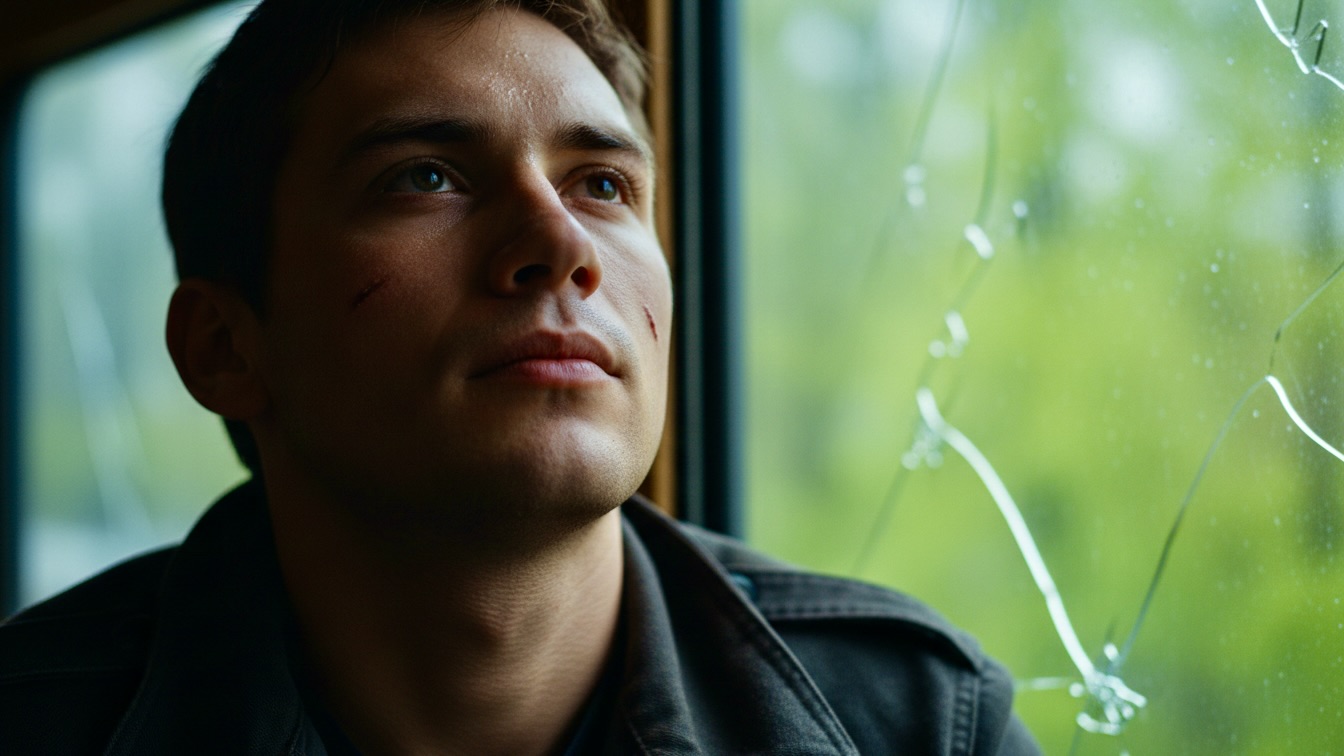
The gravity flipped. The tech bros took the air. We chose the vacuum outside instead.
My coffee stopped being a liquid at exactly 8:14 AM.
It didn't spill. It just detached from the paper cup. A dark brown, vibrating sphere hanging in the dead space between my knees and the gray fabric of the seat in front of me.
I stared at it.
My brain, sluggish and under-caffeinated, tried to process the physics. Surface tension. Volume. I blinked. The coffee sphere drifted up, inching toward the fluorescent lights on the ceiling.
I didn't scream. Nobody screamed. We were commuters on the 7:30 inbound. We were conditioned to ignore weird things on the train. You don't make eye contact with the guy playing music out of his phone speaker, and you don't acknowledge the coffee violating the laws of mass. It was Tuesday. I had a marketing stand-up in forty minutes. I was entirely out of the emotional bandwidth required to panic over a localized anomaly.
Beside me, Helen slowly lowered her phone. The screen was cracked, a spiderweb of shattered glass radiating from the bottom left corner. She looked at the floating coffee, then looked at me.
"Did we hit a pocket?" she asked. Her voice was flat.
"Looks like it," I said.
"Great. The blue line is going to be backed up for hours."
Outside the window, it was April. A disgustingly beautiful spring morning. The kind of morning that makes you resent the fact that you have to spend it inside a sealed metal tube moving at a hundred and twenty miles an hour. The trees whipping past the reinforced glass were a bright, electric green. The sunlight was sharp and aggressive, slicing through the dusty windows and highlighting the exact amount of grime on the floorboards.
I watched a single drop of coffee break away from the main sphere and drift toward Helen's shoulder.
Then my stomach hit my throat.
It wasn't a slow transition. The train didn't gradually lift off the tracks. It was a sheer. A violent, mechanical tear in reality. One second, gravity was pulling us down into our worn, unergonomic seats. The next second, the vector snapped 180 degrees.
Down became up.
The floor ceased to be the floor.
I didn't fall. I was thrown. My seatbelt wasn't buckled—nobody buckles up on the commuter rail—and I hit the ceiling hard. My shoulder slammed into the curved plastic housing of the overhead lights. The sound was deafening. It wasn't just the impact of my body; it was the sound of forty people, hundreds of laptops, briefcases, phones, and travel mugs all hitting the ceiling at the exact same moment.
The train car groaned, a horrible, deep metal shriek that vibrated in my teeth.
I lay there on the hard plastic of the ceiling. The lights dug into my spine. My vision blurred, graying out at the edges. I tried to pull air into my lungs, but my diaphragm was paralyzed by the impact.
I breathed.
It tasted like copper.
I blinked the stars out of my eyes and tried to orient myself. The geometry of the world was entirely wrong. I was lying on the ceiling. Above me—which used to be below me—were the seats, bolted to the floor, hanging upside down like stalactites in a gray, corporate cave. The hand straps, meant for standing passengers to hold onto, were sticking straight up from the floor, rigid and useless.
The emergency brakes must have engaged, because the friction was massive. Sparks showered outside the window, tearing through the bright spring morning. The trees outside were sideways now. The horizon was tilted at a severe, sickening angle.
Then, the momentum died. The train shuddered, gave one last violent jolt, and stopped.
Silence.
Not total silence. There was the hiss of an air leak somewhere. The pop and crackle of electrical shorts. But the human silence was heavy. The collective shock of forty people trying to figure out if they were dead.
"Helen?" I coughed. Dust was thick in the air. Gray, particulate dust that tasted like old skin cells and burnt rubber.
"Here," a voice grunted from my left.
I turned my head. Helen was tangled in the straps of someone's discarded messenger bag. She had a cut on her forehead, right at the hairline. Blood was trickling down, but because the gravity was inverted, it wasn't running down her face. It was pooling up, defying logic, dripping off her eyebrows into the open air.
"You okay?" I asked, pushing myself up onto my elbows. My shoulder screamed.
"No," she said, wiping at the blood. She looked at her hand, disgusted. "I'm really not."
I sat up fully. The train car was a mess. Luggage had rained down on us. Someone's heavily branded corporate backpack had burst open, scattering protein bars and charging cables across the ceiling panels. People were groaning, starting to untangle themselves.
We were in Car 4. The 'quiet car.' Usually reserved for the people who paid a premium to not hear high school kids screaming on their way to the city. Mostly tech workers, mid-level managers, the kind of people who wore fleece vests indoors.
I looked down the length of the car.
Three guys were already standing. They had been in the lounge section, the part with the curved benches. They had fallen a shorter distance. They looked fine. Annoyed, dusty, but fine.
One of them was wearing a gray fleece vest over a button-down. Let's call him Fleece. The guy next to him had a smartwatch that was currently blaring a high heart rate warning. That was Watch. The third guy was just tall and aggressively broad-shouldered.
Fleece was looking up at the old ceiling, which was now the floor beneath our feet.
"The masks didn't drop," Fleece said. His voice was loud in the quiet car. It had that specific pitch of a guy used to talking over people in meetings.
I looked up.
The oxygen compartments were built into the overhead bins. But because we were upside down, the compartments were now below us. Or rather, they were embedded in the floor we were standing on.
A sudden, sharp hiss echoed through the car.
The pressure dropped. My ears popped, painful and fast.
The anomaly wasn't just a gravity sheer. It had compromised the hull. The train was sealed, meant to pass through low-pressure zones on the mag-lev track, but the crash had cracked something. The air was venting out into the dead zone outside.
I felt it immediately. The air grew thin. Every breath suddenly felt hollow, like drawing from a straw with a hole in it. My heart rate spiked, my body realizing it was starving before my brain did.
With a series of dull thuds, the plastic panels on the old ceiling—the current floor—popped open.
Yellow rubber masks fell out. But because gravity was still pulling us "down" toward the roof of the train, the masks didn't dangle from above. They deployed and then just laid there on the floor, tethered by clear plastic tubes to the compartments.
There were exactly six masks in our immediate section.
Before I could even process the math, Fleece moved.
He dropped to his knees, grabbed two of the yellow masks, and pulled them toward him. Watch and the tall guy did the same. Within three seconds, they had gathered all six masks from our sector. They didn't put them on yet. They just held them, wrapping the clear plastic tubing around their wrists like they were securing a boat to a dock.
"Hey," Helen said. Her voice was already sounding a little reedy. The air was leaving fast. "Pass two over here."
Fleece looked at us. He looked at Helen's bleeding head, my dusted jacket, and then down at the masks in his hands. He didn't look angry. He looked completely, terrifyingly rational.
"I don't think that's a good idea," Fleece said.
I stood up. My knees shook. The gravity felt heavier than normal. 1.2 Gs, maybe. Just enough to make moving feel like walking through mud.
"What are you talking about?" I said. "There are six masks. There are five of us in this section. Do the math, man."
Watch shifted his weight. He put one of the masks over his face. I could hear the sharp hiss of the oxygen flowing. He took a deep breath, his eyes closing in relief. He kept the second mask clutched in his fist.
"We don't know how long rescue is going to take," Fleece said, using his calmest, most irritating management voice. "The feed lines might be damaged. If we have two masks each, we double our survival time. It's just basic resource allocation."
I stared at him. The sheer audacity of it short-circuited my brain for a second. The world had literally turned upside down, the air was being sucked out of the room, and this guy was talking about resource allocation.
"You're hoarding oxygen," Helen said. She took a step forward.
The tall guy stepped in front of Fleece. He was easily six-foot-three, built like a guy who spends his weekends doing obstacle course races. He crossed his arms.
"Back off," the tall guy said.
"Give us the masks," I said, stepping up beside Helen. I felt dizzy. The edges of the car were starting to look fuzzy.
"We need to optimize our footprint here," Fleece said from behind the tall guy. He pulled a mask to his face, inhaled deeply, and then pulled it down to speak. "If we spread it out, we all might run out before they cut through the hull. If we consolidate, at least some of us make it. I'm sorry, but that's the reality of the situation."
He wasn't sorry. He was thrilled. The rules of polite society had been suspended, and he was taking full advantage. He was the CEO of Car 4 now.
Helen laughed. It was a harsh, dry sound.
"I'm going to kill him," she whispered to me.
"You're going to pass out before you reach him," I whispered back.
It was true. My lungs were burning. The instinct to hyperventilate was kicking in, but panting only made it worse. The air I was pulling in had nothing in it. It was just dead volume.
I looked at the three of them. The Ceiling Kings. They had the masks. They had the physical advantage. If we fought them, we would burn what little oxygen we had left in our blood. Even if I managed to drop the big guy—highly unlikely—Fleece and Watch would just wait for us to pass out.
"Listen," I tried, keeping my voice level. "You don't need two masks. Just give us one. We can share."
"I said table it," Fleece said. He actually used the phrase 'table it'. He put the mask back over his face and turned his back to us.
Helen grabbed my arm. Her grip was insanely tight. Her fingernails dug through my jacket.
"Gerry," she said.
I looked at her. Her face was pale. The cut on her head was still bleeding, the drops falling upward and splashing quietly against the fluorescent light panels beneath our boots.
She pointed up.
I followed her finger.
Above us, on the original floor of the train, was a square panel outlined in red hazard tape.
*EMERGENCY MAINTENANCE HATCH. DO NOT OBSTRUCT.*
I knew what it was. Everyone who rode the mag-lev knew the layout. Under the floor of every car was an access hatch used by the drones at the depot to service the undercarriage. It was a manual release. A heavy red lever that bypassed the electronic locks in case of total power failure.
"The hatch," Helen said, her voice dropping to a harsh whisper.
I looked at the hatch, then looked at the window.
Outside, the spring morning was entirely static. The leaves on the trees didn't move. There was no wind. There couldn't be wind.
The train had hit an anomaly. A gravity sheer. But these anomalies didn't just mess with mass; they stripped the environment. The reason the train was sealed was because the track ran through dead zones where the atmosphere had been sheared away.
Outside that window wasn't a beautiful April morning. It was a vacuum. A zero-pressure void that just happened to be lit by the sun.
"Helen," I whispered back. "It's a void out there. If we open that, it vents the whole car."
"The car is venting anyway," she said. She was leaning against the back of an upside-down seat to keep her balance. "The pressure is dropping. We have maybe three minutes before we black out. Those guys have the tanks. We don't."
"If we open the hatch, we get sucked out."
"Yes," she said.
I looked at her. She was serious.
"The boundary of the anomaly can't be far," she said, panting slightly. "The sheer hit us at Mile 42. The dead zone usually only spans a few hundred yards. If we get out, we can walk to the edge. We can reach the atmosphere."
"Walk?" I said. "In zero gravity? In a vacuum? We'll suffocate in sixty seconds."
"We suffocate in three minutes in here," she countered. She nodded toward Fleece and his boys. They were sitting on the ceiling panels, casually breathing from their stolen masks, completely ignoring us. "And I refuse to die watching them breathe."
That was it. That was the core of it.
It wasn't a calculated risk. It wasn't a stroke of tactical genius. It was pure, unadulterated spite. I looked at Fleece, with his perfectly trimmed beard and his unearned confidence, hoarding the air just because he happened to fall closer to it.
I felt a sudden, deep heat in my chest. Anger. Clean and sharp.
I'd spent my whole life playing by the rules. Paying taxes, scanning my badge at 8:55 AM, standing in line, waiting my turn. And where did it get me? Choking to death on the ceiling of a commuter train while a guy in a Patagonia vest decided my life wasn't worth the resource allocation.
"Okay," I said. "Let's do it."
The hatch was above us. Technically, it was on the floor, but since we were standing on the ceiling, we had to climb up to reach it.
The layout of the car provided a terrible, improvised ladder. The seats were bolted to the old floor above us. They hung down, suspended by heavy steel mounts. We would have to climb the seats.
"Up," I said.
I reached up and grabbed the armrest of the nearest seat. The fabric was rough. I pulled. My shoulder protested, burning with a sharp pain from the crash. The gravity felt heavy, dragging at my boots.
I hauled myself up, swinging my legs to find purchase on the headrest of the seat. The geometry was entirely confusing. My brain kept telling me I was going to fall down, but "down" was the ceiling.
Helen followed. She was faster than me, driven by pure adrenaline and rage. She grabbed my belt, using me to steady herself as she swung onto the seat beside me.
We were now hanging suspended between the new floor and the new ceiling, clinging to the upside-down seats.
The movement caught Watch's attention.
He pulled his mask down. "Hey! What are you doing?"
I didn't answer. I reached up, my fingers brushing the red hazard tape bordering the hatch. It was still two feet above me. I needed to get higher.
I stepped onto the bottom cushion of the seat, balancing precariously. The cushion gave way slightly under my weight.
"Hey!" Fleece shouted. He stood up, dropping one of his spare masks. He pointed at us. "Get down from there!"
"You want to stop us?" Helen yelled down at him. Her voice was weak, raspy. "Come up here and stop us. Oh wait, you can't bring the tubes with you."
She was right. The clear plastic tubes connecting their masks to the floor compartments were only about four feet long. They were tethered. If they wanted to stop us, they had to take the masks off.
Fleece realized this. His face flushed red. "Don't touch that hatch! The car is pressurized! If you open that, we'll lose everything!"
"We're already losing everything," I said.
I found a handhold on the metal frame of the seat base. I pulled myself up higher. My face was inches from the emergency hatch.
My lungs were screaming. Black spots danced in my peripheral vision. The lack of oxygen was making me clumsy. My fingers felt like thick, useless sausages.
I stared at the hatch mechanism. It was a recessed lever covered by a clear plastic guard.
*IN CASE OF EMERGENCY: BREAK COVER. PULL RED LEVER. ROTATE 90 DEGREES.*
I slammed my fist into the plastic cover.
It didn't break. It just hurt my hand.
"Damn it," I muttered.
Below me, the tall guy made a decision. He ripped the mask off his face, took a massive gulp of air, and ran toward the seats. He jumped, grabbing the armrest of the seat I was climbing.
The entire structure shook.
"Get down!" the tall guy roared.
He started climbing fast. He was strong, and he was motivated by the panic of a man who suddenly realized he wasn't in control of the room anymore.
"Hurry," Helen said. She was clinging to the seat next to me, her breathing shallow and fast.
I hit the plastic cover again. Harder.
Nothing.
The tall guy grabbed my ankle. His grip was like a vice. He yanked, trying to pull me down. My hands slipped on the metal frame. I slid down a few inches, my chin hitting the bottom of the seat.
Pain flared in my jaw. The black spots in my vision grew larger.
Helen kicked out. Her boot caught the tall guy square in the shoulder. He grunted but didn't let go of my ankle.
"The phone!" Helen yelled.
She shoved her hand into her pocket and pulled out her cracked smartphone. She reached across the gap between the seats and smashed the heavy, reinforced corner of the phone directly into the plastic guard covering the lever.
The plastic shattered.
Jagged pieces rained down, bouncing off the tall guy's face. He flinched, closing his eyes, but his grip on my ankle tightened.
I ignored him. I reached into the recessed hole. My fingers closed around the cold, heavy metal of the red lever.
"Gerry, wait!" Fleece screamed from below. He was completely panicked now. The corporate mask was gone. He was just a terrified animal holding a yellow rubber tube. "We can share! We can share!"
I looked down at him.
"Too late to table it," I said.
I pulled the lever.
It was stiff. Decades of non-use fought against my muscles. I put my entire body weight into it, ignoring the burning in my shoulder and the lack of air in my blood.
The lever moved with a loud, mechanical clank.
I rotated it 90 degrees.
The reaction was instantaneous.
The locking bolts disengaged. The pressure difference did the rest. The train car still had some atmosphere left, while outside was a perfect vacuum. The hatch didn't just open; it was violently sucked outward, ripped off its hinges and thrown into the void.
The noise was impossible. It wasn't a sound; it was a physical force.
The air in the car rushed toward the opening with the power of a hurricane.
The tall guy holding my ankle was ripped away. He didn't even have time to scream. The pressure differential snatched him off the seat and threw him straight up and out the hatch. He vanished into the bright spring sunlight.
The remaining air in the car turned into a violent wind tunnel. Dust, luggage, the shattered remains of the overhead bins—everything was pulled toward the square hole in the ceiling.
I held onto the metal frame of the seat with everything I had. My muscles locked. My joints popped. The wind tore at my clothes, trying to rip me loose.
Below us, Fleece and Watch didn't stand a chance. They were holding the masks, thinking it would save them. But the masks were tethered to the floor. When the wind hit them, they were lifted off the ceiling panels. They held onto the tubes for a split second before the plastic snapped.
They flew upward, a blur of gray fleece and terrified limbs, and were sucked out the hatch, disappearing into the anomaly.
Helen was beside me, her arms wrapped around the base of the seat, her eyes squeezed shut.
The depressurization lasted maybe four seconds.
Then, it was over.
The wind stopped. The noise stopped.
The car was completely empty of air.
The silence that followed was absolute. It wasn't the quiet of a stopped train. It was the dead, flat silence of a vacuum. Sound needs a medium to travel. There was nothing left to carry it.
My lungs clamped shut. My body realized instantly that opening my mouth would mean the pressure inside my chest would equalize with the zero-pressure environment, rupturing my organs. I kept my jaw locked tight.
I looked at Helen.
Her eyes were open. They were wide, terrified, but focused. She pointed up at the open hatch.
We couldn't stay in the car. There was no air, and the metal was slowly tearing apart under the strain of the gravity sheer. Our only chance was outside. The edge of the anomaly couldn't be far.
We had maybe forty seconds of useful consciousness left on the oxygen currently circulating in our blood.
I nodded.
We let go of the seats and pushed ourselves up through the hatch.
The moment we passed through the metal frame, the gravity died completely.
We drifted out into the void.
It was the most terrifyingly beautiful thing I had ever seen. The spring trees were just feet away, but they were frozen, their leaves perfectly still. The sunlight was blinding, unfiltered by an atmosphere.
Below us—which was actually above us, or maybe sideways, the directions didn't matter anymore—the damaged commuter train hung suspended in the sheer, slowly twisting in the zero-gravity field.
Helen was floating next to me. She looked like a diver in a clear ocean.
I felt the pressure building in my head. My vision was tunneling fast, the edges going dark. I couldn't hear my own heartbeat, but I could feel it, hammering against my ribs, a desperate, frantic rhythm.
I pointed toward the front of the train, toward where the tracks disappeared into the bright, hazy edge of the anomaly field. The atmosphere was out there. The real world.
We started to swim through the empty air, kicking our legs in a desperate paddle toward the tree line.
The lock disengaged with a heavy, metallic clack, and the void rushed in to meet us.
“The lock disengaged with a heavy, metallic clack, and the void rushed in to meet us.”


