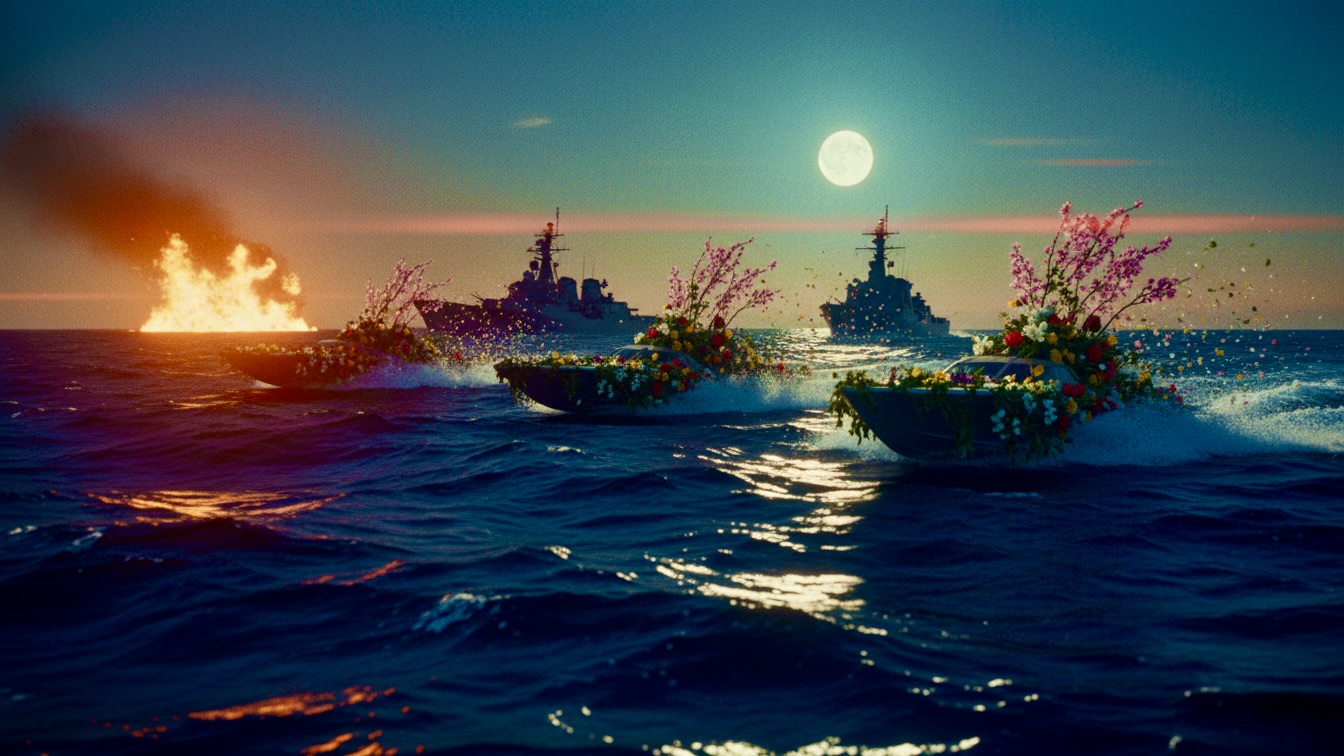
Stefan pushes the throttle as the navy ships loom, their hulls blotting out the spring moon over the strait.
The Eastern Giant navy didn't just arrive; it materialized. One day the horizon was empty, a flat line of gray water and heat haze, and the next, it was jagged with steel. Three destroyers sat like tombstones across the mouth of the strait. They were massive, ugly things, painted the color of a bruise. They didn't move. They didn't have to.
They just existed there, a physical block in the world's throat, cutting off the oil, the food, and the Wi-Fi. Stefan watched them through a pair of cracked binoculars from the roof of a flooded parking garage. Below him, the city was vibrating with a frequency he’d never felt before. It wasn't the sound of engines. It was the sound of people realizing the lights weren't coming back on.
"They’re closer than yesterday," Andrew said. He was sitting on a rusted lawn chair, scrolling through an offline map on a phone with a shattered screen. Andrew was twenty-two, but he looked forty in this light. The stress had eaten the fat off his face. "I counted six patrol boats. They’ve got heat-seekers, Stefan. If we even prime an engine, they’re going to see the thermal signature from five miles out. It’s a suicide mission. Totally cooked."
Stefan didn't look away from the ships. "The city is dying, Drew. Have you been to the lower districts? They’re burning furniture to cook rice. The hospital is on its last three barrels of diesel. If we don't move, we’re just waiting for the dark to finish us off."
"And if we do move, we’re target practice," Andrew snapped. He stood up, the chair scraping against the concrete. "It’s not a race. You can’t outrun a missile with a drift boat. This isn't the harbor circuit."
Stefan finally lowered the binoculars. "We aren't outrunning them. We’re ghosting them. It’s the Spring Solstice. The whole city is going to be on the water tonight. Or at least, the parts of it that haven't been burned down yet."
Across the city, the Strongman’s palace was a pillar of black smoke. The election had ended three days ago, but the Strongman hadn't left. He’d barricaded himself in the marble halls while the people outside tore the gates off their hinges. The revolution was messy. It wasn't some organized military coup; it was thousands of twenty-somethings in flower crowns and tactical vests, throwing bricks at riot shields and streaming the whole thing until the cell towers went dark. The Strongman was a relic, a man who thought he could own the wind. Now, he was just a prisoner in a gold-plated cage.
"The new government is a joke," Andrew muttered. "They’re all twenty-five. They’re busy arguing about who gets the office with the balcony while the navy is parked in our front yard. They’re hungover from the victory party. They won't see us coming because they aren't even looking."
"Exactly," Stefan said. "Which is why we do it tonight. The floral parade is still happening. The locals think if they throw enough petals in the water, the gods will make the ships go away. We’re going to give them a different kind of miracle."
They spent the afternoon in a hidden boathouse under the pier. The space was cramped, smelling of damp wood and high-octane fuel. Three boats sat in the gloom. They were low-profile, carbon-fiber shells built for speed, not cargo. But they’d been modified. The seats were gone, replaced by reinforced bladders filled with enough diesel to run a regional power grid for a week. The crew—Stefan, Andrew, and a girl named Mira who could rebuild a turbocharger in her sleep—worked in silence. They weren't talking about the risk. They were talking about the math.
"Weight is okay," Mira said, wiping grease onto her cargo pants. She looked at the boats. They didn't look like smuggling vessels anymore. They looked like floats. "The insulation is holding. We’ve got the heat-shielding blankets around the engine blocks, but it only buys us twenty minutes of high speed before the sensors pick up the leak. We have to stay under four knots until we hit the gap."
Stefan started taping bundles of wildflowers to the hull of the lead boat. Yellow jasmine, pink cherry blossoms, and thick green vines. They were real, plucked from the palace gardens by the looters. The scent was overpowering in the small space, a cloying sweetness that fought with the smell of fuel. "It looks ridiculous," he said.
"It looks like a religious procession," Mira corrected. "That’s the point. The Eastern Giant rules of engagement say they won't fire on non-combatant cultural displays unless they’re provoked. We’re just a bunch of kids celebrating spring. Harmless. Idiots."
"I’m not an idiot," Andrew said, though he was currently duct-taping a plastic daisy to his helmet. "I’m just terrified. There’s a difference."
As the sun dipped below the horizon, the city erupted in a strange, desperate celebration. The palace was still burning, a bright orange scar on the skyline. People were pouring into the streets, wearing the traditional flower crowns of the Solstice, their faces painted with white ash. It was a riot masked as a festival. Thousands of small, wooden boats, most of them just rowboats or kayaks, began to push off from the shore. They were covered in lanterns and flowers, a carpet of light spreading out across the dark water toward the naval line.
Stefan felt the vibration of his engine through the soles of his boots. It was a low, muffled thrum, shielded by the blankets and the water. "Radio check," he whispered into his headset.
"Loud and clear," Mira’s voice crackled. "Stay in the center of the pack. Don't break formation until I give the signal."
"Copy that. Andrew?"
"I’m here. My boat feels like a bathtub. If we tip, I’m a fireball."
"Don't tip then," Stefan said. "Full send, remember?"
They pushed out into the harbor. The scale of the blockade was terrifying from water level. The destroyers looked like mountains of cold iron. Their searchlights cut through the dark, sweeping the surface of the water with clinical precision. Stefan kept his speed low, his hand steady on the tiller. Around them, the other boats were full of people singing. It was a haunting, discordant sound—hundreds of voices out of sync, rising and falling with the waves. The smell of the jasmine was thick enough to choke on.
"Coming up on the first buoy," Mira whispered. "The minefield starts here. They laid them two nights ago. Pressure-sensitive and magnetic. Stay in my wake. I’ve got the sonar pinging low."
Stefan’s heart hammered against his ribs. Every time a wave slapped the side of his boat, he expected it to be the last thing he ever felt. The water was black, hiding the spheres of death just feet below the surface. He could see the silhouettes of the navy sailors on the decks of the destroyers above. They were leaning over the railings, watching the floral procession with a mix of boredom and confusion. They were soldiers, trained for war, not for a bunch of teenagers throwing flowers at them.
"Target lock," Andrew hissed. "A patrol boat is turning. It’s coming toward us."
Stefan saw the white spray of a bow wave. A small, fast interceptor was peeling away from the destroyer, its searchlight swinging toward their cluster of boats. "Don't move," Stefan said. "Keep the pace. We’re just a float. Just keep singing."
Andrew started singing. It was a popular pop song from three years ago, something about a summer that never ended. His voice was shaky and thin, but it was human. The searchlight hit Stefan’s boat, blinding him. He squinted, keeping his eyes on Mira’s stern. The light was so bright it felt physical, like a heat lamp on his skin. He could feel the thermal signature of his engine rising. The blankets were failing. The heat was building.
"They’re scanning," Mira said. Her voice was a flat line. "Five seconds to detection. Four. Three."
"Stefan," Andrew gasped. "They’re dropping a ramp."
"Wait for it," Stefan said, his hand tightening on the throttle. "Wait for it."
Suddenly, the searchlight flickered and died. On the shore, a massive explosion rocked the palace. A secondary fuel dump had gone up, sending a plume of fire five hundred feet into the air. For a split second, the entire harbor was lit as bright as noon. The sailors on the destroyer turned their heads toward the blast. The operator of the searchlight on the interceptor flinched.
"Now!" Stefan yelled.
He slammed the throttle forward. The engine roared, a suppressed, angry sound that sent the boat leaping out of the water. The flowers were torn away instantly, yellow jasmine and pink petals flying into the wind like confetti. Behind him, Mira and Andrew did the same. They weren't floats anymore. They were three streaks of carbon fiber and raw power, cutting through the gap between the destroyers.
"Mines!" Mira shouted over the comms. "Hard port! Now!"
Stefan yanked the wheel. The boat tilted so far the gunwale dipped under the water. A black shape flashed by just inches from the hull—a spiked sphere of iron. He didn't have time to be scared. He was purely reactive, his brain processing the water as a series of obstacles and trajectories. The interceptor was behind them now, its sirens wailing, but it was too slow to turn in the crowded harbor. They were moving at sixty knots, the wind screaming past their helmets.
"We’re clear!" Andrew yelled. "We’re through the line!"
"Not yet," Stefan said. "We have ten miles of open water and the grid is still dark. Find the markers."
They raced toward the rural coast, away from the city’s glowing embers. The darkness out here was absolute, a heavy, velvet weight that seemed to press down on the water. Stefan’s eyes ached from the strain of looking for the shore. The adrenaline was starting to fade, replaced by a cold, hollow exhaustion. He felt the weight of the fuel bladders behind him, the lifeblood of a dying town. If they failed, the hospital wouldn't just lose power; it would lose people.
They reached the small, hidden cove forty minutes later. The rural hospital sat on the cliffside, a concrete block that looked like it belonged in a different century. It was completely dark, except for a single, flickering red light over the emergency entrance. Stefan killed the engine and let the boat drift into the shallow surf. The silence that followed was deafening. It was the sound of the world holding its breath.
Andrew and Mira pulled up beside him. They looked like ghosts, their faces pale and streaked with salt. No one spoke. They jumped into the waist-deep water and began hauling the fuel bladders toward the shore. A group of people emerged from the trees—doctors in stained scrubs, nurses, and a few kids from the local village. They didn't cheer. They just started grabbing the bladders, their movements frantic and desperate.
Stefan stood on the beach, watching them. He felt a sudden, sharp clarity. The claustrophobia of the last month—the blockade, the burning city, the feeling of being trapped in a world that didn't want him to exist—simply evaporated. He breathed in. The air was cold, sharp, and tasted of the coming rain. It was the first time in weeks he didn't feel like he was drowning.
In the distance, a low hum began. It grew into a steady throb. A few seconds later, the hospital’s windows flickered. Then, one by one, they bloomed with light. The emergency generators had caught. The sound of the machinery was the most beautiful thing Stefan had ever heard.
"We did it," Andrew said, slumped over the bow of his boat. He was laughing, a dry, wheezing sound. "We actually did it. We’re legends, Stef. They’re going to write songs about the flower boats."
Stefan looked back at the horizon. The naval ships were still there, tiny silhouettes against the rising moon. The light from the hospital didn't reach them, but it didn't matter. The blockade was still there, the war was still coming, and the world was still broken. But for tonight, the lights were on.
He looked at his hands. They were covered in grease and crushed flower petals. He wiped them on his jeans, but the scent remained—a lingering sweetness that felt like a promise. He knew they couldn't stay here. The navy would be looking for the boats. The Strongman’s men would be looking for the fuel. The victory was a small one, a single spark in a very large dark.
"Don't get comfortable," Stefan said, his voice low but steady. "This was just the first run."
Andrew stopped laughing. He looked at the hospital, then at the dark sea. "The first run?"
"There’s a lot more fuel in the city," Stefan said. "And a lot more hospitals that need it."
Mira walked over, her face set in a hard, determined line. She looked at the boats, then at Stefan. "The engines need a full teardown. The salt is already eating the gaskets. We need a faster route through the reef."
Stefan nodded. He felt the weight of the future settling on his shoulders, but it didn't feel like a burden anymore. It felt like a job. He looked at the sky, where the first stars were beginning to poke through the smoke. The spring air was turning cold, but he didn't feel it. He was already thinking about the next send.
Far out in the strait, a flare went up—a brilliant, harsh red light that hung in the air for a long time before slowly drifting toward the water. It was a signal. The Eastern Giant wasn't finished. They were just getting started.
“The horizon didn't just glow; it hummed with the sound of more engines than they could ever outrun.”


