The story begins in a city strangled by a naval blockade from the Eastern Giant, a monolithic military force that has cut off essential resources and communications. Stefan, the protagonist, observes the massive destroyers from a distance, recognizing that the city is on the verge of collapse. While his friend Andrew is paralyzed by the fear of the navy’s superior technology, Stefan sees an opportunity within the chaos of a failing revolution and an upcoming cultural festival.
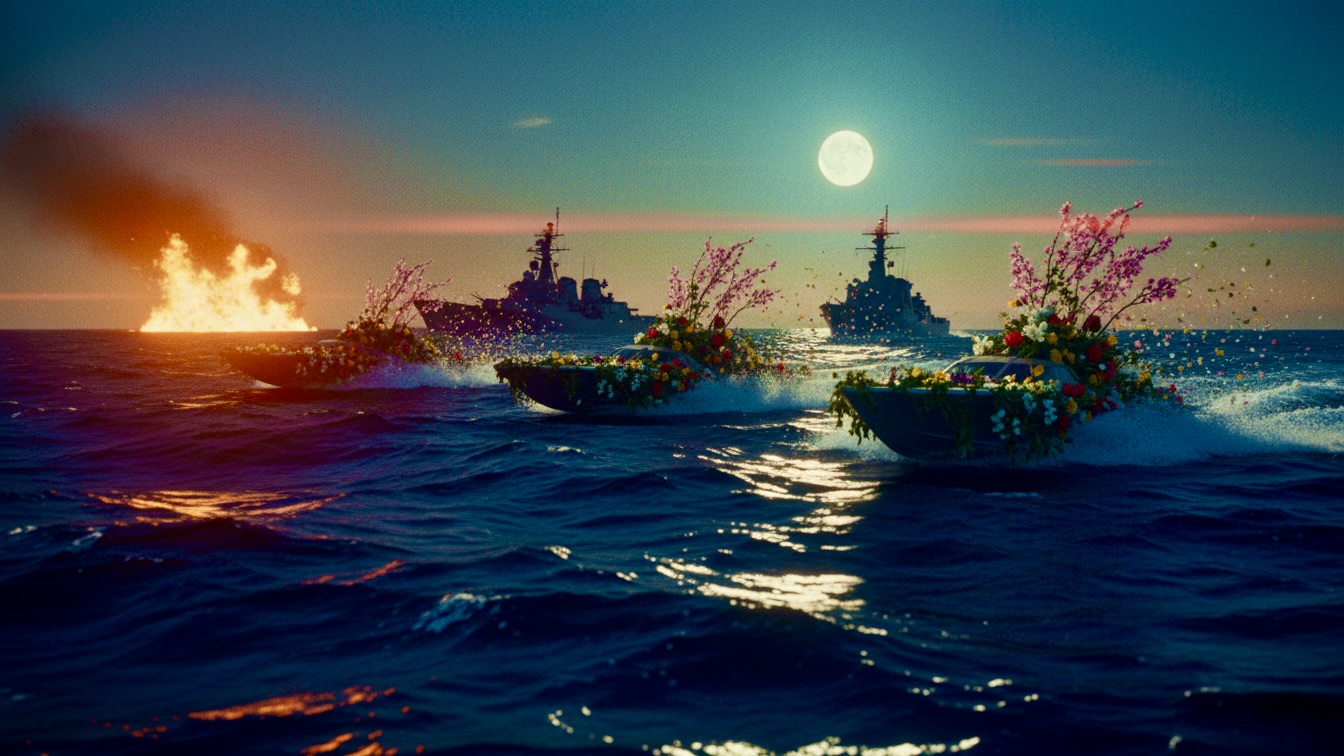
To save a rural hospital running on its final drops of fuel, Stefan, Andrew, and a skilled mechanic named Mira prepare three high-speed boats. They disguise these vessels with flowers and greenery, intending to hide in plain sight during the Spring Solstice floral parade. The plan is a desperate gamble, using the cover of a religious procession to move reinforced bladders of diesel past the navy’s heat-seeking sensors and minefields.
As the sun sets and the city erupts in a desperate celebration, the trio pushes into the harbor. They navigate through a field of pressure-sensitive mines and endure the blinding glare of a naval searchlight. A sudden explosion at the Strongman’s palace provides a momentary distraction, allowing them to break formation and race toward the open sea. Despite the terrifying proximity of the enemy and the physical toll of the journey, they successfully reach the rural coast.
The mission concludes with the successful delivery of the fuel to a darkened hospital. As the emergency generators roar to life and the building fills with light, Stefan experiences a moment of profound clarity and relief. However, the victory is tempered by the realization that the blockade remains. Stefan acknowledges that this was merely the first of many dangerous runs required to keep his community alive.
One of the central themes of the narrative is the subversion of tradition as a tool for survival. The Spring Solstice, normally a time of spiritual renewal and peaceful celebration, is weaponized by the protagonists to bypass a modern military blockade. By adorning their high-speed smuggling vessels with jasmine and cherry blossoms, they exploit the enemy's rigid rules of engagement. This creates a powerful irony where the symbols of life and beauty are used to transport the volatile fuel necessary to sustain a dying society.
The story also explores the tension between generational ideologies and the collapse of old power structures. The "Strongman" represents a fading, stagnant era of authoritarian control, while the revolution is led by "twenty-somethings" who are tech-savvy but disorganized. This transition is portrayed as messy and volatile, suggesting that while the old guard is failing, the new generation is still struggling to build something functional in the ruins. The blockade acts as a catalyst, forcing these young characters to move beyond protest and into direct, life-sustaining action.
Furthermore, the narrative examines the concept of hope as a pragmatic necessity rather than a sentimental feeling. Stefan does not believe in the "miracle" of the floral parade in a religious sense; instead, he creates his own miracle through engineering and calculated risk. The lighting of the hospital at the end of the story serves as a visceral symbol of this manufactured hope. It suggests that in a world of overwhelming darkness and "bruise-colored" steel, the only meaningful light is the one that individuals fight to keep burning.
Finally, the theme of human resilience against dehumanizing technology is prevalent throughout the text. The Eastern Giant's navy is described in cold, metallic terms, utilizing heat-seekers and magnetic mines to enforce its will. In contrast, the protagonists are defined by their physical and emotional responses—Andrew’s shaking voice, Mira’s grease-stained hands, and Stefan’s racing heart. Their success is a victory of human intuition and bravery over the clinical precision of a mechanical enemy.
Stefan emerges as a pragmatic and visionary leader who possesses the ability to remain focused when others are overwhelmed by despair. He is characterized by his observational nature, starting the story behind a pair of binoculars, which signifies his role as the strategist. He understands the psychological state of the city and recognizes that the "vibration" he feels is the sound of a collective realization of doom. This awareness drives him to take action, as he refuses to wait for the "dark to finish us off."
Psychologically, Stefan seems to thrive on the "math" of the mission, using logic to suppress the natural fear of death. He is not reckless, but he is willing to accept high stakes if the alternative is certain slow decay. His transition from an observer on a roof to a participant in the water shows his evolution into a man of action. By the end of the chapter, he has fully embraced his role as a provider, looking past the immediate victory to the long-term struggle ahead.
Andrew serves as the emotional and psychological foil to Stefan, representing the intense anxiety of a generation living under the shadow of total war. He is physically diminished by the blockade, with the text noting that the stress has "eaten the fat off his face." His focus on the "heat-seekers" and "thermal signatures" highlights a preoccupation with the overwhelming power of the enemy. He is the voice of realism that teeters on the edge of defeatism, grounded in the terrifying "math" of their likely failure.
Despite his terror, Andrew’s participation in the mission reveals a deep-seated loyalty and a hidden reservoir of courage. His shaky singing of a pop song while being targeted by a searchlight is a poignant moment of human vulnerability. It shows that his bravery is not the absence of fear, but the ability to function in spite of it. By the end of the story, his laughter signals a psychological release, even if he is quickly reminded by Stefan that their work is far from over.
Mira is the technical backbone of the group, embodying a stoic and focused competence. She is described through her labor, with grease on her pants and a deep understanding of the machinery she handles. Unlike Andrew, who focuses on the threat, Mira focuses on the solution, calculating the "twenty minutes of high speed" they have before detection. She provides the necessary grounding for Stefan’s vision, ensuring that the "miracle" they are attempting is physically possible.
Her internal state is one of disciplined determination, as evidenced by her "flat line" voice during the most tense moments of the harbor crossing. She does not engage in the philosophical debates between Stefan and Andrew; instead, she monitors the sonar and the gaskets. Her final interaction with Stefan, where she immediately identifies the need for a "full teardown" of the engines, reinforces her role as a tireless worker. She represents the essential, often unsung labor required to sustain a revolution or a resistance.
The pacing of the chapter is expertly managed, transitioning from a heavy, stagnant atmosphere to a high-octane sequence of action. The opening paragraphs use slow, descriptive language to establish the "materialized" presence of the navy, creating a sense of claustrophobia. This stillness is shattered once the boats hit the water, where the sentences become shorter and more rhythmic. The shift from the "cloying sweetness" of the flowers to the "screaming wind" of the escape mirrors the characters' transition from disguise to raw speed.
The author makes significant use of sensory details to ground the reader in the story’s harsh reality. The "bruise-colored" ships and the "shattered screen" of the phone provide a visual landscape of decay and violence. This is contrasted with the overpowering scent of yellow jasmine and pink cherry blossoms, which creates a sensory dissonance. This juxtaposition of the beautiful and the industrial serves to heighten the tension, making the floral disguise feel both absurd and deeply necessary.
The narrative voice is one of gritty realism, yet it occasionally leans into poetic imagery to emphasize the emotional stakes. Phrases like "a physical block in the world's throat" and "mountains of cold iron" elevate the navy from a mere military force to an elemental, almost mythological obstacle. The tone remains somber throughout, even during the successful delivery of the fuel. This ensures that the reader understands the gravity of the situation, as the "single spark" of the hospital lights is framed against a "very large dark."
Finally, the use of light and shadow serves as a recurring motif that reinforces the story's themes. The chapter moves from the "heat haze" of the day into the "absolute darkness" of the rural coast, with the only sources of light being the burning palace and the hospital windows. These flickers of light represent the fragile nature of human effort in the face of a totalizing force. The final image of the red flare in the distance reminds the reader that while the characters have found a temporary light, the darkness of the blockade is still very much in control.


