Analyzing the NWMO Initial Project Description and Local Impacts
This article is part of a series exploring the views and perspectives of youth, artists and community members working with the Melgund Integrated Nuclear Impact Assessment Project. This initiative is a climate entrepreneurship and arts-based community recreation program, developed through community consultation, engagement participation in the integrated impact assessment process for the NWMO’s proposed Deep Geological Repository for nuclear waste fuel.
What is Proposed
The Nuclear Waste Management Organization (NWMO) has submitted its Initial Project Description (IPD) for a Deep Geological Repository (DGR) to store Canada’s used nuclear fuel. Central to this proposal is a 15-year partnership with the Township of Ignace, framed through a Hosting Agreement and six foundational pillars of well-being: People, Economics, Infrastructure, Culture, Environment, and Governance. The NWMO claims the project is a critical component of Canada’s transition to net-zero emissions and a permanent solution that ensures intergenerational equity. The proponent positions itself as an “anchor institution” that will catalyze economic diversification and community resilience while adhering to federal regulatory efficiency directives.
Underlying Assumptions
- The safety and acceptability of DGR technology are established facts based on previous, unrelated environmental assessments.
- The “anchor institution” model will naturally lead to sustainable economic diversification rather than total dependency on the nuclear waste industry.
- Regulatory “efficiency” as mandated by federal directives will not diminish the rigour of safety or environmental oversight.
- The project is inherently “sustainable and socially responsible” before site-specific testing is completed.
- The Hosting Agreement with Ignace sufficiently covers the social license requirements for the broader geographic region.
Community Assessment
Our community assessment reveals a significant narrative gap in the NWMO’s proposal. By focusing almost exclusively on the Township of Ignace and the Wabigoon Lake Ojibway Nation (WLON), the proponent engages in “stakeholder narrowing.” This effectively marginalizes residents of Melgund Township, including Dyment and Borups Corners, who live within 10 kilometers of the proposed Revell site. These neighbors bear the highest burden of proximity—including potential property devaluation and social stigma—yet are excluded from the foundational pillars and financial provisions of the Hosting Agreement. Furthermore, the use of emotive marketing terms like “catalyst for positive change” is viewed as a way to sanitize the industrial reality of high-level nuclear waste storage. The community is concerned that framing the project as a “net-zero” solution is a form of green-washing that deflects from the multi-generational risks of containment failure and the potential for irreversible contamination of local aquifers and the Revell watershed. The reliance on past assessments to declare the technology “safe” is a logical overreach that ignores the unique hydrological and seismic variables of our specific region.
Path Forward
To ensure a transparent and rigorous assessment, the following corrective measures are recommended: First, the proponent must provide a detailed framework for “Community Well-being” that includes measurable indicators and a baseline for all affected communities, not just the official host. Second, the safety justification must be decoupled from previous assessments; the Impact Statement should focus exclusively on site-specific geological and technical data for the Revell site. Third, the NWMO must explicitly outline adaptive management protocols that would be triggered if WLON’s assessment or ongoing monitoring identifies risks that contradict current design assumptions. Finally, a defined dispute resolution mechanism is required to address potential conflicts between the Township’s vision and the assessment outcomes of Indigenous nations and neighboring communities.
About the Integrated Assessment Process
The federal Impact Assessment Agency of Canada (IAAC) has formally launched the integrated impact assessment process for the proposed Deep Geological Repository (DGR) for Canada’s Used Nuclear Fuel Project, a major national infrastructure initiative led by the Nuclear Waste Management Organization (NWMO).
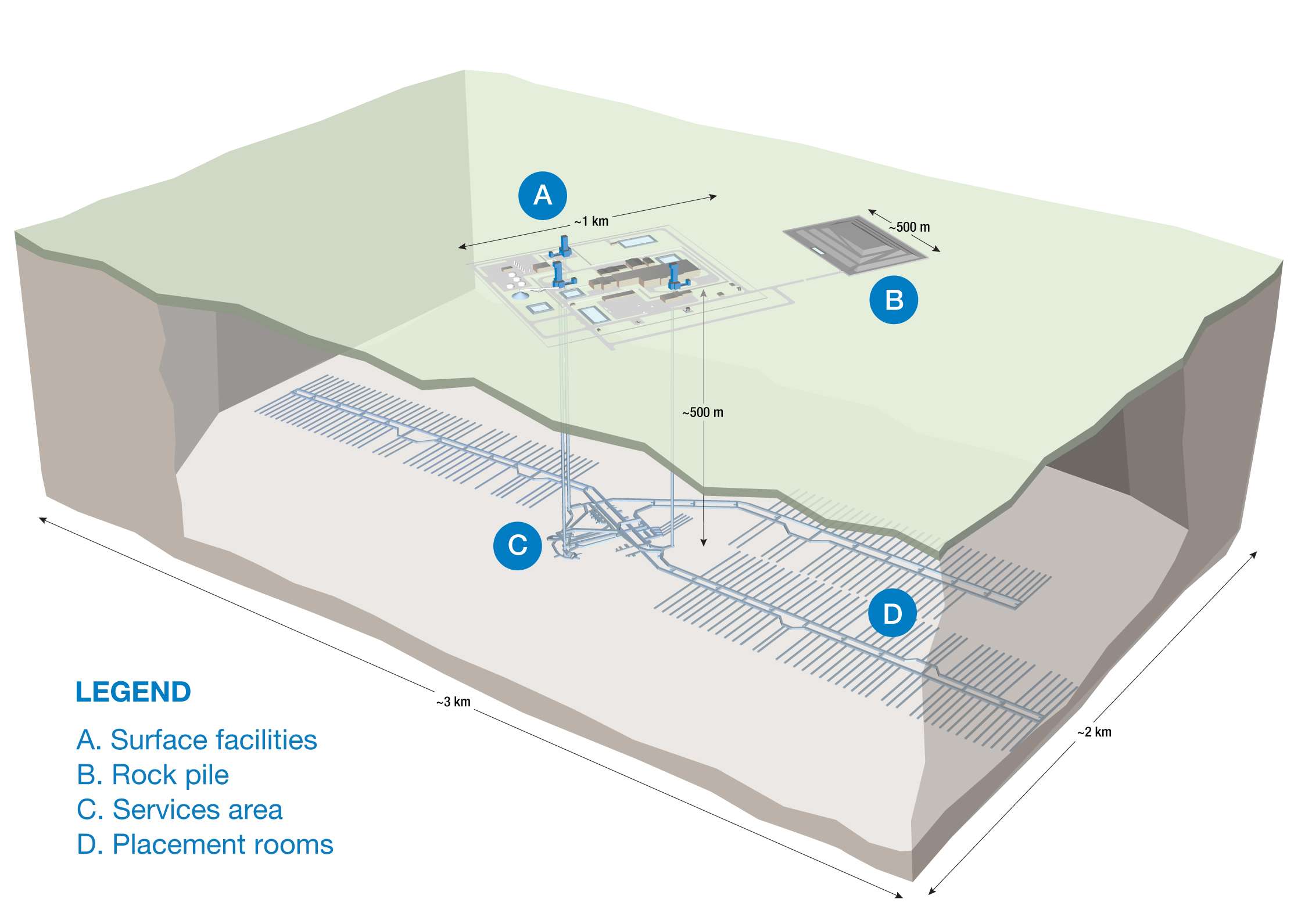
The proposed underground repository is designed to permanently contain and isolate used nuclear fuel in a secure geological formation. Wabigoon Lake Ojibway Nation and the Township of Ignace have been selected as host communities for the project. The site is located approximately 21 kilometres southeast of Wabigoon Lake Ojibway Nation and 43 kilometres northwest of Ignace, Ontario, near Highway 17.
According to project materials, the repository would provide permanent storage for approximately 5.9 million bundles of used nuclear fuel. The full lifecycle of the project is expected to span roughly 160 years, including site preparation, construction, operations, closure, and long-term monitoring.
Integrated Federal Review
Major nuclear projects in Canada are subject to an integrated assessment process jointly led by the Impact Assessment Agency of Canada and the Canadian Nuclear Safety Commission (CNSC). This “one project, one review” approach is intended to streamline regulatory oversight while ensuring rigorous evaluation of environmental, health, social, economic, and Indigenous rights impacts.
Under this framework, IAAC oversees the impact assessment requirements under the Impact Assessment Act, while the CNSC regulates nuclear safety under the Nuclear Safety and Control Act. The CNSC will issue the initial site preparation licence and manage all subsequent nuclear licensing for the project’s duration.
The integrated assessment also includes a focus on potential impacts on Indigenous Peoples, including rights, land use, cultural practices, health, and socio-economic conditions. Where potential adverse effects are identified, the process is intended to identify mitigation measures to reduce or avoid harm.
Public Comment Period Now Open
The first public comment period for the project is currently open and will run until February 4, 2026. During this phase, the public is invited to provide feedback on the Summary of the Initial Project Description submitted by the NWMO. Submissions received during this period will inform IAAC’s summary of issues, which will guide the next stages of the impact assessment. All comments submitted become part of the public project record and are posted to the federal Impact Assessment Registry.
This plain-language summary is provided by ECO-STAR North and Art Borups Corners to support public engagement.
Disclaimer: The views and perspectives expressed in this article are solely those of the independent arts program led by ECO-STAR North and Art Borups Corners. They do not reflect the official positions of the Nuclear Waste Management Organization (NWMO) or the Government of Canada.
About the Author