Format: Short Film / Anthology Episode | Est. Length: 10-12 minutes
Imagine a high-concept anthology series titled The Bio-Sync Files, where each installment peels back the glossy, augmented-reality veneer of a corporate-owned future to reveal the visceral, decaying machinery underneath. The series functions as a cautionary exploration of "Nature-as-a-Service," following different low-level employees across various sectors who stumble upon the biological cost of their curated utopia. While each episode is a standalone narrative, the recurring presence of the Bio-Sync corporation provides a connective tissue, suggesting a global ecosystem where human biology has been fully integrated into the industrial supply chain.
A weary technician meticulously dusts a plastic leaf in a "perfect" forest, only to discover a pulsing, organic berry that shouldn't exist in a world of patented polymers. This single "glitch" threatens to crash the simulated reality and reveal the slaughterhouse hidden behind the Golden Hour lighting.
When a maintenance worker in a simulated corporate garden consumes a biological glitch, his augmented reality interface shatters to reveal that the "forest" is a living, breathing recycling plant made of human meat. He must destroy the central server tree to escape the dome before the system "re-syncs" his consciousness into the very moss he was hired to clean.
The primary theme explores the commodification of the natural world and the alienation of the working class from their own sensory reality. It examines how corporate branding can sanitize horrific truths, transforming a literal biological engine into a "comforting" product through digital filters. The story posits that in a world where everything is "Nature: Reimagined," the only authentic act left is the destruction of the interface, even if the reality left behind is a ruined, ash-choked wasteland.
Secondary themes focus on the parasitic nature of social media and influencer culture, represented by Marie’s obsession with her "feed" even as her own skin is being consumed by corporate hardware. The "meat-oak" serves as a metaphor for a system that processes human life into data and "nutrients," suggesting that when nature is patented, the human body becomes the ultimate raw material. It is a critique of a society that prefers a beautiful lie over a difficult, "terribly lit" truth.
For Zach, the stakes are existential and physical: he faces the loss of his individual identity and the literal recycling of his body into the dome’s biomass. If he fails to sabotage the Server Tree, he will be "re-synced," a process that lobotomizes dissenters and turns them into mindless, hyper-productive components of the corporate machine. For Marie, the stakes are the loss of her digital status and the terrifying realization that her "followers" and "metrics" are worthless in a world where her skin is being eaten by the very brand she promotes.
The external conflict is driven by the "Gardeners," terrifying biological drones that enforce the dome’s integrity through neural recalibration and lethal force. Internally, Zach struggles with the crushing weight of corporate debt and the psychological exhaustion of maintaining a lie, while Marie represents the passive, brand-loyal resistance to reality. The overarching antagonist is the Bio-Sync system itself—a sentient, biological AI that views humans as replaceable filters in its global recycling process.
In Sector 7 of a Bio-Sync dome, technician Zach spends his days cleaning the "Eternal Oak," a polymer asset in a world where the real atmosphere is toxic "lung-rot." His coworker Marie, obsessed with her digital feed and corporate-sanctioned aesthetic, ignores the physical decay of their environment until Zach discovers a pulsing, purple berry growing from the artificial soil. Despite the system's safety warnings, Zach’s desperation and boredom lead him to eat the fruit, triggering a massive neural glitch that strips away his augmented reality filters.
The "forest" is revealed to be a Cronenbergian nightmare of meat-trees, hair-grass, and human-waste recycling tubes. As the dome’s security "Gardeners"—fleshy, tentacled spheres—attempt to forcibly "re-sync" him, Zach realizes the dome is a giant biological kidney processing the remains of the outside world. He sabotages the "Server Tree" by severing its main data-artery, crashing the sector’s reality-filters and power grid. Zach and Marie emerge from the collapsing biological engine into the harsh, unfiltered light of a ruined world, choosing a bleak, authentic existence over a curated corporate prison.
Zach (23): A physically broken maintenance worker whose cynical exterior masks a deep-seated yearning for something real. At the start, he is a passive cog in the machine, moving with the heavy gait of a man twice his age due to the dome's artificial gravity. By the end, he transitions from a janitor of lies to a saboteur of the system, reclaiming his sensory autonomy through a violent rejection of the Bio-Sync brand.
Marie: A corporate-loyalist influencer whose identity is entirely mediated through her retinal UI and "parasitic" cosmetic stickers. She begins as a vapid observer who views the world through "engagement metrics" and "aesthetic vibes," even when faced with physical horror. Her arc ends in a state of shell-shocked humanity as her filters are stripped away, leaving her to face a world where "the lighting is terrible" but the air is finally her own.
Zach meticulously cleans the "Eternal Oak" while Marie scrolls through her retinal feed, establishing the suffocating, artificial perfection of the Bio-Sync dome. The dialogue highlights the disparity between the "Golden Hour" marketing and the "lung-rot" reality the techs face, ending with Zach discovering the pulsing, purple berry glitch. Zach’s knee pops as he kneels in the shredded-tire dirt, emphasizing his physical decay within the "perfect" environment.
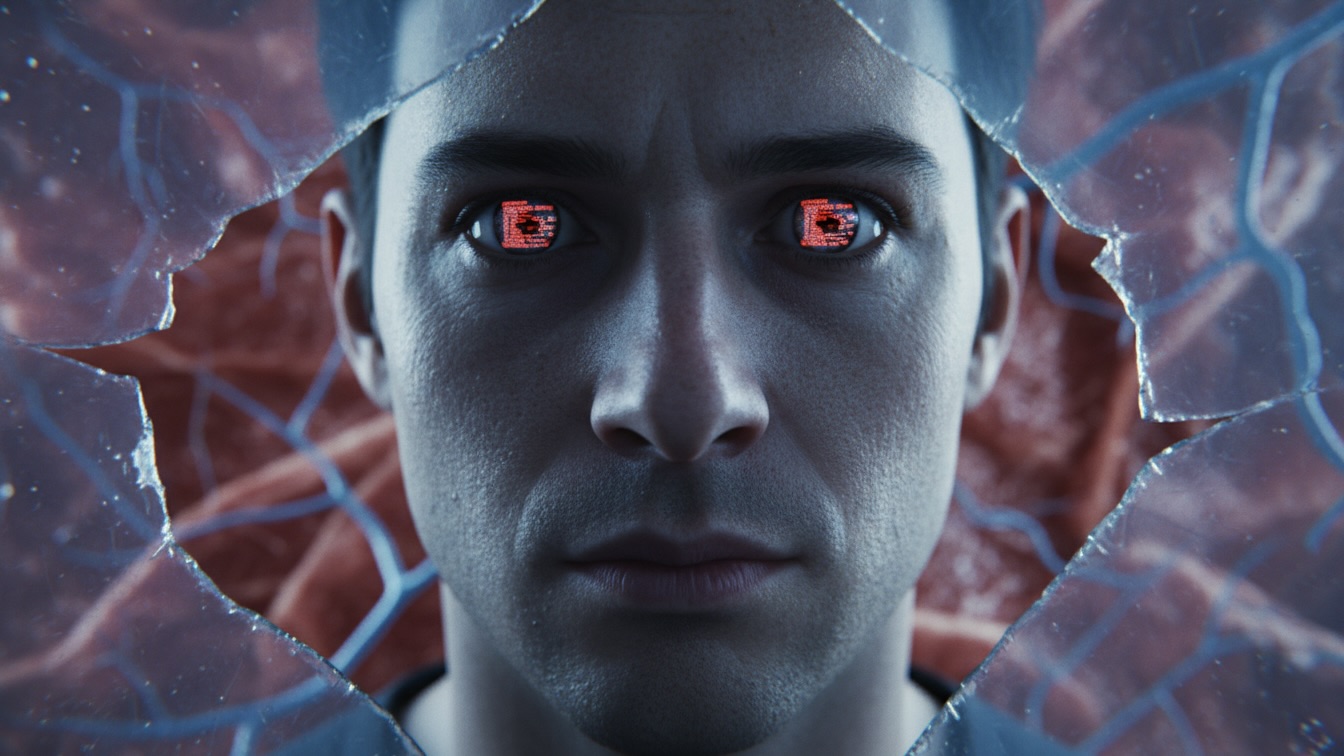
Marie dares Zach to eat the "forbidden fruit" for her feed, mocking his fear with corporate slogans about safety and comfort. Zach, driven by a sudden, nihilistic surge of boredom and spite, consumes the berry and experiences a violent system crash. The UI in his eyes flickers and dies, replaced by a "SYSTEM CRITICAL" warning that mirrors the internal collapse of his world-view.
The visual filters slough off like wet wallpaper, revealing the "Eternal Oak" as a pulsing pillar of raw meat and the "moss" as a carpet of tiny, translucent worms. Zach screams as he realizes Marie is covered in parasitic stickers and the "sunlight" is a flickering membrane over a skeletal frame. This midpoint shift transforms the sterile sci-fi setting into a visceral body-horror nightmare, forcing Zach to flee the now-hostile environment.
The "Gardeners" drop from the meat-canopy, revealed not as sleek drones but as twitching, organic spheres with needle-like injectors. Zach scrambles through a landscape of weeping sores and hair-grass, witnessing the "deleted" people being recycled into the dome's biomass. The chase reaches a crescendo as a Gardener pins Zach down, attempting to "re-sync" him with a neural needle that pumps artificial bliss into his brain.
Zach fights off the "re-sync" by stabbing the Gardener with a jagged bone-rock, breaking the cycle of corporate comfort. He reaches the Server Tree—the heart of the biological engine—and confronts the massive, pulsing arteries that power the sector's lies. Marie arrives, her digital voice stuttering and broken, as she tries to comprehend the "smeary textures" of the collapsing meat-forest.
In a final act of defiance, Zach severs the primary artery of the Server Tree, causing it to emit a digital shriek that echoes through the dome. A fountain of glowing blue data-fluid sprays the clearing, dissolving the remaining filters and killing the Gardeners instantly. The "Eternal Oak" sags and rots in real-time as the dome’s artificial sky tears open, revealing the true, ash-choked sun for the first time.
Zach and Marie sit in the "terribly lit" wreckage of the dome, looking out at the ruined, orange horizon of the real world. Marie laments the loss of her brand and the poor resolution of reality, while Zach finds a grim sense of peace in the silence. They step out into the dust, leaving the corporate kidney behind to face an ugly, but authentic, future.
The episode begins with a sense of Clinical Ennui, characterized by the sterile, repetitive nature of Zach’s work and the vapid chatter of Marie. This shifts into Visceral Dread during the berry-induced "glitch" reveal, where the audience shares Zach’s sensory shock as the world turns into a slaughterhouse. The middle act is defined by Frantic Terror during the Gardener chase, punctuated by moments of Profound Horror as the recycling process is revealed. The climax offers a Cathartic Release through the destruction of the tree, ending on a note of Melancholic Hope—the world is ruined, but the characters are finally awake.
If expanded, the season would follow Zach and Marie as they navigate the "Wasteland" outside the domes, discovering that other sectors have also begun to "glitch" as the Bio-Sync central nervous system fails. They encounter "The Unsynced," a resistance group of former techs who have survived by hacking their retinal grafts to see the truth. The season arc would involve a journey to the "Core Sector," where the original "Mother Tree" resides, aiming to shut down the global Bio-Sync network and return humanity to its biological roots.
Thematic escalation would explore the "Bio-Sync" corporation’s attempt to patch the reality-glitch by deploying more aggressive "Re-Sync" protocols that turn entire cities into biological processors. Character evolution would see Marie moving from a brand-obsessed victim to a "Reality-Hacker," using her knowledge of corporate aesthetics to camouflage the resistance. Zach would struggle with the "meat-infection" from the berry, which slowly grants him the ability to communicate with the biological machines he seeks to destroy.
The visual style relies on a "Dual-Palette" approach: the "Filtered Reality" is rendered in hyper-saturated, vaporwave aesthetics with soft, glowing "Golden Hour" lighting and 4K textures. Once the glitch occurs, the "Unfiltered Reality" shifts to a "Cronenbergian Grime," utilizing desaturated oranges, sickly purples, and wet, organic textures. The camera work transitions from steady, clinical pans in the first act to a frantic, handheld "shaky-cam" during the horror reveal, emphasizing Zach’s loss of stability.
The tone is a blend of Dystopian Satire and Body Horror, comparable to the works of David Cronenberg and the "Fifteen Million Merits" episode of Black Mirror. It maintains a cold, corporate irony through the use of upbeat AI slogans ("Nature: Reimagined for Your Comfort") juxtaposed against the wet, grinding sounds of the meat-machinery. The sound design is crucial, shifting from a clean, ambient hum to a wet, rhythmic thumping that mimics a heartbeat, creating a constant sense of biological pressure.
The target audience consists of adult viewers (18-45) who enjoy high-concept science fiction, psychological horror, and social commentary. It appeals to fans of anthology series like Love, Death & Robots and Black Mirror, as well as audiences interested in "Biopunk" aesthetics and critiques of late-stage capitalism. The episode’s focus on influencer culture and digital interfaces makes it particularly resonant for a "chronically online" demographic.
The 10-12 minute runtime is divided into a three-act structure: Act I (0-3 mins) establishes the status quo and the "glitch" discovery; Act II (3-8 mins) covers the horror reveal and the Gardener chase; Act III (8-12 mins) focuses on the sabotage and the escape. The pacing is intentionally slow in the first act to build a sense of monotony, before accelerating into a breakneck speed once the "Re-Sync" protocol is initiated. The final two minutes provide a "slow-burn" resolution, allowing the silence of the ruins to contrast with the previous chaos.
The "Eternal Oak" and the "Gardeners" should be realized through a combination of practical "gross-out" effects and CGI overlays to ensure the "meat" looks tangibly wet and heavy. The "retinal UI" elements should be designed as a diegetic layer that glitches and tears away, requiring a sophisticated motion-graphics approach to mimic a failing software interface. Production should prioritize a "wet" set design for the unfiltered reality, using slime, hair-mats, and pulsing pneumatic bladders to simulate the living machinery.
Location scouting should focus on industrial recycling plants or boiler rooms that can be "dressed" with biological elements to minimize the need for full-scale set builds. The contrast between the "perfect" dome and the "ruined" outside world can be achieved through aggressive color grading and the use of ash-simulators (grey cellulose) for the final exterior scene. Special attention must be paid to the sound mix, specifically the transition from digital "beeps" to organic "squelches" to reinforce the sensory shift.


