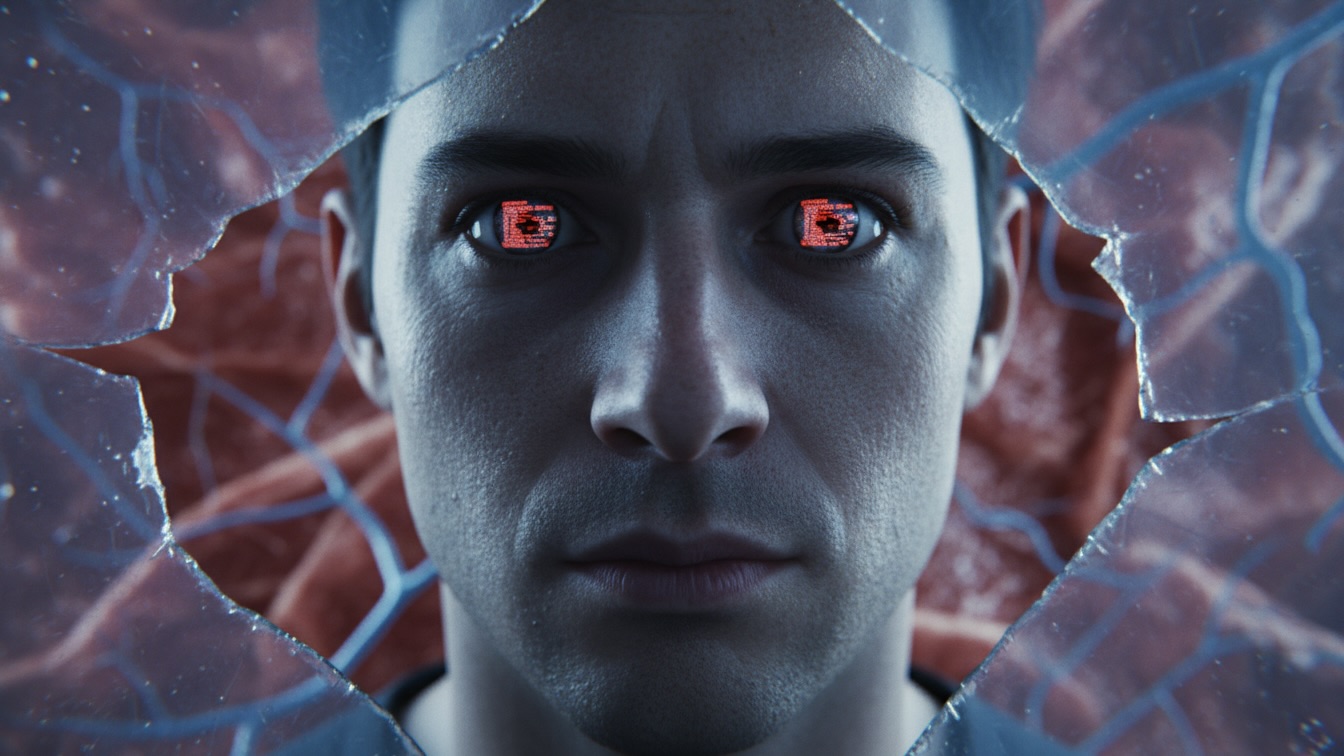
The story follows Zach, a young technician tasked with maintaining the artificial environment of a corporate-owned dome managed by Bio-Sync. While cleaning a polymer-composite "oak" tree, Zach encounters Marie, a coworker more interested in her social media metrics and retinal interface than their simulated surroundings. Their mundane existence is shattered when Zach discovers a pulsing, purple berry that appears to be a systemic glitch. Driven by a mix of exhaustion and spite toward the corporate artifice, Zach consumes the fruit, which triggers a violent neural malfunction and strips away the digital filters governing his perception.
The reality revealed to Zach is a visceral biological nightmare where the "natural" assets are actually composed of raw meat, pulsing veins, and recycled human remains. He realizes the dome is not a garden but a massive, living recycling plant that processes the dying world's atmosphere through a biological engine. Pursued by "Gardeners"—horrific organic drones—Zach flees toward the center of the sector to confront the Server Tree, the heart of the dome’s simulation. In a desperate act of rebellion, he severs a primary artery of the tree, causing the system to collapse and the artificial sky to fail.
The chapter concludes with Zach and Marie sitting in the wreckage of the dome as the simulated summer gives way to the harsh, dusty reality of the outside world. The "Eternal Oak" is reduced to a smoldering heap of meat and plastic, and the corporate UI that once dictated their lives is silenced. Despite the bleakness of the ruined landscape and the toxicity of the air, the two characters find a strange sense of liberation. They step out into the unfiltered world, trading the comfort of a corporate lie for the terrifying, poorly lit truth of human existence.
The central theme of the narrative is the dehumanizing commodification of nature and the human soul within a late-stage capitalist dystopia. Bio-Sync has not merely replaced nature; it has patented it, turning the fundamental experience of the outdoors into a subscription-based asset. The "Forest Renewal Green" and "Avian Atmosphere" packages represent the ultimate triumph of the brand over the biological, where even the air one breathes is a proprietary product. This suggests a world where reality is only permitted to exist if it can be monetized and filtered for maximum consumer comfort.
Another profound theme is the psychological dissociation required to survive in a simulated environment. Marie exemplifies this through her constant engagement with her internal UI and social media metrics, using digital clout as a shield against the sterile reality of her life. Her insistence on viewing Zach’s genuine panic as "existential-dread-core" highlights how the corporate structure encourages individuals to perform their emotions rather than feel them. This dissociation is shown to be a survival mechanism that, while providing comfort, ultimately blinds the characters to their own exploitation.
The story also explores the concept of "recycling" as a literal and metaphorical horror. The revelation that the moss is composed of "deleted" people and that the dome is a giant, corporate-owned kidney provides a gruesome commentary on the lifecycle of a corporate employee. In this world, a person's value does not end with their productivity; their very biomass is harvested to maintain the illusion for the next generation. This creates a closed loop of consumption where the workers are both the maintainers and the raw materials of the system, leaving no room for genuine life outside the corporate metabolism.
Zach serves as the narrative's disillusioned protagonist, a man whose physical body has been prematurely aged by the heavy, artificial gravity of the dome. He possesses a cynical awareness of the world’s falseness, yet he remains trapped in the cycle of labor until the discovery of the berry provides a catalyst for change. His decision to eat the glitch is not an act of curiosity but one of profound existential fatigue. He reaches a breaking point where the risk of "deletion" is preferable to the continued maintenance of a plastic lie.
Psychologically, Zach represents the awakening of the suppressed id against a sterilized, controlled environment. When the filters fall, he does not succumb to madness, though the horror he witnesses is immense. Instead, he finds a clarity of purpose that was missing from his life as a technician. By destroying the Server Tree, he transitions from a passive component of the machine to an active agent of its destruction. He chooses the "terrible lighting" of reality over the "July afternoon" of the simulation, reclaiming his humanity through the acceptance of pain and ugliness.
Marie acts as the psychological foil to Zach, embodying the total internalisation of corporate values and digital persona. She is obsessed with her "brand" and her "followers," viewing her entire existence through the lens of a camera that isn't even physical. Her reliance on the retinal UI is so complete that she initially interprets the collapse of the dome as a mere technical error or a lack of "aesthetic." For her, reality is a secondary concern to the way that reality is perceived and recorded by her audience.
However, Marie’s character undergoes a subtle but significant shift when the blue fluid of the Server Tree strips away her corporate stickers and ocular grafts. As her "influencer" persona dies along with the network, a more vulnerable, human version of her emerges. Her final comments about the lighting being "bad for her brand" show a lingering attachment to her old defense mechanisms, but her willingness to follow Zach into the dust suggests a burgeoning realization of her own personhood. She moves from being a "component" to being a "person," even if she is a person who is deeply confused and frightened by the transition.
The narrative employs a stark contrast between corporate euphemism and visceral body horror to create a jarring, unsettling tone. The author uses clinical, marketing-speak terms like "Nutrient-Rich Atmosphere" and "Legacy Asset" only to immediately undercut them with descriptions of "lung-rot" and "meat-moss." This linguistic duality mirrors the protagonist's journey from the simulated "glamour" to the raw, biological truth. The sensory details are particularly effective, shifting from the "4K textures" and "microfiber" of the beginning to the "scent of a slaughterhouse" and the "static" taste of the berry.
The pacing of the story accelerates masterfully as Zach’s perception shifts. The initial scenes are slow and heavy, reflecting the drudgery of his work and the oppressive gravity of Sector 7. Once the berry is consumed, the narrative rhythm becomes frantic and hallucinatory, mimicking a "system critical" failure. The use of digital error messages interspersed with descriptions of pulsing flesh creates a sense of "cyber-organic" horror that is both modern and primal. This stylistic choice effectively conveys the breakdown of the boundary between the digital interface and the biological mind.
Finally, the narrative voice maintains a sense of grim irony that prevents the story from becoming purely nihilistic. The ending, in particular, uses humor to highlight the absurdity of the characters' situation as they critique the "resolution" and "color palette" of the real world. This touch of satire serves to humanize Zach and Marie, showing that even in the face of total systemic collapse, the human tendency to complain and find humor remains intact. It suggests that while the corporate world was a lie, the bond formed in its wreckage is the first real thing they have ever experienced.


