Format: Short Film / Anthology Episode | Est. Length: 10-12 minutes
Imagine this story as a haunting entry in an anthology series exploring the fractures within modern working-class families. The narrative uses a single, claustrophobic night to examine how the ghosts of the past dictate the crimes of the present, utilizing the sensory details of a sweltering summer to heighten the emotional stakes.
This episode serves as a cornerstone for the anthology series The Weight of Silence, which focuses on suburban secrets and the moral dilemmas of marginalized families in decaying industrial towns. Each episode explores a different household dealing with the "grey weight" of unresolved trauma, linked by the recurring theme of how poverty and grief can lead to desperate, life-altering decisions. The overarching narrative arc of the series tracks the slow erosion of a community's moral fabric as its citizens choose between survival and the truth.
A young girl watches from her bedroom window at 2:14 AM as her brother limps home in a wrecked car, his white t-shirt stained with dark, wet spots that look black under the cold, unforgiving moonlight.
After her brother commits a hit-and-run, a young girl must choose between protecting her fractured family and facing a devastating truth. The lie she tells the police becomes a rot that threatens to destroy what remains of her home.
The primary themes are the corrosive nature of secrets and the complexity of family loyalty in the wake of trauma. The story explores how unresolved grief—specifically the loss of a father figure—can lead to a cycle of recklessness and moral decay, suggesting that silence is not a shield but a poison.
Secondary themes include accountability and the loss of innocence. Malaya’s journey represents the moment a child realizes that protecting the people they love can sometimes mean becoming complicit in their worst actions, forcing a premature transition into moral adulthood.
For Malaya, the stakes are her moral integrity and the survival of her family unit; if she speaks, she loses her brother, but if she stays silent, she loses herself. For Lenny, the stakes are his freedom and his soul, as he risks becoming the very thing that destroyed his father. For Mom, the stakes are the final thread of her sanity and the safety of her remaining children in a world that has already taken her husband.
The external conflict is the police investigation and the physical threat of the hit-and-run victim's condition. Internally, Malaya battles the "grey weight" of her complicity and the fear of breaking her mother’s heart. The primary antagonistic force is the collective grief of the family, which manifests as Lenny’s recklessness and Mom’s exhausted denial, creating an environment where the truth feels like a lethal weapon.
Three months after their father’s death, Malaya discovers her brother Lenny has returned home with a blood-stained shirt and a smashed car. When the police arrive at their door, Malaya provides a false alibi to save her brother from arrest, hoping to prevent her overworked mother from suffering further loss. However, the weight of the lie becomes unbearable when Malaya visits the crash site on Elm Street the following day and realizes Lenny left a man for dead.
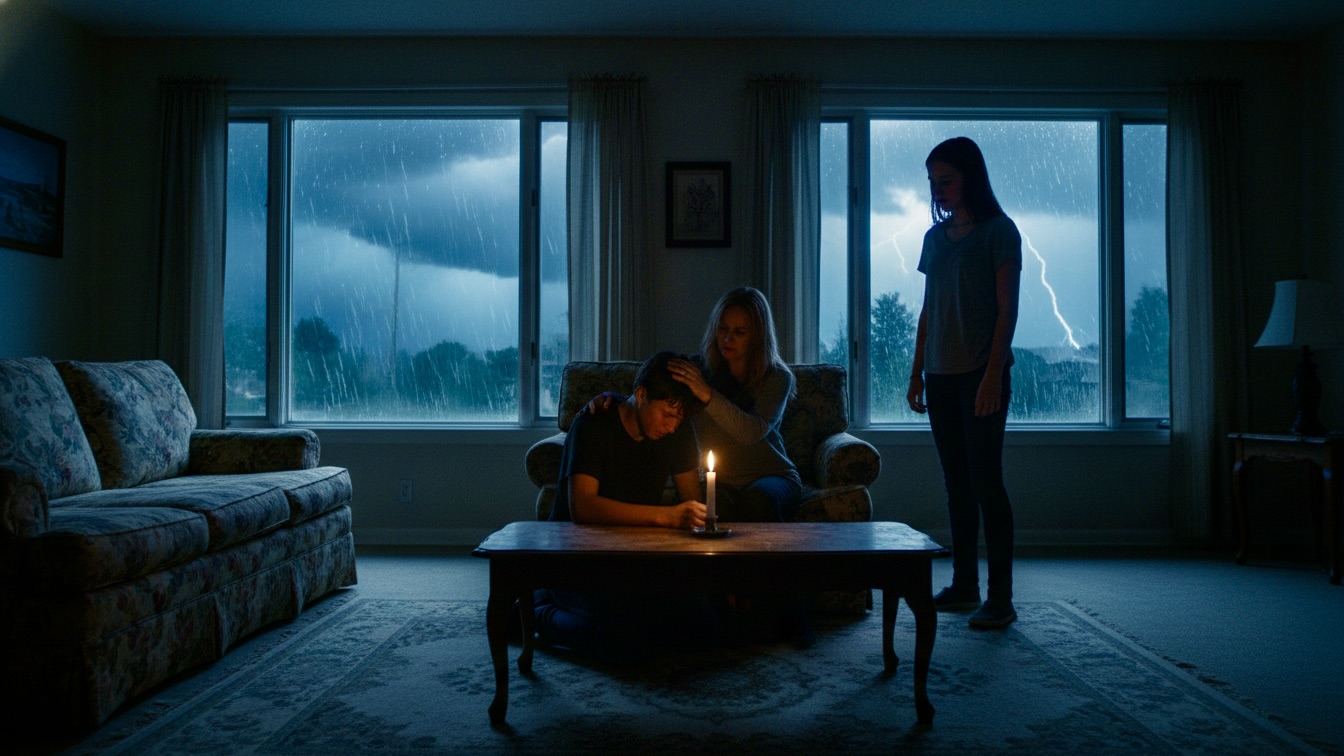
The tension peaks during a violent summer storm that knocks out the power, trapping the family in the dark. As Lenny prepares to flee the state to avoid the consequences of his actions, Malaya breaks the silence and confesses the truth to their mother. In the flickering candlelight, the family confronts the reality of their brokenness and makes the collective decision to seek justice, finally beginning the painful process of true healing through accountability.
Malaya: A quiet, observant pre-teen who acts as the family’s moral anchor. She begins the story paralyzed by the fear of losing another family member but ends with the courage to expose a painful truth for the sake of long-term survival.
Lenny: A former star athlete whose life spiraled after his father's death. He starts as a desperate fugitive hiding behind his sister's lies and ends as a broken young man forced to accept accountability for his actions.
Mom: A weary, grieving woman working multiple jobs to keep the household afloat. She transitions from a state of exhausted ignorance to a position of tragic strength, choosing justice over the comfort of a lie.
Beat 1: Malaya watches Lenny arrive home in a mangled car at 2:14 AM, noticing the blood on his shirt and the "punched eye" of his smashed headlight. She confronts him in the kitchen, smelling the metallic scent of blood and hot rubber before the police arrive to investigate a nearby hit-and-run. When the officers question them, Malaya delivers a calculated lie about watching a movie, feeling the "taste of pennies" in her mouth as the red and blue lights fade.
Beat 2: The next morning, the tension escalates in the kitchen as Lenny hides his taped knuckles under long sleeves despite the blistering heat. Mom unknowingly asks Lenny to fix the smashed headlight—the very evidence of his crime—while Malaya stares at her father’s empty work boots, feeling the house turn into a graveyard. Malaya eventually leaves the house, drawn to the crash site on Elm Street where she finds splintered wood and bloodstains, realizing Lenny’s "parked car" story was a fabrication.
Beat 3: Malaya returns home to find Lenny packing a duffel bag, intending to flee the state and abandon the family. A physical and verbal confrontation ensues in his messy bedroom, where Malaya realizes that her lie didn't save Lenny, but turned him into a coward. The argument is interrupted by a sudden, violent storm and their mother’s unexpected return, culminating in a total power outage that leaves the family in pitch darkness.
Beat 4: In the flickering light of a single emergency candle, Malaya confesses the truth about the accident and her lie to the police. Lenny breaks down in an "animal sob," confessing his guilt to his mother while the storm rages outside. The episode concludes with Mom’s quiet, steel-cold resolution to take Lenny to the police station, replacing the "grey weight" of the lie with the heavy, honest burden of justice.
The episode begins with a cold, clinical sense of dread that transitions into a suffocating, humid tension as the secret grows. The middle act is defined by a sensory overload of heat and noise (cicadas, rattling AC), mirroring Malaya's internal agitation. By the climax, the mood shifts to a cathartic but somber clarity, leaving the audience with a sense of heavy relief despite the tragic circumstances.
If expanded, the season would follow the legal proceedings of Lenny’s trial and the impact of the victim's recovery on the family’s standing in the community. It would delve deeper into the father’s death, revealing how the community’s reaction to that initial tragedy set the stage for Lenny’s downfall.
The thematic escalation would move from "The Secret" to "The Consequence," exploring how the family rebuilds their identity when they are no longer defined by what they are hiding. Character evolution would focus on Malaya’s growth into a community advocate and Mom’s journey through the legal system to save her son’s soul, if not his freedom.
The visual style is "Grit-Realism," utilizing a desaturated palette of rust, bruised purples, and harsh fluorescent lights. The camera work should be intimate and handheld during the kitchen and bedroom scenes to emphasize claustrophobia, shifting to wide, static shots for the Elm Street crash site to highlight Malaya's isolation.
Tonal influences include Winter's Bone and Manchester by the Sea, focusing on the tactile details of poverty and the heavy atmosphere of a house in mourning. The tone is somber and unflinching, avoiding melodrama in favor of quiet, devastating realism.
Aimed at viewers of prestige drama and psychological thrillers, specifically those aged 18-45 who appreciate character-driven narratives about moral ambiguity. It appeals to audiences who enjoy "slow-burn" storytelling and social realism, similar to viewers of The Bear or Mare of Easttown.
The 12-minute runtime follows a tight four-act structure. The pacing is slow and deliberate in the first half to build atmospheric dread, allowing the silence between characters to speak. The tempo accelerates during the storm confrontation, using rapid cuts and loud sound design, before settling into a somber, steady rhythm for the final candlelit resolution.
The production requires a specialized "picture car" with specific front-end damage and a practical rain-and-lightning rig for the climax. The interior of the house should feel lived-in and slightly decaying, with sound design emphasizing the rattling AC, the "crunch" of gravel, and the deafening roar of the storm.
Special attention must be paid to the "blood" effects on the shirt and the taped knuckles to ensure they look realistic under low-light conditions. The use of a single candle for the final scene will require high-sensitivity cameras to maintain the "pitch black" aesthetic without losing character expressions.


