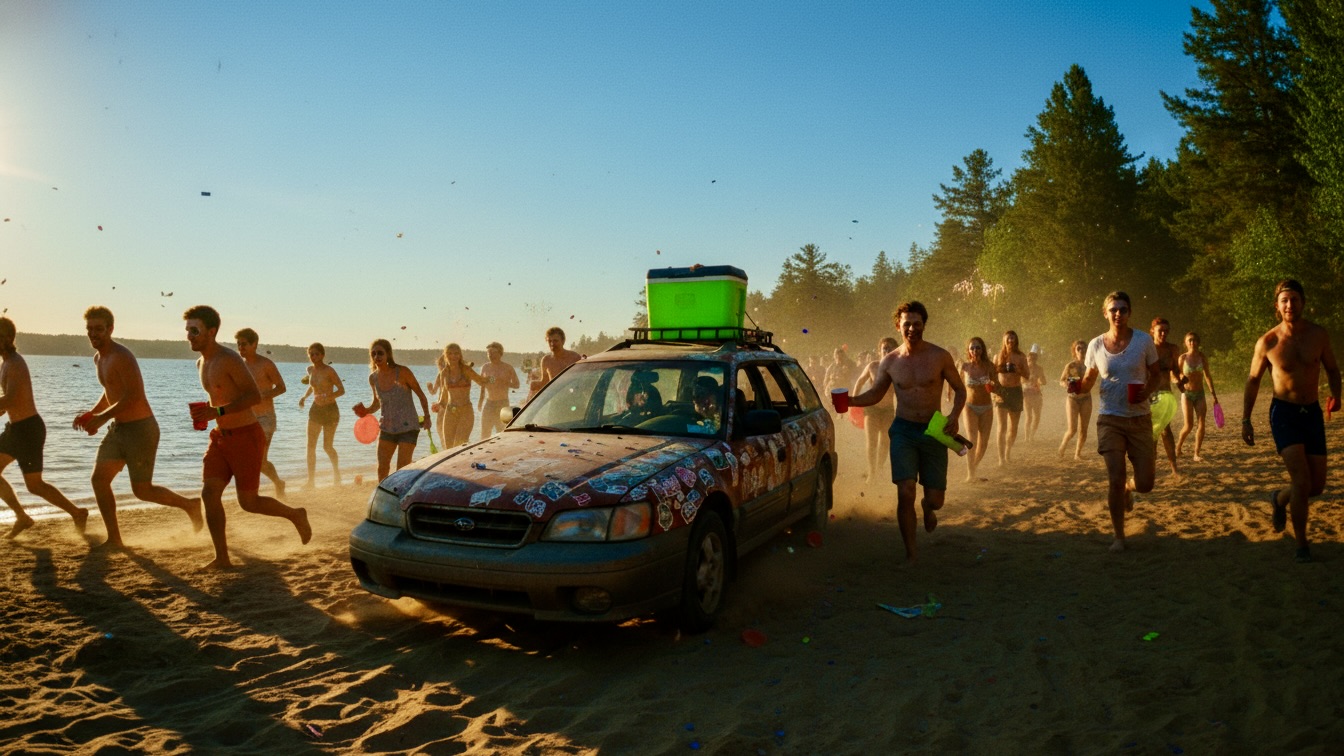
Format: Short Film / Anthology Episode | Est. Length: 10-12 minutes
This episode serves as a cornerstone for The Bargain Bin, a high-concept horror-comedy anthology series that explores the malevolent origins of seemingly mundane objects found in the forgotten corners of suburbia. Each installment follows a different set of characters who stumble upon a black canvas pop-up tent—a trans-dimensional retail outlet managed by the bureaucracy of Hell—where "free" items come with catastrophic supernatural costs. The series blends the visceral, sun-drenched body horror of 1980s cult classics with a modern satirical lens on consumerism and the "bro" culture of Middle America, suggesting a world where the apocalypse is just another retail glitch.
On a blistering Fourth of July, three hungover friends find a vibrating, neon-green vintage cooler in a mysterious black tent that smells of sulfur and cheap tequila. The "free" price tag proves too good to pass up, but the first drink pulled from its icy depths triggers a "party zombie" outbreak that threatens to turn a crowded beach into a frat-house massacre.
A group of hungover friends discovers a vintage cooler that transforms a crowded beach into a horde of undead party animals. They must navigate a frat-boy apocalypse to return the cursed item to a demonic retail clerk before the world is consumed by "Baja Blast" bloodlust.
The primary theme explores the soul-crushing nature of modern bureaucracy and retail culture, juxtaposing the literal "Hell" of a minimum-wage job with the supernatural horrors of the Seventh Circle. It satirizes the "Karen" archetype by transforming a character’s entitlement into a heroic weapon used against a demonic entity, suggesting that sometimes the only way to defeat evil is to demand to speak to its manager.
Additionally, the story examines the toxic side of "party culture" and Americana, using the Fourth of July setting to highlight the grotesque extremes of hedonism. The "party zombies" represent a loss of self to mindless consumption, where the drive to "shotgun" beers and play volleyball persists even after death, turning a day of celebration into a mindless, violent ritual.
The immediate stakes involve the physical survival of Brad and Tim as they are hunted by an impossibly fast, aggressive horde of undead. On a global scale, the cooler acts as a "Patient Zero" device; if it isn't returned, the infection will spread beyond the beach, transforming the entire population into gray-skinned, brain-eating party animals. For the characters, the struggle is also a battle against the debilitating physical toll of a severe hangover, making every movement a test of endurance.
The external conflict is driven by the "Party Zombie" horde, led by the transformed Chad, who combine supernatural speed with a relentless drive to consume both brains and alcohol. This is exacerbated by the environmental antagonism of the record-breaking heat and the bureaucratic obstructionism of Gary, the demonic retail clerk. Internally, Brad struggles with his own apathy and physical illness, while Tim must overcome his mounting rage to navigate the demonic "return policy" that stands between them and salvation.
Brad, Tim, and Chad are suffering through a brutal Fourth of July hangover when they discover a mysterious black tent in a strip mall parking lot. Inside, they find a vibrating neon-green Igloo cooler with a sign that simply reads "TAKE IT." Despite Brad’s hesitation and the smell of sulfur, Tim insists on taking it to the lake for ice. Upon arrival, Chad drinks a mysterious blue liquid from a blank silver can inside the cooler, instantly transforming into a gray-skinned, aggressive zombie who bites a fellow beachgoer, sparking a rapid, "party-themed" undead outbreak.
As the beach descends into chaos, Brad and Tim realize the cooler is a self-replicating source of the infection. They use the zombies' lingering party instincts—distracting them with frisbees and volleyball games—to fight their way back to the Subaru. They return to the black tent and confront Gary, a bored demonic manager who refuses the return due to a lack of a receipt. Tim’s explosive "Karen" energy eventually forces Gary to process the return, neutralizing the curse and reverting the zombies to humans, though Brad is left with a strawberry-scented souvenir that suggests his ordeal with the supernatural is far from over.
Brad: The Reluctant Realist. At the start, Brad is a passive observer, paralyzed by a hangover and a general sense of apathy toward his friends' bad decisions. By the end, he is forced into a leadership role, using his knowledge of "bro" psychology to manipulate the zombies and survive. His arc concludes with a hint of corruption as he unwittingly becomes a "preferred customer" of the demonic shop.
Tim: The Determined Driver. Tim begins the story as a man on the edge, obsessed with reaching the lake at any cost to salvage his holiday. His psychological shift occurs when his frustration with the supernatural turns into a weaponized form of retail entitlement. He ends the story having successfully "defeated" Hell through the sheer power of being an impossible customer.
Chad: The Catalyst. Chad is the quintessential "party animal" whose lack of impulse control leads to the disaster. He spends the majority of the episode as the primary physical antagonist, a gray-skinned predator who retains his frat-boy persona. He ends the story back in his human form, though severely traumatized and physically ill from the "Baja Blast" bloodlust.
Gary: The Infernal Clerk. A mid-level demonic bureaucrat who is entirely unimpressed by the apocalypse he helps facilitate. He represents the "banality of evil," caring more about store policy and his strawberry vape than the souls of the mortals he interacts with.
The Bargain: In the oppressive heat of a strip mall, Brad and Tim discover the black tent and the vibrating, sulfur-scented cooler. Despite the ominous humming and the freezing temperature of the plastic, they heave the unnaturally heavy object into their Subaru, driven by a desperate need for ice. The scene establishes the "Hell-as-Retail" aesthetic, with the tent appearing as a literal hole in the fabric of the world.
The First Chug: At the packed lakefront, Chad ignores Brad’s warnings and consumes a mysterious blue liquid from a blank can produced by the cooler. His transformation is instantaneous and grotesque: his skin turns to ash, his eyes fill with black veins, and he bites the nose off a passerby. The horror escalates as the victim also transforms, and the two zombies immediately begin "partying" while hunting new victims.
The Volleyball Diversion: With the beach in a state of total carnage, Brad and Tim must reach their car but are blocked by a massive horde of the undead. Brad realizes the zombies are still driven by "bro" instincts and initiates a high-stakes game of volleyball to distract them. The plan works, allowing the duo to drag the heavy, humming cooler through a crowd of zombies who are too busy spiking balls and shotgunning beers to notice them.
The Manager Confrontation: Back at the tent, Tim faces off against Gary, the demonic clerk, in a battle of bureaucratic wills. When Gary refuses the return for lack of a receipt, Tim enters a state of pure, righteous fury, demanding to speak to a manager and citing the "laws of commerce." Gary, exhausted by Tim’s persistence, finally scans the cooler with an iron barcode reader, ending the curse and causing the tent to dissolve into strawberry-scented smoke.
The episode begins with a sense of "grimy realism," focusing on the physical discomfort of heat and hangovers to ground the audience in a relatable, unpleasant reality. As the cooler is introduced, the mood shifts into "creeping dread," punctuated by the surreal humming and sulfurous smells. The midpoint transition into the beach outbreak is a sharp pivot into "frenetic horror-comedy," where the violence is graphic but the behavior of the zombies is absurd. The climax offers a "cathartic release" through Tim’s relatable frustration with customer service, ending on a "lingering unease" as the supernatural elements hint at a larger, inescapable system.
Throughout the first season, the "Black Tent" appears to different protagonists, offering items like a "Never-Ending Keg" that drowns a house party in foam or a "Cursed Grill" that cooks meat from the future. Each episode drops clues about the "Dark Lord of the Seventh Circle," who is revealed to be a corporate CEO attempting to disrupt the mortal economy through "free" demonic goods.
The season finale would bring Brad and Tim back into the fold as they realize the strawberry vape pen Brad found is actually a tracking device/contract. They are forced to lead a ragtag group of previous victims to the "Corporate Headquarters" of the tent—a massive, hellish warehouse store—to settle their debts. The thematic escalation moves from individual bad decisions to a collective struggle against a supernatural corporate takeover of the world.
The visual style is "Sun-Drenched Squalor," utilizing high-contrast lighting and oversaturated colors to make the heat feel tangible and oppressive. The camera work should be handheld and frantic during the beach scenes, reminiscent of 70s grindhouse cinema, but shift to static, wide, and "deadpan" shots when inside the black tent to emphasize Gary’s boredom. The "party zombies" should be rendered with practical makeup—ashy gray skin and black sclera—to maintain a tactile, "gross-out" horror aesthetic.
Tonal influences include the "splatstick" energy of Sam Raimi’s Evil Dead II and the nihilistic, sun-soaked dread of Midsommar, blended with the dry, workplace humor of Office Space. The color palette should contrast the "bleached white" of the sun with the "neon green" of the cooler and the "sickly blue" of the cursed liquid, creating a visual language that feels both festive and poisonous.
The target audience is the "Late-Night Genre" demographic, specifically adults aged 18-35 who enjoy elevated horror-comedy and anthology series like Black Mirror or Creepshow. It appeals to viewers who appreciate "bro-comedy" subversions and those who have experienced the specific, modern horror of retail and service-industry employment. The blend of graphic gore and satirical wit makes it ideal for streaming platforms or late-night cable blocks.
The episode is designed for a lean 10-12 minute runtime, utilizing a "breakneck" pace that mirrors the rapid onset of a disaster. The first three minutes are dedicated to the slow-burn discovery of the cooler, followed by a rapid-fire sequence of events once the first can is opened. The "Volleyball Diversion" serves as a high-tension midpoint, while the final three minutes focus on the dialogue-heavy "Retail Battle" with Gary, providing a comedic comedown before the final twist.
The "Party Zombie" outbreak requires a significant number of background actors, but the "gray ash" skin effect can be achieved through cost-effective body paint and practical blood rigs. The "vibrating cooler" and "force field" effects should be handled with a mix of practical shaking rigs and subtle post-production light ripples to maintain the grounded, DIY feel of the horror.
Location scouting should focus on a "liminal" strip mall parking lot and a crowded public beach to maximize the contrast between isolation and public chaos. The black tent itself should be a practical set piece with "Vantablack" or high-absorbency fabric to make it appear as a visual void on screen, requiring specific lighting setups to ensure the actors inside remain visible while the environment stays pitch black.


