A formal rejection from the Ministry. A ticking clock from Apex Mining. A grandfather's cryptic ledger.
The dashboard plastic burned to the touch. Summer in the basin was a violent, blinding thing. Sun glare shattered against the cracked windshield of the Ford, fracturing the light into sharp white needles. Nina sat in the driver's seat with the engine idling. The air conditioning rattled deep inside the vents, spitting out a thin, anemic stream of freezing air that hit her collarbone and vanished. Condensation beaded on the plastic louvers. A single drop broke loose, falling onto her thigh. She did not wipe it away.
Her phone rested on the center console. The screen brightness was maxed out, fighting the midday glare. The PDF attachment glowed against the dark interior of the cab. Document 1. The Ministry of Agriculture. The letterhead was crisp, geometric, completely devoid of anything organic. The text was justified, perfectly aligned, a block of bureaucratic refusal.
Dear Ms. Corbiere,
We have reviewed your grant application under the Indigenous Agricultural Heritage Initiative. While the committee acknowledges the cultural significance of traditional foodways, the primary metric for funding allocation in this fiscal quarter requires a demonstration of commercial scalability. The recovery of the undocumented seed cache detailed in your proposal does not meet the threshold for immediate agricultural yield or broader market integration. We cannot approve the allocation of ministry resources for a localized recovery operation in the northern basin.
Sincerely,
The Grant Review Board.
Nina stared at the word scalability. The letters blurred slightly at the edges. She pressed her thumb against the power button. The screen went black. The sudden absence of the stark white background made the cab feel smaller, tighter. The heat from the windows pressed inward.
She picked up the phone again. Her thumb moved over the glass, leaving a smudge of sweat and dust. She opened the voice memo app. The red record button waited, a perfect, unblinking circle. She pressed it. The timer started. Zero minutes. Zero seconds.
"They rejected it," Nina said. Her voice sounded thin over the low rumble of the idling engine. "They actually rejected it. The Ministry. Said our traditional foodways aren't a priority. Said it lacks commercial scalability."
She stopped. She swallowed hard. The dry click sounded loud in the small space.
"Bullshit," she said.
The audio waveform on the screen spiked, a jagged red mountain range.
"It's bullshit. They just don't want to fund anything that competes with the Apex infrastructure rollout. I'm going up North myself. I'm going before the mining corps tear up the basin. I'm leaving today."
She hit stop. The file saved as New Recording 41. She didn't bother renaming it. She dropped the phone back onto the console.
The truck vibrated. The tires sat deep in the gravel of her driveway. She shifted the gear selector into drive. The transmission engaged with a heavy clunk. She pulled out onto the main road, the tires kicking up a cloud of white dust that hung suspended in the still, hot air.
Ten miles down the highway, her phone buzzed against the plastic console. A text message. She glanced at the screen. Uncle Paul.
Ministry got back to you?
Nina kept one hand on the wheel. She picked up the phone with the other. The asphalt ahead shimmered with heat mirages, making the road look like it was dissolving into standing water.
Yes. Rejected. I'm driving up to the cabin now.
The three gray dots appeared on the screen. A slow pulse. Uncle Paul was typing. He was a slow typist, jabbing at the glass with a calloused index finger. The dots vanished. Reappeared. Vanished again.
Don't be stupid. The summer thaw is early. The roads are collapsing. You can't take the truck past the tree line.
Nina typed back, her thumb moving rapidly.
I'll hike in from the cutline.
The muskeg is rotten, Neen. You'll sink to your knees. The heat has turned the whole basin into soup. Turn around.
Apex moves the bulldozers in two days, Paul. If I don't go now, it's gone.
The old ways are gone, Neen. Let it be. We fight them in court, not in the mud.
The court doesn't care about grandfather's seeds. I'm going.
She tossed the phone onto the passenger seat. She didn't wait for his reply. The road narrowed. The asphalt gave way to packed dirt, then to loose gravel. The trees grew taller, denser, closing in on both sides. Spruce and jack pine, their needles dark and sharp against the pale blue sky. The truck violently shook as it hit a washboard section of the road. Nina gripped the steering wheel tighter, her knuckles turning white. The AC continued to blow its anemic, freezing breath against her chest, a stark contrast to the suffocating heat radiating from the glass.
The truck could go no further. The road simply ended, swallowed by a massive sinkhole of mud and exposed tree roots. The permafrost beneath the surface was melting rapidly in the unseasonable heat, turning the ground into a treacherous, unstable sponge. Nina parked the Ford at a severe angle, the right front tire sinking deep into the sludge.
She killed the engine. The silence was immediate and heavy, broken only by the ticking of the cooling metal and the frantic, high-pitched whine of mosquitoes swarming the windows.
She grabbed her pack from the passenger seat. She pushed the door open. The heat hit her like a physical blow. It was dense, humid, and entirely still. She stepped out. Her boot sank two inches into the mud with a wet sucking sound.
It took her three hours to hike the remaining four miles to the family's abandoned trapping cabin. The trail was a memory, overgrown with fireweed and choked by fallen birch trees. The sun beat down relentlessly, baking the back of her neck. Sweat pooled in the hollow of her collarbone and ran in rivulets down her spine.
When she finally broke through the tree line, she stopped. The cabin was in ruins. The roof had caved in completely on the left side, the cedar shingles rotting and slick with green moss. The front door hung off a single rusted hinge. The windows were empty black squares, the glass shattered long ago.
She walked forward. The ground around the cabin was littered with debris. Rusted tin cans, coils of decayed wire, a broken snowshoe frame sinking into the earth. She stepped through the doorway. The interior was dark, shadowed by the encroaching trees. The floorboards were uneven, buckling upward in jagged waves.
Nina dropped her pack. She pulled a flashlight from the side pocket and clicked it on. The beam cut through the gloom, illuminating dust motes dancing in the stagnant air. She walked toward the back corner. Her grandfather's corner. The wood stove stood there, a rusted iron cylinder, cold and dead.
She knelt beside it. Her jeans absorbed the dampness of the floor. She ran her hands over the floorboards, feeling for the seam. Her grandfather had showed it to her once, when she was seven years old. Never trust the banks, Neen. Never trust the government.
Her fingers caught an edge. She dug her fingernails into the gap. She pulled upward. The board resisted, swollen with moisture, then gave way with a loud, splitting crack. She set it aside. Beneath the floor was a square cavity dug directly into the dark earth. Inside the cavity lay a wooden box, wrapped in heavily oiled canvas.
Nina pulled the box out. It was heavy. She unwrapped the canvas, her hands shaking slightly. The oil transferred to her skin, slick and dark. She unlatched the brass hook on the box.
Inside was a leather-bound ledger. The cover was cracked, the binding loose. She opened it. The pages were yellowed, stiff with age. They were filled with her grandfather's cramped, precise handwriting. Blue ink. Columns of numbers.
42.6, 118.4. 6.2. 14 degrees.
None of it made sense. These weren't GPS coordinates. They weren't trapping quotas. They were random strings of digits. She flipped the page. More numbers. Sketches of angles, crude drawings of what looked like the sun, arcs indicating movement across the sky.
Her phone buzzed in her pocket. The sound was jarring, entirely out of place in the ruined cabin. She pulled it out. No signal. Just a single bar appearing and disappearing as the phone desperately searched for a tower. A notification popped up on the screen. A downloaded voicemail. It must have come through when she was on the ridge.
She pressed play. The speakerphone crackled.
"Ms. Corbiere."
The voice was smooth, artificial, coated in a veneer of corporate politeness. Mr. Battiste. The representative for Apex Mining.
"This is an automated courtesy call from the Apex Land Acquisition Office. We are gently reminding you that the final grace period for your family's contested land claim in Sector 4 expires in exactly forty-eight hours. At that time, all remaining structures will be cleared to commence the basin excavation project. If you have personal effects to remove, please do so immediately. Have a productive day."
The recording ended with a synthetic chime.
Nina stared at the phone. Forty-eight hours. Two days. She looked down at the ledger in her lap. The numbers blurred together. She traced the blue ink with her index finger. The paper felt brittle, ready to disintegrate. She closed the book. She wrapped it back in the oiled canvas, shoved it into her pack, and stood up. The floorboards groaned beneath her weight.
The bush was disorienting. The topography of the basin had changed drastically since Nina was a child. Forest fires had swept through three summers ago, leaving behind a skeletal landscape of blackened trunks that all looked identical. The new growth was aggressive, a dense tangle of sharp brambles and waist-high ferns that concealed the uneven ground.
Nina checked the compass on her phone. The needle drifted aimlessly, confused by the heavy iron deposits in the rock beneath her feet. The sun was beginning its slow descent, casting long, warped shadows across the forest floor.
She stopped. She turned in a slow circle. A rusted snare wire hung from a low branch to her left. She had passed that wire twenty minutes ago. She was walking in circles.
She leaned back against the charred trunk of a dead pine. The bark crumbled against her shirt. She slid down to the ground, pulling her knees to her chest. The heat was suffocating. The mosquitoes swarmed in a thick cloud around her face, landing on her forehead, her cheeks, the backs of her hands. She slapped at them weakly, smearing blood and crushed bodies across her skin.
She pulled out her phone. She opened the voice memo app. Her thumb hovered over the red button. She pressed it.
"Audio log two," she said. Her voice broke. She cleared her throat and tried again. "Audio log two. I'm... I'm out past the cabin. I don't know where I am."
The red waveform barely registered her whisper.
"I can't read the ledger. I don't understand the numbers. I thought I would know. I thought the land would just... make sense. But it doesn't."
A tear tracked through the dust on her cheek. She didn't wipe it away.
"I'm a researcher. I write papers. I sit in a climate-controlled office and I write about traditional foodways, but I don't know anything. I'm an imposter. I'm out here and I'm just a tourist in my own territory. If I don't find this cache, the knowledge dies with me. It just dies. The bulldozers come, and it's gone."
She hit stop. She dropped her head onto her knees. The silence of the forest pressed down on her, heavy and indifferent.
She sat there for ten minutes. The sun dropped lower. A sharp breeze picked up, rustling the ferns. Nina lifted her head. She looked straight across the clearing.
There it was.
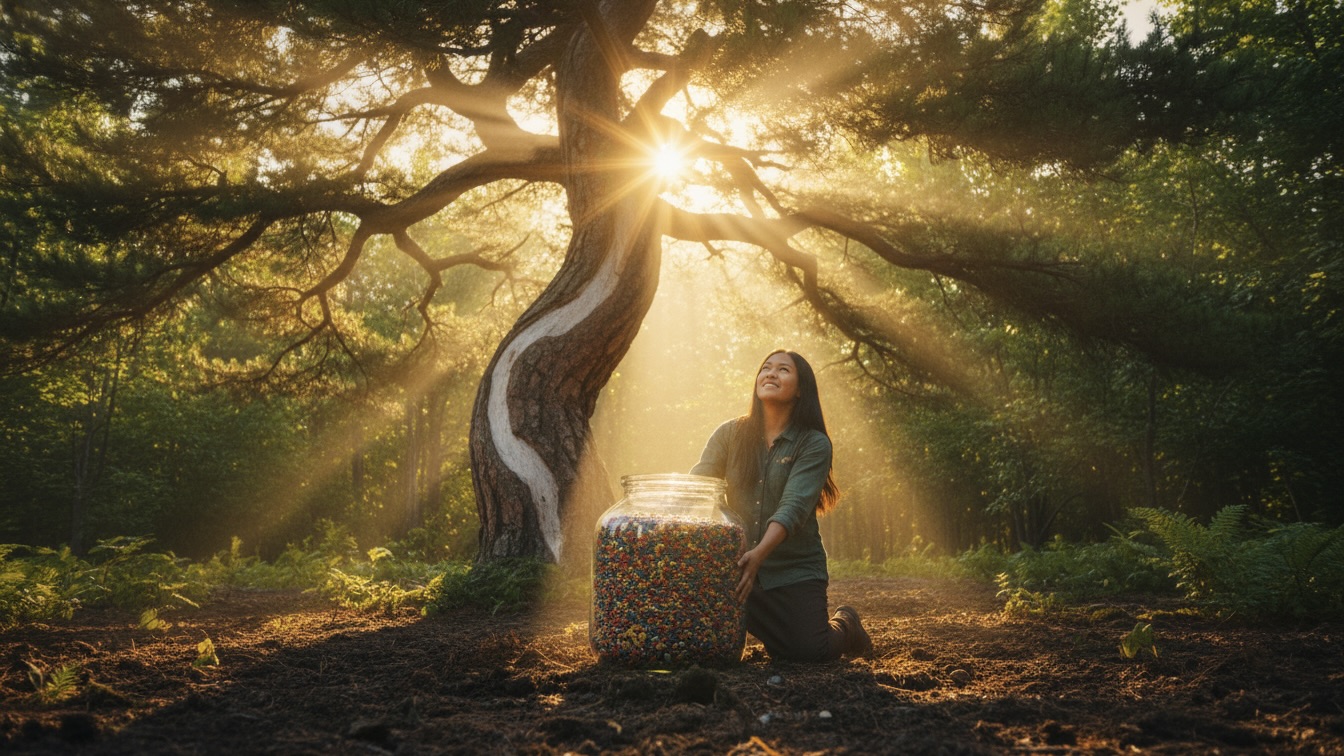
It stood at the edge of a slight depression in the earth. A massive white pine, older and thicker than anything else in the burn zone. It had survived the fires. Running down the center of the trunk, from the crown to the roots, was a deep, violently twisted scar. The wood was smooth and pale, exposed where a lightning strike had ripped the bark away decades ago.
Nina scrambled to her feet. Her legs cramped, but she ignored the pain. She pushed through the brambles, her boots snapping dry twigs.
She reached the tree. She placed her hand against the smooth, scarred wood. It felt warm, retaining the heat of the afternoon sun.
She pulled out her phone. One bar of signal. She opened the text thread with Uncle Paul.
Found the marker tree.
She hit send. The green bar crept across the top of the screen. It stalled. She held the phone up high. The bar moved again. Delivered.
She typed a second message.
The one with the lightning scar. He didn't forget.
Delivered.
Nina dropped her pack at the base of the tree. She pulled out the ledger and unwrapped it. She opened it to the first page. She looked at the numbers again. 42.6, 118.4. 6.2. 14 degrees.
She looked up at the sky. She looked at the angle of the sun. She looked at the ground. The depression in the earth wasn't natural. It was a bowl, perfectly positioned to catch the southern light.
She grabbed a handful of soil from the edge of the depression. It was dark, rich, entirely different from the sandy, acidic dirt of the surrounding pine forest.
She opened her journal. She pulled a pen from the spiral binding. She started writing quickly, her handwriting jagged and frantic.
The numbers aren't map coordinates. They're measurements. 6.2 is the soil pH. He amended the soil here. 14 degrees is the angle of the slope, maximizing solar gain. The other numbers... depth. Spacing. It's not a burial site. It's a schematic. He built a natural greenhouse. He used the permafrost layer as a temperature regulator to keep the cache dormant, but positioned it perfectly so the summer thaw wouldn't rot the containers.
The puzzle clicked together. The violent geography of the land wasn't an obstacle; it was the mechanism. She looked at the exact center of the depression. The sun hit it squarely, a spotlight of intense golden heat.
Nina dropped to her knees in the center of the depression. She didn't have a shovel. She had a heavy steel trowel from her pack, meant for taking small soil samples. She drove the blade into the earth. The top layer of soil was loose, dark, and damp. She scooped it away, throwing the dirt over her shoulder.
She dug for twenty minutes. Sweat poured off her face, stinging her eyes. Her breath came in short, ragged gasps. The trowel bit deeper. The soil changed. It grew colder, heavier. She was hitting the boundary layer, the threshold where the summer heat failed to penetrate the frozen earth below.
Her knuckles were scraped and bleeding, packed with black dirt. She drove the trowel down again with both hands.
Clink.
The vibration shot up the steel handle, jarring her wrists. It was a sharp, metallic sound. Completely unnatural in the soft earth.
Nina froze. She dropped the trowel. She dug frantically with her bare hands, tearing at the cold dirt, her fingernails scraping against something hard and smooth. She cleared the earth away.
A heavy zinc lid.
She dug wider, exposing the shape beneath it. It was a massive glass jar, thick and slightly green, encased in a protective layer of tightly packed clay. She grabbed the neck of the jar. She pulled. The suction of the wet earth fought her, but she planted her boots and heaved backward. The jar tore free with a wet ripping sound.
She fell onto her back, holding the heavy glass against her chest. She laughed. It was a breathless, raw sound that tore her throat. A sound of absolute, unadulterated relief.
She sat up. She wiped the dirt from the glass. Inside, perfectly preserved, were hundreds of seeds. Deep red beans, pale yellow corn kernels, flat white squash seeds. They were massive, robust, completely untouched by time or rot.
She pulled out her phone. Her hands shook so badly she almost dropped it. She opened the voice memo app. She pressed record.
"I got it," she gasped, her chest heaving. The sound of her heavy breathing dominated the recording. "I got it. Sealed glass jars. Corn, beans, squash. The old, strong varieties. They're perfect. They're absolutely perfect."
She hit stop. She opened her email client. The signal was weak, but holding. She drafted a new message. Destination: Community Council General Inbox.
She attached three high-resolution photos of the jars, the seeds visible through the thick glass, the lightning scar tree standing in the background.
Subject: Seed Cache Recovery.
Message: The Apex deadline doesn't matter. We don't need their conditional grants. We don't need the Ministry's approval for scalability. We have the capital right here. I'm bringing them back. We're growing our own.
She hit send. The phone struggled, the loading wheel spinning endlessly. Then, a sharp chime. Sent.
Three weeks later.
The community center was a massive, echoing space of exposed steel beams and polished concrete floors. The overhead fluorescent lights buzzed with a low, constant electric hum. The room was packed. Folding chairs were pushed back against the walls to make room for the massive wooden soil beds that now dominated the center of the hall.
The noise was constant. Overlapping voices, the sharp, bright laughter of children running between the aisles, the low murmur of elders sitting in clusters near the coffee urns.
"Make sure the depth is right, Neen."
Uncle Paul stood beside her, his hands buried deep in the dark, amended soil of the main bed. He wasn't looking at his phone. He wasn't typing. He was entirely present.
"I know the depth, Paul," Nina said. "It's in the ledger. It's exact."
"Just saying. Don't rush it."
"I'm not rushing."
Nina knelt beside the wooden frame of the bed. The glass jar sat open on the floor next to her. She reached inside. Her fingers brushed against the dry, hard surface of a single corn kernel. She pulled it out. It was heavy, dense with potential.
She looked up. The claustrophobia of the truck cab, the suffocating heat of the ruined cabin, the crushing weight of the bureaucratic rejection letter—all of it was gone. The physical space around her felt expansive, limitless. The air in the room felt suddenly lighter, charged with oxygen and the damp, rich presence of the wet soil.
She pressed her thumb into the dirt, making a perfect, small indentation. She dropped the seed into the dark earth. She covered it. She patted the soil flat.
She reached into the jar for the next one.
“She reached into the jar for the next one, unaware of the black Apex SUV idling quietly in the community center parking lot.”


