Format: Short Film / Anthology Episode | Est. Length: 10-12 minutes
A Rusted Lifeguard Chair serves as a standalone entry in The Erosion, an anthology series exploring the collapse of human relationships mirrored by the literal decay of the American coastline. Each episode centers on a different "relic" of the past—in this case, a dying beach house—that forces characters to confront the "rot" in their own lives before the environment reclaims the setting entirely. The series utilizes a high-tension, sensory-focused narrative style where the weather acts as both a ticking clock and a physical manifestation of the characters' internal turmoil.
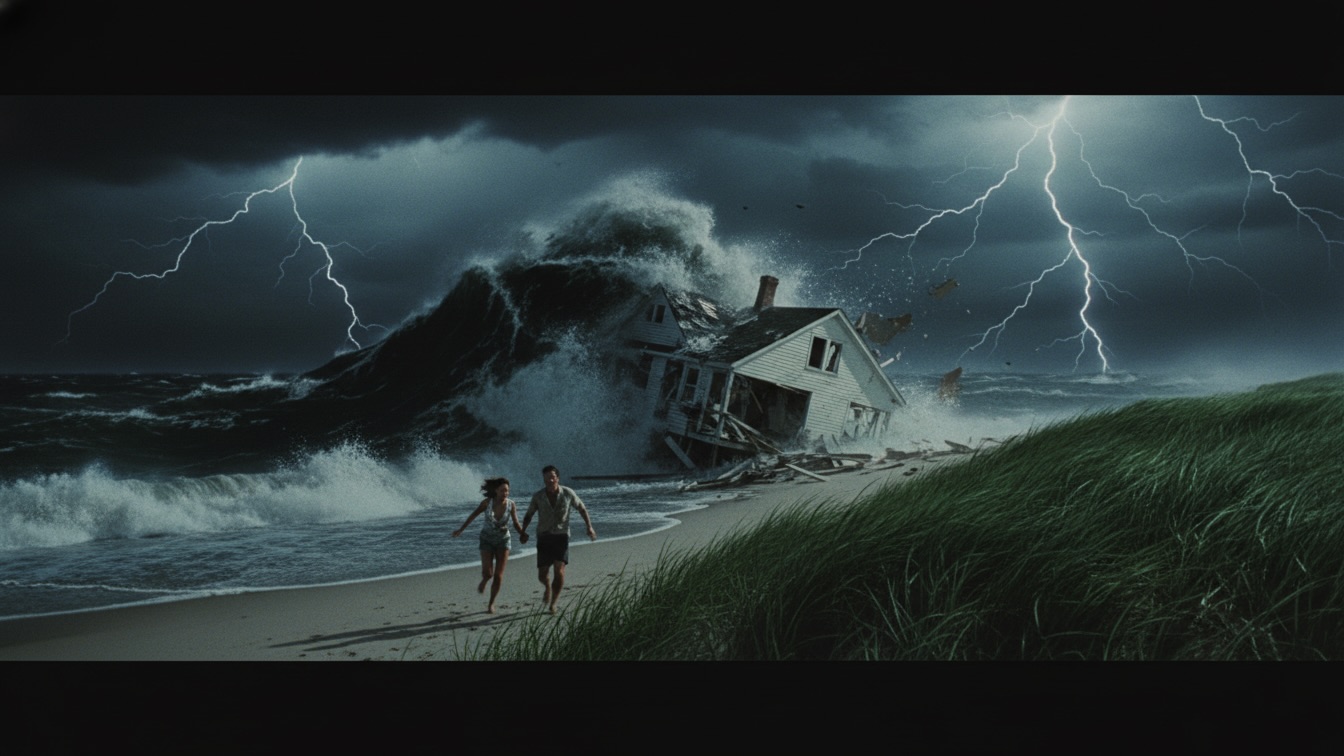
As a Category 5 hurricane bellows against the rotting wood of a coastal home, Millie and Jack are forced to confront the wreckage of their relationship before the house collapses into the Atlantic.
A grieving woman and her estranged ex-partner must survive a catastrophic hurricane while trapped in her father's decaying beach house. To escape the rising tide, they must first navigate the resentment and abandonment that destroyed their future years prior.
The primary theme is the inevitability of decay, both in the physical structure of the home and the emotional bonds of the characters. It explores the concept of "holding on" versus "letting go," symbolized by the lost wedding ring and the house itself, suggesting that survival requires shedding the weight of the past.
The second theme focuses on the paralyzing nature of grief and cowardice. Jack’s past abandonment is framed not just as a betrayal, but as a failure of courage in the face of mortality, mirroring the house’s inability to withstand the ocean’s power and the characters' inability to find solid ground.
For Millie, the stakes are both physical survival and the preservation of her father's legacy; losing the house and the ring feels like losing him a second time. For Jack, the stakes are redemptive, as he faces the literal storm he once ran away from to prove he can finally stand by Millie’s side. If they fail to reconcile or escape, they will be swallowed by the ocean, leaving their shared history unresolved and forgotten.
The external conflict is the Category 5 hurricane and the structural failure of the beach house, which acts as a ticking clock forcing the characters into close quarters. Internally, Millie struggles with deep-seated resentment and the inability to forgive, while Jack battles the shame of his past cowardice. Their inability to communicate effectively creates a friction that is as dangerous as the rising storm surge, turning the house into a psychological trap.
Millie and Jack return to her childhood beach house to pack up her late father’s belongings before a massive hurricane makes landfall. As the heat becomes stifling and the storm approaches, they uncover a Polaroid and a cheap carnival bear that trigger painful memories of Jack’s abandonment during her father’s terminal illness. The tension boils over into a series of confrontations, forcing them to acknowledge the "rot" in their relationship that mirrors the crumbling foundation beneath their feet.
When the emergency alert sounds, Millie realizes her mother’s wedding ring is missing, leading to a desperate search as the house begins to tilt into the sea. Jack injures himself trying to retrieve the heirloom from beneath the floorboards, but they are ultimately forced to abandon the physical tokens of the past to save their lives. As the house is swallowed by the Atlantic, Millie finally lets go of her anger, choosing survival and Jack’s hand over the ghosts of the house.
Millie: At the start, Millie is a woman hardened by grief and betrayal, using the task of packing as a shield against her emotions. Her arc moves from a state of rigid control and bitter isolation to a vulnerable realization that she cannot save the past. By the end, she has shed her defensive armor, choosing to move forward into an uncertain future rather than drowning with her memories.
Jack: Jack begins the story as a man seeking atonement but crippled by the guilt of his past "flight" response. He is desperate to prove his reliability, transitioning from a passive observer to a man willing to bleed to protect Millie. His arc concludes with him finally "standing next to her," fulfilling the role he abandoned years ago even as everything else is lost.
The Arrival: Millie and Jack arrive at the decaying beach house under a bruising sky, immediately establishing a cold, transactional dynamic as they begin packing. The oppressive heat and the sound of the clicking ceiling fan heighten the discomfort, signaling the internal and external pressure building within the space. Millie sets strict boundaries for their interaction, refusing to discuss the past or her father, while the "ripping" of packing tape provides a jarring, percussive soundtrack to their silence.
The Discovery: While sorting through a dusty cabinet, Jack finds a Polaroid of the house in its prime and a cheap carnival bear, forcing a confrontation about the "rot" that has taken over their lives. Millie reacts with explosive anger, accusing Jack of running away when her father was dying, which he admits was a result of youthful cowardice and a feeling of being "too small" for her grief. This midpoint beat shifts the tension from simmering resentment to an open, painful dialogue about abandonment as the first winds of the hurricane begin to rattle the windows.
The Collapse: As the Category 5 hurricane hits, the house begins to break apart, and Millie realizes her mother’s wedding ring has fallen through the warped floorboards. Jack slices his hand open trying to pry the boards apart in a desperate act of penance, but the rising water and the groaning structure force them to abandon the search. In the climax, Jack grabs Millie’s hand as the house slides into the ocean, and they flee toward the dunes, finally leaving the wreckage and the ring behind in the black water.
The episode begins with a sense of stifling, claustrophobic stagnation, characterized by the "hot, wet towel" atmosphere of the pre-storm heat. As the wind picks up, the mood shifts into high-pitched volatility, moving from cold silence to screaming matches that mirror the crashing waves. The final act is one of cathartic destruction; as the house falls, the audience experiences a release of the built-up tension, ending on a note of somber but hopeful survival amidst total loss.
If expanded, the season would follow various residents of this coastal town as they deal with the aftermath of the "Great Wash," a storm that permanently altered the shoreline. Millie and Jack’s journey would serve as the emotional backbone, with subsequent episodes exploring how they rebuild their lives in a world where their history has been physically erased.
The thematic escalation would move from individual grief to collective resilience, examining how a community handles the loss of its geography. The season would culminate in a return to the site of the beach house, where Millie and Jack find that while the house is gone, the "sand that stretches forever" from the Polaroid has begun to return in a new, different form, symbolizing a clean slate.
The visual style should be tactile and sensory, utilizing extreme close-ups on textures like peeling paint, rusty nails, and the "wet chocolate cake" consistency of the rotting wood. The color palette transitions from the sickly, jaundiced yellows and purples of the pre-storm atmosphere to a cold, desaturated blue and slate gray as the hurricane takes hold.
The tone is a blend of domestic drama and survival horror, drawing comparisons to the atmospheric dread of Take Shelter and the intimate, painful dialogue of Manchester by the Sea. Sound design is critical, with the rhythmic clicking of the fan and the "ripping" of packing tape providing a percussive, unsettling soundtrack that eventually gives way to the deafening roar of the ocean.
This content is designed for an adult audience (25-55) that appreciates character-driven dramas with high-stakes environmental backdrops. It appeals to viewers who enjoy anthology series like Black Mirror or The Leftovers, where the catastrophic elements serve as a crucible for exploring complex human relationships and unresolved trauma.
The 10-12 minute runtime necessitates a rapid escalation of tension; the first three minutes establish the "stuck" environment, the middle four minutes focus on the emotional explosion, and the final three minutes are a high-tempo survival sequence. The pacing should feel increasingly breathless, mimicking the rising wind speeds of the hurricane until the final, sudden silence of the house’s collapse.
The production requires a practical "collapsing" set or a highly detailed modular interior that can be tilted and flooded to simulate the house’s destruction. Water effects must be managed carefully to ensure the "angry, dark" quality of the ocean is captured without obscuring the actors' performances.
The use of a real Category 5 hurricane's soundscape—the "screaming" wind and "popping" boards—is essential for immersion. Special attention should be paid to the makeup department to show the progression of the characters' physical distress, from the "sticky" sweat of the opening to the "rain and blood" of the finale.


