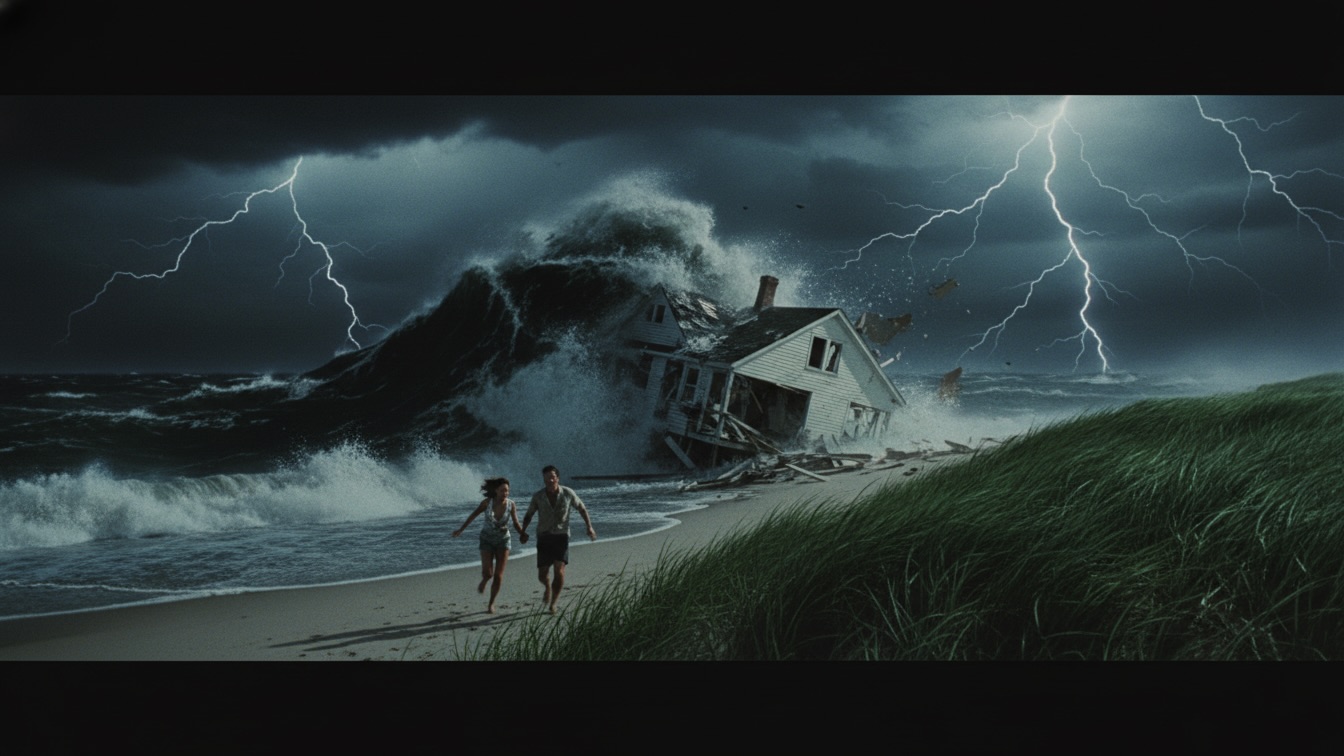
The narrative unfolds during a catastrophic hurricane, centering on Millie and Jack as they attempt to salvage the remnants of a decaying beach house. The story utilizes a reverse-chronological structure, beginning with the immediate threat of the storm and flashing back to the arrival and the emotional friction of the preceding days. These memories reveal a deep-seated trauma: Jack abandoned Millie years ago via text message while her father was dying, leaving her to face the grief alone.
As the physical structure of the house rots and succumbs to the rising tide, the emotional walls between the two characters similarly begin to crumble. Millie clings to the physical artifacts of her past, specifically her mother’s wedding ring, as a way to avoid the finality of her father's death. Jack, seeking redemption, attempts to prove his newfound reliability by assisting with the packing and ultimately risking physical injury to help her. The story concludes with the literal collapse of the house into the ocean, forcing Millie to let go of her material anchors and accept Jack’s hand to survive.
The central theme of the story is the inevitable nature of decay, both in the physical world and within the human psyche. The beach house serves as a potent metaphor for Millie’s internal state; it is a structure built on rotting foundations that can no longer withstand the pressure of the outside world. Just as the saltwater eats away at the wooden pilings, Millie’s resentment and grief have eroded her ability to connect with Jack. The environmental collapse mirrors the emotional climax, suggesting that some things must be completely destroyed before a new foundation can be laid.
Another significant theme is the contrast between cowardice and presence. Jack’s past actions define him as a man who flees when the "weather" of life becomes too harsh. His return is an attempt to rewrite this narrative, moving from the cowardice of a text message to the bravery of physical protection during a Category 5 storm. The story posits that true presence is not merely about being in a room, but about standing firm when the ground is literally shifting beneath one's feet.
The narrative also explores the burden of memory and the danger of sentimental stagnation. Millie’s refusal to look at the old Polaroid or her desperate search for the wedding ring illustrates a psychological "stuckness." She is more concerned with the symbols of her past than the reality of her present survival. The final act of letting go of the house and the ring signifies a traumatic but necessary transition from the past into an uncertain future.
Millie is a character defined by defensive rigidity and unresolved mourning. Psychologically, she exhibits signs of a "frozen" grief response, where she uses anger as a secondary emotion to mask the primary pain of her father’s death and Jack’s betrayal. Her obsession with the mechanical aspects of packing—pressing down tape wrinkles and organizing boxes—is a manifestation of her need for control in a world that feels increasingly chaotic. By focusing on small, manageable tasks, she avoids the overwhelming reality of the storm and her own emotional vulnerability.
Her relationship with the beach house is almost parasitic; she derives her identity from the memories it holds, even as those memories cause her pain. When she screams at Jack about the text message, she is finally venting years of repressed "displacement" of her anger toward her father’s illness. Her willingness to risk her life for a lost ring shows that she values the tangible connection to the dead over her own safety. It is only when the house literally vanishes that she is forced to abandon her role as a martyr of the past.
Jack functions as the story’s seeker of atonement, driven by a profound sense of shame regarding his past "flight" response. Ten years prior, his inability to cope with the reality of death led him to abandon the woman he loved, a choice that has clearly haunted his self-image. His return to the beach house is not just about helping Millie pack; it is a psychological trial he has set for himself. He needs to prove that he is no longer the "small" man who shrinks in the face of a giant like Millie’s father.
Throughout the narrative, Jack uses physical labor as a form of penance. Whether he is wrapping plates or ripping up floorboards until his hand bleeds, he is attempting to communicate through action what he cannot fully express through words. His admission of cowardice is a pivotal moment of vulnerability that marks his transition into emotional maturity. By the end of the story, his grip on Millie’s hand represents a reversal of his previous abandonment, signaling his commitment to stay even when the world is falling apart.
The author employs a visceral, sensory-driven style that emphasizes the "heaviness" of the atmosphere. The use of onomatopoeia, such as the riiiiip of tape and the clack of plates, creates an auditory landscape that feels claustrophobic and tense. These sharp, mechanical sounds contrast with the organic, overwhelming roar of the ocean, highlighting the futility of human effort against the power of nature. The sensory details—the smell of lemon soap, the taste of dirty rain, and the feeling of sticky skin—ground the reader in the physical discomfort of the characters.
Pacing in the story is handled through a non-linear structure that builds tension by withholding the full context of the characters' conflict. By starting in the middle of the storm and then jumping back in time, the author creates a sense of impending doom that colors even the most mundane activities, like packing boxes. The short, staccato sentences mirror the high-stress environment of the hurricane and the breathless quality of a panic attack. This stylistic choice ensures that the prose feels as urgent and fragmented as the characters' internal lives.
The narrative voice is intimate yet detached, focusing heavily on external actions to imply internal states. This "show, don't tell" approach is particularly effective in the scenes involving the old Polaroid and the blue bear. Instead of describing Millie's sadness, the author describes her nails pressing into her palms and her refusal to look at the picture. This allows the reader to experience the emotional weight of the story through the physical reactions of the characters, making the final collapse of the house feel like a sensory and emotional release.


