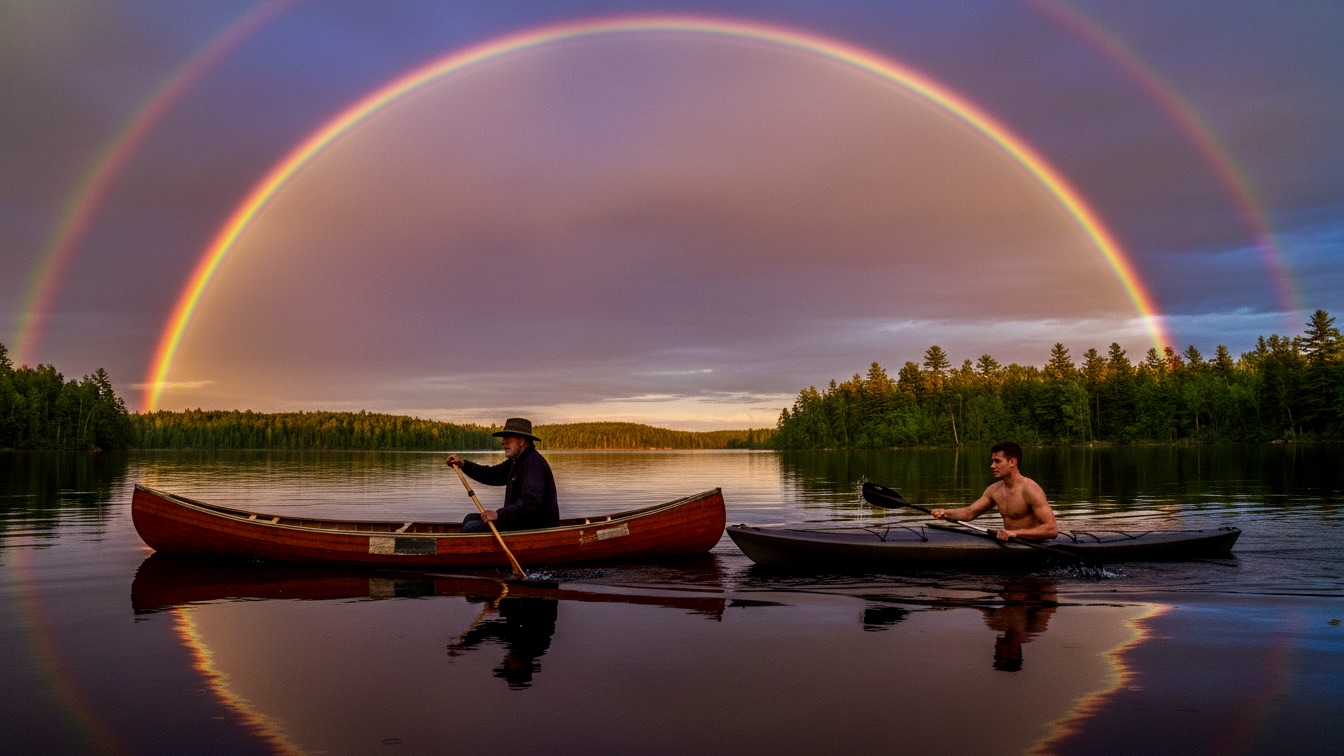
Format: Short Film / Anthology Episode | Est. Length: 10-12 minutes
Imagine this story as a standout installment in an anthology series titled The Unplugged, which explores the friction between digital performance and raw physical reality. Each episode follows a different tech-reliant individual forced into a high-stakes encounter with the natural world, stripping away their curated personas to reveal the vulnerable human beneath. The series utilizes a "hyper-real" aesthetic to contrast the filtered world of social media with the indifferent, majestic, and often terrifying scale of the wilderness.
While filming a "vibe" video about the primal silence of the North Woods, a polished influencer’s $300 carbon-fiber paddle snaps with a gunshot-like crack, leaving him stranded and spinning in circles as a massive storm front swallows the sun.
A vanity-driven influencer is forced to abandon his digital persona when a gear failure leaves him at the mercy of a cynical local guide and a violent summer squall. Survival depends on trading his three-inch screen for the terrifying, unscripted reality of the North Woods.
The primary theme explores the "Performance of Self" versus "Authentic Experience," highlighting how digital documentation acts as a barrier to true connection with the environment. It delves into the psychological weight of modern visibility, questioning whether an event has value if it isn't shared with an audience.
The story also examines the generational divide between the "Digital Native" and the "Analog Survivor," contrasting Jay’s anxiety-driven need for validation with Frank’s grounded, silent competence. This genre-bending narrative moves from a satirical look at influencer culture into a visceral survival thriller and finally into a meditative character study.
Jay faces immediate physical peril from a rapidly approaching shelf cloud and potential drowning if he cannot navigate back to shore with broken equipment. Beyond the physical, his psychological identity is at risk; the loss of his "brand" and the exposure of his internal panic disorder threaten the carefully curated facade that sustains his livelihood and sense of self.
The external conflict is a man-vs-nature struggle against a violent summer squall and the claustrophobic presence of dock spiders in a rotting cabin. Internally, Jay battles a paralyzing panic disorder and the existential dread that he does not exist if he isn't being watched. Frank serves as a philosophical antagonist, using his blunt cynicism to puncture Jay’s ego and force him to confront his own superficiality.
Jay is miles from the rental dock, performing a rhythmic, "authentic" monologue for his "Authentic Earth" followers, when his high-end paddle snaps clean in two. As he struggles to paddle his unstable kayak with a jagged stump, a massive shelf cloud turns the horizon a bruised purple, signaling a life-threatening squall. He is rescued by Frank, a weathered local in a battered cedar-strip canoe, who mocks Jay’s obsession with documentation and insists they take shelter on a nearby island rather than attempting to reach the mainland.
As the storm hits with terrifying force, they take refuge in a derelict scout cabin infested with hundreds of dock spiders, triggering a severe, hyperventilating panic attack in Jay. Frank uses grounding techniques to pull Jay back from the brink, leading to a raw conversation where Frank reveals his past as a high-stress architect who fled the city for the peace of the lake. After the storm passes, they witness a spectacular double rainbow; instead of filming it for his brand, Jay chooses to delete all his footage from the day, finally experiencing a moment of genuine, unmediated life before paddling home in silence.
Jay: A 31-year-old influencer (posing as 26) who is trapped in a cycle of digital validation and chronic anxiety. At the start of the episode, he is a "spectator in his own skin," viewing his life through a camera lens to avoid the silence of his own thoughts. By the end, he achieves a state of presence, choosing personal memory over public metrics and finding a newfound respect for the "unfiltered" world.
Frank: A 64-year-old former architect turned wilderness guide who values competence and silence over visibility. He begins as a cynical, almost hostile observer of Jay’s vanity, viewing the young man as a symptom of a broken society. However, he ends as a compassionate mentor who recognizes the "noisy" mental world Jay is trying to escape, sharing his own history of building "glass cages" in the city.
The Snap: Jay is mid-monologue about "finding your core" when his paddle shatters, instantly shifting the tone from a serene travel vlog to a frantic survival situation. He tries to maintain his persona for the camera even as the kayak spins uncontrollably, but the approaching purple horizon signals that his "content" is about to become a crisis. His brain initially prioritizes the three-hundred-dollar cost of the gear over the physical danger of the three-mile drift toward jagged granite.
The Rescue: Frank arrives in The Stubborn Spark, offering a blunt reality check that punctures Jay's ego and forces him to abandon his car-bound emergency gear for a stranger's wooden boat. The tension rises as the sky turns a radioactive green and the birds go silent, emphasizing the scale of the impending storm against Jay's fragile technology. Jay attempts to frame Frank as a "narrative beat" for his followers, but Frank threatens to throw the phone into the lake, establishing the power dynamic.
The Cabin: Trapped in the rotting scout cabin as the sky opens in a deluge, the terror of the storm is replaced by visceral horror when Jay realizes they are surrounded by hundreds of dock spiders. This triggers a full-blown panic attack, forcing Frank to physically ground Jay and lead him through a sensory "3-2-1" exercise to restore his breathing. The scene highlights Jay's extreme vulnerability as he is forced to lock eyes with Frank, finding a tether to reality that isn't provided by a screen.
The Midpoint/Bonding: As the rain turns to a rhythmic drumbeat, Frank reveals his history of "building his own cage" in the city, and the two men find an unlikely connection through humming a song by The National. This moment marks the shift from survival to reflection, as Jay admits his fear of non-existence in the silence and Frank admits the knees ache but the head clears out. They sit on the floor of the rotting cabin, two men from different eras sharing dried apples and a rare moment of genuine human connection.
The Climax/Resolution: Emerging from the cabin into a transformed, emerald world, Jay sees a perfect double rainbow and instinctively reaches for his phone to capture the "redemption" arc. He looks at the screen, then at the actual horizon, and realizes the digital version is a pale, flickering imitation of the air on his skin. In a final act of defiance against his brand, he deletes all the day's footage and paddles back to the dock in a comfortable silence, keeping the experience for himself.
The episode begins with a sense of artificial "vibe" and superficial calm, which quickly descends into frantic, high-stakes anxiety and visceral horror during the storm and cabin sequence. The emotional peak is the raw vulnerability of the panic attack, followed by a slow, meditative cooling-off period that leaves the audience with a sense of profound, quiet clarity. The final mood is one of earned peace, shifting from the "noise" of the digital world to the "rhythm" of the physical one.
In a multi-episode arc, Jay’s decision to delete the footage would serve as the "inciting incident" for his professional collapse and personal rebirth. Subsequent episodes would follow his struggle to maintain this new "unplugged" perspective as he returns to the city, eventually leading to a final confrontation where he must choose between a lucrative comeback and the quiet life he glimpsed on the lake.
Thematic escalation would involve other characters—a corporate whistleblower, a grieving mother, or a burnt-out coder—all finding their way to Frank’s lake, creating a tapestry of modern souls seeking a "frequency that only hits away from the grid." Frank would act as the recurring "bridge" character, his cabin serving as a sanctuary where the digital world is systematically dismantled in favor of the elemental.
The visual style contrasts the "filtered" aesthetic of Jay’s phone footage—oversaturated, stabilized, and shallow depth of field—with the "raw" cinematic reality of the North Woods, which feels textured, wide, and indifferent. The storm sequence uses handheld, kinetic camerawork and high-contrast lighting to mirror Jay’s internal chaos, while the aftermath transitions into slow, static, and wide-angle shots that emphasize the grandeur of the landscape.
The tone is a blend of The Bear’s claustrophobic intensity and Nomadland’s quiet naturalism. Tonal comparables include the "man against nature" tension of 127 Hours and the philosophical character study of Into the Wild, moving from a critique of modern vanity into a sincere appreciation for the sublime.
The target audience is adults aged 25–45 who experience "digital fatigue" and are interested in themes of mindfulness, mental health, and the outdoors. It appeals to viewers who enjoy prestige anthology dramas like Black Mirror (but with a naturalistic rather than sci-fi bent) and character-driven survival stories that offer a critique of contemporary social media culture.
The pacing follows a "pressure cooker" structure: a slow, deceptive build-up (3 mins), a rapid-fire escalation during the paddle snap and storm arrival (4 mins), a high-tension plateau in the cabin (3 mins), and a lingering, atmospheric resolution (2 mins). The 12-minute runtime ensures that the transition from vanity to vulnerability feels earned without overstaying the survival mechanics, maintaining a tight focus on the psychological shift within Jay.
The production requires a specialized water safety team and a "picture-car" equivalent for the period-accurate cedar-strip canoe and the modern carbon-fiber kayak. Practical effects are preferred for the storm sequence—using high-pressure water bars and wind machines—to ensure the actors' reactions to the cold and deluge are authentic.
The "dock spiders" should be a mix of practical macro-photography and subtle CGI to ensure a swarm-like effect without compromising safety. Sound design is critical; the contrast between the "breathy" microphone audio of Jay’s vlog and the roaring, immersive soundscape of the storm will be the primary tool for shifting the audience's perspective from the digital to the physical.


