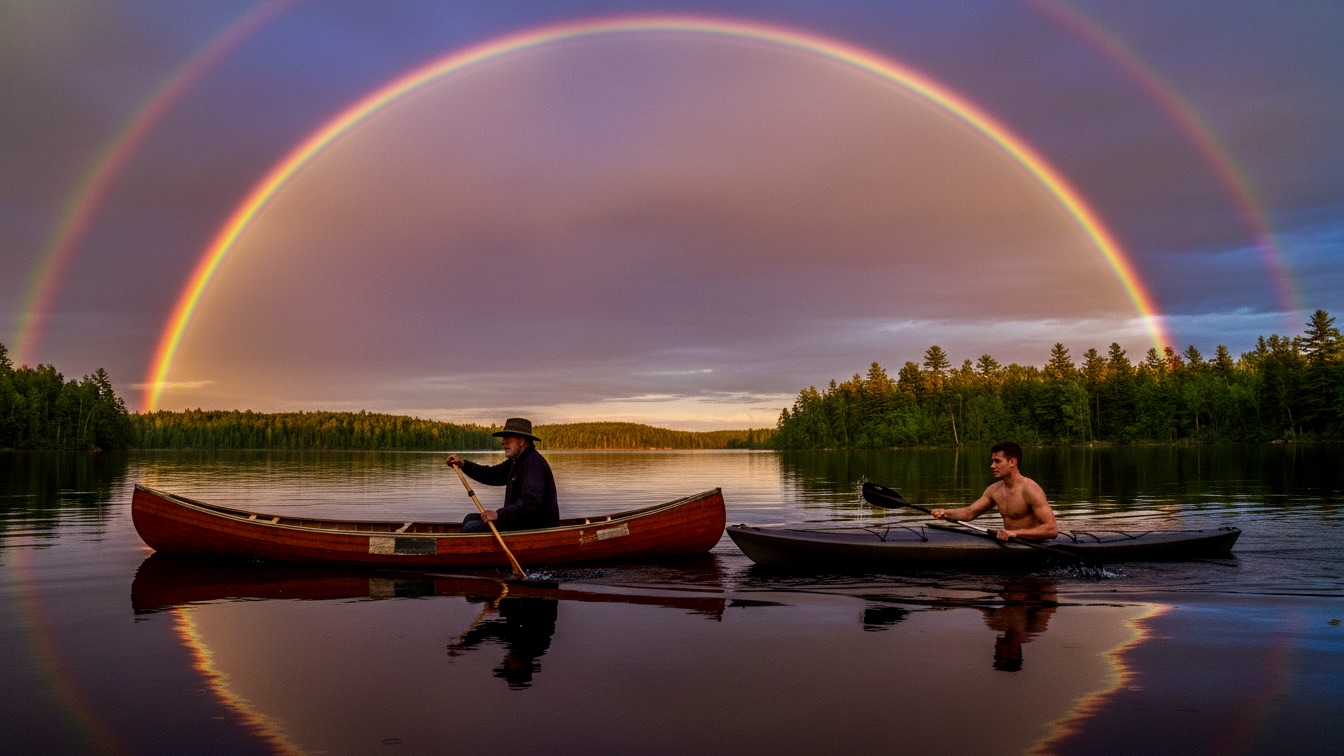
Jay, a social media influencer focused on "authentic" outdoor content, finds himself in a precarious situation when his expensive carbon-fiber paddle snaps in the middle of a large lake. While attempting to frame his gear failure as a "survival arc" for his followers, he is intercepted by Frank, a seasoned guide in a traditional cedar-strip canoe. Frank warns Jay of an imminent and dangerous shelf cloud that his weather app failed to detect, insisting they take immediate shelter on a nearby island.
The two men reach a dilapidated scout cabin just as a violent squall hits, bringing torrential rain and high winds. Inside the dark, decaying structure, Jay is confronted with a swarm of dock spiders, which triggers a severe claustrophobic panic attack. Frank intervenes, using grounding techniques to pull Jay back from the brink of a psychological breakdown. Following the storm, the men share a moment of genuine connection over music and jerky, leading Jay to a profound realization about the hollow nature of his digital existence. He ultimately chooses to delete his footage, choosing to keep the memory of the experience for himself rather than his audience.
The central theme of the story is the conflict between the "Performed Self" and the "Authentic Self." Jay’s life is a series of curated moments designed for an audience, where even a life-threatening situation is initially viewed through the lens of engagement metrics. His "Authentic Earth" series is a paradox, as the very act of filming the silence destroys the silence he claims to seek. The story suggests that true authenticity cannot be captured or shared on a server; it must be lived in the body.
Nature’s indifference serves as a secondary theme, acting as the catalyst for Jay’s transformation. The storm does not care about Jay’s brand, his hundred thousand followers, or his "vibe" videos. It is a physical force that demands presence and competence rather than performance. This indifference strips away Jay’s digital armor, forcing him to confront his physical vulnerability. The "radioactive" green of the sky and the "concrete" wall of the storm represent a reality that cannot be filtered or edited.
The narrative also explores the generational divide regarding technology and presence. Frank represents an analog past where competence is measured by skill and survival, while Jay represents a digital present where value is measured by visibility. Frank’s "Stubborn Spark" canoe and his hand-carved wooden birds stand in contrast to Jay’s carbon-fiber kayak and "gorilla-pod" phone mount. The story concludes that while technology offers a "filter" for reality, it often acts as a cage that prevents the individual from actually living.
Jay is a protagonist defined by a deep-seated existential anxiety that he masks with digital vanity. He suffers from a modern psychological condition where his sense of self is entirely dependent on external validation and the "eyes" of his followers. When he is alone on the water, he feels the need to narrate his life to feel real, suggesting that without an audience, he fears he might cease to exist. His panic attack in the cabin reveals that his "influencer" persona is a fragile shell that collapses when he is forced into a state of powerlessness.
As a character, he undergoes a significant "ego death" during the storm. The breaking of the paddle symbolizes the breaking of his connection to his manufactured world. By the end of the chapter, his decision to delete the footage represents a reclamation of his own life. He moves from being a spectator of his own existence to an active participant. He finally understands that the "silence" he was looking for wasn't a commodity to be sold, but a state of being to be inhabited.
Frank serves as the "Wise Old Man" archetype, providing a psychological anchor for Jay’s drifting identity. He is a man who has already lived through the high-visibility world Jay currently inhabits and has consciously rejected it. His competence is quiet and unhurried, born from thirty years of "guiding" and a refusal to look at the world through a three-inch screen. He does not seek to impress Jay; he seeks to keep him alive, which is a form of care that Jay is unaccustomed to receiving.
Psychologically, Frank represents the "Integrated Man" who has found peace in the silence Jay fears. He uses grounding techniques—focusing on sight, touch, and breath—to help Jay overcome his panic, demonstrating a deep understanding of human vulnerability. Frank’s choice to live on the lake is not an escape from reality, but a deeper immersion into it. He provides the "weight" that Jay’s life lacks, showing him that a life lived for oneself is more substantial than a life lived for a camera.
The author employs a sharp contrast in sensory details to highlight the shift from the artificial to the visceral. In the beginning, the descriptions are focused on the "polarized lenses" and the "rhythmic cadence" of Jay’s performance. As the storm approaches, the language becomes more muscular and grounded in physical sensation. The "shotgun crack" of the paddle and the "wet wool" of the humidity pull the reader out of the digital "vibe" and into a high-stakes survival scenario.
The pacing of the narrative mirrors Jay’s internal state, moving from the slow, performative opening to the frantic, breathless energy of the squall. The transition into the cabin brings the pacing to a grinding halt, creating a sense of claustrophobia that reflects Jay’s panic attack. This "forced stillness" allows for the thematic core of the story to emerge through dialogue rather than action. The final section, characterized by the "double rainbow logic," slows down even further, ending on a note of quiet, rhythmic serenity.
The narrative voice is third-person limited, allowing the reader to see the irony in Jay’s thoughts while still feeling the genuine terror of his situation. The author uses the setting of the cabin—with its "rotting logs" and "spider-filled rafters"—to externalize Jay’s internal chaos. The ending is particularly effective in its use of auditory imagery, such as the "haunting call of a loon" and the "rustle of leaves." These sounds replace the "digital noise" of Jay’s life, signaling a successful psychological transition into the present moment.


