A high-tech paddle breaks, leaving a city influencer stranded as a massive summer storm rolls over the lake.
The phone was perched on a shaky gorilla-pod, its lens aimed squarely at Jay’s face. He adjusted his sunglasses, the polarized lenses catching the harsh glare of the midday sun. The heat was heavy, a thick blanket of humidity that made the air feel like wet wool. He needed this shot. The 'Authentic Earth' series was lagging in engagement, and he’d promised his followers a deep-dive into the 'primal silence' of the North Woods. But the silence wasn’t primal. It was just hot. And his shoulder ached. He leaned into the microphone clipped to his life jacket.
"Hey guys, so we’re about four miles out now," Jay said, his voice dropping into that rhythmic, breathy cadence he used for his 'vibe' videos. "Just me, the water, and this absolute silence. No signal, no noise, just the rhythm of the paddle. It’s about finding that core, you know? That frequency that only hits when you’re away from the grid." He checked the screen. The framing was good. The water behind him was a sheet of glass, reflecting a sky so blue it looked filtered already. He reached for another stroke, wanting to show off his form. He dug the blade in, pulling back with a grunt of performed effort.
Then came the sound. It wasn’t a splash or a ripple. It was a sharp, dry crack that sounded like a gunshot in the still air. Jay’s momentum vanished. He lurched forward, his chest hitting the front of the cockpit. The carbon-fiber shaft of his three-hundred-dollar paddle had snapped clean in two. The blade end bobbed away on a small ripple of his own making, while he clutched the jagged, hollow tube of the handle. He stared at it. His brain didn't process the danger immediately; it processed the cost. Three hundred bucks. Gone.
"Oh, you have got to be kidding me," he muttered. He looked at the phone. It was still recording. He quickly checked his surroundings. He was at least three miles from the rental dock, and the shore to his left was a wall of jagged granite and thick brush. No beach. No easy landing. He tried to use the remaining half of the paddle like a canoe oar, but the kayak was a sleek, unstable beast designed for double-bladed symmetry. Every stroke sent him spinning in a slow, frustrating circle.
He stopped, breathing hard. The heat seemed to intensify the second he stopped moving. A bead of sweat rolled down his nose and dripped onto the screen of his phone. He wiped it away, smearing the glass. He felt a sudden, sharp spike of anxiety. The lake was big. Really big. And he was drifting. The wind, which had been non-existent ten minutes ago, was starting to pick up, blowing him steadily away from the dock and toward the rocky outcrop of the North Point.
"Okay, okay," Jay whispered to himself. "Problem-solving. Content. This is a survival arc. This is good for the brand." He reached for the phone, intending to pivot the narrative. "Change of plans, guys. We’ve had a gear failure. This is where it gets real. This is why you always carry a backup—" He stopped. He didn’t have a backup. He’d left the heavy plastic emergency paddle in the trunk of his car to save weight.
A low, rhythmic thumping sound began to vibrate through the water. It wasn’t thunder. It was the sound of a wood-on-wood strike. Jay craned his neck, looking toward the shoreline. Emerging from the shadow of a massive pine tree was a canoe. It wasn’t a modern, brightly colored one. It was a battered, silvered cedar-strip boat that looked like it belonged in a museum or a junk heap. Sitting in the stern was a man who looked like he’d been carved from the same wood as his boat. He wore a faded flannel shirt with the sleeves cut off and a wide-brimmed hat that had seen better decades.
"You having a moment?" the man called out. His voice was gravelly, carrying across the water without effort. He didn't sound particularly concerned. He sounded like he was watching a comedy special he’d seen too many times.
Jay straightened up, trying to regain some dignity. "Hey! Yeah! My paddle snapped. Just... taking stock of the situation!" He tried to sound casual, but his voice cracked at the end. He reached out to adjust the phone, making sure the old man was in the shot. This was gold. The 'Old Man and the Sea' vibe was perfect.
The man paddled closer with long, effortless strokes. He didn't use a rhythmic 'vibe' cadence. He just moved. As he drew alongside, Jay saw the name of the boat painted in peeling black letters: The Stubborn Spark. The man looked at Jay’s phone, then at Jay’s face. He didn't look impressed. He looked tired.
"That's a lot of tech for a guy who's about to get soaked," the man said. He rested his paddle across his knees. He had thick, calloused hands and eyes that were the color of the lake on a cloudy day.
"I’m documenting the journey," Jay said, holding the phone up. "I'm Jay, by the way. I’ve got about a hundred thousand people following this right now. Well, not live, but they’ll see it. You mind if I get a shot of the rescue? It’s a great narrative beat."
The man’s face went flat. "I’m Frank. And if you point that thing at me one more time, I’m going to take it and see how well it skims across the water. You’re three miles from home, the wind is turning, and look at the sky, kid. Really look at it."
Jay looked up. The brilliant blue was still there directly above them, but to the west, the horizon had turned a bruised, sickly purple. A massive, flat-topped cloud was eating the sun. It looked like a wall of concrete being pushed across the world. The temperature dropped five degrees in a single breath.
"It’s just a summer shower," Jay said, though his stomach did a slow, sickening roll. "I checked the app this morning. It said ten percent chance."
"The app doesn't live here," Frank said, already reaching out to grab the side of Jay's kayak. "I do. That’s a shelf cloud. It’s moving fast. We aren't making it back to the dock before that hits. We’re going to the island."
"The island? No, I need to get back. My car is at the dock. My gear—"
"Your gear is going to be at the bottom of the lake if you don’t shut up and grab the gunwale," Frank snapped. "Move. Now. Or I leave you to vlog your own drowning. Your choice."
Jay looked at the purple wall on the horizon. He looked at the jagged rocks. He reached out and gripped the side of the wooden canoe. Frank didn't wait. He dug his paddle in, and the two boats began to move, a strange, mismatched pair cutting through the water that was no longer glass, but a series of nervous, white-capped ripples.
The wind wasn't a breeze anymore. It was a physical push, a hand against Jay’s chest that smelled of wet dust and electricity. The water had turned from a friendly turquoise to a deep, menacing slate. Every time a wave hit the side of the kayak, Jay felt the vibration through his seat, a low-frequency hum of impending violence. Frank was paddling with a rhythmic, punishing intensity. He wasn't looking at Jay. He was looking at the small, tree-cluttered silhouette of an island about half a mile ahead.
"Keep your weight centered!" Frank shouted over the rising whistle of the wind. "Don't lean! If you flip, I can't get you back in!"
Jay was white-knuckling the side of the canoe. His phone was still in its mount, the screen dark now, though he hadn't turned it off. He didn't care about the footage anymore. He cared about the way the light had turned a strange, radioactive green. The birds had gone silent. The only sound was the slap of water against the hulls and the heavy, rhythmic grunt of Frank’s breath.
"Is it going to be bad?" Jay yelled.
Frank didn't answer for a long moment. He was fighting a cross-current that wanted to pull them toward the open water. "It’s a squall! High winds! It’ll pass quick, but it’ll be hell while it’s here!"
A sudden gust nearly ripped the hat off Jay’s head. He ducked, his heart hammering a frantic rhythm against his ribs. He’d never been this close to something so large and indifferent. In the city, a storm was something you watched through a window or ducked under an awning to avoid. Here, there were no windows. There was no 'under.' There was just the scale of the sky and the vulnerability of his own skin.
"There!" Frank pointed with his chin. A small break in the rocks appeared—a tiny, pebble-strewn cove guarded by two leaning pines.
As they entered the lee of the island, the water calmed slightly, but the sky above them was now a swirling vortex of charcoal clouds. The first fat drops of rain began to fall, hitting the water like bullets. They weren't soft. They were heavy and cold, stinging where they touched Jay’s sun-reddened skin.
Frank guided the boats into the shallows. "Get out!" he barked. "Pull the kayak up! High! Past the treeline!"
Jay tumbled out of the cockpit, his legs feeling like jelly. The water was surprisingly warm, a sharp contrast to the chilling air. He grabbed the bow of his kayak and hauled. It was heavier than he remembered, the carbon fiber feeling like lead. He dragged it over the smooth stones, the hull scraping with a sound that made him wince. Frank was already hauling his canoe, moving with a strength that belied his age.
"The cabin!" Frank pointed up a faint, overgrown trail. "Run!"
They scrambled up the bank just as the sky truly opened up. It wasn't rain; it was a deluge. A wall of water so thick it obscured the lake ten feet away. The wind shrieked through the pines, bending them at impossible angles. Jay felt a branch snap somewhere nearby, the sound lost in the roar.
They reached a small clearing where a rectangular shape loomed out of the gray. It was an old scout cabin, the wood silvered and rotting, the windows boarded up with plywood that had warped over the years. Frank kicked the door. It didn't budge. He threw his shoulder into it, and with a groan of complaining hinges, it swung inward.
They tumbled inside, Frank slamming the door shut and dropping a heavy wooden bar across it. The sudden silence was relative. The roar of the storm was still there, but it was muffled by the thick logs of the walls. It was dark, the only light coming from the gaps in the roof and the cracks in the door.
Jay collapsed against the wall, his breath coming in jagged gasps. He was soaked to the bone, his expensive 'moisture-wicking' shirt clinging to him like a second, freezing skin. "We made it," he wheezed. "Jesus. We actually made it."
Frank didn't say anything. He was standing by the door, listening. He looked like a man who was counting the seconds between the lightning and the thunder. A massive flash illuminated the cabin through the roof gaps, followed instantly by a crack of thunder that shook the floorboards.
"Don't get too comfortable," Frank said, his voice low. "We’re not alone in here."
Jay froze. He looked around the dim space. It was a single room, filled with the ruins of bunk beds and a rusted wood stove. The air was thick with the scent of damp earth and old, decaying sawdust. "What? What do you mean? Animals?"
"Look up," Frank said.
Jay tilted his head back. At first, he saw nothing but the dark rafters. Then, as his eyes adjusted, he saw them. Dozens of them. Hundreds. They were tucked into the corners, hanging from the beams, and skittering across the underside of the roof. Huge, dark shapes with long, spindly legs.
"Spiders," Jay whispered, his voice trembling. "Oh god. They’re everywhere."
"Dock spiders," Frank said, unaffected. "They come in for the same reason we did. To stay dry. They won't hurt you if you don't sit on them. Just stay in the center of the room."
Jay didn't stay in the center. He backed into the corner, his eyes wide, watching a particularly large specimen—the size of a coaster—crawl slowly down a post toward him. The fear of the storm was suddenly replaced by a visceral, skin-crawling horror. He felt his throat tighten. His chest felt like it was being bound by iron bands.
"I can't—I can't be in here," Jay gasped. He reached for the door.
Frank’s hand shot out, pinning Jay’s arm to the wall. "You go out there now, you’re dead. A tree will take you out, or the wind will toss you into the rocks. You’re staying right here."
"I can't breathe!" Jay shouted, his voice rising to a frantic pitch. "They’re going to get on me! I can feel them!"
He started to hyperventilate, his vision blurring. The cabin seemed to shrink, the walls closing in, the ceiling lowering its cargo of eight-legged nightmares toward his face. He felt the familiar, terrifying rush of a full-blown panic attack. His heart was a hammer, and the room was spinning.
"Look at me," Frank said. It wasn't a request. It was a command.
Jay tried to look away, but Frank grabbed his shoulders, forcing him to make eye contact. "Look at me, kid. Right here. Focus on my eyes. Nothing else exists. Just my eyes."
Jay's breath was still coming in short, sharp bursts, but he locked onto Frank’s steady, unblinking gaze.
"Tell me three things you can see," Frank said, his voice calm and rhythmic. "Real things. Not spiders. Things that are solid."
"I... I see your hat," Jay stammered.
"Good. What color?"
"Grey. No, brown. Faded brown."
"Good. Two more."
"The... the rusted latch on the door. And the... the button on your shirt. It’s blue."
"Good," Frank said. He didn't let go of Jay’s shoulders. His hands were warm, a solid weight that seemed to tether Jay to the ground. "Now tell me two things you can feel. Physical things."
"The wall," Jay said, his breathing slowing. "It’s cold and rough. And... your hands. You’re holding me."
"I’m not letting go," Frank said. "I’m right here. The spiders are up there, and we are down here. They have their space, we have ours. They’re just waiting for the sun, same as us. Breathe with me. In for four. Out for four. Come on."
Jay followed the rhythm. In. Out. The roar of the storm outside seemed to fade into a background hum. The cabin stopped spinning. The iron bands around his chest loosened, just a fraction. He slumped against the wall, his forehead resting against Frank’s shoulder for a brief, vulnerable second before he pulled back, embarrassed.
"Sorry," Jay whispered. "I... I have this thing. Anxiety. It gets away from me."
"Nothing to be sorry for," Frank said, finally letting go and stepping back. He sat down on a relatively clean patch of floor, leaning against a bunk post. "The world’s a noisy place. Sometimes the brain just tries to match the volume."
Jay sat down too, keeping a wary eye on the rafters, but the immediate, soul-crushing terror had receded into a manageable hum of discomfort. Outside, the thunder was a constant, rolling drumbeat, and the rain lashed against the cabin with a sound like gravel being dumped from a truck.
The storm showed no signs of letting up. The light inside the cabin had faded to a deep, monochromatic grey. Every few minutes, a flash of lightning would slice through the cracks, turning the interior into a high-contrast photograph—Frank’s weathered face, the peeling bark of the logs, the glint of spider eyes in the rafters—before plunging them back into gloom.
Jay hugged his knees to his chest. He felt small. It was a sensation he hadn't experienced in a long time. In his world, everything was designed to make him feel central. The algorithms, the comments, the metrics—it was all a feedback loop that placed him at the heart of a digital universe. Here, he was just a wet, shivering body in a rotting box, and the universe didn't care if he lived or died.
"Why do you do it?" Frank asked. He was carving a small piece of wood with a pocketknife he’d pulled from his belt. He didn't look up as he spoke.
"Do what?" Jay asked.
"The phone. The talking to people who aren't there. The 'documenting.' You were about to drown, and you were worried about the lighting."
Jay felt a flash of defensiveness. "It’s my job. It’s how I make a living. People want to see this stuff. They want to feel connected to something real."
Frank let out a short, dry laugh. "Connected? Kid, you’re looking at the world through a three-inch screen. That’s not connection. That’s a filter. You’re showing them a version of reality that’s been cleaned up and packaged. You’re lying to them, and you’re lying to yourself."
"It’s not lying," Jay argued, though his voice lacked conviction. "It’s storytelling. Everyone does it. You’re telling me you never wanted to be seen? Never wanted to feel like your life mattered to someone?"
Frank stopped carving. He looked at the piece of wood—a small, rough-hewn bird shape. "I spent thirty years being seen. I was an architect in the city. High-rise, high-stress, high-visibility. I had the car, the suit, the corner office. I built things that were designed to be looked at. Glass towers that reflected everything and held nothing."
"What happened?" Jay asked.
"I realized I was building my own cage," Frank said. "One day, I was standing on the forty-second floor of a building I’d designed, looking out at the skyline, and I realized I didn't know the name of a single person on the street below. I didn't know the name of the trees in the park. I was a ghost in a machine I’d helped create. So, I left. I ghosted society before it was a term you kids used."
"You just walked away?"
"I bought this lake house. I started guiding. I realized that out here, the only thing that matters is the next step, the next stroke, the next storm. There’s a peace in the silence that you can't find when you’re constantly trying to fill it with your own voice."
Jay looked down at his hands. They were still shaking slightly. "I think I’m afraid of the silence," he admitted, his voice barely audible over the rain. "If I stop talking, if I stop posting... it’s like I don't exist. If nobody is watching, did it even happen?"
Frank looked at him, and for the first time, there was a hint of sympathy in his eyes. "It happened to you. That’s the only person it has to happen to. You’re so busy performing your life that you’re forgetting to actually live it. You’re a spectator in your own skin."
Jay wanted to argue, to say that his community was real, that his impact was measurable. But then he thought about the panic attack. He thought about how his first instinct when the paddle snapped was to check the frame. He felt a sudden, profound sense of exhaustion. It was a weight he’d been carrying for years, the constant need to be 'on,' to be 'authentic' in a way that was fundamentally manufactured.
"I don't know how to stop," Jay said.
"The storm helps," Frank said, gesturing to the door. "It strips everything back. No signal. No audience. Just the spiders and the rain. You’re still here, aren't you? You didn't vanish because the camera was off."
Jay leaned his head back against the wall. He watched a spider move across a beam. It was purposeful, efficient, and entirely unconcerned with his presence. It was just living.
"I’m thirty-one," Jay said suddenly. "I tell everyone I’m twenty-six. I’ve been twenty-six for five years."
Frank chuckled. "I’m sixty-four. I’ve been sixty-four for about six months. It’s not so bad. The knees ache, but the head clears out."
They sat in silence for a long time. The intensity of the rain began to shift from a roar to a steady, rhythmic drumming. The wind had died down, no longer screaming through the eaves. The air in the cabin felt lighter, the scent of damp earth turning into something fresher, more vibrant.
"Listen," Frank said.
Jay listened. The thunder was distant now, a low growl in the east. But under the sound of the rain, he heard something else. A bird. A hermit thrush, its flute-like song rising from the dripping woods.
"It’s passing," Frank said. He stood up and stretched, his joints popping. He walked over to the door and lifted the bar. He pushed it open, and a blast of cool, incredibly fresh air swept into the cabin.
Jay followed him to the threshold. The world was transformed. The radioactive green was gone, replaced by a deep, saturated emerald. Every leaf, every needle, every stone was glistening, coated in a layer of silver water. The lake was still agitated, but the whitecaps were disappearing. The air smelled of ozone, pine needles, and something deep and ancient, like the earth itself had just taken a long-overdue bath.
"Wow," Jay breathed. He instinctively reached for his pocket, then stopped. He didn't pull the phone out. He just stood there, letting the cool air hit his face.
"Better than a screen, isn't it?" Frank asked.
"Yeah," Jay said. "Way better."
Frank walked out onto the small porch, looking at the sky. "The water’s still too rough to head back yet. We’ve got an hour or two. You hungry? I’ve got some jerky and some dried apples in the boat."
"I’m starving," Jay realized.
They walked down to the cove. The kayak and canoe were where they’d left them, battered but intact. Frank pulled a waterproof bag from his canoe and tossed it to Jay. They sat on the damp rocks, chewing on the tough jerky and watching the mist rise off the water in long, ghostly ribbons.
"You ever hear of a band called The National?" Jay asked, out of nowhere.
Frank looked at him, surprised. "'Trouble Will Find Me'? Used to play that album on repeat in my office when I was drafting. It was the only thing that kept me sane."
Jay grinned. "Seriously? I thought you’d be into, I don't know, folk music or something."
"I like things that have a bit of weight to them," Frank said. "That singer... he sounds like he’s lived through a few storms himself."
Jay started humming a low, melancholic melody. Frank joined in, his gravelly baritone providing a rough but steady harmony. They sat there on the edge of the world, two men from different eras, singing indie rock to a lake that didn't care about their demographics. The music was small, but it felt solid. It felt real.
The lake had settled into a gentle, rhythmic swell. The sun was low on the horizon, casting long, golden fingers across the water. Frank was kneeling by Jay’s broken paddle, his brow furrowed in concentration. He’d found a sturdy, straight branch of ash in the woods and was stripping the bark with his knife.
"Is that actually going to work?" Jay asked, watching with genuine fascination.
"Paracord and a bit of physics can fix almost anything," Frank said. He began to lash the ash branch to the two broken ends of the carbon-fiber shaft. He used a series of intricate knots, pulling the cord so tight it bit into the wood. "It won't be pretty, and it’ll be heavy as hell, but it’ll get you home."
Jay watched Frank’s hands. They moved with a practiced, unhurried grace. There was a deep competence there, a 'survivalist rizz,' as Jay’s younger followers would call it, though he decided not to use the term aloud. It was just skill. It was knowing how the world worked and how to bend it back into shape when it broke.
"There," Frank said, handing the Frankenstein-paddle to Jay. "Try that."
Jay took it. It was weighted strangely, but it felt solid. He took a few practice swings. "It’s perfect. Thank you. Seriously, Frank. For everything."
"Don't thank me yet. You’ve still got three miles to paddle with that club," Frank said, but there was a glint of a smile in his eyes. "Let’s move. The light’s fading."
They pushed the boats back into the water. Jay felt a strange reluctance to leave the island. The cabin, the spiders, the panic—it had all been a nightmare, but it had also been the most vivid thing he’d experienced in years.
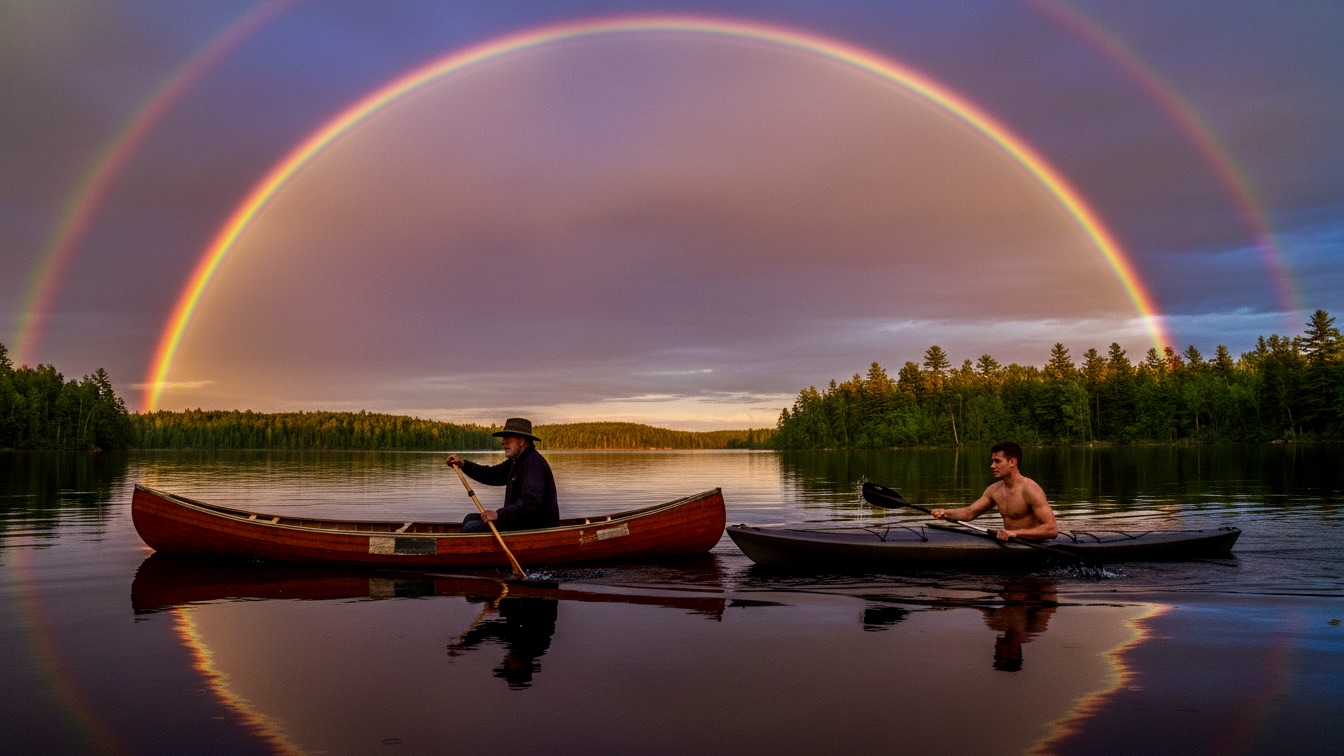
As they paddled away from the shore, the sun finally dipped below the remaining clouds. The sky exploded into a riot of color—oranges, pinks, and deep, vibrant violets. And then, Jay saw it. Emerging from the mist on the opposite shore was a rainbow. Then another, slightly fainter, arched above it. A perfect double rainbow, spanning the entire width of the lake.
"Look at that," Jay whispered.
He reached for his phone. He had it in his hand, the camera app open. The shot was perfect. The lighting was epic. The 'redemption' arc of the video was right there, waiting to be captured. He could almost see the comments: 'So glad you're okay!' 'Nature is so healing!' 'This is the content we need!'
He looked at the screen, then he looked at the rainbow. The screen was a pale, flickering imitation. It couldn't capture the way the air felt on his skin, the smell of the pine, or the quiet, steady presence of the man in the canoe beside him.
Jay looked at the footage he’d shot earlier—the staged intro, the 'vibe' talk, the moment of the paddle snapping. It all looked small. It looked fake.
He hit the 'select all' button on the day’s files. He paused for a second, his thumb hovering over the trash can icon. This was his job. This was his brand.
He tapped the screen. Delete all items?
He tapped Yes.
He put the phone in the waterproof bag, zipped it shut, and stowed it deep in the cockpit of the kayak. He felt a sudden, incredible lightness, as if he’d just shed a heavy skin.
"Everything okay?" Frank called out.
"Yeah," Jay said, digging his heavy, makeshift paddle into the water. "Everything’s great."
They paddled in silence, the only sound the rhythmic dip of their blades. The competition that had existed between them at the start—the city kid versus the old guide—had evaporated. There was only the shared task of moving through the water.
As they approached the rental dock, the lights of the small marina began to twinkle. Jay’s car was there, a sleek, silver SUV that looked out of place against the backdrop of the dark woods. He realized he wasn't looking forward to getting back into it. He wasn't looking forward to the drive, the notifications, the endless stream of digital noise.
They pulled the boats onto the dock. Jay helped Frank lift the heavy cedar-strip canoe onto its rack.
"You’re not going to post it?" Frank asked, nodding toward the bag in Jay’s kayak.
"No," Jay said. "I think I’ll keep this one for myself."
Frank nodded slowly. He reached out and shook Jay’s hand. His grip was like iron. "Good choice, kid. There are some things that don't belong on a server."
"Will you be out here tomorrow?" Jay asked.
"I’m always out here," Frank said. "Unless it’s raining. Then I’m in the cabin with the spiders."
Jay laughed. He walked toward his car, the broken paddle slung over his shoulder like a trophy. He stopped at the edge of the parking lot and looked back at the lake. The double rainbow had faded, but the moon was rising, a silver sliver reflected in the still, dark water.
He reached into his pocket and felt the cold glass of his phone. He didn't pull it out. He just stood there, breathing in the cool night air, listening to the silence that wasn't silent at all, but full of the rustle of leaves and the distant, haunting call of a loon. He felt the weight of the day, the ache in his shoulders, and the lingering sting of the rain. It felt good. It felt like something that had actually happened.
He got into his car, but he didn't turn on the engine. He didn't check his messages. He just sat in the dark, watching the lake, waiting for the feeling of being alive to settle into his bones.
“He reached for the ignition, but his hand stopped as he realized he didn't want to go back to the person he was when he arrived.”


