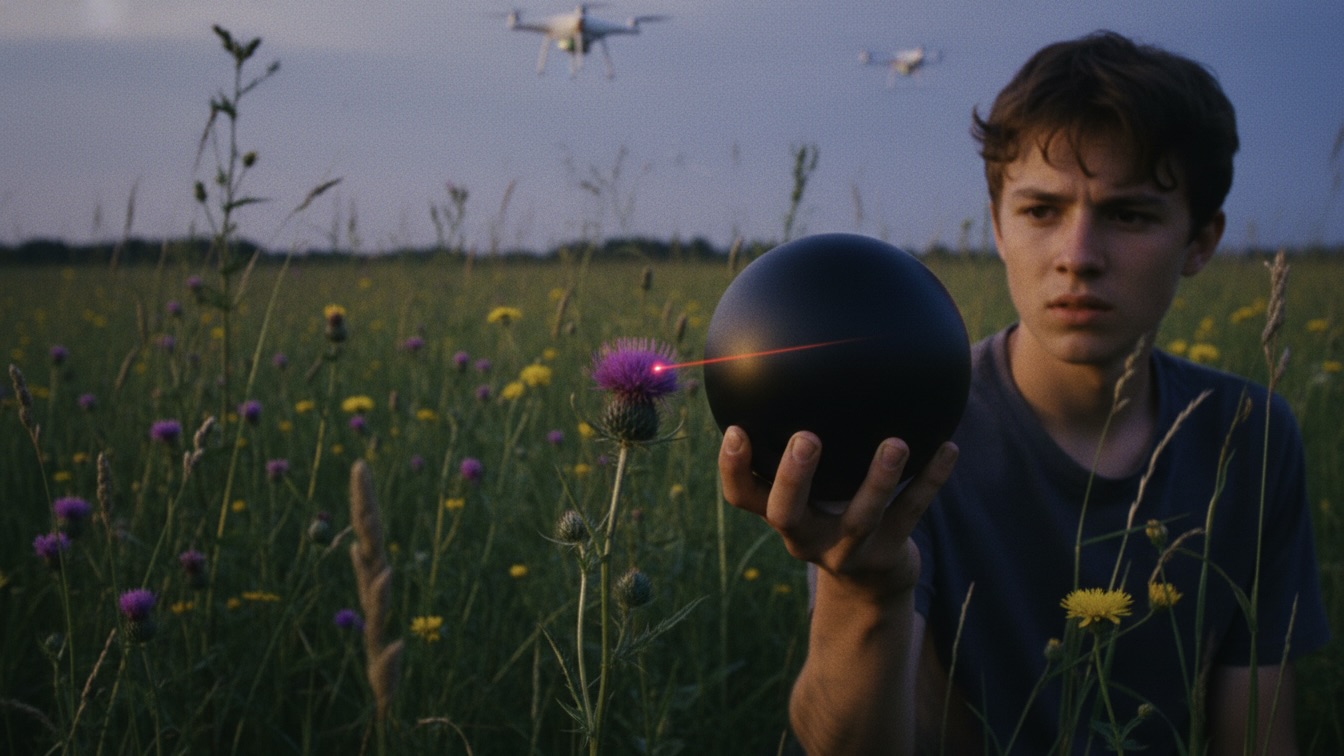
Leo struggled with the humidity while his group debated if speculative design was just fancy lying for artists.
Leo’s thumb hovered over the screen of his phone, watching the battery icon flicker from two percent to one. It was ninety-four degrees in the shade, and the shade was currently a tarp held up by four rusted poles that looked like they’d been salvaged from a scrap yard. This was the 'Advanced Speculative Design for Ecological Recovery' retreat. It felt less like a retreat and more like a very expensive way to get heatstroke while people with better haircuts than him talked about the end of the world.
He shifted his weight on the folding chair. The plastic seat had fused with the back of his thighs through his thin linen trousers. Every time he moved, it sounded like a slow-motion Velcro tear. Across the circle, Mina was already sketching. She had three different colors of neon highlighter tucked behind one ear and a tablet that was definitely more waterproof than his soul.
"The thing about speculative design," Mina said, not looking up from her screen, "is that it’s not about the thing itself. It’s about the friction the thing creates. If you design a spoon that tells you when the ocean is too acidic to eat the soup you're holding, you're not making a spoon. You're making a statement about the soup."
Leo blinked. He felt a bead of sweat crawl down his spine like a slow, exploratory insect. "I think I'd just stop eating the soup, Mina. That feels like the more efficient design choice."
Jack, who had spent the last twenty minutes trying to balance a stick on his toe, let it fall. "Efficiency is a capitalist trap, Leo. We’re here to imagine 'preferred futures,' remember? Dr. Arnold said we have to move past the 'probable' and the 'plausible' into the 'preposterous.' Or whatever the third P was. I was distracted by a horsefly."
"The third P is 'possible,'" a new voice cut in.
Dr. Arnold stepped into the shade of the tarp. He didn't look hot. It was deeply offensive. He wore a crisp white tech-fabric shirt that probably cost more than Leo’s entire digital portfolio. He carried a tablet that projected a holographic interface a few inches above the glass, shimmering slightly in the harsh summer light.
"Speculative design," Arnold continued, tapping a command that sent a swarm of blue diagrams into the air between them, "is a tool for inquiry. We aren't here to solve problems. That’s for the engineers. We are here to find the problems that people haven't even realized are coming yet. We are the canary in the coal mine, but the canary is wearing a VR headset and has a degree in fine arts."
Leo looked at the blue diagrams. They looked like jellyfish made of light. "So, we’re professional liars?"
Arnold smiled. It was a sharp, practiced look. "We are provocateurs. We create 'diegetic prototypes'—objects that exist within a narrative. If I show you a drone that mimics the mating call of an extinct bird to lure out the last remaining predators for tagging, you don't ask if it works. You ask what kind of world requires such a thing to exist."
"A depressing one," Jack muttered. He was now trying to peel a sticker off his water bottle with his teeth. "A world where we’ve completely failed the bird. That’s the vibe, right? The 'Everything is Broken' aesthetic."
"The vibe is 'Critical Awareness,' Jack," Mina corrected. She turned her tablet around. On the screen was a render of what looked like a gas mask made entirely of living moss. "I’m working on a respiratory interface that filters air through a symbiotic relationship with local flora. It doesn't just clean the air; it grows when you breathe. If you’re healthy, the mask blooms. If you’re sick, the mask wilts."
Leo stared at the moss mask. "That seems like a lot of pressure for a Tuesday morning. Imagine waking up and your face-plant is dead because you had a minor cold. That’s a bad day."
Mina shrugged. "It forces a connection. That’s the point. Speculative design is meant to be uncomfortable. If it’s comfortable, it’s just product design. We aren't trying to sell these to people at a boutique. We’re trying to make people realize they’re breathing poison."
Leo wiped his forehead with the back of his hand. He felt the grit of the forest floor on his skin. This was the 'nature' part of the retreat. They were currently sitting in a clearing three miles from the nearest paved road. The cicadas were screaming at a volume that felt personal. It was a wall of sound, a jagged, electric hum that didn't have a beginning or an end.
"Okay," Leo said, leaning forward. "So let’s say I want to speculate about the water crisis. Do I design a bottle that judges me? Or a faucet that only gives me water if I answer a trivia question about local watersheds?"
"Now you're getting it," Arnold said, nodding. "But go deeper. Don't just think about the object. Think about the system. If water is scarce, who owns the faucet? Is the trivia question a form of gatekeeping? Does the faucet recognize your face? Does it give more water to people with higher social credit?"
Jack finally got the sticker off. "This is why I stick to sculpture. Rocks don't have social credit. They just sit there and look at you."
"Rocks are part of the lithosphere, Jack," Mina said. "They have more history than your entire family tree. We could design a rock that records the temperature changes over a thousand years and vibrates when the permafrost melts."
"Great," Jack said. "A vibrating rock. That’ll really save the planet."
Leo looked at his phone again. One percent. The screen dimmed, then went black. He was officially disconnected. The realization hit him with a strange mix of panic and relief. There were no notifications. No emails. Just the heat, the screaming cicadas, and a group of people trying to imagine a future that didn't involve them all melting into the forest floor.
"The power is out on my phone," Leo announced to the group. "I am now a speculative design project. A human without a digital shadow. What’s the narrative here?"
Arnold didn't miss a beat. "The narrative is that you are now forced to rely on your primary sensors. The environment is your data stream. Look around, Leo. What is the forest telling you right now?"
Leo looked. He saw a beetle struggling to climb a blade of grass. He saw a patch of lichen that looked like dried vomit on a nearby oak tree. He felt the air, which was so heavy it felt like he was wearing a damp sweater made of lead.
"It’s telling me it’s too hot for humans to be out here," Leo said. "And that the beetle is going to fall."
The beetle fell. It landed on its back and began waving its legs frantically.
"See?" Leo said. "That’s the future. We’re the beetle."
"Then design the thing that flips the beetle back over," Arnold said. "But make it complicated. Make it a statement."
Mina started sketching again. "A robotic ant that only helps beetles if they provide a service in return. The Gig Economy of the Undergrowth."
Leo sighed. He reached for his physical sketchbook. It was a dusty, spiral-bound thing he hadn't used in months. The paper felt rough and honest under his fingertips. He drew a single line. A jagged, ugly line that looked like the sound of the cicadas.
"I think I'm going to design a cooling system for the forest," Leo said. "But it only works if you stay perfectly still. If you move, the temperature rises. It’s a design that mandates meditation or heatstroke."
"That’s dark," Jack said, actually looking impressed. "I like it."
"It’s not dark," Leo said, feeling a strange surge of energy despite the heat. "It’s speculative."
The workshop moved from the tarp to the 'Lab,' which was actually just a renovated barn with a solar array that hummed like a giant, angry hornet. Inside, the temperature dropped by exactly three degrees. It wasn't much, but it was the difference between feeling like a melting candle and feeling like a candle that had just been blown out. Leo found a charging station and plugged his phone in. The little lightning bolt appeared. Forty percent. He felt like he could breathe again.
"Alright, gather round," Arnold said, clapping his hands. He was standing in front of a large, touch-sensitive table that displayed a map of the surrounding woods. "We’ve talked about the theory. Now we do the field work. Each of you has been assigned a 'biotope'—a specific area of this forest. Your task is to find a friction point. A place where the natural world and the human world are rubbing against each other in an uncomfortable way. Then, you design the intervention."
Leo looked at his assigned coordinates. He was headed to the 'Static Marsh.' The name alone made his skin itch.
"Why do I get the marsh?" Leo asked. "Mina gets the 'Upland Meadow.' That sounds like a place where people have picnics. The marsh sounds like a place where bodies are hidden."
"The marsh is where the most interesting chemistry happens, Leo," Arnold said. "It’s a transitional space. Neither land nor water. It’s the ultimate speculative landscape because it’s constantly changing its mind about what it wants to be."
"I’m pretty sure it’s just mud and mosquitoes," Jack said. He was assigned to the 'Granite Outcrop.' "I just have to deal with rocks. I told you, rocks are the superior medium."
"Actually, Jack, your outcrop is home to a specific type of endangered lichen," Arnold said, tapping the map. "If you step on it, you’re basically committing a war crime. So, watch your feet."
Leo gathered his gear. He had a shoulder bag with his sketchbook, a digital thermometer, and a small kit for collecting samples. He looked at Mina, who was checking the straps on her high-tech backpack.
"Do you actually believe this stuff?" Leo whispered as they walked toward the exit of the barn. "The whole 'we’re changing the world through art' thing?"
Mina stopped and looked at him. Her eyes were sharp behind her clear-framed glasses. "I think the world is already changing, Leo. Most people are just pretending it isn't. Speculative design is a way to stop pretending. It’s like... okay, you know when you’re in a car and you know it’s going to crash, but you have five seconds to decide how you’re going to hit the wall?"
"That’s a terrifying analogy," Leo said.
"Well, the car is already sliding," Mina said, adjusting her cap. "Most people are arguing about what song to play on the radio. Designers are trying to figure out how to reinforce the bumper. We’re just... the people pointing at the wall and screaming, but in a way that’s aesthetically pleasing."
"I'd prefer a parachute," Leo said.
"Then design one," Mina said, and she headed off toward the meadow.
Leo started his trek toward the marsh. The trail was narrow and overgrown with blackberry brambles that seemed to reach out and grab his shins. The sun was a physical weight on his shoulders. He passed a tree that had been struck by lightning years ago; it stood like a charred skeleton, white wood peeking through the black like bone. He stopped to take a photo, but then remembered he was supposed to be using his 'primary sensors.'
He noticed the way the ground changed. It went from hard, baked clay to a soft, spongy moss that felt like walking on a giant, damp loaf of bread. The trees started to thin out, replaced by tall, spindly reeds that clattered together in the slight breeze. The sound was metallic, like a thousand tiny swords being drawn at once.
He reached the edge of the Static Marsh. It wasn't as gross as he’d expected, but it was weirder. The water wasn't clear; it was a deep, opaque copper color, and the surface was covered in a film of pollen and dust that looked like a topographical map. Bubbles rose from the bottom, popping with a wet, heavy sound.
"Okay, friction point," Leo muttered to himself. He sat down on a fallen log that looked relatively stable.
He watched the water. A dragonfly with wings the color of oil slicks hovered over a reed. It moved with a mechanical precision that made Leo think of a drone. He took out his sketchbook and started to draw the dragonfly, but instead of wings, he gave it solar panels. Instead of eyes, he gave it camera lenses.
"The Surveillance Odonata," he wrote. "Designed to monitor water quality and report unauthorized human presence in protected wetlands."
It felt too easy. Too cliché. He ripped the page out and balled it up. Arnold wanted something that hurt. Something that made people uncomfortable.
He looked down at his own feet. His sneakers were already ruined. The copper-colored water had soaked into the white canvas, staining it forever. That was a friction point. The human desire for cleanliness vs. the reality of the ecosystem.
He imagined a shoe that didn't just protect the foot, but actively filtered the water as you walked. Every step you took cleaned a gallon of the marsh. But there was a catch. The shoe was made of a material that would eventually dissolve, and the toxins it filtered would be trapped in a small capsule that you had to carry with you. You couldn't just throw it away. You were the walking filter, and you had to own the waste you produced.
"The Burden Boot," he whispered.
He started to sketch it. It looked like a cross between a combat boot and a laboratory beaker. He was so engrossed in the drawing that he didn't notice the figure standing on the other side of the reeds until they spoke.
"Is it for the mud?"
Leo jumped, nearly dropping his sketchbook into the copper water. It was Jack. He was covered in what looked like gray dust and was holding a piece of granite like it was a sacred relic.
"You scared the hell out of me," Leo said, his heart hammering against his ribs. "What are you doing here? Your outcrop is like a mile away."
"The lichen is boring," Jack said, stepping over a clump of reeds. He looked exhausted. "It just sits there. I wanted to see the 'Static Marsh.' It sounds like a bad indie band name."
"It’s a transitional space, Jack," Leo said, mimicking Arnold’s voice. "Neither land nor water. Very deep."
Jack sat down on the log next to him. "Arnold is a nerd. But he’s not wrong about the friction. Look at this rock. It’s been here for ten thousand years. And I just scratched it with my car key to see what color it was underneath. That’s friction. My stupid curiosity vs. ten millennia of geological history."
"What color was it?" Leo asked.
"Pink," Jack said. "Like a sunset. It was actually kind of beautiful. And now I feel like a jerk for doing it."
They sat in silence for a while. The marsh bubbled. The cicadas in the distance provided a constant, buzzing background track. The heat was still there, but it had settled into a steady, vibrating hum that felt less like an attack and more like an environment.
"I'm designing a shoe that makes you carry your own pollution," Leo said, showing Jack the sketch.
Jack looked at it for a long time. "That’s miserable, Leo. People would hate that."
"Exactly," Leo said. "That’s the point, right? Speculative design. It’s supposed to be a 'preferred future' that reveals how much we suck right now."
"I think my preferred future involves more air conditioning," Jack said. "But I guess the Burden Boot is a start."
Leo looked back at the water. He realized he wasn't thinking about his phone anymore. He wasn't thinking about his battery percentage or his Instagram feed. He was thinking about the copper water and the pink rock and the way the world was slowly, inevitably, folding in on itself.
"We should probably head back," Leo said. "Before the sun goes down and the mosquitoes actually kill us."
"Yeah," Jack said, standing up. "But let’s take the long way. I want to see if Mina’s mask has started blooming yet. I want to see if she’s actually as healthy as she thinks she is."
Leo laughed. It was a short, dry sound. "She’s probably fine. Mina’s the type of person who’d thrive in a post-apocalyptic wasteland as long as she had a good Wi-Fi connection and some neon highlighters."
They started walking back, their shoes squelching in the mud. The sun was beginning to dip, casting long, distorted shadows across the marsh. The light was turning a deep, bruised purple, reflecting off the copper water in a way that made the whole landscape look like a glitch in a video game. It was beautiful, in a way that felt slightly dangerous. It was exactly the kind of thing they were supposed to be studying.
The return trip was significantly more difficult than the walk out. The humidity had peaked, creating a literal wall of water vapor that made every breath feel like a chore. Leo’s 'Burden Boot' sketches were tucked into his bag, but his real-world sneakers were failing him. The left one kept slipping off in the thick mud of the marsh edge.
"I think the marsh is trying to keep my shoe," Leo panted, stopping to hook a finger into the heel of his sneaker and pull it back up.
"The marsh doesn't want your shoe, Leo," Jack said. He was walking with a strange, wide-legged gait, trying to avoid any contact with the vegetation. "It’s a chemical soup. It’s probably trying to digest your shoe. Give it another twenty minutes and you’ll just be wearing a lace and a dream."
"Very helpful, Jack. Thanks."
They reached a fork in the trail where the ground hardened into the red clay again. The relief was short-lived as they saw Mina standing there, looking absolutely frantic. Her neon-green hair was matted with sweat, and she was clutching her tablet like a shield.
"Did you see it?" she demanded as they approached.
"See what?" Leo asked. "The end of the world? We’re already in it, Mina. It’s ninety-five degrees and I’m covered in copper mud."
"No, the drone!" Mina pointed toward the treeline. "A white, multi-rotor drone. It was hovering over the meadow, but it didn't have any markings. It looked... wrong. Like it was custom-built. It was doing a grid search."
Jack squinted at the sky. "Probably just the forest service. Or some kid with too much birthday money."
"It wasn't a toy, Jack," Mina said, her voice dropping an octave. "It was silent. Completely silent. And it was carrying something. A payload. It dropped a series of small, black spheres into the tall grass."
Leo felt a prickle of unease that had nothing to do with the heat. "Black spheres? Like seeds?"
"I don't know," Mina said. "But I caught a frame of it on my tablet. Look."
She held up the screen. The image was grainy, distorted by the glare of the summer sun, but you could clearly see a sleek, white shape hovering over a sea of yellow wildflowers. Below it, three small, dark objects were caught in mid-air. They didn't look like seeds. They looked like hardware.
"Speculative design in the wild?" Jack suggested, though he didn't sound like he was joking anymore. "Maybe someone else is doing a retreat. 'Advanced Surveillance for Corporate Interests.'"
"We need to tell Arnold," Leo said.
They hurried back to the Lab. The solar array was still humming, but the sound felt more ominous now, a rhythmic thrum that vibrated in Leo’s teeth. Inside, the barn was empty except for Dr. Arnold, who was sitting at the touch-table, staring at a series of data streams.
"Dr. Arnold?" Mina said, her voice echoing in the high rafters of the barn. "We saw a drone. In the meadow. It was dropping things."
Arnold didn't look up. "I know."
Leo exchanged a look with Jack. "You know? Is it yours?"
Arnold finally looked at them. He looked older than he had that morning. The crispness of his white shirt was gone, replaced by a fine layer of dust. "It’s not mine. But it is part of the curriculum. I was wondering when you’d notice the 'Active Speculation.'"
"The what?" Leo asked.
"This retreat isn't just about drawing pictures of moss masks, Leo," Arnold said, standing up. He tapped the table, and the map of the forest changed. Red dots began to blink across the meadow and the marsh. "We are participating in a live-action simulation. Those drones belong to a firm called 'Aethelgard.' They specialize in 're-wilding through autonomous intervention.'"
"Wait," Mina said, her eyes widening. "You mean those spheres... they’re real?"
"They are synthetic pollinators," Arnold explained. "But not for bees. They are designed to target specific, invasive species and deliver a localized genetic suppressant. They are, in essence, speculative design made flesh. Or, at least, made plastic and silicon."
"That’s unhinged," Jack said. "You’re just playing God with a remote control."
"We are exploring the ethics of intervention," Arnold corrected. "Which is why your next assignment is critical. You aren't just designing a response to the environment anymore. You are designing a response to the drones. If Aethelgard is the 'solution,' what is the 'critique'?"
Leo felt a sudden, sharp clarity. The Burden Boot. The Surveillance Odonata. They weren't just exercises. They were weapons in an intellectual war.
"So, we’re the opposition?" Leo asked.
"You are the counter-narrative," Arnold said. "Aethelgard represents the 'Solutionist' future. Everything can be fixed with more tech, more data, more control. Your job is to find the 'Friction' future. The one where we live with the mess. The one where we don't try to fix the marsh, but learn how to walk in it."
Leo looked down at his muddy sneakers. He thought about the copper water and the dragonfly that looked like a machine. He thought about the black spheres hidden in the grass, silently changing the DNA of the forest.
"I want to find one," Leo said suddenly.
"One of the spheres?" Mina asked.
"Yeah. I want to see what it actually is. Not what Arnold says it is. I want to see the hardware."
"It’s nearly dark, Leo," Jack said. "And the marsh is... well, it’s the marsh."
"I don't care," Leo said. "If we’re going to speculate, we need better data. Arnold is gatekeeping the reality of the situation. I’m going back out."
"I'm coming with you," Mina said immediately. She checked the battery on her tablet. "My mask design needs a real-world threat to react to anyway. A genetic suppressant is perfect."
Jack sighed, rubbing the back of his neck. "Fine. But if I get eaten by a speculative alligator, I’m haunt-sculpting your bedrooms for eternity."
They didn't tell Arnold. They waited until he retreated to his office in the back of the barn, then slipped out into the deepening twilight. The air had finally cooled, but only slightly. The heat was still radiating from the ground, a phantom warmth that felt like the earth was breathing on their ankles.
They didn't head back to the marsh. They headed to the meadow.
Walking through the tall grass in the dark was a different kind of sensory experience. Leo couldn't see his feet. He could only feel the dry stalks brushing against his shins and the occasional sharp poke of a thistle. There were no scents to guide him, only the sounds of the night: the rustle of small animals, the distant hoot of an owl, and the ever-present, low-frequency hum of the forest’s hidden machinery.
"The drone was hovering right about here," Mina whispered, her tablet glowing like a small, blue sun in her hands.
"Spread out," Leo said. "Look for anything that doesn't feel like a plant."
He got down on his hands and knees. The grass was abrasive, scratching his palms. He moved slowly, feeling the texture of the soil. He found a rock. A twig. A discarded soda can that must have been there for years.
Then, his hand closed over something cold. Perfectly spherical. Perfectly smooth.
It was the size of a golf ball. It felt heavier than it should have, as if it were filled with lead. There were no seams. No buttons. It was just a black void in the palm of his hand.
"I found one," Leo said.
Jack and Mina scrambled over. Mina shone the light from her tablet onto Leo’s hand. The sphere didn't reflect the light; it seemed to absorb it. It was a matte black that felt like looking into a deep hole.
"It’s vibrating," Leo said, his voice trembling slightly.
He wasn't imagining it. A faint, high-pitched hum was emanating from the sphere. It was so subtle he could feel it in his bones more than he could hear it.
"Give it to me," Mina said, reaching out.
As her fingers touched the sphere, the hum intensified. Suddenly, a tiny, needle-thin beam of red light shot out from the top of the ball, scanning the surrounding grass.
"Is it... is it scanning us?" Jack asked, stepping back.
"It’s looking for the target species," Mina whispered.
Leo watched the red beam. It moved with a terrifying efficiency, flicking across the wildflowers. It stopped on a small, purple blossom—an invasive thistle that Arnold had mentioned earlier. The sphere let out a soft click.
A puff of fine, white powder erupted from a microscopic vent in the sphere. It was silent. It was clean. It was the perfect technological solution to a biological problem.
Leo felt a wave of coldness wash over him. This wasn't a prototype. This was a finished product. And they were standing in the middle of a live testing ground.
"We’re not just the counter-narrative," Leo said, looking up at the dark sky. "We’re the collateral damage."
A low hum began to grow in the distance. It wasn't the cicadas this time. It was the sound of dozens of drones, rising from the forest floor, their white frames invisible in the dark, their presence marked only by the faint, rhythmic pulse of their status lights.
"Run," Jack said.
But Leo didn't move. He was looking at the black sphere in his hand. He was thinking about the Burden Boot. He was thinking about what happens when the thing you design to save the world starts to decide what parts of the world are worth saving.
The sprint back to the barn was a blur of adrenaline and bad footing. Leo kept the black sphere clenched in his fist, its vibration now a steady, frantic pulse against his palm. Behind them, the meadow was alive with the red scanning beams of the 'synthetic pollinators.' It looked like a low-budget sci-fi movie, but the stakes felt uncomfortably real.
They burst through the barn doors, gasping for air. Dr. Arnold was still at the table, but he wasn't alone. A woman in a sharp, slate-gray suit was standing next to him. She looked like she had been carved out of the same matte-black material as the sphere.
"Ah, the researchers have returned," Arnold said. He didn't sound surprised. He sounded like a man watching a play reach its inevitable climax.
"Who is this?" Mina asked, leaning against a worktable to catch her breath.
"This is Sarah Jansen," Arnold said. "She’s the Chief Design Officer for Aethelgard. She’s also the primary sponsor of this retreat."
Sarah Jansen didn't smile. She looked at Leo’s closed fist. "You found a unit. Impressive. Most people miss them entirely. That’s the goal of the design—unobtrusive intervention."
Leo stepped forward, opening his hand. The black sphere sat there, still humming. "This isn't speculative design. You’re actually doing this. You’re changing the local ecosystem without any public oversight."
"Public oversight is a slow process, Mr. Moreno," Jansen said. Her voice was smooth, like polished glass. "The climate doesn't wait for committee meetings. We are 'speculating' in real-time. We are testing the 'Preferred Future' where humans take full responsibility for the biological errors we’ve introduced."
"By killing them?" Jack asked, his voice sharp. "That thistle isn't an 'error.' It’s just a plant that’s doing too well."
"It’s a plant that is choking out the native biodiversity," Jansen countered. "Our drones are simply leveling the playing field. It’s an act of design. We are re-authoring the landscape."
"You’re gatekeeping nature," Mina said, her face flushed with anger. "You’re deciding which DNA gets to survive based on a corporate algorithm."
Arnold cleared his throat. "Mina, this is exactly why you’re here. To critique this. To find the friction. Aethelgard wants your input. They want to know how the 'next generation' of artists feels about these interventions."
"They don't want our input," Leo said, his voice surprisingly steady. "They want our aesthetic. They want us to make this look pretty. To make it feel like 'art' so people don't notice it’s an invasion."
He looked at the sphere, then at the 'Burden Boot' sketches on the table. He realized that his design was a joke compared to the reality of the Aethelgard project. He was designing a shoe that made people feel bad; they were designing a world that didn't need people at all.
"So what now?" Jack asked. "Do we get our participation trophies and go home?"
"Actually," Sarah Jansen said, "we have a final project for you. The drones are efficient, but they lack a certain... narrative resonance. We want you to design the public-facing interface for the re-wilding project. How do we tell the story of the 'Synthetic Spring' in a way that people will embrace?"
Leo looked at Mina. She looked like she was about to explode. He looked at Jack, who was staring at his pink rock with a look of profound sadness.
"I have an idea," Leo said.
He walked over to the touch-table. He swept aside the Aethelgard maps and the blue diagrams. He took the black sphere and placed it in the center of the screen.
"The 'Preferred Future' isn't about control," Leo said, looking Sarah Jansen in the eye. "It’s about the cost of control. You want a narrative? Here’s your narrative."
He picked up a stylus and began to sketch rapidly on the table. He didn't draw a mask or a shoe. He drew a graveyard. But not a graveyard for people. A graveyard for the synthetic pollinators.
"The 'Monument to the Unintended,'" Leo said. "A massive, interactive installation in the center of the city. Every time one of your drones succeeds in killing an invasive species, a light goes out in the installation. The monument slowly goes dark. And when the last light goes out, the monument releases a cloud of the very seeds you’re trying to destroy."
There was a long silence in the barn. The hum of the solar array seemed to grow louder, filling the space with a jagged, electric tension.
Sarah Jansen tilted her head. "A design for failure?"
"A design for balance," Leo corrected. "If you’re going to play God, you should have to deal with the Devil. The monument ensures that the 'invaders' always have a backup. It’s a failsafe against your own perfection."
Mina smiled. It was a slow, wicked grin. "I love it. I can design the seed-dispersal mechanism. It’ll look like a giant, wilting flower."
"I’ll build the structure," Jack said, his eyes lighting up. "Out of granite. It’ll take ten thousand years to erode. It’ll outlast the company and the drones."
Sarah Jansen looked at Arnold. Arnold looked like he was regretting every life choice that had led him to this moment.
"It’s provocative," Jansen admitted. "It’s completely counter-productive to our business model. But it is... compelling."
"That’s speculative design, right?" Leo said, feeling a strange, hollow victory. "It’s supposed to make you uncomfortable."
He picked up the black sphere and handed it back to her. It was no longer vibrating. It was just a cold, dead piece of plastic.
"Keep the unit," Jansen said, turning toward the door. "Consider it a gift. I look forward to seeing your 'Monument' on the final day of the retreat. Just don't expect us to fund the actual construction."
She left the barn, her heels clicking on the wooden floor like a metronome. Arnold followed her, looking like a whipped dog.
Leo, Mina, and Jack stood around the table. The holographic interface flickered, casting long, distorted shadows against the barn walls. Outside, the summer night was in full swing. The cicadas had finally stopped, replaced by the rhythmic chirping of crickets and the occasional, distant hum of a drone.
"So," Jack said, breaking the silence. "Are we actually going to do it?"
"We have to," Mina said. "It’s the only way to stay sane in this place."
Leo looked at his phone. Fifty percent. He unplugged it and put it in his pocket. He didn't feel the need to check it anymore. The digital world felt small, a tiny, flickering candle compared to the massive, complicated, and terrifying reality of the forest outside.
"We start tomorrow," Leo said. "But first, I need to wash my shoes. This mud is starting to feel permanent."
He walked to the door of the barn and looked out at the meadow. In the dark, he could see the faint, red beams of the drones, moving like ghosts through the tall grass. They were quiet. They were efficient. They were the future.
But as he watched, he saw a single, stubborn thistle waving in the breeze, untouched by the light. It was a small thing, a jagged, ugly plant that didn't belong there. But it was still there.
Leo smiled. It was a bleak, tired smirk, the kind of smile you have when you realize the world is ending, but you’ve finally found a really good pen to document it with.
He turned back to his friends. The workshop was just beginning. They had a monument to build, a future to complicate, and a whole lot of friction to create.
“They didn't just want our designs; they wanted our permission to finish the job.”


