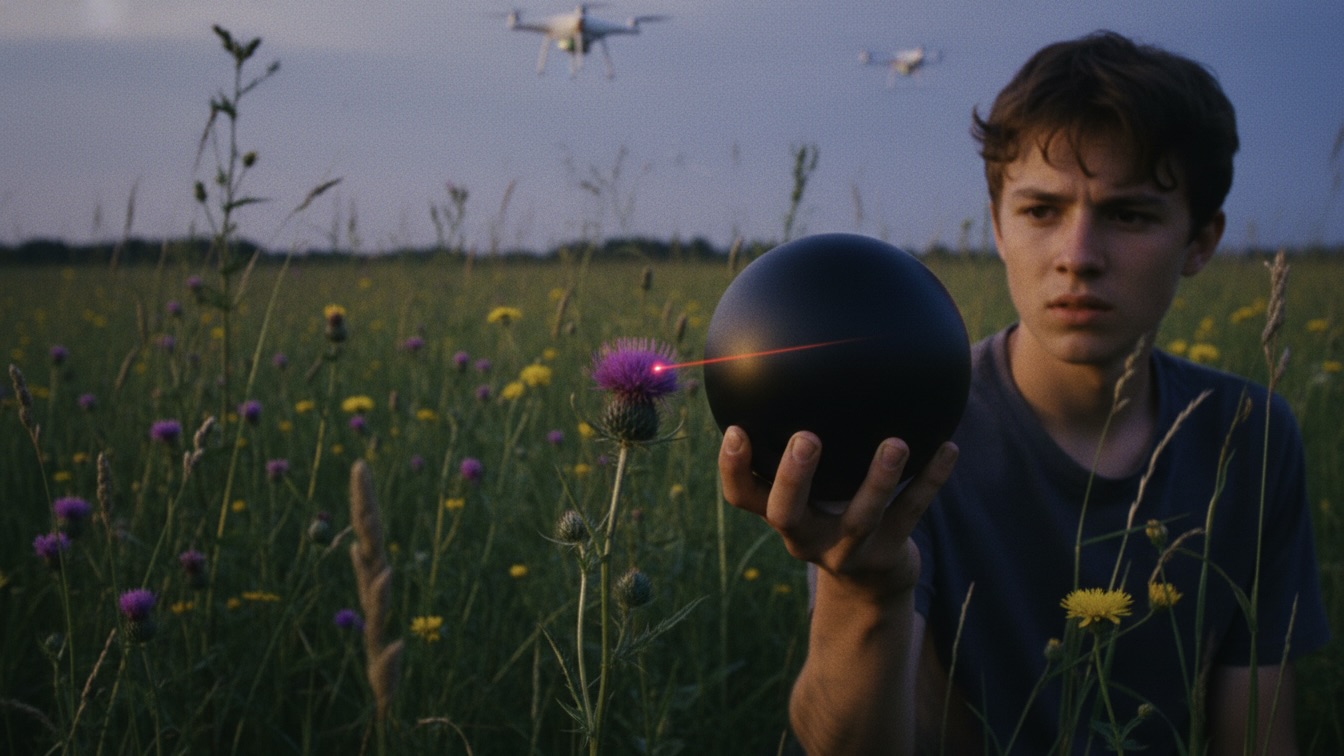
The narrative follows Leo, a skeptical participant in an "Advanced Speculative Design for Ecological Recovery" retreat held in a sweltering forest. Alongside his peers Mina and Jack, Leo struggles with the oppressive heat and the abstract, often pretentious teachings of Dr. Arnold. The retreat's focus is on creating "diegetic prototypes" that provoke thought about environmental crises rather than providing immediate solutions. When Leo’s phone battery dies, he is forced to engage more deeply with his physical surroundings, eventually leading him to the "Static Marsh" for fieldwork.
While exploring their assigned areas, the group discovers that the retreat is not merely a theoretical exercise but a live testing ground for Aethelgard, a corporation deploying autonomous drones. These drones release synthetic pollinators designed to genetically suppress invasive species. This revelation shifts the tone from academic debate to ethical confrontation. Sarah Jansen, Aethelgard’s Chief Design Officer, challenges the students to create a narrative that makes this corporate intervention palatable to the public.
In a climactic moment of creative rebellion, Leo rejects the role of a corporate aesthetician. He proposes a "Monument to the Unintended," a structure that tracks the drones' "successes" by extinguishing lights and eventually releasing the very seeds the drones aim to destroy. This counter-narrative serves as a failsafe against the hubris of technological perfection. The chapter concludes with the group united in their mission to build this monument, embracing the "friction" of a future that refuses to be neatly solved by algorithms.
The core of the story explores the tension between "Solutionism" and "Critical Awareness." Dr. Arnold and Sarah Jansen represent the solutionist perspective, which suggests that every ecological problem can be managed through superior technology and data. This worldview treats the forest as a broken machine that requires re-authoring. In contrast, Leo and his peers represent the friction of the human element, arguing that true ecological recovery requires living with the mess rather than sanitizing it through corporate intervention.
Another prominent theme is the ethics of intervention and the "God complex" inherent in environmental engineering. The drones of Aethelgard operate on a binary logic of native versus invasive, ignoring the complex, shifting reality of the "Static Marsh." By introducing genetic suppressants without public oversight, the corporation assumes total authority over the landscape’s DNA. The story suggests that when humans attempt to play God with a remote control, they often ignore the collateral damage and the loss of natural autonomy.
The role of art and design as a tool for political and social resistance is also central to the narrative. Initially, the characters view speculative design as a somewhat frivolous academic exercise. However, the discovery of the drones transforms their work into a form of intellectual warfare. Leo’s "Monument to the Unintended" demonstrates that art’s most powerful function in a crisis is not to make the disaster look "aesthetically pleasing," but to force a confrontation with the uncomfortable consequences of human actions.
Finally, the narrative touches on the theme of digital disconnection and sensory reawakening. Leo’s journey begins with a fixation on his phone’s battery life, symbolizing a reliance on digital mediation to understand the world. Once his device fails, his "primary sensors" take over, allowing him to perceive the "friction points" of the forest. This shift from the digital shadow to the physical reality of copper mud and vibrating spheres is essential for his transition from a passive observer to an active provocateur.
Leo serves as the story’s grounded protagonist, characterized by his initial cynicism and physical discomfort. He is the most relatable figure because he experiences the environment as a burden rather than a laboratory. His struggle with the heat and his dying phone battery highlights a modern anxiety about being untethered from the digital world. This vulnerability makes his eventual creative breakthrough more significant, as it is born from physical endurance rather than academic pretension.
Psychologically, Leo moves from a state of passive observation to one of assertive agency. At the beginning of the chapter, he feels like a "melting candle," overwhelmed by the demands of the retreat. However, his discovery of the black sphere in the meadow acts as a catalyst for his transformation. By the end of the narrative, he has reclaimed his voice, using the very tools Arnold taught him to subvert the corporate interests of Aethelgard.
Leo’s "Burden Boot" design reflects his internal conflict regarding responsibility and pollution. He recognizes that humans cannot simply "fix" the world without owning the waste they produce. This realization culminates in his proposal for the monument, showing his growth into a designer who values balance over control. He accepts the "bleak, tired smirk" of someone who knows the world is ending but finds purpose in documenting and complicating that end.
Mina is the ideological engine of the group, possessing a sharp intellect and a high degree of technical proficiency. She views speculative design as a moral necessity rather than a career path, as evidenced by her "moss mask" project. Her desire for a "symbiotic relationship" with flora suggests a deep-seated need for connection in an increasingly toxic world. She is less concerned with physical comfort and more focused on the "critical awareness" that design can foster.
Her reaction to the drones reveals her protective nature toward the ecosystem. She is the first to recognize the "wrongness" of the silent, white machines, sensing the threat they pose to the meadow’s autonomy. Mina’s anger toward Sarah Jansen stems from a rejection of the idea that nature should be "gatekept" by corporate algorithms. She finds her greatest fulfillment in the "wicked grin" she shares with Leo when they decide to sabotage the corporate narrative.
Jack provides the necessary levity and physical perspective to the group’s dynamic. He is obsessed with the "lithosphere," preferring the permanence and simplicity of rocks over the complexity of digital or biological systems. His cynicism toward Arnold’s jargon serves as a reality check for the more academic aspects of the retreat. Despite his complaints, he is deeply observant, noticing the "friction" of his own curiosity when he scratches a piece of granite.
Psychologically, Jack represents a desire for stability in a world of constant, terrifying change. He is the "muscle" of the group’s creative rebellion, offering to build the monument out of granite so it will outlast the drones. His loyalty to his friends and his willingness to follow Leo into the marsh despite his fears show a hidden depth of character. He may prefer air conditioning, but he is ultimately committed to the "long way" of protecting the forest’s history.
Dr. Arnold is a complex figure who occupies the space between a mentor and a corporate shill. He is "deeply offensive" in his ability to remain cool and crisp while his students melt in the heat, symbolizing his detachment from the physical reality of the crisis. He uses the retreat as a recruitment ground for Aethelgard, framing corporate intervention as a "live-action simulation." His pedagogical style is manipulative, leading his students toward a specific conclusion under the guise of "inquiry."
By the end of the chapter, Arnold appears diminished, "looking like a whipped dog" as he follows Sarah Jansen. This suggests that he may have lost his own sense of creative autonomy to the "Solutionist" future he promotes. He is a cautionary tale of what happens when the "canary in the coal mine" stops singing and starts taking corporate sponsorships. His role is to provide the "diegetic" framework that the students eventually turn against him.
Sarah Jansen is the embodiment of corporate coldness and the "Solutionist" ideology. She is described in terms of her matte-black attire and polished-glass voice, mirroring the synthetic pollinators she oversees. She views the forest as a series of "biological errors" that must be "re-authored" by her company. Her lack of a smile and her dismissal of public oversight highlight her belief in the absolute authority of the designer.
Psychologically, she is driven by a desire for efficiency and "unobtrusive intervention." She does not see herself as a villain but as a pragmatist who is doing what is necessary for the climate. Her interest in the students is purely predatory; she wants their "aesthetic" to mask the invasive nature of her technology. When she accepts Leo’s provocative monument idea, it is not out of a change of heart, but because she recognizes its "compelling" narrative power.
The narrative voice is dry and observational, utilizing a third-person limited perspective that stays close to Leo’s internal state. This choice allows the reader to experience the absurdity of the retreat through Leo’s skeptical lens. The tone shifts effectively from satirical and weary in the beginning to ominous and urgent during the drone discovery. The author uses humor, such as the "slow-motion Velcro tear" of the chair, to ground the high-concept sci-fi elements in relatable human discomfort.
Sensory details are a major strength of the writing, particularly the descriptions of the heat and the marsh. The "copper-colored water" and the "damp sweater made of lead" create a visceral sense of place that makes the environment feel like a character itself. The contrast between the organic sounds of the screaming cicadas and the "mechanical precision" of the dragonfly/drone highlights the central theme of technology versus nature. These details reinforce the idea that the characters are being physically and mentally tested by their surroundings.
The pacing of the chapter is carefully managed, starting with a slow, languid buildup that mimics the lethargy of a heatwave. The rhythm accelerates once Leo’s phone dies and the group heads into the forest, with shorter sentences and more frequent dialogue. The "Muddy Shoe Incident" serves as a transition point, moving the story from theoretical debate to physical action. The final confrontation in the barn is the narrative peak, followed by a quiet, resolute resolution that leaves the reader with a sense of "bleak" hope.
Finally, the use of metaphors and analogies, such as the "car sliding toward a wall," provides a clear framework for the complex ideas of speculative design. These figures of speech help bridge the gap between abstract design theory and the life-or-death reality of ecological collapse. The "Monument to the Unintended" itself serves as a powerful closing metaphor for the necessity of failure and balance. The writing successfully balances intellectual depth with a compelling, character-driven plot.


