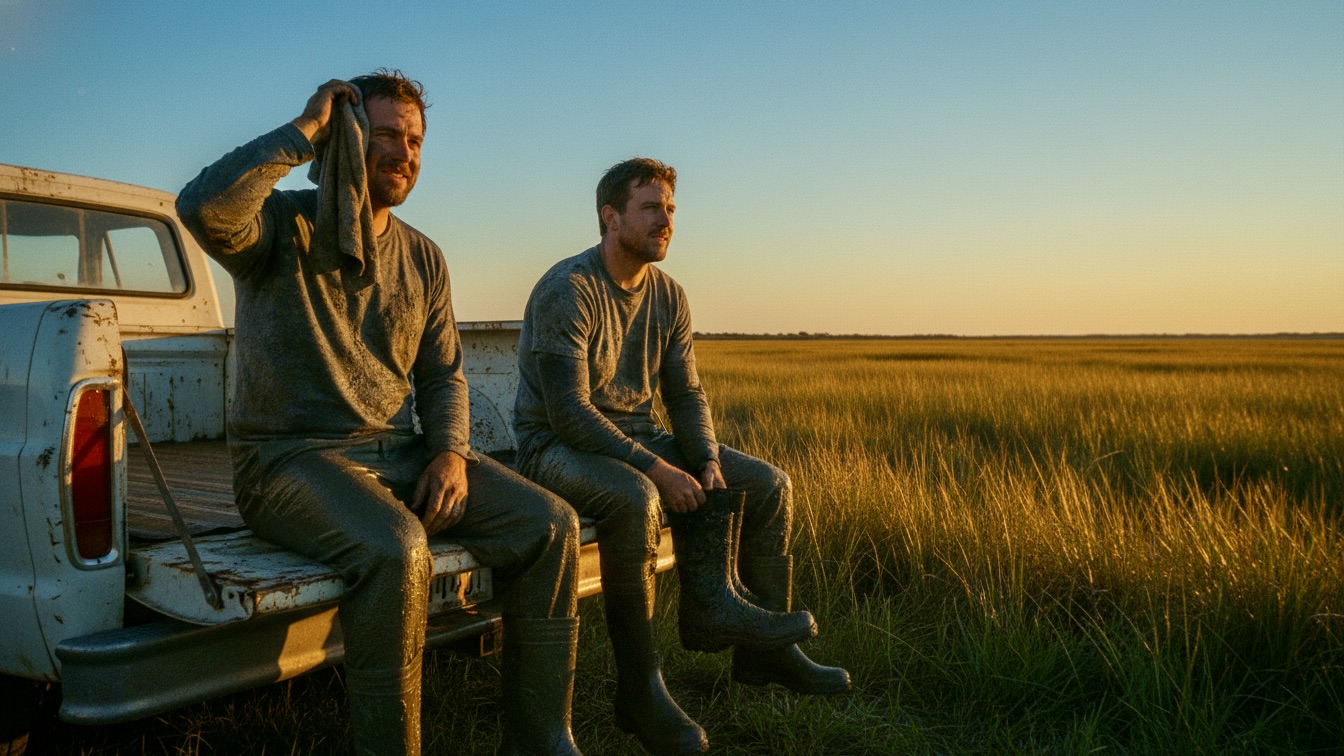
The story follows Arnie, a dedicated environmentalist and bird-counter, as he navigates a sweltering marshland to document local wildlife. His routine is interrupted when he discovers a Great Blue Heron hopelessly entangled in neon green fishing line and snagged on a submerged branch. In his frantic attempt to rescue the bird, Arnie becomes trapped hip-deep in the treacherous mud just as the tide begins to turn. Help arrives in the unexpected form of Matt, a surveyor for a development company whom Arnie has previously vilified as a corporate enemy.
Initially, the interaction between the two men is fraught with tension and ideological conflict. However, the immediate danger of the rising tide and the suffering of the heron force them into a desperate collaboration. Matt risks his own safety to reach the bird, and Arnie manages to free himself and assist in the final moments of the rescue. After the heron successfully takes flight, the two men struggle back to solid ground, sharing a moment of exhaustion and mutual respect. This shared ordeal leads to a significant psychological shift, as Matt reveals his personal connection to the land and proposes a compromise to protect the nesting grounds during construction.
A primary theme of the narrative is the destructive impact of human negligence on the natural world, symbolized by the "shocking, neon green" fishing line. This man-made object is a visual and physical intrusion into the gold and brown palette of the marsh, representing a "prehistoric" struggle forced upon modern wildlife. The heron’s plight serves as a catalyst for the human characters to confront the consequences of their species' presence in the ecosystem. It highlights the irony that while humans create the danger, they are also the only ones capable of rectifying it through conscious effort and sacrifice.
The story also explores the theme of shared vulnerability as a bridge across ideological divides. Arnie and Matt represent the classic conflict between preservation and progress, yet the "gray nothing" of the mud treats them with equal indifference. In the face of the rising tide, their professional titles and political stances become irrelevant. This environmental "leveling" forces them to recognize their shared humanity and the fragility of their lives. The mud acts as a crucible, stripping away their superficial differences and leaving only the primal instinct to survive and protect.
Finally, the narrative touches upon the possibility of reconciliation through dialogue and empathy. Arnie’s initial perception of Matt is a psychological projection of "corporate greed," while Matt views Arnie as an obstructive nuisance. By the end of the story, the physical act of saving the heron transforms their relationship from one of combatants to one of collaborators. The proposed meeting at the town hall suggests that true progress is not found in total victory for one side, but in the difficult work of finding common ground.
Arnie is characterized by a deep, almost visceral empathy for the natural world, which manifests as both a strength and a psychological burden. His willingness to rush into the mud without regard for his own safety reveals a personality that prioritizes the collective well-being of the ecosystem over his own survival. This altruism, however, is coupled with a rigid moral binary that leads him to demonize those he perceives as threats to the environment. He suffers from a form of "activist burnout," where his anger toward developers has blinded him to the individual humanity of those working within the industry.
As the story progresses, Arnie undergoes a significant internal shift from judgment to understanding. When he learns about Matt’s financial struggles and his sister’s hospitalization, his cognitive dissonance is challenged. He is forced to reconcile his image of the "corporate shill" with the reality of a man trying to survive in a difficult economy. This realization humbles him, allowing him to transition from a defensive "battlefield" mindset to one of proactive cooperation. By the end of the chapter, Arnie has regained a sense of peace, having found a partner in his mission rather than another enemy to fight.
Matt initially presents as a pragmatic, detached professional who views the marsh as a series of measurements and deadlines. His psychological defense mechanism involves "looking at it as a job" rather than a place, a strategy used to avoid the guilt associated with altering the landscape. He projects an aura of granite-jawed stoicism, yet his actions reveal a deeply buried sense of compassion and a lingering connection to his childhood roots. Despite his complaints about the schedule and the "No Trespassing" signs, he cannot ignore the suffering of the bird or the danger Arnie is in.
The rescue mission acts as a moment of catharsis for Matt, allowing him to reconnect with the version of himself that once fished the channels with his father. His decision to risk his expensive equipment and his own safety suggests that his professional persona is a mask for a man who still values the land. Matt’s vulnerability is revealed not just through the physical struggle in the mud, but through his admission of financial pressure. This honesty paves the way for him to offer a professional compromise, showing that he is willing to use his expertise to protect the environment he was hired to develop.
The pacing of the story is expertly handled, utilizing a "ticking clock" mechanic in the form of the rising tide. The narrative begins with a slow, sensory-rich description of the heat and the mud, establishing a sense of heavy, stagnant atmosphere. As soon as the heron is discovered and Arnie becomes trapped, the rhythm of the sentences quickens, reflecting the characters' rising panic. The transition from the "wet kiss" of the mud to the "rushing sea" of the flood creates a palpable sense of urgency that drives the plot toward its climax.
Sensory details are used throughout the text to ground the reader in the physical reality of the marsh. The author employs evocative metaphors, such as the sun being a "white-hot coin" and the mud sounding like a "giant tongue sticking to the roof of a mouth." These descriptions emphasize the tactile and often unpleasant nature of the environment, making the characters' struggle feel visceral and real. The contrast between the "neon green" of the line and the "smoky gray" of the bird provides a sharp visual focus that underscores the theme of human intrusion into nature.
The tone of the story shifts from one of isolation and despair to one of tentative hope. This is reflected in the changing landscape, moving from the "gray nothing" of the mud pits to the "shimmering gold" of the sunset. The final scene at the tailgate provides a quiet, reflective coda to the high-stakes action of the rescue. The narrative voice remains grounded and observant, allowing the emotional weight of the encounter to emerge naturally from the dialogue and the characters' shared silence. This stylistic choice ensures that the resolution feels earned rather than sentimental.


