Format: Short Film / Anthology Episode | Est. Length: 10-12 minutes
Imagine this story as the pilot episode of The Buffer Zone, a prestige anthology series exploring the volatile intersection of human development and the raw, unforgiving natural world. Each episode centers on a different ecological "hot zone" where a single, high-stakes encounter forces ideological enemies to find common ground or perish. The series serves as a character-driven examination of the modern environmental crisis, stripping away political rhetoric to reveal the shared vulnerability of all living things beneath the rising tide.
Arnie, a lone conservationist, discovers a Great Blue Heron dying in a tangle of neon fishing line, but his frantic rescue attempt leaves him buried waist-deep in lethal marsh mud as the tide begins to turn. He is forced to beg for help from the very man leading the construction project destined to destroy the habitat.
A judgmental birdwatcher becomes trapped in a deadly tidal marsh while attempting to save an entangled heron. He must rely on his corporate rival to orchestrate a desperate rescue before the incoming Atlantic tide drowns them both.
The primary theme explores the collapse of ideological purity when confronted with the visceral reality of survival. Arnie views the world through a binary lens of "protector" versus "destroyer," yet he finds himself physically and morally dependent on the man he has spent months demonizing. The story suggests that environmental preservation is not merely a matter of policy, but a deeply personal labor that requires empathy for human struggle as much as for the wildlife.
The secondary theme focuses on the indifference of nature to human intent. The marsh mud and the rising tide act as a leveling force, treating the conservationist and the developer with the same cold, rhythmic lethality. The neon green fishing line serves as a haunting symbol of human negligence, a "man-made" intrusion that triggers a chain reaction of life-threatening events for both the avian and human characters.
The immediate stakes are life and death, as the incoming tide threatens to drown Arnie while he is immobilized in the "plinth mud." For the heron, the stakes are the loss of a vital limb or slow strangulation by the tightening fishing braid. On a broader level, the encounter puts the future of the marsh at stake, as the resolution of this crisis will determine whether the upcoming development project proceeds with ecological sensitivity or corporate apathy.
The primary external antagonist is the environment itself, specifically the "suction of the plinth"—a treacherous, concrete-like mud that uses hydraulic pressure to trap anything that enters it. The secondary external conflict is the ticking clock of the Atlantic tide, which acts as a relentless, non-negotiable deadline. Internally, the conflict is driven by the mutual resentment between Arnie and Matt, whose clashing worldviews on land use and economic survival initially prevent them from working together effectively.
Arnie, a weary birdwatcher, is counting egrets in a sweltering marsh when he finds a Great Blue Heron hopelessly entangled in neon green fishing line. In his rush to save the bird, Arnie ignores safety protocols and sinks waist-deep into a patch of treacherous mud just as the tide begins its rapid return. He is discovered by Matt, a surveyor for a development company Arnie has been protesting, who initially mocks Arnie for trespassing on the construction site.
As the water rises to their waists, the two men are forced into an uneasy alliance to free the panicked bird and extract Arnie from the mud’s grip. Matt uses a construction plank to reach Arnie, and together they manage to cut the heron free, witnessing its triumphant flight back into the wild. This shared moment of grace breaks their mutual animosity, leading to a quiet realization at a truck tailgate that they both care for the land in different, complicated ways.
Arnie (The Idealist): A middle-aged, salt-gritty conservationist who has replaced human connection with a rigid, often self-righteous devotion to wildlife. His psychological arc moves from a state of judgmental isolation to a humbled recognition of his own fallibility and the humanity of his "enemies." By the end, he realizes that saving the marsh requires building bridges with people, not just building fences around birds.
Matt (The Pragmatist): A younger, buzz-cut surveyor driven by the crushing pressure of medical bills and professional deadlines. He begins the story as a cynical "corporate shill" who views the marsh as a set of coordinates to be conquered, but the act of saving the heron reawakens his childhood connection to the land. His arc concludes with a quiet act of rebellion as he decides to use his technical expertise to advocate for a more expensive, eco-friendly construction plan.
Arnie spots the struggling heron and rushes into the tidal pool, only to have the mud instantly swallow him to the waist. He realizes his phone is dead and the tide is turning, leaving him screaming for help into an empty, shimmering horizon. The tension peaks as the water begins to seep into the mud around him, tightening the suction on his lower body.
Matt appears in his orange safety vest, initially using the encounter to lecture Arnie about trespassing and the inevitability of the new boardwalk. The argument turns into a desperate negotiation as Arnie points out the dying heron and the rapidly approaching silver line of the incoming tide. Matt’s corporate facade cracks when he sees the bird’s terror, and he decides to risk his own safety to intervene.
Matt uses a pressure-treated board to navigate the mud, reaching Arnie and attempting a physical extraction that nearly tears Arnie’s joints. They realize the mud is too thick for a simple pull, forcing them to wait for the rising water to soften the clay while they focus on the heron. Matt crawls into the muck to pin the bird down, risking a strike from its dagger-like beak while Arnie prepares to cut the line.
The two men work in frantic tandem, with Matt holding the thrashing bird and Arnie snipping the neon green braid as the water reaches their chests. The heron is freed and takes flight in a visceral display of power, providing a momentary surge of adrenaline that allows Arnie to finally pop free from the mud. They scramble back to the high ground, exhausted and covered in gray slime, as the marsh completely disappears beneath the flood.
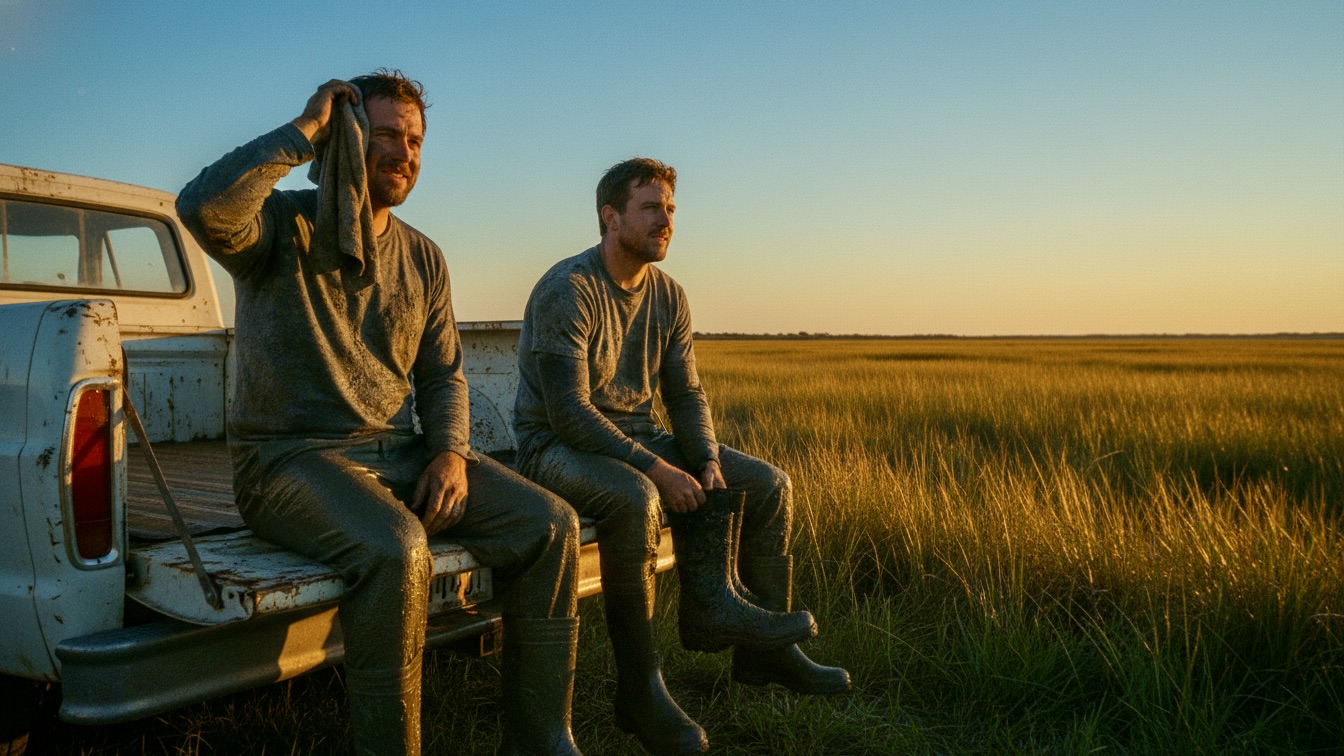
The aftermath takes place at Matt's battered truck, where the heat of the day gives way to a golden sunset and a shared bottle of lukewarm water. Matt reveals his personal financial struggles and his childhood history with the marsh, shattering Arnie’s perception of him as a faceless villain. They strike a tentative deal to present a revised, habitat-friendly development plan to the town council on Tuesday.
The episode begins with a sense of oppressive, sweltering isolation, characterized by the "wet kiss" sound of the mud and the "white-hot coin" of the sun. This shifts into high-octane panic and claustrophobia as Arnie sinks, followed by a sharp, cynical friction during the initial confrontation with Matt. The midpoint brings a sense of awe and shared purpose during the heron’s release, ending on a note of quiet, stubborn hope and the cooling relief of a summer evening.
If expanded, the season would follow Arnie and Matt as they navigate the corrupt politics of the town council and the development company to protect the nesting grounds. Each subsequent episode would introduce a new "trapped" element—a legal loophole, a contaminated water source, or a local politician’s secret—mirroring the physical trap of the marsh mud. The overarching narrative would track the gradual restoration of the local ecosystem alongside the personal redemption of the town’s residents.
The season would culminate in the "Big Storm," a hurricane that tests the new, eco-friendly boardwalk and the strength of the alliance between the conservationists and the builders. Characters from earlier episodes would return, showing how the "buffer zone" between nature and progress has become a space for community resilience. The finale would echo the pilot, with Arnie and Matt standing on the completed boardwalk, watching a new generation of herons return to a habitat that was nearly lost.
The visual style is "Tactile Realism," emphasizing the grit, salt, and viscous texture of the marsh environment. The camera work should be intimate and handheld during the struggle in the mud to create a sense of claustrophobia, shifting to wide, sweeping cinematic shots when the heron takes flight to emphasize the vastness of the landscape. The color palette should transition from the harsh, overexposed whites and browns of the midday heat to the deep, saturated oranges and purples of the "Tailgate Sunset."
The tone is a blend of survival thriller and quiet character drama, reminiscent of films like Leave No Trace or The Florida Project. It avoids sentimentalizing nature, showing its brutality and beauty in equal measure. Tonal comparables include the atmospheric tension of Bloodline mixed with the ecological reverence of a high-end BBC nature documentary.
This episode is designed for an adult audience (ages 25-55) who appreciate slow-burn, high-stakes dramas with environmental and social themes. It appeals to viewers of "cli-fi" (climate fiction) and prestige anthology series like Black Mirror or The White Lotus, but with a more earnest, grounded emotional core. The content is suitable for a general TV-MA or TV-14 rating, depending on the intensity of the survival elements and language.
The pacing is "Real-Time Escalation," where the first five minutes establish the slow, rhythmic heat of the marsh before the inciting incident accelerates the tempo. The middle act (the rescue) should feel breathless and frantic, with quick cuts and heightened sound design of the rushing water. The final three minutes deliberately slow down, allowing the audience and characters to breathe as the sun sets, mirroring the receding adrenaline of the protagonists.
The production requires a specialized "mud pit" set that can safely simulate the suction of plinth mud while allowing the actor to be extracted repeatedly. This will likely involve a hidden platform or a non-toxic, synthetic mud compound that maintains the visual density of marsh clay without the biological hazards. Safety divers and cold-water gear (hidden under costumes) will be necessary for the "Water at the Waist" sequences to prevent hypothermia during long shooting days.
The Great Blue Heron should be a combination of a highly detailed animatronic for close-up interactions (the beak snapping and line cutting) and a CGI model for the flight sequences. Practical fishing line must be used with extreme caution to ensure no real wildlife is harmed during the location shoot. The "Tailgate Sunset" scene should be filmed during the actual golden hour to capture the specific, shimmering light described in the source text.


