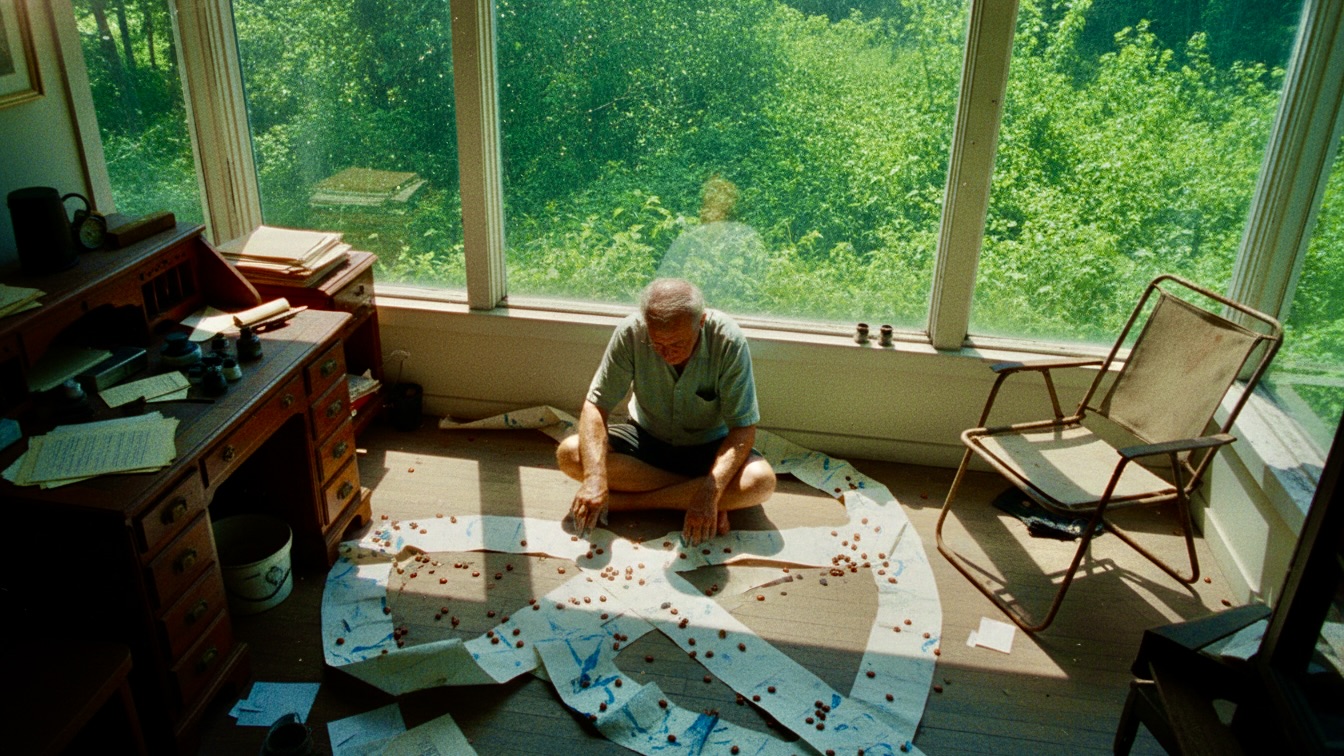
The story follows Gus, a retired accountant living in a sweltering Winnipeg summer, who is attempting to break the Guinness World Record for the longest continuous chain of handwritten correspondence. This pursuit of analog order occurs in the wake of the Digital Sanity Act of 2025, which has banned social media and plunged the neighborhood into a heavy, forced silence. Gus finds his meticulous work interrupted by an invasive swarm of Asian ladybugs and the discovery of cryptic, neon-green notes hidden within his mailbags. These notes, authored by local youth, warn of environmental collapse and a mysterious "fish-folk" resistance emerging from the polluted Red River.
When a government inspector named Henderson arrives early to audit the record, the tension between Gus’s desire for procedural purity and the chaotic reality of the world reaches a breaking point. A massive swarm of ladybugs disrupts the audit, allowing Gus to choose between his sterile record and the messy, urgent communications of the younger generation. Ultimately, Gus abandons the rigid requirements of the Guinness Book. He joins forces with his courier Leon, his neighbor Martha Hickes, and a group of teenagers to stitch together a new, massive scroll that combines his formal letters with their raw, desperate warnings about the changing environment.
The narrative explores the tension between artificial order and organic chaos, specifically through the lens of record-keeping. Gus views his ledger as a "masterpiece of logistics," an attempt to maintain a sense of control in a world that has discarded his professional skills. However, the story suggests that true human connection cannot be sanitized or strictly regulated. The "purity" that Henderson demands is revealed to be a form of denial, whereas the "corrupted" data set of the fish-folk notes represents the actual pulse of a society in crisis.
The environmental theme is pervasive, manifesting as a visceral and repulsive "ladybug plague" that serves as a harbinger of deeper ecological rot. The beetles are not the charming insects of folklore but are described as biting, foul-smelling invaders that thrive on contaminated larvae. This reflects a world where the "permafrost is melting" and the natural order is revolting against human neglect. The ladybugs act as a physical manifestation of the truth that cannot be suppressed by government bans or bureaucratic silence, eventually forcing their way into the sunroom to dismantle the audit.
The Digital Sanity Act of 2025 serves as a critique of modern communication and the psychological impact of its removal. While the government framed the ban as a "blessing" of analog peace, the story portrays it as a vacuum that breeds isolation and boredom. For the youth, the loss of digital spaces has not led to a return to some pastoral ideal but has instead created a desperate need for "steganography" and secret networks. The transition from digital outrage cycles to physical protest notes suggests that the human impulse to communicate is irrepressible, adapting to whatever medium remains available.
Finally, the story examines the bridge between generations during a period of societal collapse. Gus and Martha represent two different responses to the "old ways." While Gus initially clings to the past as a way to hide from the present, Martha embraces the role of a "youth advocate," providing the physical space for the next generation to build their own systems. The final act of sewing the pages together into a single scroll symbolizes a reconciliation. It merges the formal history of the elderly with the urgent, jagged future of the youth, creating a ledger that is honest rather than merely accurate.
Gus is a man defined by his professional history as an accountant, a background that leaves him psychologically ill-equipped for the "digital architecture" of the modern world. He suffers from a profound sense of obsolescence, having been discarded by his firm for being too "legacy." His obsession with the Guinness record is a coping mechanism, a way to prove that his life and his skills still possess inherent value. He treats ink and paper with a religious reverence because they are the only tools he has left to exert influence over his environment.
His psychological journey moves from a state of rigid adherence to rules toward an acceptance of meaningful disorder. Initially, he is horrified by the "violation of the ledger" and the corruption of his data set. He sees the teenagers' notes as a threat to his three years of hard work. However, the physical intrusion of the ladybugs and the cold indifference of Henderson act as catalysts for his transformation. He eventually realizes that his "peace of mind" was a luxury bought at the cost of ignoring the suffering of the world around him.
By the end of the chapter, Gus finds a new sense of purpose that is not tied to external validation or official certification. He moves from being a passive observer of "the way the light hits the side of the garage" to an active participant in the resistance. His decision to write the transition for the new scroll using a cheap Bic pen signifies his abandonment of aesthetic perfection in favor of raw truth. He accepts the "bleak smirk" of his new reality, finding satisfaction in the "most honest work" he has ever done.
Leon serves as the foil to Gus’s structured world, representing a generation that feels suffocated by the analog "sanity" imposed upon them. He is described as having the "glassy stare" of a youth forced to look at a reality that offers him no future. His lethargy and apparent boredom are masks for a deep-seated anxiety about the dying river and the changing climate. Unlike Gus, who seeks to record the world as it was, Leon is focused on communicating the world as it is becoming, even if that communication is jagged and "crumpled."
He possesses a sophisticated understanding of subversion, utilizing Gus's mail route as a "Trojan horse" for encrypted fragments. This demonstrates a psychological resilience; despite being stripped of digital tools, he has adapted the old ways to serve new, urgent purposes. His defiance toward Henderson shows that he no longer respects the authorities who have failed to protect his environment. He is the one who ultimately challenges Gus to see the "continuity" in the protest notes, effectively inviting the older man into the future.
Martha is a subversive figure who uses her status as an "old woman" to provide cover for the youth resistance. She is psychologically astute, recognizing that the peace Gus enjoys is a "luxury" that the younger generation cannot afford. Her decision to let the children smoke on her porch and build antennas out of colanders reflects her belief in community over government-mandated silence. She views the social media ban not as a return to sanity, but as a "vacuum" that threatens to extinguish the spirit of the youth.
She acts as the moral compass of the story, forcing Gus to confront his own complicity in the silence of the neighborhood. Her "bleak smirk" suggests a woman who has seen cycles of rebellion before and understands that the "old ways" only work if they are flexible enough to include new voices. She is the bridge that allows the accountant and the activists to unite. By offering Henderson rain-barrel water, she physically confronts the bureaucracy with the reality of the environmental crisis they are trying to ignore.
Henderson represents the sterile, unfeeling hand of the Ministry of Heritage. He is a man who values "pristine conditions" and "hygiene" over the actual content of the human experience. Psychologically, he is a creature of the manual, unable to process anything that falls outside the "unauthorized" or "irregular." His high-pitched yelp during the ladybug swarm reveals his fundamental fragility; he can only exist within the controlled environment of a government office.
He serves as the primary antagonist not because of malice, but because of his commitment to a "purity" that is effectively a form of erasure. He is willing to disqualify years of human interaction because of a few "orange spots" or "crumpled notes." His flight from the house at the end of the chapter symbolizes the retreat of the old, rigid order in the face of a messy, living truth. He leaves behind an empty briefcase, a fitting metaphor for a bureaucracy that has nothing left to offer a world in transition.
The narrative voice is characterized by a heavy use of sensory metaphors that ground the abstract themes of environmental and digital decay in a visceral reality. The sunroom is described as a "kiln," and the heat hits like a "wet wool blanket," creating a sense of claustrophobia that mirrors the protagonist's internal state. The ladybugs are the most potent stylistic device, described through "sickening clicks" and a smell like "burning rubber and old vinegar." These repulsive details prevent the story from becoming a nostalgic ode to the analog past, instead framing the return to paper as a desperate act of survival.
The pacing of the chapter follows a slow, rhythmic buildup that mimics the "sharp, rhythmic throb" of Gus’s carpal tunnel, eventually exploding into the chaotic swarm of the climax. The initial focus on the "physical continuity of the ink" and the "masterpiece of logistics" establishes a sense of order that makes the subsequent intrusion of the neon-green notes and the ladybugs feel truly disruptive. The shift from the quiet, mahogany desk to the "bomb-maker’s workshop" in the backyard marks a transition in the story’s energy, moving from the static to the kinetic.
Symbolism is used effectively to highlight the generational and societal shifts occurring in the narrative. The "Iroshizuku Kon-peki" ink, deep and vibrant, represents the beauty and order of the old world that is literally running dry. In contrast, the "cheap, blue ballpoints" and "jagged marker" of the youth represent a new, less aesthetic but more resilient form of communication. The "fish-folk" imagery and the rotting tails in the drawings symbolize a generation that feels mutated by their environment, forced to adapt to a "silt" that the older generation refuses to see.
The tone of the story is one of "bleak hope," a term that Gus himself seems to embody by the conclusion. There is a persistent sense of loss—the loss of the digital world, the loss of a clean river, and the loss of professional dignity. However, this is balanced by the communal act of "stitching" the scroll together. The final image of the thirty-foot scroll snaking through the house suggests that while the world may be ending, the act of recording that end provides a new kind of meaning. The "crunch" of the ladybugs, once a sound of disgust, becomes the final note of an honest ledger.


